

Phase 1: 공감 (Story Opening)
안녕하세요! 매일한글 에디터입니다.
Imagine leaving behind the flashing neon lights of Hongdae and stepping into a tranquil temple nestled deep in Bukhansan. The scent of pine and burning incense fills the cool mountain air. As you walk across the polished wooden terrace, a Buddhist monk in flowing grey robes turns around and looks at you with a gentle smile. Suddenly, your mind goes completely blank. Do I shake hands? Do I bow to the floor? What title do I use?
Many of our international students tell us they feel frozen in this exact moment, terrified of being disrespectful. But don’t worry! Meeting a monk is not an exam—it is a warm cultural encounter. Based on real feedback from travelers and Templestay participants, this friendly guide will give you simple, authentic A2 phrases and non-verbal etiquette so you can chat over a cup of warm lotus tea with calm confidence.
Phase 2: 핵심 표현 3선 심층 분석 (Top 3 Key Expressions)
1. 스님, 안녕하세요 (Seunim, annyeonghaseyo)
- Pronunciation: [Seu-nim, an-nyeong-ha-se-yo] (Think: “Suh-neem”, rhymes with “sun” + “beam”)
- Meaning: Literal: “Monk, are you at peace?” | Real Nuance: “Hello, Venerable Monk!”
- K-Culture Moment: Seen frequently in K-Dramas like Crash Landing on You or variety shows like 2 Days & 1 Night whenever cast members visit mountain temples during countryside road trips.
- Editor’s Insight: In Korean, you never call a monk “당신 (dangsin)” or “선생님 (seonsaengnim)”. The title 스님 (Seunim) is both their title and honorific pronoun. Adding it before “안녕하세요” creates immediate warmth and deep respect.
- Situation Spectrum: Casual: ⚠️ (too informal for temples) | Semi-formal: ✅ | Formal: ✅
- 🤔 Think About It: In English, we often greet religious figures as “Father” or “Sir”. Notice how Korean embeds the respectful title directly into the everyday greeting!
2. 성불하십시오 (Seongbul-hasipsio)
- Pronunciation: [Seong-bul-ha-sip-si-o] (Sounds like: “Seong-bool-ha-ship-she-oh”)
- Meaning: Literal: “Please achieve Buddhahood.” | Real Nuance: “May you find inner peace and enlightenment.”
- K-Culture Moment: The signature parting phrase uttered by monks to temple visitors when concluding a peaceful conversation or walking past the main Dharma hall.
- Editor’s Insight: For A2 learners, “성불하세요 (Seongbul-haseyo)” is an acceptable everyday version, but using the formal “성불하십시오” when departing shows that you truly understand Buddhist culture.
- Situation Spectrum: Casual: 🚫 | Semi-formal: ✅ | Formal: ✅
- 🤔 Think About It: Instead of wishing someone “good luck” or “safe travels”, Korean Buddhist tradition wishes for your ultimate spiritual awakening. How does that compare to farewells in your country?
3. 차 한잔 주셔서 감사합니다 (Cha hanjan jusyeoseo gamsahamnida)
- Pronunciation: [Cha han-jan ju-syeo-seo gam-sa-ham-ni-da] (Pronounce ‘cha’ like English ‘chai’ without the ‘i’, and ‘han-jan’ like ‘one shot’)
- Meaning: Literal: “Because you gave me a cup of tea, thank you.” | Real Nuance: “Thank you so much for the tea and your hospitality.”
- K-Culture Moment: When sitting on the floor across from a head monk during 차담 (Chadam – tea conversation), receiving a steaming porcelain cup of green tea.
- Editor’s Insight: This follows the useful A2 pattern [Noun] 주셔서 감사합니다 (“Thank you for giving me [Noun]”). It shows sincere gratitude for hospitality.
- Situation Spectrum: Casual: ⚠️ | Semi-formal: ✅ | Formal: ✅
- 🤔 Think About It: In Korean culture, acknowledging the specific kindness (giving tea) directly in the thank-you sentence sounds much warmer than a flat “Thank you”.
Phase 3: 교과서 한국어 vs 진짜 한국어 (Textbook vs. Real Korean)
Situation 1: Greeting the monk upon first meeting
- 📖 교과서 한국어 (Textbook Korean): 안녕하십니까? 만나서 반갑습니다. (Annyeonghasimnikka? Mannaseo banggapseumnida.) — “How do you do? It is a pleasure to meet you.”
- 🗣️ 진짜 한국어 (Real Korean): 스님, 안녕하세요! 반갑습니다. (Seunim, annyeonghaseyo! Banggapseumnida.) — “Hello, Monk! It’s so nice to meet you!”
- 💡 왜 다를까? (Why the difference?): Standard textbooks often teach ultra-military formal endings that feel robotic. Calling the monk “스님” with hands pressed together in front of your chest strikes the perfect balance of warmth and reverence.
Situation 2: When the monk offers a snack or more tea
- 📖 교과서 한국어 (Textbook Korean): 저는 그것을 먹겠습니다. (Jeoneun geugeoseul meokgetseumnida.) — “I will consume that.”
- 🗣️ 진짜 한국어 (Real Korean): 감사합니다! 잘 먹겠습니다. (Gamsahamnida! Jal meokgetseumnida.) — “Thank you! I will enjoy this treat!”
- 💡 왜 다를까? (Why the difference?): Native speakers use “잘 먹겠습니다” to express polite appreciation before receiving food or tea offered by someone elder or respected.
Phase 4: K-Culture 딥다이브 & 비언어적 매너 (Culture Deep Dive & Non-Verbal Manners)
4-1. 눈치 (Nunchi) & Gestures: The Art of Hapjang (합장)
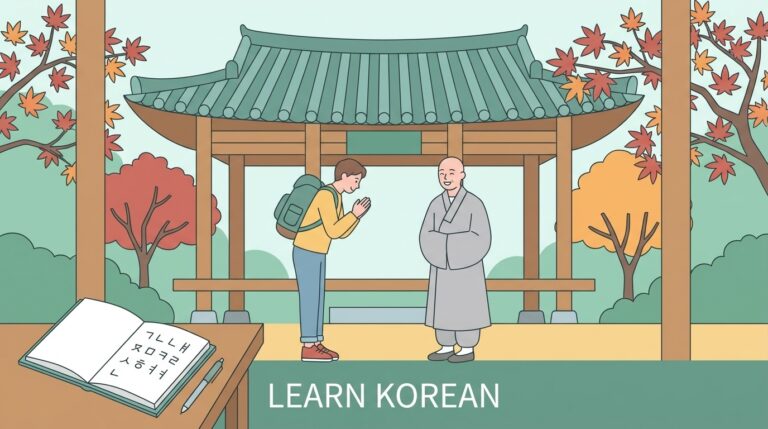
- The Gesture: Never attempt a Western handshake or a sudden high-five. Instead, bring both palms flat against each other in front of your chest, elbows relaxed at your sides. This is 합장 (Hapjang). Gently bow your head and upper body at a 30 to 45-degree angle.
- Eye Contact: Keep your eyes lowered towards your fingertips rather than staring intensely into the monk’s eyes. It signals humility and a calm heart.
- Footwear Manners: When entering a monk’s tea room or temple hall, always slip off your shoes and point the toes of your shoes toward the outside, away from the door.
4-2. Cultural Code: 차담 (Chadam – Tea & Life Chat)
In Korea, one of the highlights of religious tourism is 차담 (Chadam). This is not a strict theological sermon. Monks sit with everyday travelers, brew fragrant local tea, and listen to your life worries—career burnout, breakups, or finding peace. It is the Korean Buddhist version of mindful therapy.
Phase 5: 실전 롤플레이 시나리오 (Real-World Roleplay Scenario)
- Setting: A quiet temple tea room with sliding paper doors (한지창) overlooking an autumn courtyard. Rain patters gently outside.
- Characters:
- Alex: A beginner Korean learner on his first weekend Templestay.
- Ven. Jinwoo (진우스님): A monk with a warm smile and kind eyes.
- Turn 1 (Alex): (Bowing with palms together) 스님, 안녕하세요! 처음 뵙겠습니다. (Seunim, annyeonghaseyo! Cheoeum boepgetseumnida.) — “Hello, Monk! Nice to meet you for the first time.”
- Turn 2 (Ven. Jinwoo): 어서 오세요. 비가 오는데 오느라 고생했어요. (Eoseo oseyo. Biga oneunde oneura gosaenghaesseoyo.) — “Welcome. It was raining; you had a long journey getting here.”
- Turn 3 (Alex): 아닙니다, 스님. 절이 정말 아름다워요. (Animnida, seunim. Jeori jeongmal areumdawoyo.) — “Not at all, Monk. The temple is truly beautiful.”
- Turn 4 (Ven. Jinwoo): 고마워요. 이리 앉으세요. 따뜻한 차 한잔 드릴게요. (Gomawoyo. Iri anjeuseyo. Ttatteutan cha hanjan deurilgeyo.) — “Thank you. Please sit here. I will pour you a warm cup of tea.”
- Turn 5 (Alex): (Receiving the teacup with both hands) 감사합니다, 스님. 잘 마시겠습니다. (Gamsahamnida, seunim. Jal masigetseumnida.) — “Thank you, Monk. I will enjoy the tea.”
- Turn 6 (Ven. Jinwoo): 차 맛이 어때요? 편하게 이야기 나눠요. (Cha masi eottaeyo? Pyeonhage iyagi nanwoyo.) — “How does the tea taste? Please feel free to share your thoughts comfortably.”
- Turn 7 (Alex): 향이 아주 좋아요. 좋은 시간 주셔서 감사합니다. (Hyangi aju joayo. Joeun sigan jusyeoseo gamsahamnida.) — “The aroma is wonderful. Thank you for this meaningful time.”
- Turn 8 (Ven. Jinwoo): 편안한 하루 보내세요. 성불하십시오. (Pyeon-anhan haru bonaeseyo. Seongbul-hasipsio.) — “Have a peaceful day. May you achieve enlightenment.”
🔀 인터랙티브 분기점 (Interactive Choice)
The monk hands you a traditional Korean rice cookie (약과 – Yakgwa). How do you respond?
- Choice A: Grab it with one hand and say, “고마워! (Gomawo!)”
- Feedback (Bad): ❌ “고마워” is banmal (informal). Using one hand to take an item from a monk is considered disrespectful in Korea.
- Choice B: Take it with both hands, bow slightly, and say: “감사합니다, 스님! 잘 먹겠습니다.” (Gamsahamnida, seunim! Jal meokgetseumnida.)
- Feedback (Best): 🌟 Perfect! Using two hands and formal polite gratitude demonstrates top-tier Korean cultural manners.
- Choice C: Wave your hands frantically and say: “저는 다이어트 중이에요.” (Jeoneun daieoteu jung-ieyo. – I am on a diet.)
- Feedback (Risk): ⚠️ While honest, refusing hospitality bluntly can feel awkward in traditional Korean settings. Better to accept politely first.
Phase 6: 10초 감정 섀도잉 드릴 (10-Second Shadowing Drill)
Practice these lines out loud! Follow the rhythm pauses (/) and emotional tone cues.
[🙏 차분하고 정중하게 / Calm and respectful]- 스님, / 안녕하세요! / 뵙게 되어 / 영광입니다.
- (Seunim, / an-nyeong-ha-se-yo! / boep-ge doe-eo / yeong-gwang-im-ni-da.)
- “Monk, / hello! / It is an honor / to meet you.”
[🍵 따뜻하고 진심 어린 톤 / Warm and heartfelt]- 따뜻한 차 / 주셔서 / 정말 감사합니다.
- (Tta-tteu-tan cha / ju-syeo-seo / jeong-mal gam-sa-ham-ni-da.)
- “For the warm tea / that you served me / thank you so much.”
[🧘 평온하고 고요한 여운 / Serene and gentle]- 마음이 / 참 / 편안해졌습니다.
- (Ma-eum-i / cham / pyeon-an-hae-jyeot-seum-ni-da.)
- “My heart / truly / has become peaceful.”
Phase 7: K-Culture 미니 사전 (Mini Dictionary)
- 스님 (Seunim) | Buddhist Monk / Nun
- The universal Korean honorific for all ordained Buddhist monastics. Never drop the honorific suffix “-님 (-nim)”.
- 합장 (Hapjang) | Palms-together bow
- The foundational Buddhist greeting gesture symbolizing harmony and respect between two living beings.
- 차담 (Chadam) | Monk tea conversation
- A tea-drinking gathering between a monk and visitors, dedicated to peaceful dialogue and everyday meditation.
- 공양 (Gongyang) | Temple meal / Offering
- The sacred consumption of temple food. Leaving leftover rice or banchan is taboo; one eats mindfully in gratitude.
Phase 8: 여행자를 위한 생존 키트 (Traveler’s Survival Kit)
서바이벌 표현 TOP 3 (Survival Phrases)
- 사진 찍어도 되나요? (Sajin jjigeodo doenayo?)
- Meaning: “May I take a photo?”
- Pro Tip: Always ask before pointing your camera at monks or sacred Buddha statues inside the Dharma halls.
- 신발을 어디에 두나요? (Sinbareul eodie dunayo?)
- Meaning: “Where should I leave my shoes?”
- Pro Tip: Most temple halls require shoe removal before stepping on heated wooden floors.
- 조용히 하겠습니다 (Joyonghi hagetseumnida)
- Meaning: “I will be quiet / speak softly.”
- Pro Tip: Useful when guided into meditation zones or silent study halls.
Editor’s Travel Note
- Planning a temple visit? Make bookings directly through the Templestay official reservation portal to experience authentic tea rituals.
- For public transit deep into Korean national park trails where temples reside, use the Naver Map navigation app instead of standard Google Maps, as local bus schedules update live there.
Phase 9: “한 발 더 깊이” (Cultural Insights)
In modern Korea, life moves at breakneck ppalli-ppalli (빨리빨리 – quick, hurry) speed. Yet temples function as spiritual sanctuaries where ordinary Koreans, regardless of their personal religion, pause to breathe. When you bow to a monk, you are not worshiping an authority figure; you are recognizing the Buddhist concept of 인연 (Inyeon – karmic connection). In Korean thought, meeting another person on a mountain path requires hundreds of lifetimes of shared connection. Approach every encounter with that gentle perspective!
💬 Your Turn: Have you ever visited a Buddhist temple or met a monk before? What surprised you the most about the atmosphere? Leave a comment below!
Phase 10: FAQ & 오해 방지 (FAQ & Common Mistakes)
Q: Can I use “안녕 (Annyeong)” if the monk seems close to my age?
A: Absolutely not! In Korean Buddhist culture, ordained monastics are treated as spiritual mentors regardless of their biological age. Always stick to polite formal Korean, such as “안녕하세요 (Annyeonghaseyo)” or “안녕하십니까 (Annyeonghasimnikka)”.
Q: What if I accidentally stepped on the raised wooden door threshold (문턱)?
A: Don’t panic! In traditional Korean architecture and temple folklore, stepping on the threshold (문턱) brings bad luck and damages delicate woodwork. If you step on it accidentally, simply step down, bow slightly with palms joined, and whisper: “죄송합니다 (Joesonghamnida).”
Q: Can I shake the monk’s hand if they extend their hand first?
A: Yes! If a monk initiates a handshake, you may take it gently with both hands supporting your right wrist. However, standard practice remains the palm-pressed Hapjang bow.
🚨 흔한 실수 (Common Mistakes) TOP 3
- Calling a monk “선생님” (Seonsaengnim)
- Correct Action: Always use 스님 (Seunim). Calling a monk “teacher” sounds confusing in religious contexts.
- Crossing legs casually during tea time
- Correct Action: Sit cross-legged (양반다리 – Yangbandari) or kneel neatly. Pointing your outstretched feet directly at the monk is impolite.
- Taking tea with only one hand
- Correct Action: Use two hands! Hold the cup with your right hand and lightly support the base of the cup with your left hand.
Phase 11: 액션 미션 & 참여 유도 (Action Missions)
- 🥉 Bronze Level: Stand in front of your mirror. Join your palms together at your chest, bow gently, and practice saying: “스님, 안녕하세요! 반갑습니다.” 3 times smoothly.
- 🥈 Silver Level: Comment below this blog post writing one sentence using the pattern [Noun] 주셔서 감사합니다 (e.g., 차 주셔서 감사합니다 or 가르쳐 주셔서 감사합니다).
- 🥇 Gold Level: Visit a local temple or search a YouTube clip of a Korean Templestay, spot the moment someone greets a monk, and shadow their exact speech!
🎮 K-Culture Mission: Watch an episode of a Korean travel vlog or a historical K-Drama. Whenever a temple scene appears, pause and check: Did the characters keep their hands together in 합장? Tag us on Instagram @DailyHangul with your answer!
Phase 12: 인터랙티브 퀴즈 챌린지 (Interactive Quiz Challenge)
Quiz 1. Situation Judgment
You have just entered a monk’s tea room. The monk pours you a cup of tea. What is the most natural thing to say and do?
* A) Take it with your left hand and say, “땡큐! (Thank you!)”
* B) Take the cup with both hands and say, “감사합니다, 잘 마시겠습니다!”
* C) Reject the tea immediately by saying, “차 싫어요 (I hate tea).”
👉 Click to reveal the answer and explanation
Correct Answer: B
Explanation: In Korean etiquette, receiving drinks from an elder or a monk requires two hands. Saying “감사합니다, 잘 마시겠습니다” demonstrates polite gratitude for the offered hospitality!
Quiz 2. Fill in the Blank
Complete the respectful parting blessing often spoken in Korean temples:
“편안한 하루 보내세요. [ ]하십시오.”
👉 Click to reveal the answer
Correct Answer: 성불 (Seongbul)
Explanation: The complete phrase is 성불하십시오 (Seongbul-hasipsio), which means “May you achieve enlightenment / Buddhahood.”
Quiz 3. True or False
When entering the main hall of a Korean temple, it is polite to step directly on top of the wooden threshold (문턱) to show confidence. (True / False)
👉 Click to reveal the answer
Correct Answer: False
Explanation: Never step on the door threshold (문턱)! Always step over it gently to respect both the building and traditional Korean spiritual customs.







