

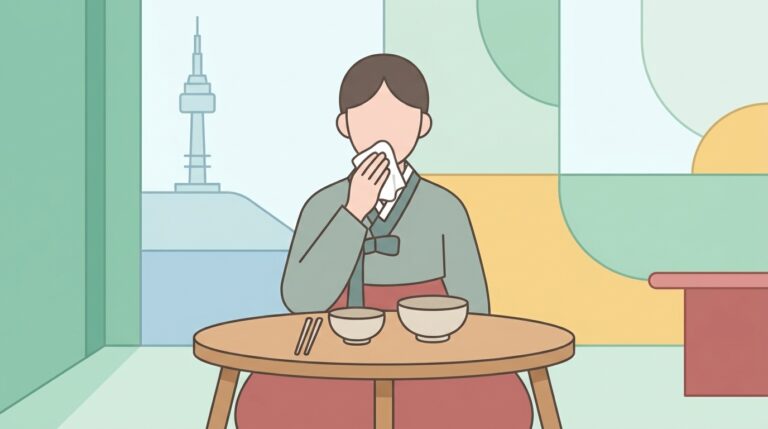
Phase 1: Empathy (Story Immersion Opening)
안녕하세요! 매일한글 에디터입니다.
Picture this: You are seated around a bubbling pot of kimchi-jjigae with your Korean colleagues in a bustling Gangnam restaurant. The steam rises, fragrant and intensely spicy. Suddenly, your sinuses react to the chili pepper, and your nose begins to run uncontrollably. In many Western cultures, the courteous, hygienic response is second nature: you draw a tissue from your pocket, turn your head slightly, and clear your nasal passages with a definitive blow. Problem solved, right?
Except, the moment that brassy trumpet sound echoes across the table, an icy hush descends. Chopsticks freeze mid-air. Your Korean manager’s eyes widen in sheer shock, while a junior coworker awkwardly studies their rice bowl. You intended to be sanitary, yet you have inadvertently committed one of Korean dining culture’s most visceral social faux pas: blowing your nose loudly at the dinner table.
Navigating bodily functions in a foreign culture is a profound sociolinguistic minefield. At the C2 level, mastery goes far beyond grammar drills; it requires deciphering the unspoken communal sensibilities that govern personal space. In Korea, where dense collective living elevates auditory and tactile consideration (baeryeo) to an art form, clearing your nose in public—especially where people eat, study, or commute—triggers an involuntary visceral aversion. Conversely, a quiet, repetitive sniffle, while frustrating in London or New York, is often extended tacit forgiveness in Seoul. Based on real feedback from seasoned expatriates and corporate executives, this masterclass demystifies the acoustic, linguistic, and cultural codes behind handling a runny nose with exquisite Korean finesse.
Phase 2: Core Expressions Deep Dive
1. 잠시 실례하겠습니다 (Jamsi sillyehagessumnida)
- Pronunciation: Jahm-shi shil-lye-ha-get-seum-ni-da (Sounds like ‘Jahm-she’ followed by ‘she-lay-ha-get-soom-nee-dah’)
- Meaning: “Excuse me for a moment.” (Pragmatically: “I need to step away to handle a private bodily necessity without inconveniencing your senses.”)
- K-Culture Moment: In high-stakes corporate K-Dramas like Misaeng, this refined phrase is deployed by savvy managers slipping out of an intense client dinner to compose themselves or handle an urgent physical discomfort away from the table.
- Editor’s Insight: This is your quintessential gold-standard escape hatch. Never announce why you are leaving (e.g., do not mention your nose or tissue). The supreme polite strategy in Korea is an understated departure that leaves biological functions cloaked in discretion.
- Situation Spectrum: Casual ⚠️ | Semi-formal ✅ | Formal ✅
- 🤔 Think About It: In your home culture, is it considered more polite to explain the exact biological reason for stepping away, or does maintaining vagueness preserve communal dignity?
2. 훌쩍거려서 죄송합니다 (Huljjeokgeoryeoseo joesonghamnida)
- Pronunciation: Hool-jjeok-geo-ryeo-seo joe-song-ham-ni-da (The ‘hul’ mimics the sudden intake of air, paired with a soft, deferent apologetic cadence)
- Meaning: “I apologize for sniffling.” (Pragmatically: “I am acutely conscious that my involuntary nasal sounds may be disturbing the communal acoustic peace, and I beg your patience.”)
- K-Culture Moment: Frequently overheard in quiet university study halls (Dokseosil) or during tense company team meetings during the transition from autumn to winter (hwanjeolgi).
- Editor’s Insight: If you suffer from sudden rhinitis and cannot step away immediately, vocalizing your nunchi (awareness of the disturbance) immediately diffuses social irritation. Koreans prioritize whether you show remorse for disrupting sensory harmony over the physical noise itself.
- Situation Spectrum: Casual ⚠️ | Semi-formal ✅ | Formal ✅
- 🤔 Think About It: Why does publicly acknowledging a minor bodily disturbance alleviate irritation in collective societies, whereas in individualistic societies it might merely draw unwanted attention?
3. 비염 때문에 코가 자꾸 막히네요 (Biyeom ttaemune koga jakku makhineyo)
- Pronunciation: Bee-yeom ddae-moo-neh ko-gah jahk-koo mahk-hee-neh-yo (Flows rhythmically with an open, relatable sigh on the final ‘yo’)
- Meaning: “My nose keeps getting congested because of rhinitis.” (Pragmatically: “Please excuse my nasal voice or dabbing; this is an involuntary chronic condition, not poor personal hygiene.”)
- K-Culture Moment: Used organically on Korean variety shows when cast members tear up or speak with a muffled voice after eating scorching dishes on Delicious Rendezvous or 2 Days & 1 Night.
- Editor’s Insight: Medicalizing the issue slightly using biyeom (rhinitis/allergies) transforms what could be perceived as unsanitary sloppiness into an empathic medical nuisance that almost every Seoulite deals with during fine dust (hwangsa) season.
- Situation Spectrum: Casual ✅ | Semi-formal ✅ | Formal ⚠️
- 🤔 Think About It: Does invoking an objective physiological ailment mitigate social judgment in your native tongue as effectively as it does in Korean interpersonal dynamics?
Phase 3: Textbook Korean vs. Real Korean
Situation 1: Excusing Yourself from a Meal to Clear Your Nose
- 📖 교과서 한국어: 저는 화장실에 가서 코를 풀고 오겠습니다. (Jeoneun hwajangsire gaseo koreul pulgo ogessumnida. / I will go to the restroom, blow my nose, and return.)
- 🗣️ 진짜 한국어: 잠시 화장실 좀 다녀올게요. 콧물이 자꾸 나와서요. (Jamsi hwajangsil jom danyeoolgeyo. Konmuri jakku nawaseoyo. / I’ll step to the restroom for a brief moment; my nose keeps running.)
- 💡 왜 다를까? Specifying the mechanical act of blowing one’s nose (코를 풀다) out loud creates an unpalatable mental image for dining companions. Native speakers euphemistically pivot to merely visiting the restroom while lightly referencing the persistent symptom.
Situation 2: Apologizing for an Involuntary Sniffle in an Office or Study Cafe
- 📖 교과서 한국어: 제가 콧물을 들이마셔서 시끄러우셨다면 사과드립니다. (Jega konmureul deurimasyeoseo sikkeureousyeotdamyeon sagwadeurimnida. / I apologize if my inhaling of mucus was noisy.)
- 🗣️ 진짜 한국어: 환절기라 코가 좀 맹맹하네요. 거슬리셨다면 죄송해요. (Hwanjeolgira koga jom maengmaenghaneyo. Geoseullisyeotdamyeon joesonghaeyo. / It’s seasonal allergy time, so I’m sounding a bit stuffy. I’m sorry if it was distracting.)
- 💡 왜 다를까? Advanced C2 phrasing utilizes sensory-rich mimetic/phonetic predicates like 맹맹하다 (nasally stuffed) and soft affective verbs like 거슬리다 (to grate or distract), humanizing the discomfort rather than sounding like an artificial legal confession.
Phase 4: K-Culture Deep Dive & Non-Verbal Manners
4-1. Nunchi & Gestures: The Art of the Micro-Dab
In Korean public life, the physical handling of bodily emissions follows a strict visual and acoustic hierarchy. When blowing your nose is inevitable, the absolute rule is avoiding the trumpet resonance (팽!).
- The Non-Verbal Protocol: If you must tend to your nose at a desk or casual table, never grip a tissue with both hands and blow with full lung capacity. Instead, employ the tok-tok (톡톡) technique: press a soft tissue lightly against the nostrils, blot unobtrusively, turn your head 90 degrees away from any company, and shield your profile with your free hand.
- Gaze Mechanics: Drop your gaze down toward the floor or your lap. Making eye contact while touching a tissue to your nose suggests brazen disregard for the spectator’s visual comfort. Demonstrating a subdued, apologetic posture signals to everyone that you understand this act is an unfortunate transgression of public space.
4-2. Cultural Code: Soup Culture (탕/찌개) vs. Commensality
Korea’s culinary identity is inherently communal and predominantly liquid-based. From boiling-hot tteokbokki to simmering jjigae, meals are eaten in shared proximity, with diners dipping spoons into shared centerpieces or sitting elbow-to-elbow in cozy establishments. Hot, spicy broth acts as a natural vasodilator; everyone at the table knows that runny noses are biologically inevitable.
Yet, precisely because the phenomenon is universal, Korean dining etiquette developed a strict sensory boundary: Food and respiratory waste must never intersect. While Western diners often view sniffling as unhygienic because mucus remains inside the body, traditional Korean sensibilities view an acoustic nose-blow as spraying airborne droplets and contaminating the shared ambient dining sphere. Thus, a discrete, muted sniffle (훌쩍) is tolerated as a lesser temporal disturbance, whereas an explosive nasal expulsion at the table is regarded as severe minpye (민폐, a public nuisance).
Phase 5: Real-Life Roleplay Scenario
Setting: An intimate, wood-paneled Hanok dining room in Insadong. Ji-won (a seasoned, observant Korean marketing director) is hosting Alex (a foreign senior manager). A fiery pot of braised short ribs (Maeun Galbi-jjim) is simmering between them.
Characters:
* Ji-won: Gracious, highly perceptive, attuned to social harmony.
* Alex: Cultured, fluent, but struggling with seasonal rhinitis triggered by spicy food.
Dialogue:
- Ji-won: 갈비찜이 생각보다 좀 맵죠? 양념이 칼칼해서 땀이 쏙 나네요. (Galbijjimi saenggakboda jom maepjyo? Yangnyeomi kalkalhaeseo ttami ssok naneyo. / The galbi-jjim is spicier than expected, right? The seasoning has quite a kick, making you sweat!)
- Alex: 🎭 Subtly dabbing the corner of his nose with a single sheet of pocket tissue, smiling wryly 네, 그런데 진짜 맛있어요. 한국 매운맛은 중독성이 있네요. (Ne, geureonde jinjja masisseoyo. Hanguk maeunmaseun jungdokseongi inneeyo. / Yes, but it’s remarkably delicious. Korean spice is truly addictive.)
- Ji-won: 입맛에 맞으시다니 다행이에요. 그런데 알렉스 님, 환절기라 감기 기운 있으신 건 아니죠? (Ipmase majeushidani dahaeng-ieyo. Geureonde Alex nim, hwanjeolgira gamgi giun itsusin geon anijyo? / I’m glad it suits your palate. But Alex, with the change of seasons, you don’t have a cold coming on, do you?)
- Alex: 🎭 Lowering his head slightly, showing remorse for an inadvertent soft sniffle 감기는 아닌데, 비염이 도져서 훌쩍거리게 되네요. 거슬리셨다면 죄송합니다. (Gamgineun aninde, biyeomi dojeoseo huljjeokgeorige doeneyo. Geoseullisyeotdamyeon joesonghamnida. / It’s not a cold, but my rhinitis flared up, so I’ve been sniffling. I apologize if it was distracting.)
- Ji-won: 아이고, 죄송하긴요! 요즘 미세먼지도 심해서 다들 고생하더라고요. (Aigo, joesonghagin-yo! Yojeum misemeonjido simhaeseo dadeul gosaenghadeoragoyo. / Oh, not at all! The fine dust has been severe lately, so everyone is suffering.)
- Alex: 🎭 Realizing a tissue dab is no longer sufficient to control his congestion 저, 지원 님, 대화 중에 죄송하지만 잠시 손 좀 씻고 와도 될까요? (Jeo, Ji-won nim, daehwa junge joesonghajiman jamsi son jom ssitgo wado doelkkayo? / Ji-won, pardon me mid-conversation, but may I wash my hands for just a moment?)
- Ji-won: 🎭 Nodding warmly, gesturing toward the garden hallway 그럼요, 편하게 다녀오세요. 저기 복도 끝 오른쪽에 파우더룸 있어요. (Geureomyo, pyeonhage danyeo-oseyo. Jeogi bokdo kkeut oreunjjoge paudeorumi isseoyo. / Of course, please take your time. There’s a powder room at the end of the hall on the right.)
- Alex: 🎭 Bowing slightly from the waist as he stands 감사합니다. 금방 다녀오겠습니다. (Gamsahamnida. Geumbang danyeo-ogessumnida. / Thank you. I will be right back.)
🔀 Interactive Decision Point
Suppose your nose begins running profusely during an executive dinner. What do you do?
- Option A: Pull the decorative restaurant napkin from your lap and loudly blow your nose right at the table to swiftly eliminate the physical issue.
- Outcome (Bad): Instant cultural dissonance. The acoustic resonance will kill the convivial atmosphere, your dining companions will lose their appetite, and using a communal cloth napkin for nasal discharge is considered extraordinarily offensive.
- Option B: Endure in silence by sharply sniffling inward every 8 seconds throughout the entire two-hour meal without acknowledging it.
- Outcome (Risk): While more forgivable than blowing your nose across the tabletop, continuous wet sniffling in an enclosed VIP room tests everyone’s patience and displays a lack of proactive manners.
- Option C (Best): Quietly dab once or twice, softly apologize using 훌쩍거려서 죄송합니다, and then excuse yourself to the restroom with 잠시 손 좀 씻고 오겠습니다 to thoroughly and privately clear your nose.
- Outcome (Best): Unimpeachable elegance. You protect the dining sanctuary, honor sensory boundaries, and demonstrate supreme sociolinguistic command.
Phase 6: 10-Second Emotional Shadowing Drill
Master the cadence, pauses, and emotional weight of these native cadences. Break at each slash /.
- [🥺 미안하고 조심스럽게 / Regretful and socially conscious]
- 코가 자꾸 맹맹해서요… / 제가 훌쩍거려 / 방해되진 않았죠?
- Koga jakku maengmaenghaeseoyo… / jega huljjeokgeoryeo / banghaedwejin anatjyo?
- (My nose keeps feeling congested… I haven’t been disturbing you with my sniffling, have I?)
- [😌 품격 있고 자연스럽게 / Polished, discreet, and poised]
- 죄송하지만, / 잠시 손 좀 씻고 올게요. / 편하게 먼저 드세요.
- Joesonghajiman, / jamsi son jom ssitgo olgeyo. / pyeonhage meonjeo deuseyo.
- (Excuse me, / but I’ll step out to wash my hands for a second. / Please feel free to continue eating.)
- [😅 머쓱하지만 위트 있게 / Sheepish, relatable, and self-effacing]
- 국물이 얼큰해서 그런지 / 콧물이 멈추질 않네요. / 민폐 끼쳐 죄송합니다!
- Gungmuri eolkeunhaeseo geureonji / konmuri meomchujil anneeyo. / minpye kkichyeo joesonghamnida!
- (I think the broth is so pleasantly spicy / that my nose won’t stop running. / Sorry for being a nuisance!)
Phase 7: K-Culture Mini Dictionary
- 민폐 (Minpye) [Noun]
- Translation: Public nuisance; causing inconvenience or sensory discomfort to others.
- Usage: Highly relevant in communal spaces like subways, study cafes, and restaurants. Blowing one’s nose loudly with an audible honk is universally cataloged as minpye, along with loud phone calls on the train.
- 눈치 (Nunchi) [Noun]
- Translation: Intuitive social radar; the ability to read the ambient emotional and social atmosphere.
- Usage: Having nunchi in this context means realizing that while you desperately want physical relief, the people around you are savoring soup; thus, you step away without prompting.
- 맹맹하다 (Maengmaenghada) [Adjective]
- Translation: Stuffy, hyper-nasal (referring to voice or congested breathing).
- Usage: Used conversationally to soften an awkward nasal condition: 목소리가 맹맹하다 (“My voice sounds all stuffed up due to allergies”).
- 팽하다 (Paenghada) [Verb]
- Translation: To blow one’s nose with a sharp, explosive sound.
- Usage: Almost exclusively used critically to describe an inconsiderate, loud nose-clearing: 공공장소에서 코를 팽 풀면 어떡해? (“How could you just blow your nose with a loud honk in public?”).
Phase 8: Traveler’s Survival Kit
Survival Expressions TOP 3
- 혹시 휴지 좀 더 주실 수 있나요? (Hoksi hyuji jom deo jusil su innayo?)
- Pro Tip: Restaurant tables usually feature thin, rough dispenser napkins intended solely for wiping the mouth or spills. If you need skin-safe tissues for a sensitive nose, politely ask staff or purchase proper travel tissues.
- 화장실이 어디에 있나요? (Hwajangsiri eodie innayo?)
- Pro Tip: Never clear your nasal congestion directly in the dining booth. Memorize this question to locate the restroom where you can blow your nose freely behind closed doors.
- 미세먼지 마스크 하나 주세요. (Misemeonji maseukeu hana juseyo?)
- Pro Tip: Entering a pharmacy (yakguk) or convenience store for a mask is the ultimate Korean defense. Wearing a mask shields your sniffling from view, keeps cold air out of your sinuses, and demonstrates communal etiquette.
Editor’s Travel Note
- Essential App Guide: In Seoul, public restrooms in subway stations and commercial buildings are pristine, free, and ubiquitous. Always ensure you have the 네이버 지도 앱 다운로드 installed on your phone to pinpoint nearby subway station exits, public department store amenities, and pharmacies when caught with sudden seasonal congestion.
- The Pocket-Tissue Rule: Korean convenience stores (CU, GS25, 7-Eleven) sell premium moisturized pocket tissues (porang-hyuji). Keep a pack in your coat. Using coarse wooden table napkins on your face will irritate your skin and mark you as uninitiated.
Phase 9: “One Step Deeper” (Cultural Reflection)
In Western individualist philosophies, physiological needs are viewed pragmatically: if your nose is clogged, keeping phlegm inside is considered unhealthy, making a quick, clean blow the most hygienic, rational solution. However, Korean etiquette is forged in Confucian social ecology, where bodily functions are perceived through the lens of aesthetic modesty and sensory restraint. An explosive nose blow imposes an unavoidable visual and acoustic disruption upon innocent bystanders, violating their right to a serene, clean environment. In this cultural paradigm, suffering a quiet, inward sniffle is viewed as an act of self-sacrifice—enduring minor personal discomfort to preserve collective harmony.
💬 Your Turn: Have you ever experienced an awkward culture clash regarding bodily noises in another country? How do people in your native culture perceive sniffling versus blowing your nose in a quiet restaurant? Share your thoughts in the comments below!
Phase 10: FAQ & Avoiding Misunderstandings
Q: Is it truly forbidden to blow your nose in Korean restaurants, even quietly?
A: While “forbidden” is strong, it is heavily frowned upon. If you must, you may use a tissue to gently wipe away excess moisture without making an audible air sound. However, generating an acoustic “honk” at the dining table is universally viewed as unhygienic. The standard etiquette is to excuse yourself to the restroom.
Q: Why do Koreans seem to tolerate constant sniffling on the subway if noise is an issue?
A: A sniffle is understood as an involuntary, suppressed struggle against a symptom, whereas a full nose-blow is viewed as a conscious, deliberate choice to release bodily fluids into the communal atmosphere. While sniffling can become annoying over long periods, it is culturally classified as a minor misfortune rather than an act of outright disrespect.
Q: Can I use the wet wipes (물티슈) provided at Korean restaurants to wipe my nose?
A: Absolutely not! Mul-tisyu provided at tables are formulated with disinfectants and fabric chemicals meant solely for sanitizing your hands before meals. Using them on your nasal passages or blowing your nose into them at the table will earn horrified glances from staff and companions alike.
🚨 Common Mistakes Warning Board
- ❌ Mistake 1: Leaving crumpled, used nasal tissues on the restaurant table or plate.
- 👉 Correct Action: Pocket your used tissues immediately or discard them in a restroom waste receptacle. Never leave biological remnants beside food.
- ❌ Mistake 2: Sniffling loudly and incessantly in a silence-mandated zone like a study cafe (study cafe) or university library.
- 👉 Correct Action: Step outside, take allergy medication (bibong-yak), or wear a sanitary mask to dampen the sound.
- ❌ Mistake 3: Loudly explaining that you are going to the bathroom to “blow your nose.”
- 👉 Correct Action: Use refined circumlocution. Simply state 잠시 손 좀 씻고 오겠습니다 (I will go wash my hands for a moment).
Phase 11: Action Missions
- 🥉 Bronze Mission (Solo Practice): Stand in front of a mirror with a tissue. Practice the discrete “micro-dab and head-turn” gesture while keeping your mouth closed, pairing it with the apologetic phrase: 훌쩍거려서 죄송합니다.
- 🥈 Silver Mission (Community Engagement): Watch an episode of a Korean reality food show (such as Street Alcohol Fighter or I Live Alone). Spot how cast members react when their noses run from spicy food. Share your observations in the comments or on your Instagram story tagging
@DailyHangul. - 🥇 Gold Mission (Real-World Application): Next time you dine at a Korean barbecue or stew restaurant, deliberately excuse yourself using the phrase 잠시 손 좀 씻고 올게요 instead of using a table napkin to clear your sinuses at the table.
🎮 K-Culture Media Mission: In K-Dramas, observe how characters behave when crying vs. when having a cold. Notice that even during dramatic tearful breakdowns, characters rarely blow their noses loudly on camera—they delicately dab beneath their eyes with handkerchiefs. Find one scene exemplifying this refined restraint!
Phase 12: Interactive Quiz Challenge
Test your situational mastery of Korean etiquette with these three contextual challenges!
Question 1: Situational Judgment
You are sitting in a quiet, high-end cafe in Hannam-dong working on your laptop. Your allergies trigger a sudden runny nose. What is the most culturally adept sequence of actions?
* A) Blow your nose energetically into your coffee napkin so you can concentrate in comfort.
* B) Turn your head away, discreetly dab your nose with your own tissue, and if congestion persists, pack your laptop and go to the restroom.
* C) Sniffle loudly every 5 seconds to signal to everyone around you that you are unwell.
🔍 Click to Reveal Answer & Feedback
Correct Answer: B
Explanation: Blowing your nose into a cafe napkin in a quiet public venue shatters the acoustic ambiance and violates hygiene boundaries. While an occasional quiet dab is fine, persistent congestion warrants stepping into the restroom to handle the matter discreetly.
Question 2: Fill-in-the-Blank
Complete the following polite sentence used to excuse yourself from a formal business meal:
“대화 중에 죄송하지만, 콧물이 자꾸 나와서 잠시 ______ 좀 다녀오겠습니다.”
* A) 코 풀러 (to blow my nose)
* B) 손 씻으러 (to wash my hands)
* C) 병원에 (to the hospital)
🔍 Click to Reveal Answer & Feedback
Correct Answer: B
Explanation: Euphemism is the soul of C2 Korean pragmatics. Announcing that you are going specifically to blow your nose (코 풀러) introduces an unrefined bodily image. Saying you are going to “wash your hands” (손 씻으러) or simply “visit the restroom” (화장실 좀) is standard polite decorum.
Question 3: True or False Cultural Rule
True or False: In traditional Korean dining culture, blowing your nose loudly at the table is considered far more disruptive and unsanitary than a quiet, repetitive sniffle.
🔍 Click to Reveal Answer & Feedback
Correct Answer: TRUE
Explanation: In the West, sniffling is often criticized as “unhygienic” because mucus is retained, leading Westerners to prefer blowing it out immediately. In Korea, however, blowing your nose spreads sensory and acoustic pollution to other diners sharing the same food space, making a muffled sniffle the far lesser of two evils.







