

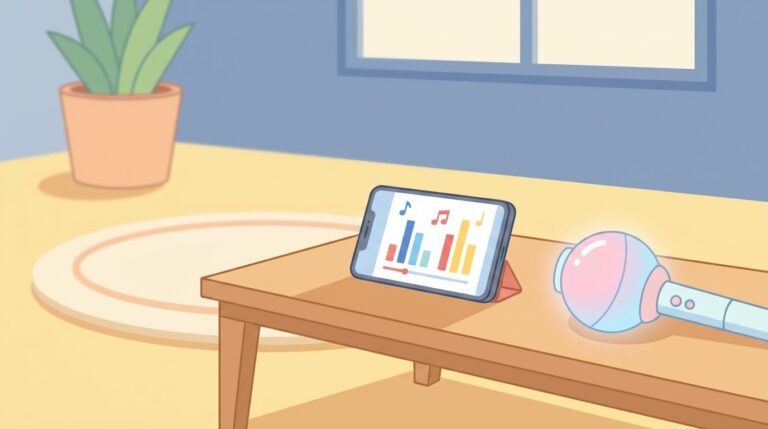
Master K-Pop Music Chart Talk in Korean: An Absolute Beginner Guide
Phase 1: Empathy (Story-Immersive Opening)
안녕하세요! 매일한글 에디터입니다. (Hello! I am your Daily Hangul editor.)
Picture this: It is precisely 6:00 PM Korean Standard Time. The countdown clock on your laptop hits zero. Your ultimate K-pop bias group has just dropped their brand new comeback title track! Within seconds, your timeline turns into pure frenzy. Notifications pop up one after another. Korean fans are posting screenshots of streaming graphs on Melon and Genie, typing strings of frantic Korean words paired with rocket emojis and crying faces.
You desperately want to cheer alongside your fandom sisters and brothers. You want to celebrate that your favorite group just took the top spot, or motivate everyone to keep listening! But as you hover your fingers over the keyboard, you realize all you know how to write is “Saranghaeyo” or “Oppa fighting.” You feel like an outsider peeking through the window of a party you helped organize.
Take a deep breath—you are definitely not alone. Over the past ten years running Daily Hangul and mentoring thousands of global K-pop enthusiasts, I have seen this exact moment happen every single comeback season. The technical jargon of Korean music charts feels intimidating, but celebrating chart wins only takes a few simple, vibrant A1-level phrases! By the end of this guide, you will know exactly how to shout chart achievements in natural, authentic Korean, stream alongside domestic fans, and feel like a true insider.
Phase 2: Top 3 Core Expressions Breakdown
1. 1위 했어요! (Il-wi haesseoyo!)
- Pronunciation: [Il-wi hae-sseo-yo] (Sounds like Eel-wee hae-suh-yo. Rhymes loosely with “feel we”).
- Meaning: Literally “Did 1st place!” | Actual Nuance: “They hit number one!” / “We reached #1!”
- K-Culture Moment: You open the Melon Top 100 chart during the 7:00 PM update, see your group’s song sitting proudly at the top rank, and post a screenshot on Weverse or X.
- Editor’s Insight: In Korean, ranking achievements do not use the verb “to get” (받다). Instead, Koreans use the all-purpose verb 하다 (hada – to do). So, ranking first is literally “doing first place.”
- Situation Spectrum: Casual: ⚠️ (1위 했어! – friends only) | Semi-formal: ✅ (1위 했어요! – fandom spaces) | Formal: ✅ (1위 했습니다! – award shows)
- 🤔 Think About It: Notice how fans say “We did first place” rather than “They got first place.” How does language reflect the collective effort between idols and fans in Korea?
2. 스밍해요! (Seuming-haeyo!)
- Pronunciation: [Seu-ming-hae-yo] (Sounds like Suh-ming-hae-yo).
- Meaning: Literally “Do streaming!” | Actual Nuance: “Let’s stream!” / “Keep streaming!”
- K-Culture Moment: Rallying other fans in group chats or comment sections right after a music video release to boost digital scores for weekly music shows.
- Editor’s Insight: This is iconic Korean fandom slang! Koreans take the English word “Streaming” (스트리밍), trim it down to two punchy syllables 스밍 (seu-ming), and tack on the action verb 해요 (haeyo).
- Situation Spectrum: Casual: ✅ (스밍해!) | Semi-formal: ✅ (스밍해요!) | Formal: 🚫 (Too casual/slangy for corporate settings).
- 🤔 Think About It: English borrows words, but Korean loves shortening foreign loanwords into two-syllable power words. Can you think of similar abbreviations in your language?
3. 노래 진짜 좋아요! (Norae jinjja joayo!)
- Pronunciation: [No-rae jin-jja jo-a-yo] (Sounds like No-reh jeen-jjah jo-ah-yo).
- Meaning: Literally “Song really is good!” | Actual Nuance: “This song is an absolute bop!”
- K-Culture Moment: Leaving positive, algorithm-boosting reviews under the album release page on Korean music apps so casual listeners check it out.
- Editor’s Insight: While your textbook teaches “정말 (jeongmal)” for “really,” everyday natives overwhelmingly use 진짜 (jinjja) when expressing raw excitement.
- Situation Spectrum: Casual: ✅ (노래 진짜 좋아!) | Semi-formal: ✅ (노래 진짜 좋아요!) | Formal: ✅ (노래가 정말 좋습니다!)
- 🤔 Think About It: Why does leaving genuine song compliments matter so much on Korean streaming apps compared to platforms like Spotify?
Phase 3: Textbook Korean vs. Real-World Korean
Situation 1: Asking what position the song is holding on the chart
- 📖 Textbook Korean: 순위가 몇 등입니까? (Sunwiga myeot deung-imnikka? – What rank is the song?)
- 🗣️ Real Korean: 차트 몇 위예요? (Chateu myeot wi-yeyo? – What rank is it on the chart?)
- 💡 Why the difference? Textbook phrases rely on stiff Sino-Korean words like 순위 (rank) and formal question endings. Real fans borrow the familiar loanword 차트 (chart) followed by friendly conversational polite form (~예요).
Situation 2: Encouraging everyone to play the music continuously
- 📖 Textbook Korean: 음악을 계속 재생하십시오. (Eum-ag-eul gyesok jaesaenghasipsio. – Please continue to play the music.)
- 🗣️ Real Korean: 숨쉬듯 스밍해요! (Sum-swi-deut seuming-haeyo! – Stream like you breathe!)
- 💡 Why the difference? Fandoms love witty, dramatic metaphors! Comparing streaming music to involuntary breathing shows dedication with lighthearted humor.
Phase 4: K-Culture Deep Dive & Non-Verbal Manners
4-1. Nunchi (눈치) & Chart Etiquette
When monitoring music charts in Korea, timing and tact—known as Nunchi (눈치)—are essential. If your bias group takes #1 by overtaking another beloved group, bragging excessively or taunting the other fandom is considered extremely poor etiquette. Korean fans celebrate using gratitude-focused phrases toward the artists and fandom peers rather than disparaging runners-up. If you attend a fan gathering or visit a birthday café (생일 카페) during comeback week, avoid loud complaints about other artists’ charting numbers.
4-2. The Digital Chart Ecosystem: Why Digital Points Matter
In Western music industries, physical vinyl or radio airplay plays a huge role. But in South Korea, digital streaming on domestic platforms—such as Melon, Genie, Bugs, and FLO—accounts for up to 50–60% of points on weekly music shows like M Countdown or Inkigayo. When a song achieves a 지붕킥 (jibung-kik) (literally “roof-kick”), it means streaming traffic hit the maximum ceiling of the real-time graph. Knowing these chart metrics helps you understand why Korean fans treat chart releases like Olympic finals!
Phase 5: Real-World Roleplay Scenario
Setting: Comeback evening at a cozy fan café in Hongdae, Seoul. You sit next to Minji, a seasoned K-pop fan holding a cheering lightstick, tapping her tablet screen eagerly.
- Turn 1 (Minji): 드디어 6시예요! 떨려요! (Deudieo yeoseot-si-yeyo! Tteollyeoyo! / It’s finally 6 o’clock! I am so nervous!)
🎭 Clutches her lightstick tightly with both hands - Turn 2 (You): 저도 너무 떨려요! (Jeodo neomu tteollyeoyo! / I am so nervous too!)
🎭 Leans forward and peeks at Minji's tablet screen - Turn 3 (Minji): 차트 진입 확인해 볼까요? (Chateu jin-ip hwag-inhae bolkkayo? / Shall we check the chart entry rank?)
🎭 Refreshes the streaming app with a trembling finger - Turn 4 (You): 네, 빨리 봐요! (Ne, ppalli bwayo! / Yes, let’s look quickly!)
🎭 Taps the table enthusiastically - Turn 5 (Minji): 대박! 1위 했어요! (Daebak! Il-wi haesseoyo! / Unbelievable! They hit number 1!)
🎭 Gasps with hands covering her open mouth - Turn 6 (You): 와, 노래 진짜 좋아요! (Wa, norae jinjja joayo! / Wow, the song is really good!)
🎭 Flashes two big thumbs up - Turn 7 (Minji): 우리 계속 스밍해요! (Uri gyesok seuming-haeyo! / Let’s keep streaming together!)
🎭 Presses the loop playlist button and smiles warmly - Turn 8 (You): 네, 같이 응원해요! (Ne, gachi eungwon-haeyo! / Yes, let’s cheer together!)
🎭 Clinks iced Americano plastic cups in celebration
🔀 Interactive Decision Point
How do you reply to Minji after celebrating the win?
- Option A: “스밍 멈추지 마세요!” (Seuming meomchuji maseyo! – Do not stop streaming!)
- Feedback (Risk): Grammatically correct, but sounds like a strict drill sergeant ordering a peer around. Might dampen the fun mood!
- Option B: “축하해요! 1위 축하해요!” (Chukhahaeyo! Il-wi chukhahaeyo! – Congratulations! Happy number 1!)
- Feedback (Best): Perfect! Polite, warm, and shares the collective happiness of the achievement.
- Option C: “노래 별로예요.” (Norae byeolloyeyo. – The song is so-so.)
- Feedback (Bad): Social disaster! Saying the song is unimpressive right as a fan celebrates will instantly ruin the rapport.
Phase 6: 10-Second Emotion Shadowing Drill
Practice these lines aloud, pausing at the slash marks (/) and matching the emotional cues:
[🔥 Pure Excitement & Joy]와! / 1위 했어요! / 대박이에요! (Wa! / Il-wi haesseoyo! / Daebak-ieyo! – Wow! / They hit number one! / That is incredible!)[🎧 Determined & Encouraging]우리 / 신곡 / 계속 스밍해요! (Uri / sin-gok / gyesok seuming-haeyo! – Let’s / keep streaming / the new track!)[😍 Heartfelt Admiration]이번 노래 / 진짜 좋아요! (Ibeon norae / jinjja joayo! – This song / is really so good!)
Phase 7: K-Culture Mini Dictionary
- 차트인 (Chateu-in): Entering the official music chart rankings (usually Top 100) immediately upon release.
- 역주행 (Yeok-ju-haeng): Literally “driving in reverse.” Refers to a sleeper hit where an older or overlooked track climbs back up to the top of the charts weeks or months later.
- 지붕킥 (Jibung-kik): “Roof-kick.” When a track reaches the absolute peak limit on a real-time streaming chart graph.
- 총공 (Chong-gong): Short for “total attack” (총공격). Refers to an organized, coordinated fan effort to stream songs or vote at a designated hour.
Phase 8: Traveler’s Survival Kit
Top 3 Survival Expressions
- 음원 나왔어요? (Eum-won nawasseoyo?)
- Pronunciation: [Eum-won na-wa-sseo-yo?]
- Meaning: Is the digital track released yet?
- Pro Tip: Use this when hanging out in K-pop cafés or merch shops around release hours.
- 멜론 차트 보여주세요. (Melon chateu boyeojuseyo.)
- Pronunciation: [Mel-lon cha-teu bo-yeo-ju-se-yo.]
- Meaning: Please show me the Melon chart.
- Pro Tip: Useful when talking to Korean fan friends about real-time ranks.
- 응원봉 있어요? (Eung-won-bong isseoyo?)
- Pronunciation: [Eung-won-bong i-sseo-yo?]
- Meaning: Do you have a lightstick in stock?
- Pro Tip: Essential when visiting official merchandise stores in Myeongdong or Gangnam.
Editor’s Travel Note
If you travel to Seoul during a comeback, map out fan-organized pop-ups and birthday cafés using the Naver Map app download for fans. Note that domestic music platforms like Melon often require a Korean mobile carrier identity verification (본인인증) to register paid streaming accounts. If you don’t have a Korean ARC (Alien Registration Card), use global YouTube Music and Spotify, or team up with local fan friends at cafés to monitor charts together!
Phase 9: One Step Deeper (Thinking Question)
In many Western music scenes, fan dedication is expressed individually: you buy concert tickets and listen through your private headphones. In Korea, however, fandom operates on the concept of 우리 (Uri – We/Our). When fans say “1위 했어요!”, they view the rank not merely as the artist’s solitary win, but as the shared fruit of mutual labor. Artists consistently credit fandoms in their acceptance speeches, creating a deep emotional contract of mutual care.
💬 Your Turn: How does your culture view the relationship between pop artists and their listeners? Do you like the team-sport dynamic of K-pop, or do you prefer casual listening? Share your thoughts below!
Phase 10: FAQ & Common Mistakes
Q: Why do fans use “했어요” instead of “받았어요” for #1?
A: In Korean, ranks and scores use 하다 (to do). You “do” first place (1위 하다), rather than receive it (받다), because ranking reflects active accomplishment rather than a physical gift.
Q: Can non-Korean fans say “스밍해요” to anyone?
A: Keep this phrase within fandom spaces or with friends who understand K-pop. Saying “스밍해요” to an older store clerk or a professor will likely be met with confused stares because it is fandom-specific internet slang.
Q: What is the difference between 1등 (il-deung) and 1위 (il-wi)?
A: Both mean “first place.” However, 1위 (il-wi) is the standard term used for official charts, awards, and sports rankings, whereas 1등 (il-deung) is more common for school tests or casual contests.
🚨 Common Mistakes Alert
- Mistake: Pronouncing 1위 as “Il-deng” or “Hana-wi”.
- Correct Action: Always use Sino-Korean numbers for rankings: 1위 (Il-wi), 2위 (I-wi), 3위 (Sam-wi).
- Mistake: Dropping the polite ending “~요” with strangers.
- Correct Action: Do not say “1위 했어!” to strangers on social media unless you have agreed to speak casually (반말). Always keep the polite ~요 attached.
- Mistake: Writing “스트리밍 하세요” on fan bulletin boards.
- Correct Action: While correct grammatically, it feels like an automated system notice. Use the friendly community term 스밍해요! instead.
Phase 11: Action Missions
- 🥉 Bronze Mission (Solo Practice): Say “1위 했어요! 노래 진짜 좋아요!” out loud 5 times looking in the mirror with maximum enthusiasm.
- 🥈 Silver Mission (Social Media): Find your favorite K-pop group’s latest post and leave a polite comment in Korean: “노래 진짜 좋아요! 스밍해요!”
- 🥇 Gold Mission (Real-Time Chart Tracking): Check the real-time Korean chart at 7:00 PM KST today and text a fan friend in Korean stating whether the track entered the top ranks.
- 🎮 K-Culture Mission: Watch a video of an idol winning first place on Music Bank or Inkigayo. Listen closely for the host shouting “1위!” and notice the exact expressions the idols use.
Phase 12: Interactive Quiz Challenge
Quiz 1: Situation Check
Your friend texts you a screenshot showing your favorite idol group at the very top of the music chart. What is the most natural immediate response?
* A) 순위가 몇 등입니까?
* B) 1위 했어요! 대박!
* C) 음악을 재생하십시오.
👉 Click to reveal Answer & Explanation
Correct Answer: B) 1위 했어요! 대박!
Explanation: “1위 했어요! 대박!” (They took #1! Incredible!) perfectly expresses spontaneous excitement. Option A is an awkward textbook question, and Option C is a stiff command.
Quiz 2: Fill in the Blank
Complete this fan slogan: “우리 신곡 계속 _______!” (Let’s keep streaming our new song!)
* A) 스밍해요
* B) 공부해요
* C) 자요
👉 Click to reveal Answer & Explanation
Correct Answer: A) 스밍해요
Explanation: “스밍해요” comes from streaming + 해요. B means “let’s study,” and C means “let’s sleep.”
Quiz 3: True or False Cultural Question
Statement: In Korean culture, it is completely acceptable to go onto another rival group’s fan page and post “우리 1위 했어요!” to tease them.
* A) True
* B) False
👉 Click to reveal Answer & Explanation
Correct Answer: B) False
Explanation: Good Nunchi (눈치) and Korean fandom manners prioritize staying within your own fan community space to celebrate achievements without provoking rival fandoms.







