

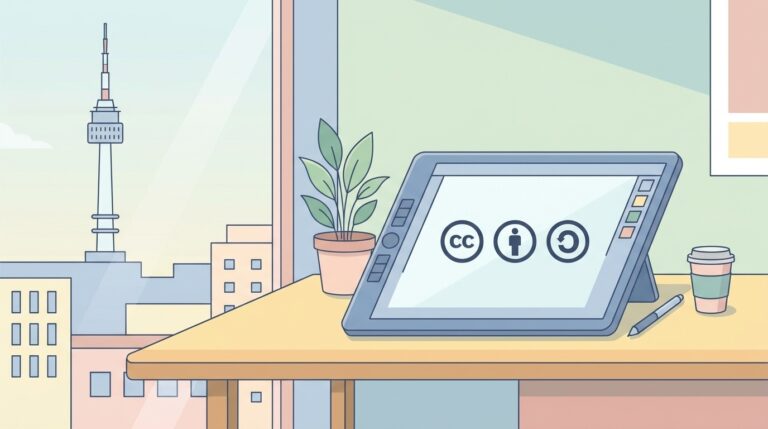
Navigating Copyright and Creative Commons in Korea: The Professional Creator’s Guide
Phase 1: Empathy (Story-Driven Opening)
안녕하세요! 매일한글 에디터입니다.
Picture this: You are sitting at a bustling cafe in Seongsu-dong, laptop open, working on a dynamic multimedia campaign. You have blended stunning photography of Seoul’s modern skyline with an indie producer’s lo-fi soundtrack. You are ready to publish your portfolio piece or launch your brand campaign, but suddenly, cold sweat trickles down your spine. You open the description box, cursor blinking, and wonder: If I simply write ‘출처: 인스타그램 (Source: Instagram)’ or drop a vague link, will Korean netizens call me out for ‘불펌’ (unauthorized scraping)? What are the exact legal parameters of Creative Commons in Korea’s hyper-connected, fiercely protective digital sphere?
If you have ever felt paralyzed trying to distinguish between acceptable fan tribute, commercial derivative work, and strict copyright infringement in Korea, you are not alone. As a creative navigating Korean digital platforms—whether you are collaborating with local design studios, running a K-Culture editorial, or managing an indie publishing project—mastering copyright attribution is not just about avoiding legal disputes. It is about signaling respect, fluency, and nunchi within Korea’s creative ecosystem. Based on years of mentoring bilingual digital creators and corporate content leads in Seoul, I have distilled the exact C1-level expressions, socio-cultural conventions, and licensing frameworks you need to create and collaborate with bulletproof confidence.
Phase 2: Core Expressions Deep Dive
1. 출처를 표기해 주시면 2차 창작 및 비영리적 배포가 가능합니다.
- Pronunciation: [Chul-cheo-reul pyo-gi-hae ju-si-myeon i-cha chang-jak mit bi-yeong-ri-jeok bae-po-ga ga-neung-ham-ni-da] (Pronunciation tip: Pronounce ‘출처’ smoothly like the English ‘tool-chuh’, keeping the aspirated ‘ch’ crisp, not voiced.)
- Meaning: Literal: If you mark the source, secondary creation and non-commercial distribution are possible. / Nuance: “Derivative fan works and non-commercial re-distribution are welcome, provided proper attribution is visibly credited.”
- K-Culture Moment: Seen ubiquitously in the disclaimers of indie webtoon illustrators on Postype, X (formerly Twitter), or Naver Blog setting ground rules for fan art and translation reposts.
- Editor’s Insight: ‘2차 창작’ (secondary creation) is a sacred cornerstone of K-Pop fandom and indie webtoon circles. By deploying this elegant, passive-permissive phrasing, you welcome community engagement while setting strict professional boundaries against commercial exploitation.
- Situation Spectrum: Casual: ⚠️ | Semi-formal: ✅ | Formal: ✅
- 🤔 Think About It: In many Western creator communities, Fair Use is often treated as an assumed defense. In Korea, however, creators place heavy emphasis on explicit pre-clearance and public acknowledgement. How does specifying the exact conditions upfront reflect the Korean virtue of mutual respect (ye-ui)?
2. 본 콘텐츠는 상업적 이용 및 2차 가공(변경)이 금지되어 있습니다.
- Pronunciation: [Bon kon-ten-cheu-neun sang-eop-jeok i-yong mit i-cha ga-gong-i geum-ji-doe-eo it-seum-ni-da] (Pronunciation tip: ‘가공’ sounds like ‘gah-gong’. Ensure ‘금지’ has a sharp, definitive ‘g’ and ‘j’ sound without hesitation.)
- Meaning: Literal: This content prohibits commercial use and secondary processing (modification). / Nuance: “All rights reserved against commercial monetization or unauthorized alteration (CC BY-NC-ND).”
- K-Culture Moment: Displayed at the conclusion of official behind-the-scenes vlogs, K-Pop concept teasers, or government cultural archives under public licensing to prevent malicious repurposing.
- Editor’s Insight: Notice the term ‘2차 가공’ (secondary processing/editing). In Korean online culture, cropping out a creator’s watermark, re-color grading, or editing a video clip into TikTok shorts without permission is often viewed as more offensive than simply reposting the original file.
- Situation Spectrum: Casual: 🚫 | Semi-formal: ✅ | Formal: ✅
- 🤔 Think About It: Why does Korean digital culture differentiate between simply sharing a link versus ‘2차 가공’ (altering the asset)? What does this reveal about ownership over one’s artistic labor?
3. 원작자의 라이선스 정책을 준수하여 합법적으로 인용하였습니다.
- Pronunciation: [Won-jak-ja-ui ra-i-seon-seu jeong-chae-geul jun-su-ha-yeo hap-beop-jeok-eu-ro in-yong-ha-yeot-seum-ni-da] (Pronunciation tip: Flow ‘준수하여’ [jun-su-ha-yeo] naturally like ‘june-soo-high-yuh’.)
- Meaning: Literal: I cited this lawfully by complying with the original creator’s license policy. / Nuance: “This excerpt is cited in strict compliance with the author’s licensing terms and relevant copyright provisions.”
- K-Culture Moment: Standard professional phrasing included in corporate white papers, video documentaries, or podcast program notes when referencing open-access datasets, indie music samples, or media clips.
- Editor’s Insight: At the C1 level, moving away from casual phrases like ‘저작권 지켰어요’ (I followed copyright) toward ‘라이선스 정책을 준수하여 인용하다’ immediately establishes your professional credibility and legal literacy.
- Situation Spectrum: Casual: 🚫 | Semi-formal: ⚠️ | Formal: ✅
- 🤔 Think About It: Using formal legal vocabulary in creative work balances artistic freedom with institutional professionalism. Does your native culture favor formal legal disclaimers or casual attribution notes?
Phase 3: Textbook Korean vs. Real Korean
Situation 1: Requesting Permission for an Open-Licensed Asset
- 📖 교과서 한국어 (Textbook): 저작권자님, 이 창작물을 써도 됩니까? (Jeojakkwonjanim, i changjangmureul sseodo doemnikka? / “Copyright owner, may I use this creative product?”)
- 🗣️ 진짜 한국어 (Real-World C1): 작가님, 표기된 CCL 조건(출처 표기 및 비영리)에 맞춰 출처를 명확히 밝히고 인용해도 될지 확인차 연락드렸습니다. (Jakganim, pyogidoen CCL jogeone matchwo chulcheoreul myeonghwak-hi balkhigo inyonghaedo doelji hwag-incha yeonnak-deu-ryeot-seumnida. / “Dear Creator, I’m reaching out to verify if I may cite your work with clear attribution, strictly honoring your stated CCL terms of attribution and non-commercial use.”)
- 💡 왜 다를까? Directly addressing someone as ‘저작권자님’ sounds like a robotic court subpoena. In actual creative industries, creators are respectfully addressed as ‘작가님’ (Creator/Author), and clarifying that you already reviewed their specific CCL terms signals professionalism and consideration.
Situation 2: Emphasizing that Redistribution is Strictly Regulated
- 📖 교과서 한국어 (Textbook): 불법으로 퍼가지 마십시오. (Bulbeobeuro peogaji masipsio. / “Do not take illegally.”)
- 🗣️ 진짜 한국어 (Real-World C1): 본 저작물은 무단 전재, 재배포 및 AI 학습용 무단 수집을 엄격히 금지합니다. (Bon jeojangmureun mudan jeonjae, jaebaepo mit AI hapseup-yong mudan sujibeul eomgyeok-hi geumjihamnida. / “Unauthorized republication, redistribution, and data scraping for AI training are strictly prohibited.”)
- 💡 왜 다를까? Textbook Korean relies on colloquial imperatives. Contemporary C1 Korean reflects real-world digital developments, adopting authoritative legal terminology like ‘무단 전재’ (unauthorized republication) and modern clauses protecting against generative AI scraping.
Phase 4: K-Culture Deep Dive & Non-Verbal Manners
4-1. 눈치 (Nunchi) & Digital Etiquette in Attribution
In the Korean digital creative sector, displaying CCL badges is only half the battle; where and how you place your attribution reflects your social intelligence (nunchi).
1. The ‘First Screen’ Courtesy: When republishing open-source or Creative Commons photography, placing the attribution tucked away behind multiple sub-menus or buried beneath 30 hashtags is considered disingenuous (눈 가리고 아웅 – a shallow deception). The proper convention is to place the original creator’s handle or CCL tier clearly in the caption header or directly overlay it unobtrusively in the lower right corner.
2. The Polite DM Notification (알림의 미덕): Even if an asset is tagged with CC BY (Attribution Only), seasoned Korean content producers frequently send a brief, courteous courtesy DM (사전 양해 메시지) informing the creator: ‘멋진 작품 감상했습니다. 명시하신 CCL 조건에 맞춰 정성껏 출처를 남겨 소개하고자 합니다.’ This small act of relational respect frequently turns a cold citation into a lasting professional connection.
4-2. Cultural Code Analysis: The Sensitive Border of ‘불펌’ vs. ‘덕질’
Korea possesses one of the world’s most vibrant fan-creation cultures (덕질 문화). From high-resolution K-pop concert photography taken by fansite masters (홈마) to webtoon reimagining, derivative creation is celebrated. However, the cultural condemnation of ‘불펌’ (unauthorized ripping/theft) is absolute.
When foreign creators repost Korean illustrations or video edits without clear source badges, online communities react strongly—not necessarily out of malice, but because intellectual effort (공든 탑) is deeply respected in Korean society. Using Creative Commons badges (CCL) correctly is your passport into this community: it declares that you are a cultural collaborator who understands the boundary between celebration and exploitation.
Phase 5: Real-World Roleplay Scenario
Setting: A vibrant open-plan creative studio near Hapjeong Station. You are discussing the copyright clearance of design resources with Min-ji, a senior creative director.
- 민지 (Min-ji): 이 그래픽 에셋, 이번 홍보용 웹진 메인 배너에 활용하기 딱 좋은데요? 라이선스 확인은 해보셨어요? (I geuraepik eset, ibeon hongboyong wepjin mein baeneoe hwalyonghagi ttak joeunde-yo? Raiseonseu hwag-ineun haebosyeosseoyo? / “This graphic asset is absolutely perfect for our promotional webzine main banner. Have you checked the licensing terms?”)
- 🎭 행동 지문: Min-ji leans forward, tapping her stylus against her tablet while scrutinizing the illustration details.
- You: 네, 원작자가 표기한 CCL 조건을 확인해 봤는데, CC BY-NC-ND로 등록되어 있습니다. (Ne, wonjakjaga pyogihan CCL jogeoneul hwag-inhae bwanneunde, CC BY-NC-NDro deungnokdoe-eo it-seumnida. / “Yes, I checked the creator’s CCL terms, and it is registered under CC BY-NC-ND.”)
- 🎭 행동 지문: You bring up the creator’s portfolio page, pointing calmly to the specific licensing icons displayed at the bottom.
- 민지 (Min-ji): 아, 그렇다면 상업적 용도로 배포되거나 수정되면 안 된다는 뜻이네요? 우리 프로젝트는 브랜드 협찬이 들어가잖아요. (A, geureotamyeon sang-eop-jeok yongdoro baepodoego-na sujeongdoemyeon an doenda-neun tteu-sineyo? Uri peurojekteuneun beuraendeu hyeopchani deureogajanayo. / “Ah, which means it cannot be distributed commercially or altered, right? Our project involves brand sponsorship.”)
- 🎭 행동 지문: Min-ji crosses her arms thoughtfully, assessing the commercial risk.
- You: 맞습니다. 비영리 조건과 변경 금지 조건이 모두 포함되어 있어서 직접 활용은 어렵습니다. 대신 동일 테마의 CC BY 리소스나 공공누리 제1유형 저작물로 대체하는 것을 제안합니다. (Matseumnida. Biyeongri jogeon-gwa byeongyeong geumji jogeoni modu pohamdoe-eo isseoseo jikjeop hwalyong-eun eoryeopseumnida. Daesin dong-il temaui CC BY risoseuna Gonggong Nuri je-il-yuhyeong jeojangmullro daechehaneun geoseul je-anhapnida. / “Exactly. Since both non-commercial and no-derivatives conditions apply, direct use is impossible. Instead, I suggest substituting it with a CC BY resource on the same theme or an asset under Korea Open Government License Type 1.”)
- 🎭 행동 지문: You click open a pre-organized folder containing compliant alternative public resources.
🔀 Interactive Decision Branch
What is your next move in this scenario?
* Option A: “그냥 출처만 조그맣게 적어두고 쓰면 아무도 모를 거예요.” (If we just write the source in tiny print, nobody will notice.)
* Option B: “제가 원작자분께 별도의 상업적 이용 허락 라이선스 계약을 위한 문의 메일을 즉각 발송하겠습니다.” (I will immediately send an inquiry email to the creator to negotiate a separate commercial licensing contract.)
* Option C: “저작권 표시를 지우고 AI로 다시 돌려서 생성하죠.” (Let’s scrub the watermark and run it through AI to generate a clone.)
[Feedback Analysis]
- Option A (Bad): Direct copyright infringement. In Korea's digital sphere, this invites immediate legal notice (*내용증명*) and massive brand reputation damage.
- Option B (Best): Flawless C1 professional execution! Contacting the creator for an explicit contract (*별도 라이선스 계약*) when CCL conditions don't cover commercial use demonstrates ultimate competence.
- Option C (Risk): Highly unethical and legally precarious under evolving Korean copyright and AI legislation.
Phase 6: 10-Second Emotional Shadowing Drill
Practice these high-frequency professional sentences. Follow the emotion markers and observe the breath pauses indicated by /.
- [🧐 신중하고 꼼꼼하게 (Thoughtful & Thorough)]
저작권 침해 요소를 사전에 방지하기 위해 / 라이선스 표기 조항을 / 다시 한번 검토하겠습니다.
(Jeojakkwon chimhae yosoreul sajeone bangjihagi wihae / raiseonseu pyogi johang-eul / dasi hanbeon geomtohagess-eumnida.)
“To preemptively prevent any copyright infringement issues / I will review / the licensing attribution clauses once again.” -
[💡 확신에 찬 목소리로 (Confident & Professional)]
본 자료는 / 공공누리 제1유형 조건에 따라 / 출처를 명시하고 자유롭게 활용할 수 있습니다.
(Bon jaryoneun / gonggongnuri je-il-yuhyeong jogeone ttara / chulcheoreul myeongshihago jayuropge hwalyonghal su isseumnida.)
“This asset / pursuant to Korea Open Government License Type 1 terms / can be freely utilized with proper attribution credited.” -
[🤝 정중하지만 단호하게 (Polite yet Firm)]
원작자의 2차 가공 금지 조항이 있으므로 / 원본의 비율과 색감을 / 훼손하지 않는 선에서 인용해 주세요.
(Wonjakjaui icha gagong geumji johangi isseumeuro / wonbonui biyulgwa saekgameul / hwesonhaji anneun seonese inyonghae juseyo.)
“As the original creator retains a No-Derivatives clause / please cite within limits / that do not compromise the original proportions and color palette.”
Phase 7: K-Culture Mini Dictionary
-
불펌 (Bul-peom)
- Translation: Unauthorized copying / Illegal re-uploading (Compound of ‘불법’ [illegal] + ‘퍼가기’ [scraping/ladling]).
- Usage: Essential internet slang across community boards like Theqoo, Instiz, and Naver Cafe. Example: “제 작업물 불펌하지 마시고 출처 남겨주세요.” (Please do not rip my work without permission; leave credit.)
- 2차 가공 (I-cha Ga-gong)
- Translation: Secondary modification / Derivative manipulation.
- Usage: Refers to cropping, adding filters, editing logos, or splicing digital assets into remixes. Commonly prohibited under ND (No Derivatives) conditions.
- 공공누리 (Gong-gong Nu-ri / KOGL)
- Translation: Korea Open Government License (KOGL).
- Usage: The official Korean public licensing system applied to municipal imagery, historic texts, and state-funded cultural data. Type 1 (제1유형) allows commercial use with source attribution.
- 내용증명 (Nae-yong Jeung-myeong)
- Translation: Certified Mail / Formal Legal Notice of Infringement.
- Usage: The standard legal first strike sent through the Korean postal service when a creator or enterprise discovers unauthorized commercial use of copyrighted material.
Phase 8: Survival Kit for Creators and Travelers
Top 3 Creator Survival Expressions
- 상업적 목적으로 활용해도 되나요?
- Romanization: Sang-eop-jeok mok-jeok-eu-ro hwalyong-haedo doenayo?
- Pro Tip: Use this when interviewing indie artisans in Ikseon-dong or filming artisans inside local workshops for your YouTube travel vlog.
- 포트폴리오에 출처를 남기고 게시해도 될까요?
- Romanization: Poteupolrioe chulcheoreul namgigo gyesihaedo doelkkayo?
- Pro Tip: The gold-standard respectful phrase for foreign designers interning or freelancing in Seoul when seeking permission to feature collaborative projects.
- 자유이용 저작물 표기(CCL)가 되어 있나요?
- Romanization: Jayu-iyong jeojangmul pyogi(CCL)ga doe-eo innayo?
- Pro Tip: Essential when curating historical images or museum assets for educational articles.
Editor’s Travel Note: Practical Creator Infrastructure in Korea
When capturing footage or acquiring media in Korea, reference authentic public digital repositories. Search the [한국저작권위원회 공식 웹사이트 (Korea Copyright Commission)] for specific precedent cases on copyright infringement. For royalty-free cultural assets, navigate directly to [공공누리 포털 사이트 (Gonggong Nuri KOGL Portal)] to access hundreds of thousands of certified, free-to-use cultural artifacts and high-resolution city photos. If you are meeting creators or renting production studios in Hongdae or Seongsu, always bookmark studio addresses via the [네이버 지도 앱 다운로드 (Naver Map App Download)] to ensure punctuality—being even five minutes late to a creative meeting in Seoul significantly strains professional rapport.
Phase 9: “A Step Deeper” (Humanities Essay)
In traditional Korean agrarian society, community creative works—such as folk songs (Minyo) or communal storytelling (Pansori)—belonged collectively to the village (마을 공동체), continually reshaped by passing voices. However, contemporary South Korea has engineered one of the most sophisticated, high-tech intellectual property landscapes in the world. This creates a fascinating cultural paradox: while the warm, community-driven spirit of Jeong (정) encourages sharing, remixing, and fan celebrations, the modern digital economy demands crystal-clear boundaries and legal rigor. Understanding Creative Commons in Korea is essentially learning how to navigate this exact boundary—where collective cultural enthusiasm meets strict, professional respect for individual authorship.
💬 Your Turn: In your home country, is online creative work generally seen as open for community remixing, or do people demand strict legal licensing from day one? Let’s discuss in the comments below!
Phase 10: FAQ & Avoiding Misunderstandings (FAQ Schema)
Q: Can I use K-Pop music videos or idol photos if I state ‘No Copyright Infringement Intended’ in Korean?
A: No. Phrases like ‘저작권 침해 의사가 없습니다’ (No copyright infringement intended) carry zero legal weight in South Korea. If the agency or photographer has not attached an open CCL license, reposting remains a technical violation. For public portfolios, always rely on assets explicitly cleared under CC licenses or official press kits provided for promotional use.
Q: What is the difference between CCL (Creative Commons) and Gonggong Nuri (공공누리)?
A: Creative Commons is an international private framework, whereas Gonggong Nuri (KOGL) is the official open license created by the South Korean Ministry of Culture, Sports, and Tourism specifically for public institutional assets. Gonggong Nuri uses 4 distinct types; Type 1 is functionally identical to CC BY, allowing commercial use and modification as long as the governmental source is credited.
Q: If a Korean creator tags their work as CC BY-NC, can I feature it on my monetized YouTube channel?
A: No. Even if your video is primarily educational or a review, YouTube monetization (AdSense) qualifies as ‘영리적 목적’ (commercial purpose) under Korean copyright interpretation. You must reach out via business email and secure explicit written permission or negotiate a separate commercial license.
🚨 Common Mistakes Warning Board
- Mistake: Crediting the platform instead of the author (e.g., writing 출처: 네이버 블로그 or 출처: 핀터레스트).
- Correct Action: Always credit the individual creator’s original name or handle: 출처: 네이버 블로거 [이름]님 / CC BY 조건 준수.
- Mistake: Cropping out personal stamps or digital watermarks to make your design look ‘clean’.
- Correct Action: Removing a creator’s watermark (워터마크 삭제) constitutes an intentional violation of moral rights (저작인격권) in Korea. Keep it intact unless granted explicit permission.
- Mistake: Assuming all educational or non-profit projects are automatically exempt from copyright claims.
- Correct Action: Non-profit status does not grant blanket immunity under Korean copyright law. Always check if the resource is designated CC BY or in the public domain (공공저작물).
Phase 11: Action Missions & Community Challenge
- 🥉 Bronze Mission (Solo Practice): Take a look at your personal social media or blog. Audit three images you didn’t produce yourself, and re-write their attribution lines in flawless Korean using the pattern:
출처: [Creator Name] (CC BY-NC 4.0 라이선스 준수). - 🥈 Silver Mission (Community Engagement): Find an independent Korean illustrator or photographer on Instagram or X whose work inspires you. Leave a polite, professional Korean comment praising their art and respecting their rights: “멋진 작품 항상 잘 보고 있습니다! 작업물의 라이선스 규정을 존중하며 응원합니다.”
- 🥇 Gold Mission (Real-World Implementation): Create a sample media kit or slide presentation for a Korean brand, containing an official ‘저작권 및 라이선스 고지 (Copyright & License Notice)’ slide applying today’s C1 vocabulary.
- 🎮 K-Culture Mission: Watch the end credits of a modern Korean independent film or high-end documentary vlog. Pause to spot how many different licensing tags (CCL, 공공누리, 음원 라이선스) appear in the closing sequence!
Phase 12: Interactive Quiz Challenge
Test your mastery of Korean copyright nuances and CCL terminology!
Q1. Situational Judgment: You are designing a commercial brand brochure for a retail client in Seoul. You find a breathtaking photograph marked with the following badge: CC BY-NC-SA. Can you use this asset in the brochure?
Q2. Fill-in-the-Blank: Complete the professional sentence below:
“원작자의 명예를 훼손하지 않고, 사전에 고지된 라이선스 조건을 철저히 ________하여 인용하였습니다.”
(Hint: Verb meaning ‘to comply with/honor’)
Q3. True or False: Under the Korean ‘공공누리 제1유형’ (KOGL Type 1) license, commercial use is permitted as long as the original public source is credited.
👉 Click to Reveal Answers & In-Depth Explanations
A1. Answer: No, you cannot use it.
Explanation: The NC marker stands for Non-Commercial (비영리). Because your brochure is for a commercial retail client (상업적 홍보물), using this image violates the creator’s conditions regardless of attribution.
A2. Answer: 준수(하)여 (Jun-su-ha-yeo)
Explanation: At the C1 level, pairing ‘라이선스 조건’ (licensing terms) with ‘준수하다’ (to comply with / to abide by) represents the most natural, sophisticated corporate collocation.
A3. Answer: True (O)
Explanation: KOGL Type 1 (공공누리 제1유형: 출처표시) allows creators to freely use, alter, and monetize public assets, provided that the government or institutional source is prominently cited.







