

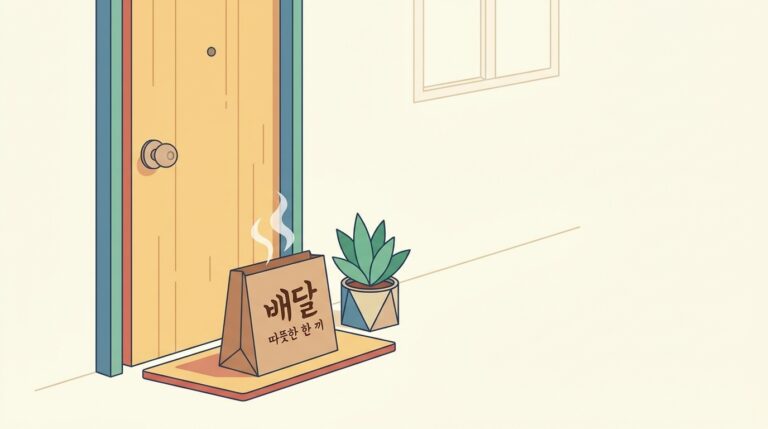
Master Contactless Delivery: How to Ask Riders to Leave Food at Your Door Like a Local
Phase 1: Empathy (Welcome to the K-Delivery Realm!)
안녕하세요! 매일한글 에디터입니다. (Hello! This is your Daily Hangul editor.)
Picture this: It is 11:45 PM on a chilly Seoul evening. You just climbed four flights of stairs after walking 18,000 steps through Myeongdong and Hongdae. Your legs feel like overcooked noodles, your introverted social battery sits at a flat zero percent, and your stomach is growling fiercely. Naturally, you fire up a food delivery app and successfully order a golden box of half-seasoned, half-fried chicken (banban chikin).
Ten minutes later, your phone buzzes with an alert: “기사님이 출발했습니다” (The rider has departed). Suddenly, cold sweat breaks out on your neck. You are in oversized dinosaur pajamas, your hair resembles a bird’s nest, and you desperately do not want a face-to-face social encounter right now. You just want the courier to quietly leave the food in front of your apartment door. But when the intercom unexpectedly rings—ding dong!—your mind blanks. Do you yell “문!” (Door)? Do you say “놓으세요” (Place it)? Will you sound rude? Or worse, will they misunderstand and take your midnight chicken away?
If you have ever frozen in front of an apartment door intercom, take a deep breath. Over the past decade of coaching intermediate learners, I have seen even B1-level speakers stumble on this exact high-pressure moment. Today, you will master the exact, polite, native-approved phrases to handle contactless delivery smoothly, confidently, and respectfully.
Phase 2: Core Expressions Deep Dive
Here are the top three golden phrases native Koreans use every day to request contactless delivery.
1. 문 앞에 두고 벨 눌러 주세요 (Mun ape dugo bel nulleo juseyo)
- Pronunciation: [Mun a-pe du-go bel nul-leo ju-se-yo] (Sounds like: “Moon ah-peh doo-go bell nool-ler joo-seh-yo”)
- Meaning: Literal: “Leave it in front of the door and press the bell, please.” vs. Actual Nuance: “Please drop it off outside my door and give the doorbell a quick ring.”
- K-Culture Moment: You will hear this constantly in modern lifestyle K-dramas where the busy, independent protagonist is working late from a laptop in loungewear and grabs their takeout the second the chime rings.
- Editor’s Insight: The verb root 두다 (duda – to leave/set down) combined with -고 (and) creates a seamless sequence of actions. It feels warmer and less demanding than saying “놓아라”. Adding -아/어 주세요 keeps it respectably polite without being stiff.
- Situation Spectrum: Casual: ⚠️ | Semi-formal: ✅ | Formal: ✅
- 🤔 Think About It: In many Western countries, couriers rarely ring bells after drop-off unless instructed. Why do Koreans prefer an explicit “drop AND ring” prompt? It guarantees the food remains hot while keeping personal contact at zero.
2. 문 앞에 놓아주시고 문자 부탁드립니다 (Mun ape no-aju-si-go munja butak-deurimnida)
- Pronunciation: [Mun a-pe no-a-ju-si-go mun-ja bu-tak-deu-rim-ni-da] (Sounds like: “Moon ah-peh no-ah-joo-she-go moon-jah boo-tahk-deu-rim-nee-dah”)
- Meaning: Literal: “Place it in front of the door and I request a text message.” vs. Actual Nuance: “Please leave it at the door and just send a confirmation text message instead of ringing.”
- K-Culture Moment: A classic trope where an exhausted office worker sneaks late-night snacks into their studio apartment without waking a sleeping puppy or an irritable roommate.
- Editor’s Insight: Notice 부탁드립니다 (I humbly request). This is the gold standard of Korean customer politeness. It protects the rider’s dignity while asking for a digital notification instead of a loud chime.
- Situation Spectrum: Casual: ⚠️ | Semi-formal: ✅ | Formal: ✅
- 🤔 Think About It: How does switching the notification channel from sound (bell) to text (문자) reflect Korean apartment etiquette (cheung-gan so-eum, noise between floors)?
3. 그냥 문 앞에 놔주시면 돼요 (Geunyang mun ape nwa-jusimyeon dwaeyo)
- Pronunciation: [Geu-nyang mun a-pe nwa-ju-si-myeon dwae-yo] (Sounds like: “Goo-nyang moon ah-peh nwah-joo-she-myeon dweh-yo”)
- Meaning: Literal: “It is okay if you just put it in front of the door.” vs. Actual Nuance: “No need to wait for me! You can just set it down right there by the door.”
- K-Culture Moment: When the delivery driver catches you by surprise via the hallway intercom while you are in the middle of a phone call or brushing your teeth.
- Editor’s Insight: The word 그냥 (geunyang – just/simply) paired with -(으)시면 돼요 (-simyeon dwaeyo – you can simply do…) politely grants permission. It relieves the delivery rider of any pressure to wait for you to answer in person.
- Situation Spectrum: Casual: ⚠️ | Semi-formal: ✅ | Formal: ⚠️
- 🤔 Think About It: In English, “You can just leave it there” might sound dismissive if your tone drops. In Korean, the high-rising polite ending ~돼요 makes it sound accommodating and considerate.
Phase 3: Textbook Korean vs. Real Korean
Let’s bridge the gap between classroom grammar and the genuine streets of Seoul.
Situation 1: Writing a delivery note in the app (배달 요청사항)
- 📖 교과서 한국어: 음식을 현관문 앞에 배치해 주시기를 희망합니다. (Eumsigeul hyeongwanmun ape baechihae jusigireul huimanghamnida.) — “I desire that you deploy the sustenance before the entrance door.”
- 🗣️ 진짜 한국어: 문 앞에 두고 벨 눌러주세요! (Mun ape dugo bel nulleojuseyo!) — “Please leave it at the door and ring the bell!”
- 💡 왜 다를까?: Words like 배치하다 (to deploy/arrange) belong in military manuals or corporate furniture catalogs, not late-night dining! Real Koreans use active, brief compound verbs like 두고 가다 (to leave and go).
Situation 2: Replying when the rider speaks through the intercom door phone
- 📖 교과서 한국어: 당신은 소포를 바닥에 내려놓아도 좋습니다. (Dangsineun soporeul badage naeryeonoado joeusseumnida.) — “You may set the parcel upon the floor ground.”
- 🗣️ 진짜 한국어: 아, 네! 문 앞에 놔주세요. 감사합니다! (A, ne! Mun ape nwajuseyo. Gamsahamnida!) — “Ah, yes! Please just leave it at the door. Thank you!”
- 💡 왜 다를까?: The textbook pronoun 당신 (you) can sound aggressive or confrontational between strangers. Spoken Korean naturally drops the pronoun entirely and begins with a polite conversational filler: “아, 네!” (Ah, yes!).
Phase 4: K-Culture Deep Dive & Non-Verbal Manners
4-1. 눈치 (Nunchi) & The Intercom Micro-Manners
Imagine the rider knocks while you’re standing right next to the front door. Should you fling the door open instantly?
* The 10-Second Nunchi Rule: Unless you are completely dressed and eager to greet them, wait about 5 to 10 seconds before opening your door. Korean delivery riders are on a fierce timer; opening the door immediately can startle them mid-step or make them feel rushed while snapping a drop-off verification photo.
* The Accidental Encounter: If you accidentally open the door right into each other, don’t freeze! Execute a gentle 15-degree head nod and say warmly: “감사합니다! 수고하세요!” (Gamsahamnida! Sugohaseyo! – Thank you! Keep up the hard work!). This displays top-tier social manners.
4-2. Culture Code: The “Palli-Palli” Speed & Contactless Respect
In Korea, food delivery is not a casual part-time gig; it is an ultra-synchronized logistics network driven by the 빨리빨리 (Palli-Palli, Hurry-Hurry) philosophy. Before the pandemic, couriers waited face-to-face for payment or signatures. Today, more than 80% of urban apartment deliveries are contactless (비대면 배달). Requesting drop-off at your door is not seen as anti-social or cold; rather, it saves the rider 30 to 45 seconds per delivery run, helping them finish their daily route safely and efficiently.
Phase 5: Real-World Roleplay Scenario
- Background Setting: You are relaxing in your rented studio officetel in Mapo-gu, Seoul. You ordered steaming hot Kimchi-jjigae via your delivery app. Suddenly, the hallway wall intercom beeps sharply.
- Character: 기사님 철수 (Rider Chul-soo) — A swift, friendly veteran delivery rider wearing a neon windbreaker and helmet.
- 🎭 벨 소리: 딩동-! (Ding dong!)
- 🧑🦱 철수: 배달 왔습니다! (Baedal watseumnida!)
(Delivery is here!) - 🙋♂️ You: 아, 네! 기사님, 문 앞에 두고 가주세요! (A, ne! Gisanim, mun ape dugo gajuseyo!)
(Ah, yes! Driver, please just leave it by the door!) - 🧑🦱 철수: 네, 문 앞에 둘게요! 벨 누를까요? (Ne, mun ape dulgeyo! Bel nureulkkayo?)
(Okay, I’ll set it at the door! Shall I ring the bell?) - 🙋♂️ You: 아뇨, 벨은 안 누르셔도 돼요. 문자만 남겨주세요! (Anyo, beleun an nureusyeodo dwaeyo. Munjaman namgyeojuseyo!)
(No, you don’t need to ring the bell. Just leave a text, please!) - 🧑🦱 철수: 알겠습니다. 맛있게 드세요! (Algetseumnida. Masitge deuseyo!)
(Understood. Enjoy your meal!) - 🙋♂️ You: 네, 감사합니다! 조심히 가세요! (Ne, gamsahamnida! Josimhi gaseyo!)
(Yes, thank you! Travel safely!) - 🧑🦱 철수: 네, 수고하세요! (Ne, sugohaseyo!)
(Yes, take care!)
🔀 Interactive Branching Decision
The intercom buzzes. You are in your pajamas and don’t want to talk for long. How do you respond?
- Option A: 문 앞에 던져요! (Mun ape deonjyeoyo!)
- Option B: 네, 기사님! 문 앞에 놔주시면 제가 바로 가져갈게요. 감사합니다! (Ne, gisanim! Mun ape nwajusimyeon jega baro gajyeogalgeyo. Gamsahamnida!)
- Option C: 그냥 가세요. (Geunyang gaseyo.)
- Option A Feedback [Bad]: 던지다 means “to throw violently.” You are literally screaming, “Throw the food at my door!” Your soup will explode across the carpet.
- Option B Feedback [Best!]: Perfect B1 honorific competence! You acknowledged the rider politely (기사님), clarified you will pick it up immediately (제가 바로 가져갈게요), and sealed it with gratitude.
- Option C Feedback [Risk]: 그냥 가세요 translates bluntly to “Just leave.” The rider might think you are canceling the order or furious with them!
Phase 6: 10-Second Emotion Shadowing Drill
Practice these natural intonations out loud using the pause marks (/) and emotional cues!
[😊 Brightly & Reassuring]
아, 네! / 문 앞에 / 두고 가주세요!
(A, ne! / Mun ape / dugo gajuseyo!)-
[🤫 Polite & Whispering-tone]
벨 누르지 마시고 / 노크만 / 부탁드려요.
(Bel nureuji masigo / nokeuman / butakdeuryeoyo.) -
[🙏 Grateful & Energetic]
문 앞에 놔주시면 돼요, / 감사합니다, 수고하세요!
(Mun ape nwajusimyeon dwaeyo, / gamsahamnida, sugohaseyo!)
Phase 7: K-Culture Mini Dictionary
- 비대면 배달 (Bidaemyeon Baedal) | Contactless Delivery
- Everyday usage: The ubiquitous checkbox on Korean delivery apps preventing unnecessary door-to-door physical contact.
- 공동현관 비밀번호 (Gongdong-hyeongwan Bimilbeonho) | Building Main Entrance Access Code
- Everyday usage: The exterior keypad code you must leave in the delivery memo so the driver can enter the apartment complex lobby.
- 라이더님 / 기사님 (La-i-deo-nim / Gisa-nim) | Delivery Rider / Courier Driver
- Everyday usage: The courteous, respectful titles used to address delivery professionals instead of impersonal terms.
- 수고하세요 (Sugo-haseyo) | “Keep up the good work!”
- Everyday usage: The quintessential Korean parting farewell addressed to service workers, couriers, and taxi drivers.
Phase 8: Traveler’s Survival Kit
Top 3 Survival Phrases
- 문 앞에 두고 문자 주세요. (Mun ape dugo munja juseyo.)
- Pro Tip: Type this directly into the app’s “Rider Request Note” (라이더 요청사항).
- 조심히 올라오세요. (Josimhi ollaoseyo. — “Please come up carefully.”)
- Pro Tip: A kind message to use when it is raining, snowing, or the building elevator is undergoing maintenance.
- 벨 누르지 말아주세요. (Bel nureuji marajuseyo. — “Please do not ring the bell.”)
- Pro Tip: Crucial if you are staying in an Airbnb with paper-thin walls or traveling with toddlers.
Editor’s Travel Note: App Navigation
When ordering in Korea without a local credit card, foreign travelers frequently utilize multilingual platforms. Before submitting your payment, consult our [배달의민족 앱 다운로드 및 주문 가이드] to confirm your exact apartment building number (동) and unit (호). Always enter your ground-floor building pin code formatted as: 공비: #1234# so riders reach your doorstep without calling you.
Phase 9: Thinking Deeper (한 발 더 깊이)
In Korean multi-unit residences like villas and officetels, the space immediately outside your front door (문 앞) is a fascinating cultural threshold. It is technically public common property, yet culturally respected as an extension of personal sanctuary. When you request contactless delivery using humble honorific phrasing, you are acknowledging that the delivery rider is bridging the public world and your private sanctuary. Politeness in Korean is not just about grammatical endings; it is about acknowledging the labor that sustains modern urban convenience.
💬 Your Turn: In your home country, is it common to ask food couriers to leave food on the porch without direct interaction, or is hand-to-hand delivery expected? Share your cultural experience in the comments below!
Phase 10: FAQ & Common Mistakes
Q: Is it considered impolite in Korea to ask riders to put food directly on the hallway floor?
A: Not at all! Modern Korean delivery packaging includes sturdy paper bags or insulated boxes specifically designed for clean floor drop-offs. Couriers prefer it because it allows them to complete deliveries rapidly.
Q: What if my building entrance is locked with a pin pad and I can’t speak fluent Korean on the phone?
A: Prevent the phone call entirely by typing your passcode in the delivery note field before ordering: write 공동현관 비번: KeypadCode + 종/호 (e.g., #1234#).
Q: What is the difference between “수고하세요” and “감사합니다” when talking to a delivery rider?
A: 감사합니다 means “Thank you” for the immediate food. 수고하세요 acknowledges their physical effort and wishes them well on the rest of their delivery route. Native speakers often blend them together: “감사합니다! 수고하세요!”
🚨 Common Mistakes Warning Board
- Saying “문 앞에 버려주세요” instead of “놓아주세요”
- Why it’s wrong: 버리다 means “to throw away/discard as trash.”
- Correct Action: Say 문 앞에 놔주세요 (Mun ape nwajuseyo).
- Omitting the Honorific Marker “-시-” when addressing strangers
- Why it’s wrong: Saying “문 앞에 둬” is 반말 (informal talk) and sounds disrespectful to an adult delivery worker.
- Correct Action: Use 문 앞에 두시면 돼요 or 문 앞에 두고 가주세요.
- Calling the driver “아저씨” (Ajeossi) through the speaker
- Why it’s wrong: While common in older media, 아저씨 can sound slightly dismissive in modern customer service.
- Correct Action: Address them as 기사님 (Gisanim) or 라이더님 (La-i-deo-nim).
Phase 11: Action Missions
- 🥉 Bronze Mission (Solo Practice): Stand in front of your room door. Point at the floor and say aloud three times with a bright voice: “문 앞에 두고 벨 눌러주세요!”
- 🥈 Silver Mission (Dictation & Social): Open your phone’s memo app or Instagram story and practice typing from memory: “문 앞에 놓아주시고 문자 부탁드립니다.”
- 🥇 Gold Mission (Real-Life Application): The next time you order delivery in Korea, use the contactless delivery note and greet the rider through the door intercom using “기사님, 문 앞에 놔주시면 돼요, 감사합니다!”
- 🎮 K-Culture Mission: Watch any slice-of-life K-drama episode and spot the exact moment an officetel resident receives a delivery notification. Notice whether they pick it up right away or wait for the hallway footsteps to fade!
Phase 12: Interactive Quiz Challenge
Test your real-world delivery competence!
1. Situation Judgment: You have an important Zoom business meeting at home and can’t make any noise. Which request should you paste into your delivery app?
* A) 문 앞에 던지고 소리 질러주세요.
* B) 문 앞에 놓아주시고 노크나 벨 대신 문자 부탁드립니다.
* C) 문 열고 들어오셔서 식탁에 놔주세요.
2. Fill in the Blank: Complete this polite sentence:
“기사님, 문 앞에 두고 가______, 감사합니다!”
* A) 먹어라
* B) 주셔라
* C) 주세요
3. True or False: In Korea, addressing your delivery driver as “기사님” over the intercom is considered respectful and culturally preferred over “아저씨”.
* (True / False)
👉 Click to reveal answers & explanations!
- Answer: B — “문 앞에 놓아주시고 노크나 벨 대신 문자 부탁드립니다” specifies contactless drop-off with a silent text message confirmation instead of loud doorbells.
- Answer: C (주세요) — The compound polite imperative 두고 가주세요 (Please leave it and go) is the standard natural phrase.
- Answer: True — 기사님 is the standard, courteous title for delivery couriers and drivers in modern South Korea.







