

Phase 1: Empathy (Story-Driven Opening)
안녕하세요! (Annyeonghaseyo!) I’m your editor from Daily Hangul, your 10-year local culture navigator.
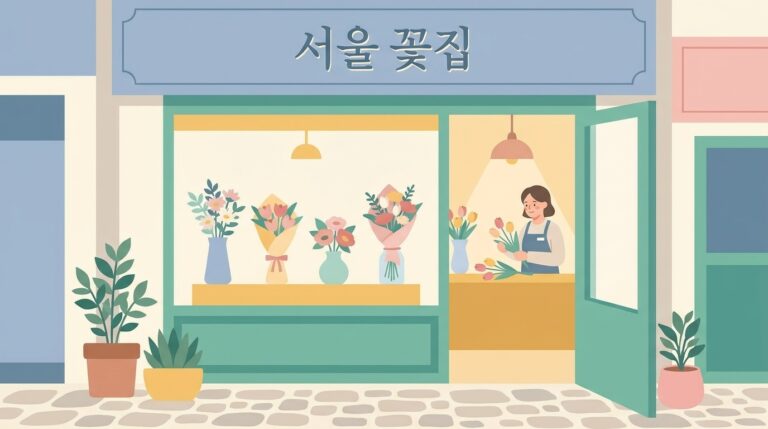
Picture this: You are strolling through a dreamy, aesthetic alleyway in Yeonnam-dong or Seongsu-dong. Through a sparkling glass window, you see pastel ranunculus, sweet-scented sweetpeas, and gorgeous eucalyptus branches. Tonight is your friend’s birthday party, and you want to walk in with an effortlessly chic Korean flower bouquet. You push the glass door open, greeted by a chime and a friendly florist. But panic hits—there are no price tags anywhere! In your wallet, you have a strict budget of around 30,000 KRW (~$22 USD). Your mind starts racing: “What if I point to a flower and the final bouquet ends up costing 100,000 KRW? How do I tell them my budget without sounding cheap or rude?”
This is one of the most common anxiety spikes our learners report when stepping into Korean boutique shops. Unlike supermarkets where pre-arranged bunches carry bar codes, Korean flower shops create bespoke magic on the spot. If you don’t know how to set your budget upfront, you might end up overspending or awkwardly declining at the counter. But don’t worry! With just a couple of natural, field-tested phrases, you can walk in like a confident local, state your price comfortably, and leave with a breathtaking bouquet tailored just for you.
Phase 2: Core Expressions Deep Dive
1. 3만 원 정도로 맞춰주실 수 있나요?
- Pronunciation: [Sam-man won jeong-do-ro mat-chwo-ju-sil su in-na-yo?] (Sounds like “Sum-mahn won jung-doe-row maht-chwo-joo-sheel soo een-nah-yo”)
- Meaning: Literal: “Can you match it to around 30,000 won?” / Actual Nuance: “Could you put together a bouquet for around 30,000 won, please?”
- K-Culture Moment: In modern romance K-Dramas like Business Proposal, characters drop by neighborhood florists to order casual celebration bouquets by immediately naming their comfortable price point.
- Editor’s Insight: The magic verb here is 맞추다 (matchuda), which means “to adjust / tailor to.” In Korean floral culture, you don’t pick flowers stem-by-stem; you provide a budget framework and let the florist exercise their artistic flair within that boundary.
- Situation Spectrum: Casual (⚠️) | Semi-formal (✅) | Formal (✅)
- 🤔 Think About It: In many Western shops, you buy flowers per individual stem ($4 per rose). Why do Korean flower shops prioritize custom-blended bouquets based on budget tiers?
2. 예산은 이 정도 생각하고 있어요.
- Pronunciation: [Ye-san-eun i jeong-do saeng-gak-ha-go is-seo-yo] (Sounds like “Yay-sahn-eun ee jung-doe seng-gahk-hah-go ee-ssuh-yo”)
- Meaning: Literal: “As for budget, I am thinking this much.” / Actual Nuance: “My budget is roughly around this amount.”
- K-Culture Moment: When couples in slice-of-life dramas prepare anniversary gifts or parents’ day gifts, they discuss financial parameters smoothly without awkward hesitation.
- Editor’s Insight: Notice the ending ~생각하고 있어요 (~saenggakhago isseoyo) (“I am thinking…”). Korean communication values soft boundaries. Instead of demanding “My budget is strictly 30,000 won,” this wording opens up a polite, collaborative dialogue with the vendor.
- Situation Spectrum: Casual (⚠️) | Semi-formal (✅) | Formal (✅)
- 🤔 Think About It: How does framing a limit as a “thought” rather than a hard “command” create warmer rapport between a customer and an artisan?
3. 포장비 포함인가요?
- Pronunciation: [Po-jang-bi po-ham-in-ga-yo?] (Sounds like “Poh-jahng-bee poh-hahm-een-gah-yo?”)
- Meaning: Literal: “Is wrapping fee included?” / Actual Nuance: “Does that total include the wrapping / packaging?”
- K-Culture Moment: When someone grabs a single wrapped flower (한 송이 꽃) on university campus gates during graduation season and checks the total before tapping their card.
- Editor’s Insight: Korean floral wrapping is world-famous—multiple layers of translucent paper, fabric ribbons, and water pouches. While standard bouquets include wrapping in the quoted price, single-stem flowers or budget mini-bouquets under 15,000 KRW occasionally charge an extra 2,000–3,000 KRW for luxury paper.
- Situation Spectrum: Casual (⚠️) | Semi-formal (✅) | Formal (✅)
- 🤔 Think About It: In Korea, gift packaging (포장) is treated as an essential component of the emotional gift itself. Does packaging carry the same weight in your culture?
Phase 3: Textbook Korean vs Real Korean
Situation 1: Declaring your spending limit
- 📖 교과서 한국어: 제 예산은 3만 원입니다. 저것을 만들어 주세요. (Je yesaneun sam-man won-imnida. Jeogeoseul mandeureo juseyo.)
- 🗣️ 진짜 한국어: 3만 원대로 예쁘게 맞춰주실 수 있나요? (Sam-man won-dae-ro yeppeuge matchwojusil su innayo?)
- 💡 왜 다를까?: Textbook Korean sounds like an official corporate contract! Real locals add the suffix -대 (-dae) meaning “range” and the friendly request 예쁘게 맞춰주세요 (“please make it pretty within this range”) to sound respectful and warm.
Situation 2: Inquiring about single stems on a modest budget
- 📖 교과서 한국어: 꽃 한 개를 얼마에 팝니까? (Kkot han gaereul eolmae pamnikka?)
- 🗣️ 진짜 한국어: 만 원 이하로 한 송이 포장도 되나요? (Man won iharo han song-i pojangdo doenayo?)
- 💡 왜 다를까?: Textbook Korean uses the generic item counter “개 (gae),” which sounds awkward for flowers. Native speakers use the flower counter 송이 (song-i) and politely ask if single-stem packaging is available under 10,000 KRW.
Phase 4: K-Culture Deep-Dive & Non-Verbal Manners
4-1. 눈치 (Nunchi) & Gestures
When discussing budget in a Korean boutique shop, never flash cash dismissively or drop a credit card onto the counter. Keep both hands relaxed around waist level. If your budget is flexible, say the number while tilting your head slightly with an appreciative nod. If you have a reference picture on Instagram, hold your phone with both hands to show the florist, saying: “이런 느낌으로 3만 원대 가능할까요?” (Ireon neukkimeuro sam-man won-dae ganeunghalkkayo? – “Could you make something with this vibe in the 30,000 won range?”).
4-2. Culture Code: Romance, Practicality, and “Gaseongbi”
In K-Dramas, giving flowers isn’t reserved exclusively for grand proposals. Flowers celebrate passing exams, 100-day relationship milestones (백일), or casual coffee dates. Because flower gifting is so everyday, florists in Seoul are completely used to young shoppers operating within realistic student budgets. Nobody expects you to drop 100,000 KRW on a Tuesday afternoon! Respecting your own budget while appreciating their craft is considered mature and practical (가성비 – great value).
Phase 5: Real Role-Play Scenario
- Setting: A stylish, sunlit boutique flower shop in Yeonnam-dong filled with fresh seasonal blooms.
- Characters:
- You: A traveler buying a thoughtful birthday gift.
- Minji (민지): The warm and artistic local florist.
- Turn 1 (Minji): 어서 오세요! 어떤 꽃 찾으세요? (Eoseo oseyo! Eotteon kkot chajeuseyo? / “Welcome! What kind of flowers are you looking for?”)
🎭 환하게 웃으며 가위를 내려놓는다. - Turn 2 (You): 안녕하세요! 친구 생일 선물용 꽃다발을 사려고 하는데요. (Annyeonghaseyo! Chingu saeng-il seonmulyong kkotdabareul saryeogo haneundeyo. / “Hello! I’m looking to buy a bouquet for my friend’s birthday.”)
🎭 매장을 둘러보며 다정하게 말한다. - Turn 3 (Minji): 아, 생일 축하용이군요! 혹시 생각해 두신 예산이나 꽃 색상이 있으신가요? (A, saeng-il chukhayong-igunyo! Hoksi saenggakkhae dusin yesan-ina kkot saeksang-i isseusingayo? / “Ah, for a birthday! Do you have a budget or color palette in mind?”)
🎭 쇼케이스 꽃들을 부드럽게 가리킨다. - Turn 4 (You): 3만 원 정도로 맞춰주실 수 있나요? 노란색 톤이면 좋겠어요. (Sam-man won jeongdoro matchwojusil su innayo? Noransaek ton-imyeon jokesseoyo. / “Could you make one for around 30,000 won? I’d love yellow tones.”)
🎭 두 손을 모으고 차분하게 요청한다. - Turn 5 (Minji): 네, 가능해요! 오늘 들어온 노란 튤립이랑 버터플라이 라넌큘러스로 예쁘게 해드릴게요. (Ne, ganeunghaeyo! Oneul deureoon noran tyullip-irang beoteopeullai raneonkyulleoseuro yeppeuge haedeurilgeyo. / “Yes, absolutely! I’ll put together a lovely bouquet with fresh yellow tulips and butterfly ranunculus.”)
🎭 꽃들을 신선하게 골라 꺼낸다. - Turn 6 (You): 정말 감사합니다! 포장비도 이 가격에 포함인가요? (Jeongmal gamsahamnida! Pojangbido i gagyeoge pohamingayo? / “Thank you so much! Is the wrapping fee included in this price?”)
🎭 살짝 미소 지으며 조심스럽게 확인한다. - Turn 7 (Minji): 네, 3만 원에 고급 포장까지 다 포함이에요! 10분 정도 걸리는데 편하게 앉아서 기다려 주세요. (Ne, sam-man wone gogeup pojangkkaji da poham-ieyo! Sip-bun jeongdo geollineunde pyeonhage anjaseo gidaryeo juseyo. / “Yes, elegant wrapping is fully included in the 30,000 won! It will take about 10 minutes, so please have a seat and relax.”)
🎭 대기 의자를 가리킨다. - Turn 8 (You): 네, 예쁘게 부탁드려요! (Ne, yeppeuge butakdeuryeoyo! / “Thank you, please make it look pretty!”)
🎭 기분 좋게 목례하며 자리에 앉는다.
🔀 Interactive Decision Branch
While arranging, Minji asks: “혹시 메시지 카드도 필요하신가요?” (Do you need a message card?)
* Choice A: “네, 짧은 축하 카드 한 장 적을 수 있을까요?” (Ne, jjalbeun chukha kadeu han jang jeogeul su isseulkkayo?)
* Feedback (Best): Perfect! Boutique Korean florists provide small complimentary gift cards. This makes your gift 10x more personalized.
* Choice B: “얼마예요? 공짜면 주세요.” (Eolmayeyo? Gongjjamyeon juseyo.)
* Feedback (Bad): Too blunt! Asking “Is it free?” in this manner sounds aggressive and breaks the gentle ambiance.
* Choice C: “그냥 꽃만 대충 싸주세요.” (Geunyang kkotman daechung ssajuseyo.)
* Feedback (Risk): The word “대충” (roughly/carelessly) can subtly hurt the pride of an artisan florist who cares deeply about presentation.
Phase 6: 10-Second Emotion Shadowing Drill
Practice these lines with pause marks (/) and emotional cues:
[😊 Polished & Courteous]
3만 원 / 정도로 / 맞춰주실 수 있나요?
(Sam-man won / jeongdoro / matchwojusil su innayo?)-
[💡 Curious & Gentle]
혹시 / 포장비도 / 포함인가요?
(Hoksi / pojangbido / pohamingayo?) -
[✨ Excited & Trusting]
친구 생일인데 / 노란색 톤으로 / 예쁘게 부탁드려요!
(Chingu saeng-il-inde / noransaek toneuro / yeppeuge butakdeuryeoyo!)
Phase 7: K-Culture Mini Dictionary
- 꽃다발 (Kkotdabal) | Bouquet | The universal term for hand-tied bouquets of cut flowers.
- 한 송이 (Han song-i) | Single stem | Commonly requested for graduations, first dates, or casual treats for yourself.
- 포장 (Pojang) | Wrapping / Packaging | Refers to the paper, water pouch, and ribbon design surrounding flowers.
- 예산 (Yesan) | Budget | The core financial noun used across retail and gifting when discussing limits.
Phase 8: Survival Kit for Travelers
Top 3 Travel Survival Lines
- 제일 인기 있는 꽃으로 골라주세요. (Jeil ingi inneun kkocheuro golla-juseyo.)
- Pro Tip: If you don’t know floral seasonal varieties in Korean, use this phrase to get whatever is freshest that morning.
- 이동 시간이 1시간 정도 걸려요. (Idong sigani han-sigan jeongdo geollyeoyo.)
- Pro Tip: Tell the florist your travel duration so they will add a water pouch (물처리 – mul-cheori) to keep the stems hydrated.
- 카드 결제 되나요? (Kadeu gyeolje doenayo?)
- Pro Tip: Almost 100% of Korean florists accept international cards (Visa/Mastercard), so no cash crunch worries!
Editor’s Travel Note
Skip the standardized flower stands inside subway stations if you want the real Korean design aesthetic. Instead, check the [Naver Map app download for navigating Korean flower shops] and type “꽃집” in areas like Mangwon, Yeonnam, or Anguk. Look for neighborhood shops with high visitor review ratings mentioning “친절해요” (kind florist) and “꽃이 싱싱해요” (fresh flowers).
Phase 9: “Think One Step Deeper”
In Western retail, buyers often prefer absolute price transparency via stickers and itemized menus. In Korea, discussing a budget isn’t seen as frugal—it is seen as establishing a collaborative canvas for the florist. By saying ~맞춰주세요 (“please match it to”), you are signaling mutual trust: you provide the boundary, and the florist provides the artistry. It reflects the delicate Korean balance of modesty, mutual respect (배려), and shared aesthetic appreciation.
💬 Your Turn: In your home country, do people normally specify their budget to a florist, or do you pick stems individually from buckets? Share your floral shopping stories in the comments!
Phase 10: FAQ & Common Mistakes
Q: What is a typical starting budget for a custom boutique bouquet in Seoul?
A: Mini gift bouquets typically start around 25,000 to 35,000 KRW ($18–$26 USD). Medium-sized, full bouquets with premium imported stems usually run around 50,000 to 70,000 KRW.
Q: What if I don’t know the Korean names of flowers?
A: You don’t need to know flower botany! Simply state the color palette or vibe: “파스텔 톤” (pastel tone), “화사한 느낌” (bright/vibrant vibe), or “차분한 톤” (calm/muted tone).
Q: Can I buy just a single flower in Korean shops?
A: Absolutely! Ask for 한 송이 포장 (han song-i pojang). It usually costs between 5,000 and 10,000 KRW and comes exquisitely wrapped.
🚨 Common Mistakes Checklist
- Mistake 1: Saying “싸게 해주세요” (Make it cheap). -> Correct Action: Never haggle with a florist. Instead, state your price gracefully using
~정도로 맞춰주세요. - Mistake 2: Forgetting to mention a long subway commute. -> Correct Action: Always tell them if you will be traveling over 30 minutes so they add a water wrap (물처리).
- Mistake 3: Tapping payment before confirming packaging. -> Correct Action: For smaller arrangements, double-check with
포장비 포함인가요?to avoid surprise charges.
Phase 11: Action Mission & Engagement
- 🥉 Bronze Mission: Practice saying
3만 원 정도로 맞춰주실 수 있나요?smoothly out loud 5 times in front of a mirror. - 🥈 Silver Mission: Screenshot your favorite flower bouquet on Instagram and practice writing a mock Korean order in your notes app stating your budget and desired color.
- 🥇 Gold Mission: Walk into a Korean flower shop (or use a Korean flower delivery website) and order a bouquet specifying your budget in Korean!
- 🎮 K-Culture Mission: Watch an episode of a romantic K-Drama (like Crash Landing on You or King the Land) and listen carefully whenever someone gifts flowers—can you spot any wrapping details?
Phase 12: Interactive Quiz Challenge
1. Situational Check: You have 30,000 KRW and want the florist to assemble a bouquet for that price. Which sentence is the most natural?
* A) 3만 원만 받으세요.
* B) 3만 원 정도로 맞춰주실 수 있나요?
* C) 3만 원어치 아무거나 파세요.
2. Fill-in-the-Blank:
* “혹시 이 가격에 포장비 _____인가요?” (Hint: included)
3. True or False:
* In Korea, it is considered rude to give the florist a budget limit instead of choosing stems individually. (True / False)
👉 Click here to reveal answers & explanations!
- Answer: B (3만 원 정도로 맞춰주실 수 있나요? is courteous, natural, and standard practice).
- Answer: 포함 (Poham – meaning “included”). The full sentence: 혹시 이 가격에 포장비 포함인가요?
- Answer: False! Giving a budget ceiling is standard etiquette in Korean floral shops and helps the florist pick matching stems efficiently!







