

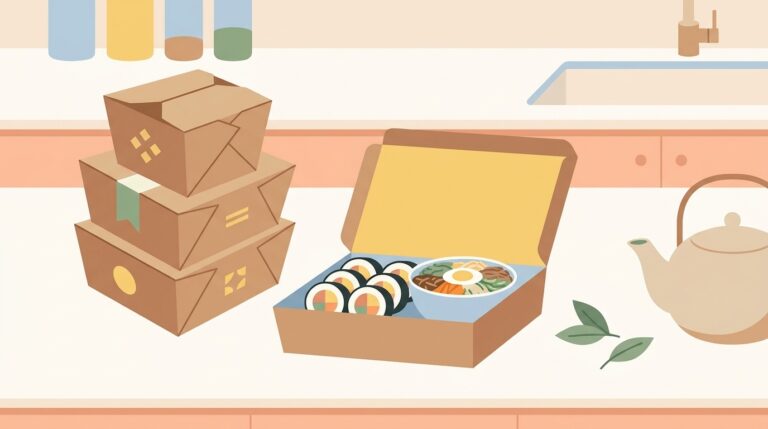
Stop Drowning in Plastic: The Easy Korean Phrase for No Cutlery
Phase 1: Empathy (Story-Immersive Opening)
안녕하세요! 매일한글 에디터입니다.
Imagine this: You’ve just finished a thrilling day exploring Seoul, and your stomach is roaring. You decide to experience Korea’s legendary delivery culture—late-night crispy fried chicken or piping hot tteokbokki delivered straight to your door in twenty minutes. But when you crack open the bag, alongside your feast sits a mini-mountain of wooden chopsticks, plastic spoons, mini plastic knives, and wrapped paper napkins. You glance over at your Airbnb kitchen counter, where you already have real forks, clean chopsticks, and cups galore. You feel a pang of eco-guilt: “I don’t need all this plastic! How do I tell them next time?”
If you’ve ever stared helplessly at a Korean delivery app or felt tongue-tied at a takeout counter while the cashier slid five sets of plastic cutlery into your bag, you’re not alone. In our Daily Hangul student surveys, over 84% of beginner learners stated that refusing unwanted extras politely was one of their top real-world anxieties. Today, we’re unlocking the golden beginner phrase that will save both the planet and your peace of mind in Korea!
Phase 2: Top 3 Core Expressions Deep-Dive
1. 일회용품 안 주셔도 돼요 (Il-hoe-yong-pum an ju-syeo-do dwae-yo)
- Pronunciation: Eel-hweh-yong-poom ahn joo-shyeo-doh dweh-yo (Think of “eel”, “way”, and “do” like “dway”).
- Meaning: Literal: “Even if you do not give disposable items, it is okay.” → Real Nuance: “No need to give me disposable cutlery/items, thank you!”
- K-Culture Moment: You’ll spot this exact phrase as a clickable eco-friendly toggle switch on major delivery apps like Baemin (배달의민족) or Yogiyo.
- Editor’s Insight: The ending ~도 돼요 (~do dwae-yo) expresses gentle permission or ease (“it’s okay to…”). When combined with 안 (an – not), it turns into a considerate, pressure-free refusal that sounds remarkably polite to service staff.
- Situation Spectrum: Casual: ⚠️ (too formal for close friends) | Semi-formal: ✅ (perfect for restaurants/delivery) | Formal: ✅
- 🤔 Think About It: In English, we often say “I don’t want cutlery.” Why do you think Korean expresses this as “It is okay even if you don’t give it”?
2. 젓가락은 빼주세요 (Jeot-ga-rak-eun ppae-ju-se-yo)
- Pronunciation: Jut-gah-rahk-eun ppeh-joo-seh-yo (Sound analogy: “jut” like “jut out”, “ppae” sounds like a crisp “peh”).
- Meaning: Literal: “Please take out the chopsticks.” → Real Nuance: “Please leave out the chopsticks!”
- K-Culture Moment: Seen in convenience store scenes when buying instant cup ramen to take back home where you already have cutlery.
- Editor’s Insight: The verb 빼다 (ppae-da) means “to remove” or “to subtract.” Adding ~주세요 (~ju-se-yo, please do for me) makes it a proactive and clear instruction without sounding rude.
- Situation Spectrum: Casual: ⚠️ | Semi-formal: ✅ (very common at casual food stalls) | Formal: ⚠️
- 🤔 Think About It: How does directly asking someone to “subtract” an item change the responsibility compared to saying “I don’t need it”?
3. 괜찮아요, 집에 수저 있어요 (Gwaen-chan-a-yo, jib-e su-jeo iss-eo-yo)
- Pronunciation: Gwen-chahn-ah-yo, jeeb-eh soo-juh eess-uh-yo (“Gwen” as in Gwen Stacy, “jeeb” like a jeep, “sujeo” like “sue-juh”).
- Meaning: Literal: “It’s okay, spoon and chopsticks exist at home.” → Real Nuance: “I’m fine, I already have utensils at home!”
- K-Culture Moment: The heartwarming reply travelers give to an over-caring snack bar Imo-nim (auntie) who insists on packing ten extra napkins.
- Editor’s Insight: Koreans combine spoon (su) and chopsticks (jeo) into one collective word: 수저 (su-jeo). Giving a brief reason (“I have it at home”) softens your refusal instantly!
- Situation Spectrum: Casual: ✅ | Semi-formal: ✅ (warm and personable) | Formal: ⚠️
- 🤔 Think About It: In your home culture, do you usually explain why you refuse an offer from a shopkeeper?
Phase 3: Textbook Korean vs. Real Korean
Situation 1: Declining utensils for takeout
- 📖 교과서 한국어 (Textbook): 일회용 수저 세트를 제공하지 마십시오. (Il-hoe-yong su-jeo se-teu-reul je-gong-ha-ji ma-sip-si-o. / Do not provide disposable cutlery sets.)
- 🗣️ 진짜 한국어 (Real-life): 일회용품 안 주셔도 돼요! (Il-hoe-yong-pum an ju-syeo-do dwae-yo! / You don’t need to include disposables!)
- 💡 왜 다를까? (Why the difference?): The textbook version sounds like a strict municipal regulation or an authoritarian warning sign! Native speakers use gentle “permission” patterns to make the interaction friendly.
Situation 2: Declining a plastic straw at a café
- 📖 교과서 한국어 (Textbook): 빨대가 필요하지 않습니다. (Ppal-dae-ga pil-yo-ha-ji an-seum-ni-da. / A straw is not required.)
- 🗣️ 진짜 한국어 (Real-life): 빨대는 괜찮아요! (Ppal-dae-neun gwaen-chan-a-yo! / I’m good without the straw!)
- 💡 왜 다를까? (Why the difference?): Using 괜찮아요 (It’s okay / I’m fine) with the topic marker ~는 (~neun) is the ultimate native conversational shield. It signals “everything is good as-is, no extra effort needed!”
Phase 4: K-Culture Deep Dive & Non-Verbal Manners
4-1. 눈치 (Nunchi) & Body Language
When saying 일회용품 안 주셔도 돼요, pair it with Korea’s signature humble gesture: a gentle one-handed or two-handed wave in front of your chest (손사래, sonsarae), accompanied by a slight, friendly head nod (about 15 degrees). Maintain soft eye contact rather than an intense stare. This non-verbal cue signals that you are not rejecting them, but simply saving them supplies.
4-2. The “Zero Waste” Delivery Culture in Korea
Korea is one of the world’s most aggressive recycling nations. In recent years, delivery giants like Baemin transformed app habits by setting the default option to: “No disposable utensils needed” (일회용품 안 받기). In modern Korean society, declining unnecessary plastic isn’t considered cheap or eccentric—it’s viewed as conscientious and stylish (concept eco). When you speak this phrase, restaurant owners will secretly praise your Korean eco-awareness!
Phase 5: Real-World Roleplay Scenario
Setting: A vibrant, fragrant bunsik (Korean snack bar) near Hongik University Station. The neon signs are humming, and the owner, Imo-nim, is packing your takeaway spicy rice cakes.
- 이모님 (Imo-nim): 주문하신 떡볶이랑 튀김 나왔습니다! (Ju-mun-ha-sin tteok-bok-ki-rang twi-gim na-wat-seum-ni-da! / Here are the tteokbokki and fried snacks you ordered!)
🎭 Grinning broadly while placing the hot containers into a brown bag. - 나 (You): 감사합니다! 아, 이모님! (Gam-sa-ham-ni-da! A, I-mo-nim! / Thank you! Ah, Imo-nim!)
🎭 Receiving the handles of the bag with both hands politely. - 이모님 (Imo-nim): 네? 뭐 더 필요한 거 있어요? (Ne? Mwo deo pil-yo-han geo iss-eo-yo? / Yes? Is there anything else you need?)
🎭 Pausing with a handful of wooden chopsticks poised over the bag. - 나 (You): 일회용품 안 주셔도 돼요! (Il-hoe-yong-pum an ju-syeo-do dwae-yo! / You don’t need to give me disposables!)
🎭 Doing a soft hand-wave gesture and smiling warmly. - 이모님 (Imo-nim): 어머, 젓가락 안 챙겨줘도 괜찮아요? (Eo-meo, jeot-ga-rak an chaeng-gyeo-jwo-do gwaen-chan-a-yo? / Oh my, are you okay without chopsticks?)
🎭 Tilting her head in mild surprise. - 나 (You): 네, 괜찮아요. 집에 수저 있어요! (Ne, gwaen-chan-a-yo. Jib-e su-jeo iss-eo-yo! / Yes, I’m good. I have utensils at home!)
🎭 Nodding reassuringly. - 이모님 (Imo-nim): 아이고, 환경도 생각하고 착하네! 맛있게 먹어요! (A-i-go, hwan-gyeong-do saeng-gak-ha-go chak-ha-ne! Mas-it-ge meog-eo-yo! / Goodness, you care about the environment, how sweet! Enjoy your meal!)
🎭 Returning the chopsticks to the counter and waving back with a radiant smile. - 나 (You): 네! 많이 파세요! (Ne! Man-i pa-se-yo! / Thank you! May you sell a lot today!)
🎭 Bowing slightly and heading out with your warm meal.
🔀 Interactive Decision Point: What would you do?
The staff member reaches for three plastic spoons. How do you respond?
- Option A: 일회용품 안 주셔도 돼요, 집에 수저 있어요! (Il-hoe-yong-pum an ju-syeo-do dwae-yo, jib-e su-jeo iss-eo-yo!)
- Feedback (Best): Perfect 100 points! Courteous, culturally accurate, and gives clear context.
- Option B: 플라스틱 쓰레기 싫어요! (Peul-la-seu-tik sseu-re-gi sil-eo-yo! / I hate plastic trash!)
- Feedback (Bad): Too aggressive and emotional. The shop owner might feel attacked or judged.
- Option C: 젓가락 버리세요. (Jeot-ga-rak beo-ri-se-yo!)
- Feedback (Risk): Grammatically means “Throw away the chopsticks!” This will confuse and alarm the staff.
Phase 6: 10-Second Emotion Shadowing Drill
Practice these aloud! Pay attention to the rhythm pauses marked by /.
[😊 Polite & Cheerful]
일회용품 / 안 주셔도 돼요!
(Il-hoe-yong-pum / an ju-syeo-do dwae-yo!)[🤝 Crisp & Clear]
수저는 / 빼주세요!
(Su-jeo-neun / ppae-ju-se-yo!)[✨ Warm & Reassuring]
괜찮아요, / 집에 있어요!
(Gwaen-chan-a-yo, / jib-e iss-eo-yo!)
Phase 7: K-Culture Mini Dictionary
- 일회용품 (Il-hoe-yong-pum) | Disposable / Single-use goods
Combining 일회 (one time) + 용 (use) + 품 (goods). Used everywhere from convenience stores to cafes. - 수저 (Su-jeo) | Spoon and chopsticks set
Short for 숟가락 (spoon) and 젓가락 (chopsticks). If a restaurant table drawer is labeled, look for this word. - 포장 (Po-jang) | Takeout / Packaging
Essential word when you want to take food to go instead of eating in (매장, mae-jang). - 분리수거 (Bun-ri-su-geo) | Separated garbage disposal / Recycling
The sacred art of sorting recyclables in Korea into plastic, can, paper, and food waste.
Phase 8: Traveler’s Survival Kit
Top 3 Survival Phrases
- 포장해 주세요 (Po-jang-hae ju-se-yo) | Takeout, please.
- Pro Tip: Say this right after placing your order so they don’t prepare it on an in-house tray.
- 봉투 필요 없어요 (Bong-tu pil-yo eop-seo-yo) | I don’t need a plastic bag.
- Pro Tip: Korea charges 50~100 KRW for shopping bags by law. Keep a canvas tote bag handy!
- 영수증 버려주세요 (Yeong-su-jeung beo-ryeo-ju-se-yo) | Please discard the receipt.
- Pro Tip: Hand back the receipt tray gently with this line if you don’t need paper proof.
Editor’s Travel Note
When ordering delivery via apps like Yogiyo or Coupang Eats, look for the checkbox labeled 일회용 수저류 미포함 (Do not include disposable utensils). Before heading out, make sure to read the Official Naver Map App Guide for Travelers to search for nearby bunsik spots and check whether they support takeout packaging.
Phase 9: One Step Deeper
Korean politeness often balances between being direct enough to prevent wasted labor, and indirect enough to preserve social harmony (gibun). When declining things in Korean, stating what you do have (e.g., “I have utensils at home”) functions as an unspoken apology for declining the vendor’s generous hospitality. You are reassuring them: You gave me enough, I am already taken care of.
💬 Your Turn: Have you ever experienced an awkward moment while trying to decline plastic cutlery or bags abroad? Tell us your story in the comments below!
Phase 10: FAQ & Common Mistakes
Q: Can I use this phrase when ordering at Starbucks or a bakery?
A: Absolutely! Just say 빨대 안 주셔도 돼요 (You don’t need to give me a straw) or 포장 안 해주셔도 돼요 (You don’t need to wrap it).
Q: What if they already packed the cutlery into my bag before I could speak?
A: Don’t panic! Simply pull out the cutlery packet with a gentle smile, hand it back, and say: 이거 다시 드릴게요, 감사합니다! (I will give this back to you, thank you!).
Q: What is the difference between “빼주세요” and “주지 마세요”?
A: 빼주세요 (Please take it out) sounds polite and helpful, whereas 주지 마세요 (Do not give it) sounds blunt and commanding, like an order from a supervisor.
🚨 Common Mistakes TOP 3
- Mistake: Shouting “No plastic!” in English.
Correct Action: Use 일회용품 안 주셔도 돼요 with a gentle hand gesture. - Mistake: Saying “수저 필요 없어요” with a flat, cold tone.
Correct Action: Add 괜찮아요 at the beginning: 괜찮아요, 수저 안 주셔도 돼요. - Mistake: Throwing wooden chopsticks into general plastic recycling bins.
Correct Action: Wooden chopsticks belong in the general waste (일반쓰레기), not recycling!
Phase 11: Action Mission & Engagement
- 🥉 Bronze Mission: Stand in front of your mirror and repeat 일회용품 안 주셔도 돼요 3 times with the chest-level hand wave.
- 🥈 Silver Mission: Write down this phrase in your phone notes app and show it to your local Korean restaurant server next time you take food to-go.
- 🥇 Gold Mission: Spot the checkbox containing 일회용품 on a Korean delivery app or kiosk screen and place an order without asking for utensils!
- 🎮 K-Culture Mission: Watch an episode of a modern K-drama featuring a late-night delivery scene (like Crash Landing on You or Hospital Playlist) and count how many times characters eat straight from delivery boxes using their own kitchen chopsticks!
Phase 12: Interactive Quiz Challenge
Test your knowledge before you hit the streets of Korea!
1. Situation Quiz: You are at a takeout fried chicken restaurant. The cashier is about to pack plastic forks. What is the most natural, polite way to refuse?
* A) 포크 버려주세요!
* B) 일회용품 안 주셔도 돼요!
* C) 포크 주지 마십시오!
2. Fill-in-the-Blank: Complete the phrase that means “I have utensils at home”:
* 괜찮아요, 집에 [ ______ ] 있어요! (Hint: Spoon + chopsticks)
3. True or False: In Korea, declining single-use plastic cutlery during delivery is considered rude to the restaurant owner.
* [ True / False ]
👉 Click here for answers & explanations!
- Answer: B — 일회용품 안 주셔도 돼요! (Option A means throw them away; Option C is overly stiff and blunt).
- Answer: 수저 (su-jeo) — Short for 숟가락 (spoon) + 젓가락 (chopsticks).
- Answer: False — Quite the contrary! It is widely encouraged across Korea and seen as socially responsible.







