

Phase 1: 공감 (Story-driven Empathy Opening)
안녕하세요! 매일한글 에디터입니다.
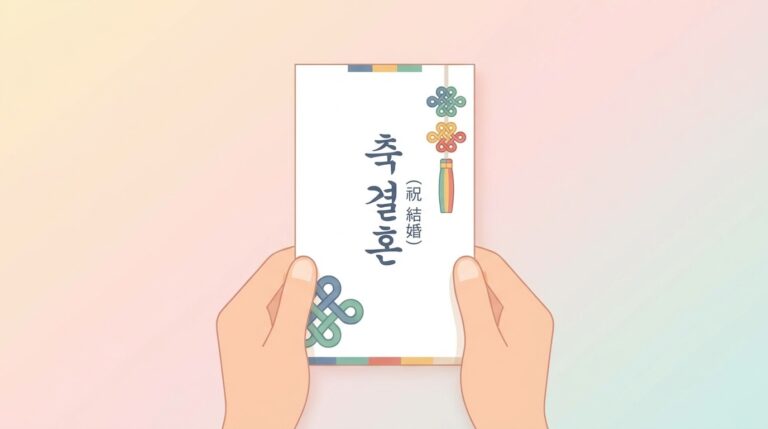
Picture this: You are sitting at your desk on a quiet Tuesday afternoon when your Korean coworker walks over with a nervous, polite smile. They hand you a pristine, pastel-toned envelope sealed with gold foil—a 청첩장 (cheongcheopjang, wedding invitation). You congratulate them warmly, but the moment you get back to your seat, a silent panic sets in. You find yourself staring at an ATM screen in Gangnam on a Saturday morning, paralyzed by arithmetic: Should I withdraw 50,000 KRW? Is 100,000 KRW too much? Wait, they booked an upscale convention hall in Yeouido—what if the buffet costs more than my gift? If I only give 50,000 won, will I become the subject of breakroom gossip?
If you have ever felt this sudden rush of cultural anxiety, take a deep breath. You are not alone—even native Koreans agonize over this exact calculation every spring and autumn wedding season! In Korea, deciding the amount of 축의금 (chug-uigeum, wedding congratulatory money) is not merely a financial transaction; it is a delicate dance of social balance, relational distance, and unspoken community reciprocity. Drawing from hundreds of real expat consultations and decades of Korean social navigating, this guide will turn that awkward ATM dilemma into smooth, effortless cultural confidence.
Phase 2: 핵심 표현 3선 심층 분석 (3 Core Expressions Deep Dive)
1. 축의금 얼마 해야 돼요? (Chug-uigeum eolma haeya dwaeyo?)
- Pronunciation: [Chug-ui-geum eol-ma hae-ya dwae-yo?] (Think: “Choog-ee-geum” + “ul-mah” + “heh-yah dway-yo”)
- Meaning: Literal: “How much congratulatory money must I do?” / Natural: “How much wedding gift money should I give?”
- K-Culture Moment: Seen in relatable workplace K-Dramas like Misaeng or Agency, where juniors gather near the coffee vending machine to quietly synchronize their gift amounts so nobody stands out awkwardly.
- Editor’s Insight: Koreans rarely decide the amount alone if they share a mutual social circle with the bride or groom. Asking this question to your peers is not seen as cheap or nosy; it is considered sensible social coordination.
- Situation Spectrum: Casual ✅ | Semi-formal ✅ | Formal ⚠️
- 🤔 Think About It: In many Western cultures, asking “How much are you giving?” feels invasive. Why does Korean culture treat this collective consultation as polite teamwork?
2. 밥값은 해야죠 (Bap-gapseun haeyajyo)
- Pronunciation: [Bap-gap-seun hae-ya-jyo] (Think: “Bop-gop-seun” + “heh-yah-jyo”)
- Meaning: Literal: “One must do the meal price.” / Natural: “At the very least, I should cover the cost of my meal.”
- K-Culture Moment: Frequently heard during lunchtime discussions when colleagues evaluate wedding venues (e.g., “Their hall is in Gangnam with a luxury steak course—밥값은 해야죠!“).
- Editor’s Insight: Due to recent inflation, wedding buffet meals often cost between 60,000 to 90,000 KRW per head. Giving 50,000 KRW while attending and eating now creates a deficit for the couple. This phrase is the golden standard to justify stepping up from 50k to 100k.
- Situation Spectrum: Casual ✅ | Semi-formal ✅ | Formal ✅
- 🤔 Think About It: What does the expectation to cover one’s own guest plate say about the financial partnership between wedding hosts and their guests in Korea?
3. 얼굴만 비추고 올게요 (Eolgulman bichugo olgeyo)
- Pronunciation: [Eol-gul-man bi-chu-go ol-ge-yo] (Think: “Uhl-gool-mahn” + “bee-choo-go” + “ohl-geh-yo”)
- Meaning: Literal: “I will only shine my face and come back.” / Natural: “I will just drop by quickly to show my face.”
- K-Culture Moment: Characters who have back-to-back commitments or distant connections use this phrase to justify stopping by the photo wall, dropping off the envelope, and leaving without dining.
- Editor’s Insight: This is your strategic lifesaver! If you want to show respect but cannot afford 100,000 KRW, you can give 50,000 KRW, take photos with the couple in the bridal room, and politely excuse yourself before dining without asking for a meal coupon.
- Situation Spectrum: Casual ✅ | Semi-formal ✅ | Formal ⚠️
- 🤔 Think About It: How does showing your physical presence (showing your face) carry emotional value even when you cannot stay for the full celebration?
Phase 3: 교과서 한국어 vs 진짜 한국어 (Textbook vs. Real Korean)
Situation 1: Deciding the standard rate based on social closeness
- 📖 교과서 한국어: 친밀도에 따라 축의금 액수를 결정합시다. (Chinmildo-e ttara chug-uigeum aeksureul gyeoljeonghapsida. – Let us determine the wedding gift amount depending on the degree of intimacy.)
- 🗣️ 진짜 한국어: 친하면 10만 원, 애매하면 5만 원 국룰인 거 알지? (Chinamyeon simman-won, aemaehamyeon oman-won gungnurin geo alji? – If we’re close it’s 100k, if ambiguous it’s 50k, you know that’s the unwritten rule, right?)
- 💡 왜 다를까?: Real Koreans rely on the slang term 국룰 (gungnul, universal/national unspoken rule) to navigate societal ambiguity rather than stiff analytical vocabulary like “degree of intimacy.”
Situation 2: Delivering money on behalf of someone who cannot attend
- 📖 교과서 한국어: 불참하는 동료의 축의금을 대신 전달하겠습니다. (Bulchamhaneun dongryoui chug-uigeumeul daesin jeondalhagessseumnida. – I shall deliver the gift money on behalf of the absent colleague.)
- 🗣️ 진짜 한국어: 민우가 못 온대서 내가 봉투 대신 넣어주려고. (Min-uga mot ondaeseo naega bongtu daesin neoheojuryeogo. – Min-woo said he can’t make it, so I’m dropping off his envelope for him.)
- 💡 왜 다를까?: In everyday speech, Koreans refer to the act of gifting cash as 봉투를 넣다 (putting in the envelope) rather than formal delivery verbs.
Phase 4: K-Culture 딥다이브 & 비언어적 매너 (Deep Dive & Non-verbal Manners)
4-1. 눈치 (Nunchi) & Gestures
- The Envelope Submission: When you arrive at the reception desk (접수대, jeopsudae), never hand over a bare bill. Cash must always be inside a clean white envelope. Hold the envelope with both hands, bow your head slightly, and present it so the writing faces the receiver.
- Writing Your Name: On the front center of the envelope, pre-printed Sino-Korean characters like 祝結婚 (Chuk-gyeol-hon, Congratulations on Marriage) are standard. On the back bottom-left, write your name vertically. If you are an office colleague, write your company or team name to the right of your name (e.g., 마케팅팀 알렉스) so the bookkeeper knows exactly who you are.
- The Meal Ticket (식권, Sik-gwon): The desk will ask, “식권 필요하세요?” (Do you need a meal ticket?). Only accept tickets for the exact number of people attending with you. If you are not dining, politely wave your hand and say, “식사는 안 하고 갈게요” (I will be leaving without eating).
4-2. Cultural Code Analysis: The Odd Number Rule & The Inflation Shock
Why do Koreans gift 50,000, 70,000, or 100,000 KRW, but almost never 40,000 or 60,000 KRW? Traditionally rooted in Yin and Yang philosophy, odd numbers (홀수, holsu) symbolize positive energy, movement, and life, whereas even numbers (짝수, jjaksu) were historically associated with stillness. The number 10 (100,000 KRW), although technically even, is celebrated as a “full complete number” (꽉 찬 수, ggak chan su).
Today, modern buffet dining fees have altered the baseline:
* 50,000 KRW: Acceptable only if you do not attend the ceremony in person (transfer via KakaoPay) or if you just drop by to say hello without dining.
* 100,000 KRW: The current undisputed baseline if you attend in person and eat at a standard wedding hall.
* 150,000 ~ 200,000+ KRW: Close friends, mentors, or high-end hotel weddings (where meals alone cost 120,000+ KRW).
Phase 5: 실전 롤플레이 시나리오 (Roleplay Scenario)
Setting: Friday 5:30 PM, pantry of an IT startup in Pangyo. You are getting coffee, and your team member Min-woo approaches you holding an invitation.
- 민우 (Min-woo): 알렉스 씨, 내일 김 팀장님 결혼식 가요? (Alex-ssi, naeil Gim timjangnim gyeolhonsik gayo?)
🎭 Tapping the invitation against his palm with a curious gaze.
“Alex, are you going to Team Leader Kim’s wedding tomorrow?” -
나 (You): 네, 가려고요. 그런데 축의금 얼마 해야 돼요? (Ne, garyeogoyo. Geureonde chug-uigeum eolma haeya dwaeyo?)
🎭 Scratching your neck with an embarrassed smile.
“Yes, I plan to. But how much wedding gift money should I give?” -
민우 (Min-woo): 호텔 예식이잖아요. 식대가 꽤 비싸더라고요. (Hotel yesik-ijanh-ayo. Sikdaega kkwae bissadeoragoyo.)
🎭 Lowering his voice to an office whisper.
“It’s a hotel wedding, you know. The meal cost per head is pretty steep.” -
나 (You): 아, 그럼 5만 원은 좀 무리겠죠? (A, geureom oman-woneun jom murigetjyo?)
🎭 Widening eyes in realization.
“Ah, then 50,000 won would probably be inadequate, right?” -
민우 (Min-woo): 직접 가서 밥 먹을 거면 10만 원이 기본이에요. 밥값은 해야죠! (Jikjeop gaseo bap meogeul geomyeon simman-woni gibonieyo. Bap-gapseun haeyajyo!)
🎭 Nodding firmly while counting on his fingers.
“If you go in person and eat, 100,000 won is baseline. You’ve got to cover the meal cost!” -
나 (You): 내일 다른 약속이 있어서 식사는 못 할 것 같은데요. (Naeil dareun yaksogi isseoseo siksaneun mot hal geot gateundeyo.)
🎭 Checking the calendar on your phone.
“I have another engagement tomorrow, so I don’t think I can stay for the meal.” -
민우 (Min-woo): 그럼 얼굴만 비추고 봉투에 5만 원 넣거나, 아예 송금만 해도 돼요. (Geureom eolgulman bichugo bongtue oman-won neohgeona, aye songgeumman haedo dwaeyo.)
🎭 Shrugging comfortably with a reassuring grin.
“In that case, you can just show your face and put 50,000 won in the envelope, or simply wire the money.” -
나 (You): 다행이네요! 내일 식장 가서 인사만 드리고 올게요. (Dahaeng-ineyo! Naeil sikjang gaseo insaman deurigo olgeyo.)
🎭 Sighing in relief and clasping hands together.
“What a relief! I’ll head to the venue tomorrow just to say hi.”
🔀 인터랙티브 분기점 (Choose Your Move!)
What will you say to Team Leader Kim at the reception desk?
- Choice A: “팀장님, 축하드려요! 밥값 생각해서 10만 원 넣었습니다! 맛있게 먹고 갈게요!”
(Team leader, congratulations! I put in 100k considering the meal cost! I will enjoy the food!) - Choice B: “팀장님, 결혼 진심으로 축하드려요! 뒤에 일정이 있어서 얼굴만 비추고 갑니다.”
(Team leader, heartfelt congratulations on your marriage! I have a schedule afterward, so I just stopped by to show my face.) - Choice C: “팀장님, 호텔 밥이 너무 비싸서 5만 원만 봉투에 넣고 밥 먹으러 갑니다!”
(Team leader, the hotel meal is too expensive, so I put only 50k in the envelope and I’m heading to eat!)
Feedback:
* Choice A (Risk): While generous with 100k, announcing that you calculated the “meal price” directly to the celebrant is tactless! Keep financial arithmetic between peers.
* Choice B (Best): Polite, graceful, and explains why you aren’t staying to eat. Giving 50k-70k here is completely acceptable and saves the host meal expenses.
* Choice C (Bad): Major social blunder! You announced giving a low amount while actively consuming an expensive meal. Instant nunchi disaster!
Phase 6: 10초 감정 섀도잉 드릴 (10-Second Emotion Shadowing Drill)
Practice these lines out loud with intonation breaks (/) and emotional cues:
[🤔 진지하게 고민하며 - Thoughtful & Contemplative]
“축의금 얼마 해야 돼요? / 직접 가면 10만 원은 / 해야겠죠?”
(Chug-uigeum eolma haeya dwaeyo? / Jikjeop gamyeon simman-woneun / haeyagetjyo?)-
[💡 확신을 주며 쿨하게 - Reassuring & Matter-of-fact]
“호텔 뷔페니까 / 밥값은 해야죠! / 10만 원이 국룰이에요.”
(Hotel bwipe-nikka / bap-gapseun haeyajyo! / Simman-woni gungnurieyo.) -
[😊 정중하고 가볍게 - Polite & Breezy]
“약속이 있어서 / 식사는 안 하고 / 얼굴만 비추고 갈게요!”
(Yaksogi isseoseo / siksaneun an hago / eolgulman bichugo galgeyo!)
Phase 7: K-Culture 미니 사전 (Mini Dictionary)
- 축의금 (Chug-uigeum): Congratulatory cash gift presented in a white envelope at weddings. Always prepared in clean, crisp bills.
- 청첩장 모임 (Cheongcheopjang Mo-im): The pre-wedding dinner where the bride or groom treats friends or coworkers to food and drinks while hand-delivering the paper invitation. (Pro Tip: If they bought you a good dinner at this meeting, your minimum gift standard jumps to 100,000 KRW!).
- 식권 (Sik-gwon): Meal ticket exchanged at the reception desk for your envelope. It prevents wedding crashers from taking advantage of the buffet.
- 품앗이 (Pum-asi): Traditional Korean cultural concept of mutual communal aid. What you pay forward today will return to you when you get married or hold family milestone events.
Phase 8: 여행자를 위한 생존 키트 (Survival Kit for Visitors & Expats)
Survival Expressions TOP 3
- 봉투 어디에 있어요? (Bongtu eodie isseoyo?)
Where are the envelopes?
Pro Tip: Wedding venue lobbies always have small writing desks equipped with free envelopes, black pens, and signboards. - 축표(영수증) 주시나요? (Chukpyo jusinayo?)
Do you provide a claim slip/receipt?
Pro Tip: Traditional venues issue a numbered slip (chukpyo) confirming they received your envelope. - 식권 한 장만 주세요. (Sik-gwon han jangman juseyo.)
Please give me just one meal voucher.
Pro Tip: Clear, courteous, and prevents unnecessary banquet tickets from being wasted.
Editor’s Travel Note
- Cash is King at Weddings: While Korea is virtually cashless everywhere else, you cannot pay wedding gift money with credit cards! Stop by an ATM prior to entering the hall. For locating the nearest bank branches easily, use the 네이버 지도 앱 다운로드 to search for “ATM” or “은행”.
- Digital Option: If you cannot attend and have a Korean mobile banking setup, sending money via KakaoPay with an ornamental “축하합니다” (Congratulations) virtual envelope is 100% acceptable today.
Phase 9: “한 발 더 깊이” (Think Deeper)
In Western weddings, registries focus on personal household items—toasters, bed linens, or honeymoon experiences. Korea’s wedding culture, however, operates on a collective social contract known as 관혼상제 (Gwan-hon-sang-je, the four major rites of passage: adulthood, marriage, funerals, and ancestral rites).
축의금 is not simply a gift; it is a financial buffer crowd-funded by the extended community to help young couples offset astronomical hall rentals and meal costs. In essence, it is an interest-free community loan governed by memory. The couple keeps a meticulous ledger (축의금 명부, chug-uigeum myeongbu), recording your exact name and contribution, which they will look up whenever you experience a major life event in return.
💬 Your Turn: Does your home culture have a system of collective financial reciprocity, or do you prefer physical gift registries? Share your experiences in the comments below!
Phase 10: FAQ & 오해 방지 (FAQ Schema)
Q: Can I give 40,000 KRW or 90,000 KRW?
A: Absolutely avoid this. Even numbers (except 10 and multiples of 10) are traditionally avoided, and the number 4 (사) sounds identical to Death (死). Stick strictly to the standard units: 50,000 / 100,000 / 150,000 / 200,000 KRW.
Q: What if I received an invitation from a coworker I rarely talk to?
A: If you do not plan on attending the wedding, you are not obligated to send money. However, if you work on the same small floor or project team, sending 50,000 KRW via KakaoPay or a mutual colleague maintains workplace harmony.
Q: Should I seal the envelope with glue before handing it over?
A: No! Never seal or tape the envelope. The clerks at the desk must open it immediately, record the amount in the ledger, and slip the cash into safe storage. Keep the flap folded cleanly.
🚨 흔한 실수 (Common Mistakes) Warning Board
- Mistake: Wearing bright white dresses or head-to-toe ivory suits.
Correct Action: In Korea, white is reserved exclusively for the bride. Opt for navy, dark grey, pastel pink, or neat beige. - Mistake: Writing your name in red ink on the envelope.
Correct Action: Writing names in red ink symbolizes misfortune or death. Always use black or dark blue ink. - Mistake: Taking three meal tickets when only two people are dining.
Correct Action: The couple pays for every single ticket distributed at the desk, whether consumed or discarded. Take only what you immediately need.
Phase 11: 액션 미션 & 참여 유도 (Action Missions)
- 🥉 Bronze Mission (Solo Practice): Practice folding a blank paper envelope and writing your name vertically in Korean on the bottom left corner:
[소속] + [이름]. - 🥈 Silver Mission (Community Share): Share in the comments below: “내가 한국 결혼식에 간다면 축의금으로 [ ? ]만 원 할 거예요!” (Fill in the blank with your own relational tier).
- 🥇 Gold Mission (Real-world Execution): The next time you receive a wedding invitation or watch a wedding scene in a K-Drama, identify whether the guest intends to dine (밥값은 해야죠) or just drop by (얼굴만 비추고 올게요).
- 🎮 K-Culture Mission: Watch Episode 1 or 2 of relatable lifestyle dramas like Because This Is My First Life or Work Later, Drink Now and spot the white envelopes exchanged in the reception lobby!
Phase 12: 인터랙티브 퀴즈 챌린지 (Interactive Quiz Challenge)
Q1. Situation Judgment: You are invited to an acquaintance’s wedding at a hotel. You decided to go alone, eat at the buffet, and take group photos. What is the most culturally appropriate gift amount?
* A) 30,000 KRW
* B) 50,000 KRW
* C) 100,000 KRW
* D) 40,000 KRW
Q2. Fill in the Blank: When you cannot stay to eat and only drop by to greet the couple, you say:
“시간이 없어서 [ _______ ]만 비추고 갈게요!”
Q3. True or False: It is considered polite etiquette to tightly glue down the wedding money envelope so the cash doesn’t fall out during delivery.
* (True / False)
👉 Click here to reveal the answers & explanations!
- Q1 Answer: C) 100,000 KRW. (Because you are attending and eating, 50,000 won fails to cover the meal cost at modern venues. 40,000 contains the unlucky number 4, and 30,000 is an outdated amount).
- Q2 Answer: 얼굴 (Eolgul). (The complete phrase is “얼굴만 비추고 갈게요” – showing just one’s face).
- Q3 Answer: False. (Envelopes should never be glued or taped. The desk clerks count and verify the money on the spot).







