

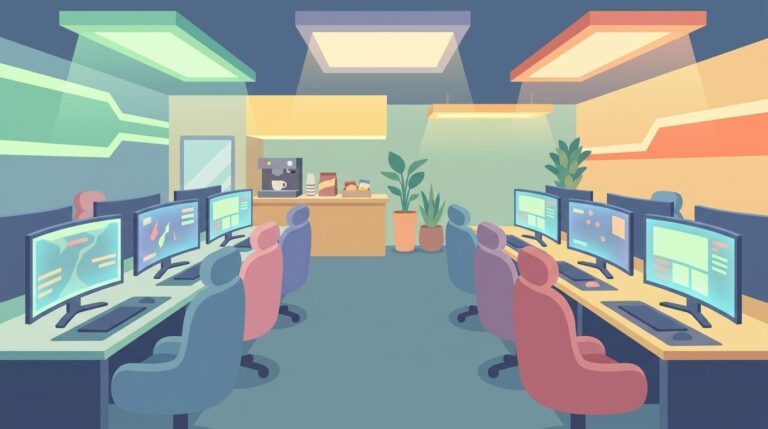
Phase 1: Empathy (Story-Driven Opening)
안녕하세요! 매일한글 에디터입니다. (Hello! I’m your Daily Hangul editor.)
Imagine this: You have finally arrived in Seoul. After a long flight, dropping off your luggage, and grabbing street tteokbokki, there is one bucket-list experience calling your gamer soul: visiting a legendary Korean PC bang (PC방). You step down into a futuristic gaming lounge in Hongdae. Neon LED lights pulse across endless rows of curved monitors, the air smells delightfully of fried dumplings and Shin Ramyeon, and mechanical keyboards click in an intense, symphonic rhythm. You are ready to dive into a high-spec match of your favorite battle royale or RPG game on buttery-smooth ultra settings.
Then, reality hits. The automated kiosk at the entrance flashes endless Korean text with specs like “RTX 4080 석” or “프리미엄 FPS 전용석.” You look around, feeling frozen. Where are the high-spec machines? How do you ask the desk attendant if the PC will run the newest graphic-heavy titles without stuttering?
Don’t worry—you are not alone. In fact, over 80% of our intermediate B1 learners tell us that walking into a PC bang for the first time felt more intimidating than ordering at a traditional market. This guide is built directly from real student experiences and local gamer tips. By the end of this guide, you will be able to navigate seat specs, claim the best rig in the house, and order a feast directly to your desk in natural, natural Korean.
Phase 2: Core 3 Expressions Deep Dive
Here are the top three expressions you need to lock down high-spec gaming glory:
1. 여기 사양 어떻게 돼요? (Yeogi sayang eotteoke dwaeyo?)
- Pronunciation: Yeo-gi sa-yang eo-tteo-ke dwae-yo? (Think of “sayang” sounding like sa-yahng, rhythmic like a casual question)
- Meaning: “What are the specs here?” (사양 = hardware specifications; 어떻게 돼요 = how are they / what are they?)
- K-Culture Moment: Seen frequently in K-Vlogs or youth dramas when friends scout out the best gaming spot near university campuses before a major competitive raid.
- Editor’s Insight: In Korean gaming spaces, asking about “사양” (specifications) immediately signals that you are someone who cares about hardware performance (GPU, CPU, refresh rates). It’s far more natural than asking about computer brands.
- Situation Spectrum:
- Casual: ✅ (with friends: 여기 사양 어떻게 돼?)
- Semi-formal: ✅ (to staff: 여기 사양 어떻게 돼요?)
- Formal: ⚠️ (a bit too conversational for corporate tech presentations)
- 🤔 Think About It: Notice how Korean uses “어떻게 돼요?” (literally: “How does it become?”) rather than “What is it?” (무엇입니까?). How does asking “how it is” feel softer compared to directly asking “what”?
2. 렉 안 걸리는 자리 어디예요? (Rek an geollineun jari eodiyeyo?)
- Pronunciation: Rek an geol-li-neun ja-ri eo-di-ye-yo? (“Rek” sounds just like the English gaming term “lag”)
- Meaning: “Which seat has zero lag?” or “Where can I sit for smooth performance?”
- K-Culture Moment: In comedy web dramas when a character takes esports rank matches way too seriously and needs the absolute fastest connection in the room.
- Editor’s Insight: The word “렉” (lag) combines with the verb “걸리다” (to catch/stuck). So “렉 걸리다” means “experiencing lag”. Adding “안” negates it: “seat that does not catch lag.”
- Situation Spectrum:
- Casual: ✅ (렉 안 걸리는 자리 어디야?)
- Semi-formal: ✅ (to part-time staff)
- Formal: 🚫 (slangy usage of 렉 is inappropriate in business contexts)
- 🤔 Think About It: Gamers across the world invent hybrid terms. Notice how Korean took the English noun “lag” and turned it into an active condition with “걸리다”!
3. 시간 충전 어디서 해요? (Sigan chungjeon eodiseo haeyo?)
- Pronunciation: Si-gan chung-jeon eo-di-seo hae-yo? (“Chung-jeon” sounds like choong-jeon, similar to charging a battery)
- Meaning: “Where do I add time?” (Literally: “Where do I recharge time?”)
- K-Culture Moment: The classic moment an overseas character visits a Korean gaming hub and tries to hand cash directly to the cashier instead of using the unmanned kiosk.
- Editor’s Insight: Korean PC bangs sell computer access in blocks of hours via prepaid systems. The word “충전” is universally used for charging phone batteries, transit cards (T-money), and PC bang gaming hours.
- Situation Spectrum:
- Casual: ✅ (시간 충전 어디서 해?)
- Semi-formal: ✅ (Essential for talking to kiosk staff)
- Formal: ⚠️
- 🤔 Think About It: Why do you think Korean uses “recharge” (충전) for abstract time rather than just “buy” (사다)? It reflects a cultural mindset of keeping reserves full!
Phase 3: Textbook Korean vs Real Korean
Let’s see how textbook Korean compares to the punchy, practical language spoken on the gaming floor.
Situation 1: Asking if high-end games run smoothly
- 📖 Textbook Korean: 이 컴퓨터로 고사양 게임을 원활하게 플레이할 수 있습니까? (I keompyuteoro gosayang geimeul wonhwalhage peulleihal su itsseumnikka? – “Can one smoothly play high-spec games with this computer?”)
- 🗣️ Real Korean: 여기 배그 잘 돌아가요? (Yeogi Baegeu jal doragayo? – “Does PUBG run well here?”)
- 💡 Why is it different? Real locals don’t say “wonhwalhage play-hada”. They name a famously heavy game (like PUBG / Baegeu, or Cyberpunk) and ask if it “돌아가다” (literally: spins/runs smoothly).
Situation 2: Asking if you can order food right at your station
- 📖 Textbook Korean: 음식을 주문하려면 카운터로 가야 합니까? (Eumsigeul jumunharyeomyeon kaunteoro gaya hamnikka? – “Must I go to the counter in order to order food?”)
- 🗣️ Real Korean: 자리에서 바로 시키면 돼요? (Jarieseo baro sikimyeon dwaeyo? – “Can I just order right from my seat?”)
- 💡 Why is it different? In modern PC bangs, you never walk to the counter to order food. Everything is done on the desktop screen. “자리에서 시키다” (order from seat) is the natural phrasing.
Phase 4: K-Culture Deep Dive & Non-verbal Manners
4-1. 눈치 (Nunchi) & Gaming Etiquette
- The Headset Rule: Unlike LAN cafes in some countries, sound is rarely played through open external speakers. Put your headset on immediately before booting your game. If you speak on Discord, maintain a moderate volume—shouting angry gaming slurs will trigger intense nunchi (judgmental side-eyes) from neighboring players.
- Chair Push-In Manners: When grabbing food or leaving, always tuck your large reclining gaming chair back under the desk. PC bang aisles can be narrow, and leaving chairs pulled out blocks staff delivering hot trays of ramyeon.
4-2. Cultural Code: The Rise of the “PC-ttorang” (PC Restaurant)
In Korea, PC bangs have evolved far beyond gaming centers—they are premier gourmet hangouts called PC-ttorang (PC방 + 레스토랑). High-spec gaming is paired with restaurant-grade meals. Popular staples include Jjapaguri topped with fried eggs, Sotteok-sotteok (sausage and rice cake skewers), and the iconic drink Ashotchu (iced tea with an added shot of espresso). High-spec games take huge amounts of energy, and food arrives directly at your station within five minutes of clicking “Order” on your screen!
Phase 5: Real-Life Roleplay Scenario
Setting: CyberPulse PC Lounge, a high-end esports arena in Sinchon.
Character: Min-woo (민우), a 23-year-old part-time attendant wearing gaming team merchandise.
- Turn 1 (Learner): 저기요, 여기 고사양 게임 존이 따로 있나요?
(Jeogiyo, yeogi gosayang geim joni ttaro innayo?)
“Excuse me, is there a separate high-spec gaming zone here?”
🎭 Looking around at the floor map near the counter -
Turn 2 (Min-woo): 네! 안쪽 40번부터 60번 자리가 전 좌석 4080 그래픽카드 존이에요.
(Ne! Anjjok sasip-beonbuteo yuksip-beon jariga jeon jwaseok sasing-palsip geuraepik-kadeu jon-ieyo.)
“Yes! Seats 40 through 60 in the back are all RTX 4080 graphic card seats.”
🎭 Pointing toward the blue neon aisle -
Turn 3 (Learner): 아, 다행이네요! 거기 렉 안 걸리고 잘 돌아가죠?
(A, dahaeng-ineyo! Geogi rek an geol-ligo jal doragajyo?)
“Ah, what a relief! It runs smoothly without lag over there, right?”
🎭 Smiling with a relieved expression -
Turn 4 (Min-woo): 그럼요. 모니터도 240Hz라 배그나 발로란트 하실 거면 딱 좋아요.
(Geureomyo. Moniteodo ibaek-sasip herteu-ra Baegeuna Balloranteu hasil geomyeon ttak joayo.)
“Of course. The monitors are 240Hz too, so if you play PUBG or Valorant, it’s perfect.”
🎭 Giving a reassuring thumbs-up -
Turn 5 (Learner): 결제는 입구 기계에서 충전하면 되나요?
(Gyeoljeneun ipgu gigye-eseo chungjeonhamyeon doenayo?)
“Do I recharge payment at the entrance machine?”
🎭 Reaching into pocket for a payment card -
Turn 6 (Min-woo): 네, 키오스크에서 ‘비회원 충전’ 누르시고 시간 선택하시면 영수증 나와요.
(Ne, kioseukeu-eseo bi-hoewon chungjeon nureusigo sigan seontaekhasimyeon yeongsujeung nawayo.)
“Yes, tap ‘Non-member recharge’ on the kiosk, choose your hours, and a receipt will print out.”
🎭 Demonstrating tapping on an imaginary screen -
Turn 7 (Learner): 혹시 게임하면서 자리에서 라면도 시킬 수 있어요?
(Hoksi geimhamyeonseo jarieseo ramyeondo sikil su isseoyo?)
“By any chance, can I also order ramyeon from my seat while gaming?”
🎭 Chuckling with anticipation -
Turn 8 (Min-woo): 당연하죠! 바탕화면 상단 ‘먹거리 주문’ 버튼 누르시면 갖다 드립니다.
(Dang-yeonhajyo! Batang-hwamyeon sangdan meokgeori jumun beoteun nureusimyeon gatda deurimnida.)
“Of course! Just click the ‘Food Order’ button at the top of your desktop and we’ll bring it to you.”
🎭 Handing over a printed quick-start guide
🔀 Interactive Choice Point
You sit down at computer #45, but the system prompts you in Korean for an ID and PIN that you don’t have yet. How do you ask Min-woo for help?
- Option A: “저기요, 비회원 영수증 번호 어디에 입력해요?” (Excuse me, where do I enter the non-member receipt number?)
- Option B: “야! 컴퓨터 안 켜져!” (Hey! The computer won’t turn on!)
- Option C: “아이디 없는데 그냥 켜주시면 안 돼요?” (I don’t have an ID, can’t you just turn it on for me?)
Feedback:
- Option A (BEST): Spot on! Highly polite, clear, and demonstrates you understand the non-member receipt system. Min-woo will immediately show you the card login box.
- Option B (BAD): Avoid at all costs! “야” is rude impolite talk (반말) reserved only for close childhood friends. Attendants will feel disrespected.
- Option C (RISK): Risky! The PC bang management software requires automated prepaid tracking. The attendant cannot override it manually without system authorization.
Phase 6: 10-Second Emotion Shadowing Drill
Practice these lines with rhythm, pause markers (/), and genuine gamer emotion!
[🔥 승부욕 가득 차서 - Fiercely competitive]
여기 사양 제일 좋은 자리가 / 어디예요?
(Yeogi sayang jeil joeun jariga / eodiyeyo?)
“Where is the seat / with the absolute best specs here?”-
[🥺 조심스럽고 친근하게 - Polite and gentle inquiry]
저기요, / 외국인 카드 결제도 / 되나요?
(Jeogiyo, / oegugin kadeu gyeoljedo / doenayo?)
“Excuse me, / does international card payment / work here?” -
[😋 배고프고 신나게 - Excited and hungry]
게임 시작하기 전에 / 라면부터 시키자!
(Geim sijakhagi jeone / ramyeonbuteo sikija!)
“Before we start the game, / let’s order ramyeon first!”
Phase 7: K-Culture Mini Dictionary
- 사양 (Sayang) | Hardware Specifications
Used when discussing PC or phone specs. In daily life, you will hear people say “고사양” (high spec) or “저사양” (low spec). - 피캉스 (Pikangse) | PC Bang + Vacance (Vacation)
A trendy lifestyle term describing spending a hot summer or rainy weekend staying cool inside an air-conditioned PC bang eating good food and binge-gaming. - 렉 (Rek) | Lag / Frame Drops
Originating from the English word “lag”. Commonly paired with verbs: “렉 걸려요” (It’s lagging) or “렉 풀렸어요” (The lag cleared up). - 비회원 (Bi-hoewon) | Non-Member / Guest
Crucial for travelers! If you don’t have a Korean resident registration number (주민등록번호) or local mobile phone verification, you will always select the “비회원” option at kiosks.
Phase 8: Survival Kit for Travelers
Top 3 Survival Phrases
- 비회원으로 할게요. (Bi-hoewoneuro halgeyo.)
“I will play as a non-member.”
💡 Pro Tip: Saves you 10 minutes of trying to sign up on a screen that requires Korean ID identity verification. - 헤드셋 소리가 안 나와요. (Hedeuset soriga an nawayo.)
“No sound is coming from the headset.”
💡 Pro Tip: Often the sound output toggle in Windows is set to monitor speakers. Staff can fix this in two seconds. - 남은 시간 환불돼요? (Nameun sigan hwanbuldwaeyo?)
“Can remaining time be refunded?”
💡 Pro Tip: Most Korean PC bangs do not refund unused non-member prepaid hours, but asking politely confirms policy.
Editor’s Travel Note
- App Navigation: Before hunting down a gaming session, search for “PC방” directly using the 네이버 지도 앱 다운로드 instead of international map apps, as local maps list hardware specs and real customer photos.
- Kiosk Payment Tips: Many automated kiosks only take Korean payment services or local cards. Look for kiosks with IC chip slots labeled “신용카드” (credit card) that accept Visa/Mastercard. If your international card is rejected, carry 10,000 KRW cash notes to pay at cash-ready kiosks.
Phase 9: “One Step Deeper” (Reflective Essay)
In many Western cultures, gaming has historically been viewed as an isolating home hobby carried out in private bedrooms. In South Korea, however, the PC bang established video games as a shared civic ritual. It represents Korea’s unique “방” (Bang / Room) culture—a communal third space between home and school or work, alongside noraebangs (singing rooms) and jjimjilbangs (bathhouses). When Korean gamers sit shoulder-to-shoulder, ordering identical bowls of spicy noodles and coordinating battle calls, gaming ceases to be solitary—it becomes a celebration of collective energy and shared space.
💬 Your Turn: Have you ever experienced a gaming cafe in your own home country? How does the social atmosphere compare to Korea’s community-driven “Bang” culture? Share your stories below!
Phase 10: FAQ & Avoiding Misunderstandings
Q: Can foreigners play at Korean PC bangs without a Korean phone number?
A: Yes! Always select “비회원” (Non-member) on the automated kiosk. You simply select the amount of time you want (e.g., 2 hours), pay with cash or an international card, and the kiosk will print a slip with a login number.
Q: Are high-spec seats more expensive than regular seats in Korean PC bangs?
A: In most PC bangs, the hourly rate is completely flat across all standard seats (usually 1,500 to 2,500 KRW per hour). However, specialized VIP zones with curved OLED panels or top-tier GPUs might require an extra 500 KRW per hour or have a dedicated booking option at the kiosk.
Q: Is there an age restriction at night in Korean PC bangs?
A: Yes. Under Korean youth protection laws, teenagers under 19 years old must leave the PC bang by 10:00 PM. Attendants will check physical ID cards (such as your passport) around 9:50 PM. Always keep your passport or alien registration card handy!
🚨 Common Mistakes (경고판)
- Mistake: Trying to create an online account on the PC bang website without a local Korean phone verification.
Correct Action: Use the kiosk’s “비회원” (Non-Member) option to generate a temporary login ticket. - Mistake: Leaving the station to pay cash for food at the main counter.
Correct Action: Order food directly through the desktop menu and choose “현장 결제” (pay on delivery) or card payment right at your seat. - Mistake: Speaking at full volume on Discord or open voice chat late at night.
Correct Action: Keep your voice low and monitor your surroundings using nunchi.
Phase 11: Action Missions & Community Engagement
- 🥉 Bronze Level (Solo Practice): Stand in front of your mirror and practice saying: “여기 사양 어떻게 돼요?” 5 times smoothly without pausing.
- 🥈 Silver Level (Social Share): Snap a screenshot of your favorite high-spec PC game and post on Instagram or X with the caption: “이번 주말엔 피캉스 가자!” (Let’s go for a PC vacation this weekend!).
- 🥇 Gold Level (Real-World Mission): Walk into a local Korean PC bang, use the kiosk to purchase 2 hours as a non-member (비회원), sit down, and successfully order a snack from the computer menu in Korean.
🎮 K-Culture Mission: Watch Episode 10 of the classic drama Crash Landing on You (사랑의 불시착), where the character Captain Ri Jeong-hyeok discovers the wondrous world of Korean online gaming in a Seoul PC bang! Pay attention to how gamers are seated and how food is delivered.
Phase 12: Interactive Quiz Challenge
Test your knowledge before you hit the gaming floor!
1. Situational Judgment:
You walk into a PC bang with games running slow on an old monitor, but you want to play a high-fps shooter. What should you ask the attendant?
* A) “여기 왜 이렇게 어두워요?”
* B) “고사양 모니터 있는 자리가 어디예요?”
* C) “컴퓨터 다 꺼주세요.”
2. Fill in the Blank:
“시간 ________ 어디서 해요?” (Where do I recharge time?)
* A) 쇼핑 (Shopping)
* B) 환승 (Transfer)
* C) 충전 (Chungjeon)
3. True or False:
In modern Korean PC lounges, you must walk up to the kitchen counter to order and collect your ramyeon. (True / False)
👉 Click here to check the answers and explanations!
- Answer: B (고사양 모니터 있는 자리가 어디예요? – Asking for the high-spec monitor section helps you get optimal refresh rates!).
- Answer: C (충전 – “Chungjeon” is the precise term used for charging time on prepaid gaming accounts).
- Answer: False (PC bangs deliver food right to your desk! You order directly through the desktop software).







