

Stop Pointing Awkwardly: How to Say Up and Down in Korean Like a Local
Phase 1: Empathy (Welcome to Daily Hangul!)
안녕하세요! I’m your Daily Hangul editor and your 10-year local culture navigator.
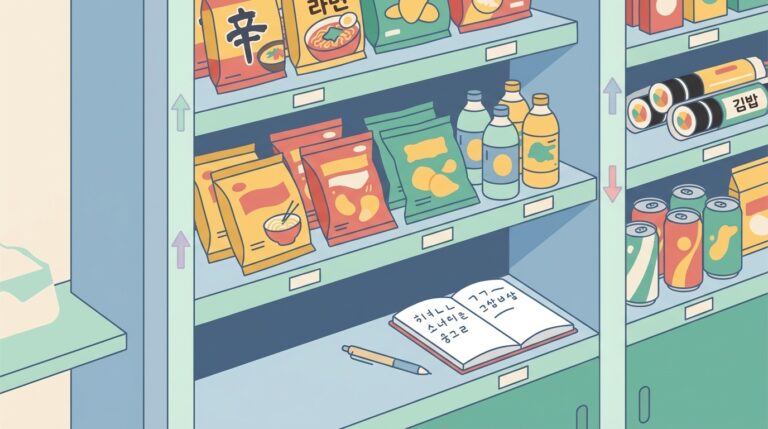
Picture this: You are standing inside a bustling, multi-story Olive Young in Myeongdong or hunting for viral ramen in a jam-packed GS25 convenience store. You finally build up the courage to ask the staff where your item is. The clerk smiles, gestures with a swift hand motion, and says something ending in “…wie isseoyo!” or “…araee isseoyo!” Suddenly, your brain short-circuits. Did they say up? Down? The top shelf? Downstairs? In that moment of panic, we’ve all done that desperate “hand-airplane” mime dance while smiling nervously.
Learning spatial directions—especially the fundamental concepts of ‘above’ and ‘below’—is one of the most immediate game-changers for any beginner learning Korean. Based on feedback from hundreds of our A1 learners, mastering just these two foundational concepts wipes out 90% of travel anxiety inside Korea’s maze-like subway stations, multi-floor department stores, and tiered cafes. Let’s make sure you never feel lost again!
Phase 2: Core 3 Expressions Deep Dive
1. 위 (Wi)
- Pronunciation: Wi (Sounds like the English word “we”, pronounced short and crisp!)
- Meaning: Literal: Top / Above / Up | Nuance: On a surface, on an upper shelf, or physical upper level.
- K-Culture Moment: In a K-drama thriller or variety show scavenger hunt, when someone spots the hidden clue: “저기 책장 위에 있어요!” (Jeogi chaekjang wie isseoyo! / It’s right on top of the bookshelf!)
- Editor’s Insight: ‘위’ (wi) is a quick monosyllable. When you attach the location particle ‘-에’ (-e), it becomes ‘위에’ (wie), meaning “on” or “above”.
- Situation Spectrum: Casual: ✅ | Semi-formal: ✅ | Formal: ✅
- 🤔 Think About It: In English, we distinguish between “on” (touching) and “above” (floating). Korean often groups these simply under ‘위’—how does your native language handle objects touching a surface versus floating above it?
2. 아래 (Arae) / 밑 (Mit)
- Pronunciation: Arae (Sounds like “ah-reh”) / Mit (Rhymes with “meet”, but with an unreleased quick ‘t’).
- Meaning: Literal: Below / Under / Beneath | Nuance: ‘아래’ (arae) is softer and often used for relative directions or downstairs; ‘밑’ (mit) is punchy and refers to the base or right beneath an object.
- K-Culture Moment: An idol drops their photocard backstage and shouts: “소파 밑에 들어갔어요!” (Sopa mite deureogasseoyo! / It went right under the sofa!)
- Editor’s Insight: Beginners often freeze choosing between 아래 and 밑. For daily physical objects (like under a desk or lower rack), Koreans instinctively use ‘밑’ (mit). For directional layers and floors, ‘아래’ (arae) reigns supreme.
- Situation Spectrum: Casual: ✅ | Semi-formal: ✅ | Formal: ✅
- 🤔 Think About It: Why do you think conversational Korean prefers the single-syllable ‘밑’ when talking about fast, immediate objects in hand?
3. 위로 가세요 / 아래로 내려가세요 (Wiro gaseyo / Araero naeryeogaseyo)
- Pronunciation: Wiro gaseyo (“wee-ro gah-seh-yo”) / Araero naeryeogaseyo (“ah-reh-ro neh-ryeo-gah-seh-yo”)
- Meaning: Literal: Go toward the top / Please head down toward below | Nuance: Polite instructions for moving vertically (stairs, escalators, elevators).
- K-Culture Moment: Inside the bustling Gangnam Subway Station when a friendly station manager helps an overwhelmed commuter: “2번 출구는 위로 올라가세요!” (Ibeon chulguneun wiro ollagaseyo! / For Exit 2, please head up!)
- Editor’s Insight: The particle ‘-로’ (-ro) indicates direction (“toward”). Korean loves combining directional particles with movement verbs (olla-gada = go up, naeryeo-gada = go down).
- Situation Spectrum: Casual: ⚠️ (Use ‘위로 가’ without ‘-세요’ with close friends) | Semi-formal: ✅ | Formal: ✅
- 🤔 Think About It: Notice how Korean pairs both the direction marker (-로) and a specialized directional verb (올라가다/내려가다) together for precision!
Phase 3: Textbook Korean vs. Real Korean
Situation 1: Asking where a snack is on the shelf
- 📖 Textbook Korean: “과자는 위쪽 선반에 위치하고 있습니다.” (Gwajaneun wijjok seonbane wichi-hago itseumnida. / The snack is situated on the upper shelf.)
- 🗣️ Real Korean: “과자 맨 위에 있어요!” (Gwaja maen wie isseoyo! / The snacks are right at the very top!)
- 💡 Why is it different? Real locals drop formal administrative words like ‘위치하다’ (to be located) and use vibrant prefixes like ‘맨’ (maen = the very/topmost).
Situation 2: Asking where the bathroom is in a cafe
- 📖 Textbook Korean: “화장실은 아래층에 존재합니까?” (Hwajangsireun araecheunge jonjaehamnikka? / Does a restroom exist on the lower floor?)
- 🗣️ Real Korean: “화장실 밑에 있어요?” (Hwajangsil mite isseoyo? / Is the restroom downstairs?)
- 💡 Why is it different? Everyday Korean avoids stiff philosophical verbs like ‘존재하다’ (to exist). A simple ‘밑에 있어요?’ is quick, crisp, and 100% natural.
Phase 4: K-Culture Deep-Dive & Non-Verbal Manners
4-1. 눈치 (Nunchi) & Gestures
In Korea, non-verbal etiquette speaks louder than words. When pointing out “위” (up) or “아래” (down):
* Never point with a stiff index finger: Pointing directly at someone or their immediate space with one finger can appear confrontational or bossy.
* The Open-Palm Sweep: Native speakers hold their fingers lightly together with the palm turned slightly upward when indicating “위로” (upwards), or a gentle downward sweep of an open hand for “아래로” (downwards).
* The Attentive Nod: Pair your question with a small micro-bow (목례, mongnye) while tilting your head slightly to signal politeness and active listening.
4-2. Culture Code: The 3D Vertical World of Seoul
Seoul is famous for being a vertical city. Due to mountain topography and hyper-dense urban design, shopping centers, subway lines, and food alleys are layered on top of and beneath one another. In K-Dramas, characters constantly utter “옥상으로 올라와” (Oksangeuro ollawa – “Come up to the rooftop”) for dramatic conversations, or “지하에서 만나” (Jiha-eseo manna – “Meet me in the basement”). Understanding vertical spatial markers isn’t just vocabulary—it’s essential urban navigation.
Phase 5: Real-Life Roleplay Scenario
- Setting: A multi-story Olive Young beauty flagship store in Hongdae on a Saturday afternoon.
- Character: Minji (A helpful store employee in a black apron with a walkie-talkie).
- You: “저기요, 선크림 어디에 있어요?” (Jeogiyo, seonkeurim eodie isseoyo? / Excuse me, where is the sunscreen?)
🎭 Action: You make gentle eye contact with hands politely folded in front. - Minji: “아, 선크림이요? 저쪽 매대 위에 있어요!” (A, seonkeurim-iyo? Jeojjok maedae wie isseoyo! / Ah, sunscreen? It’s right on top of that display stand over there!)
🎭 Action: She smiles warmly and points with an open palm toward a high shelf. - You: “맨 위 칸에 있어요?” (Maen wi kane isseoyo? / On the very top shelf?)
🎭 Action: You glance upward with an inquiring expression. - Minji: “네, 맞아요! 인기 상품이라 맨 위에 뒀어요.” (Ne, majayo! Ingi sangpum-ira maen wie dwosseoyo. / Yes, exactly! It’s popular so we placed it right at the very top.)
🎭 Action: She nods eagerly while arranging a nearby basket. - You: “혹시 클렌징폼은 아래에 있나요?” (Hoksi keullenjingpomeun araee innayo? / By any chance, is the facial cleanser down below?)
🎭 Action: You tilt your hand downwards toward the floor. - Minji: “클렌징폼은 한 층 아래, 지하 1층에 있어요!” (Keullenjingpomeun han cheung arae, jiha il-cheunge isseoyo! / Cleansers are one floor below, on Basement Level 1!)
- You: “계단으로 아래로 내려가면 되나요?” (Gyedaneuro araero naeryeogamyeon doenayo? / Should I head down using the stairs?)
🎭 Action: You turn slightly toward the staircase with an understanding smile. - Minji: “네! 바로 내려가시면 보여요!” (Ne! Baro naeryeogasimyeon boyeoyo! / Yes! You will see it right as you walk down!)
🎭 Action: She bows lightly with both hands together.
🔀 Interactive Decision Point
You want to ask where the shopping baskets are located before you head to the stairs. What do you say?
- Choice A: “바구니는 밑에 있나요?” (Baguni-neun mite innayo?)
- Feedback: [Best!] Perfect, natural, and polite A1 Korean! The employee will point straight to the stack on the floor.
- Choice B: “바구니 위!” (Baguni wi!)
- Feedback: [Bad] Dropping honorifics sounds like a barking command. Minji will be startled by the bluntness.
- Choice C: “바구니가 하늘 위에 존재해요?” (Baguni-ga haneul wie jonjaehaeyo?)
- Feedback: [Risk] Hilariously poetic (“Does the basket exist above the sky?”). Minji might think you’re reciting K-drama lyrics!
Phase 6: 10-Second Emotion Shadowing Drill
Say these aloud! Pay attention to the pauses (/) and feel the emotion:
- [😊 Bright & Inquisitive]
“저기요, / 이거 위에 있어요? / 아래에 있어요?”
(Jeogiyo, / igeo wie isseoyo? / araee isseoyo?)
Excuse me, / is this on top? / or down below? -
[🏃 Urgent & Eager Subway Rider]
“지하철 타는 곳은 / 아래로 내려가요?”
(Jihacheol taneun goseun / araero naeryeogayo?)
To ride the subway, / do I head down below? -
[✨ Relieved & Triumphant]
“아! / 맨 위 선반에 / 있었네요!”
(A! / maen wi seonbane / isseonne-yo!)
Ah! / It was right here / on the very top shelf!
Phase 7: K-Culture Mini Dictionary
- 맨 위 (Maen wi) | The absolute topmost tier | Indispensable when shopping at convenience stores or asking convenience staff for upper items.
- 밑 (Mit) | Base / Underneath / Bottom | The most common spoken alternative to arae for items resting beneath tables, chairs, or beds.
- 옥상 (Oksang) | Rooftop | The iconic K-Drama rooftop setting where characters eat cup ramen or confess romantic feelings.
- 지하 (Jiha) | Basement / Underground | Found everywhere in Korean transit (e.g., 지하철 = subway, 지하 1층 = B1).
Phase 8: Traveler’s Survival Kit
TOP 3 Survival Phrases
- “위층이에요, 아래층이에요?” (Wicheung-ieyo, araecheung-ieyo?)
Translation: Is it upstairs or downstairs?
Pro Tip: In multi-floor cafes in Seongsu or Hongdae where restrooms are hidden, this sentence saves you endless guessing. - “아래로 가면 되나요?” (Araero gamyeon doenayo?)
Translation: Should I go downwards?
Pro Tip: Lifesaver inside confusing transfer stations like Express Bus Terminal or Seoul Station. - “위에 올려주세요.” (Wie ollyeojuseyo.)
Translation: Please put it on top.
Pro Tip: Use this when loading heavy luggage into taxis or asking a cafe barista to put a pastry on top of your carry box.
Editor’s Travel Note
Always install the Naver Map navigation app before landing in Korea. Google Maps has limited walking functionality in Korea, while Naver Map explicitly marks whether exits and shops are located at ‘B1’ (지하) or upper levels (‘2F’, ‘3F’). Also, when entering elevators in older Korean buildings, the number 4 is sometimes replaced by the letter F (due to historical superstition regarding the word sa), but basement levels are always marked with a clear B (jiha).
Phase 9: “One Step Deeper” (Cultural Reflection)
In Korean society, vertical concepts are not just about physical space—they deeply reflect interpersonal culture. The traditional Korean family and corporate structure distinctions categorize people into witsaram (윗사람, “upper people” / elders and seniors) and araetsaram (아랫사람, “lower people” / juniors). Yet, when navigating modern physical spaces, using humble and warm requests with staff breaks down social barriers immediately.
💬 Your Turn: Have you ever gotten completely turned around trying to find an exit or restroom in a Korean subway station? Drop your funniest navigational fail in the comments below!
Phase 10: FAQ & Misconception Prevention
Q: What is the real difference between ‘아래’ (arae) and ‘밑’ (mit)?
A: Think of ‘밑’ (mit) as being directly covered or directly underneath an object touching or shadowed by it (like chaeksang mit = under the desk). ‘아래’ (arae) is a broader spatial term denoting lower altitude, lower floors, or general downward direction.
Q: How do I say “upstairs” and “downstairs” simply?
A: Just attach the word for floor, 층 (cheung)! Upstairs is 위층 (wicheung) and downstairs is 아래층 (araecheung).
Q: Can I use ‘위’ to describe someone older or higher in status?
A: Not by itself! While senior people are called witsaram (윗사람), you should never call a person directly “위”. Always address them by their title (선생님, 매니저님, etc.).
🚨 Common Mistakes Alert
- Pronouncing 위 like “Wae” (왜): Slipping your vowels turns “Is it above?” (Wie isseoyo?) into “Why is it there?” (Wae isseoyo?). Keep your lips rounded and say a clean “Wee”!
- Dropping the location particle ‘-에’: Saying “선반 위 있어요” sounds incomplete. Always add the particle: “선반 위에 있어요” (seonban wie isseoyo).
- Aggressive single-finger pointing: Always soften your body language by using an open, upturned palm when giving or asking for directions.
Phase 11: Action Mission & Engagement
- 🥉 Bronze Mission (Solo): Look around your room right now. Spot 3 items and say out loud: “[Item]은 책상 위에 있어요!” (It’s on the desk) and “[Item]은 의자 밑에 있어요!” (It’s under the chair).
- 🥈 Silver Mission (Social): Take a photo of your study space or your K-pop album shelf, post it on your Instagram Story or Threads with the Korean caption: “책 위에 있어요!”, and tag your language journey.
- 🥇 Gold Mission (Real World): Visit an Asian grocery store or a Korean restaurant this week. Ask the staff: “이거 위층에 있어요?” or confirm an item’s shelf placement in Korean!
- 🎮 K-Culture Mission: Watch any variety show (like Running Man) or K-drama episode this week. Listen closely and spot at least one moment someone shouts “위!” or “밑에 봐!”.
Phase 12: Interactive Quiz Challenge
1. [Situational] You are in a multi-story bookstore in Gwanghwamun. You want to ask the staff if English books are upstairs. Which sentence is best?
* A) 영어 책은 위층에 있어요? (Yeongeo chaekeun wicheunge isseoyo?)
* B) 영어 책은 하늘에 있어요? (Yeongeo chaekeun haneure isseoyo?)
* C) 영어 책은 옥상에 가요? (Yeongeo chaekeun oksange gayo?)
2. [Fill-in-the-Blank] Fill in the missing location particle to say “It is under the table.”:
“테이블 [ ______ ]에 있어요.” (밑 / 위)
3. [True or False] When pointing toward an upper floor to an elder in Korea, it is polite to point directly with your index finger.
* (True / False)
👉 Click here to reveal the answers and explanations!
- Answer: A (위층 means upstairs! Choice B asks if books are in the sky, and Choice C asks if books go to the rooftop!)
- Answer: 밑 (“테이블 밑에 있어요.” means “It is under the table.”)
- Answer: False! (Never point with a single index finger at elders; always use a gentle, open palm gesture with fingers together.)






