

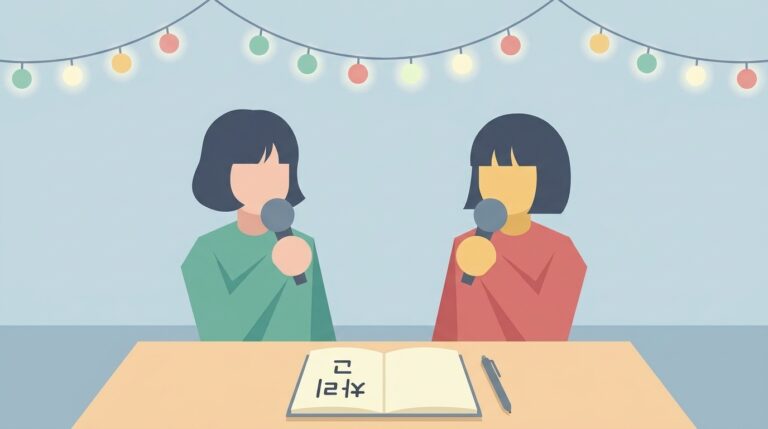
Singing Ballads at Korean Karaoke: The Ultimate Beginner Guide
Phase 1: 공감 (The Emotional Ballad Dilemma)
안녕하세요! 매일한글 에디터입니다.
Picture this: You are having an absolute blast with your Korean friends in a neon-drenched Hongdae noraebang (노래방 – karaoke room). You just finished jumping around to a high-octane BTS track, your throat is dry, and the disco ball is spinning wildly. Suddenly, the disco lights dim. The frantic EDM beat stops. A melancholic piano intro begins to trickle through the speakers.
Your Korean friend grabs the microphone with both hands, closes their eyes, and takes a deep, solemn breath. Welcome to the sacred Korean ballad hour!
In Korea, singing ballads isn’t just about showing off your vocal range; it is a cultural ritual of emotional release. But for foreign learners, this moment often brings a wave of panic: Wait, is it rude to talk right now? What if I want to sing a slow K-drama OST, but the song is way too high? How do I ask for permission without killing the mood?
Don’t worry! Based on real classroom feedback from our A2 learners and over a decade of navigating Seoul’s lively karaoke nightlife, I have created this ultimate survival guide. By the end of this article, you will know the exact phrases, machine hacks, and social manners (nunchi) needed to sing your favorite ballad like a true local!
Phase 2: 핵심 표현 3선 심층 분석 (Top 3 Core Expressions)
Let’s break down the three most natural, indispensable expressions you need when the room shifts into ballad mode.
1. 이 노래 불러도 돼요? (I norae bulleodo dwaeyo?)
- Pronunciation: I norae bulleodo dwaeyo? (Sounds like: “Ee no-rae bool-leo-doh dway-yo?”)
- Meaning:
- Literal: Is it okay if I sing this song?
- Actual Nuance: “Mind if I slow down the energetic vibe with this ballad?”
- K-Culture Moment: You often see this in dramas like Hospital Playlist or reality shows like I Live Alone, where a character timidly asks friends before queuing an emotional 5-minute track in the middle of an upbeat party.
- Editor’s Insight: This uses the foundational A2 grammar pattern -어도 돼요 (permission). Ballads completely change the atmosphere of a room. Asking this single question shows immense social consideration (baeryeo – 배려).
- Situation Spectrum: Casual: ✅ (이거 불러도 돼?) | Semi-formal: ✅ (이 노래 불러도 돼요?) | Formal: ⚠️ (이 노래를 불러도 되겠습니까?)
- 🤔 Think About It: In many Western karaoke bars, songs run on a strict queue where anyone can sing whatever they want. Why do Koreans prioritize collective room mood over individual song turns?
2. 키 좀 낮춰 줘! (Ki jom natchwo jwo!)
- Pronunciation: Ki jom natchwo jwo! (Sounds like: “Kee jom naht-chwo jwo!”)
- Meaning:
- Literal: Please lower the key a bit!
- Actual Nuance: “Help! This song is way too high for my vocal cords; hit the remote control!”
- K-Culture Moment: Anyone trying to sing legendary Korean power ballads by Park Hyo-shin, Ailee, or Kim Bum-soo immediately discovers the notes are superhuman. You yell this across the room to the friend holding the remote.
- Editor’s Insight: The word 키 (ki) comes from the English musical “key.” The verb 낮추다 (natchuda) means “to lower.” In semi-formal situations with coworkers, simply add -요 to say 키 좀 낮춰 주세요 (Ki jom natchwo juseyo).
- Situation Spectrum: Casual: ✅ | Semi-formal: ✅ (키 좀 낮춰 주세요) | Formal: 🚫
- 🤔 Think About It: Why is it socially acceptable—and even encouraged—to ask friends to manipulate the machine for you during your performance in Korea?
3. 같이 부르자! (Gachi bureuja!)
- Pronunciation: Gachi bureuja! (Sounds like: “Gah-chee boo-reu-jah!”)
- Meaning:
- Literal: Let’s sing together!
- Actual Nuance: “Join in on the chorus so I don’t faint on this high note alone!”
- K-Culture Moment: That magical peak in a K-drama friendship where two friends clutch one microphone together and belt out the chorus of an iconic 2000s ballad while locking teary eyes.
- Editor’s Insight: The ending -자 (-ja) is the casual “let’s” form (A2). Inviting someone to sing along turns an awkward solo performance into a warm, shared memory.
- Situation Spectrum: Casual: ✅ | Semi-formal: ⚠️ (같이 불러요) | Formal: 🚫
- 🤔 Think About It: How does shared singing break down social distance in hierarchical societies?
Phase 3: 교과서 한국어 vs 진짜 한국어 (Textbook vs. Real Korean)
Standard textbooks teach grammatically spotless sentences that often sound like a legal contract inside a karaoke room! Here is how to speak like a native.
Situation 1: Asking to adjust the song’s pitch
- 📖 교과서 한국어 (Textbook):
- 음정을 낮추어 주십시오. (Eumjeong-eul natchueo jusipsio. – “Please adjust the musical pitch downward.”)
- 🗣️ 진짜 한국어 (Real-Life):
- 키 한 번만 낮춰 줘! (Ki han beonman natchwo jwo! – “Drop the key down just one notch!”)
- 💡 왜 다를까? (Why is it different?):
- “음정 (pitch)” sounds like you are at an opera conservatory audition. In modern Korean karaoke culture, everyone adopts the loanword 키 (key) and pairs it with the soft request buffer 한 번만 (just once).
Situation 2: Asking your friend to sing the chorus with you
- 📖 교과서 한국어 (Textbook):
- 함께 합창합시다. (Hamkke hapchanghapsida. – “Let us perform in a chorus together.”)
- 🗣️ 진짜 한국어 (Real-Life):
- 후렴구 같이 부르자! (Huryeom-gu gachi bureuja! – “Let’s sing the chorus together!”)
- 💡 왜 다를까? (Why is it different?):
- “합창” evokes a classical church choir or graduation ceremony. Real Koreans say 후렴구 (refrain/chorus) or simply 싸비 (ssabi – popular slang for chorus).
Phase 4: K-Culture 딥다이브 & 비언어적 매너 (Culture Deep-Dive & Non-Verbal Manners)
4-1. 눈치 (Nunchi) & Gestures: The Ballad Protocol
When someone starts singing a ballad, the social rules of the noraebang flip instantly:
1. Put Down the Tambourine: Shaking a noisy tambourine during an emotional ballad ruins the singer’s focus (mol-ip – 몰입). Put the tambourine on the table immediately!
2. The Two-Hand Grip & The Ceiling Gaze: Watch any Korean singer. During a ballad, they hold the mic with both hands, close their eyes, and tilt their head slightly toward the ceiling. Mirroring this posture helps you tap into the emotional resonance of the music.
3. Silent Head Nods: Even if you don’t know the lyrics, nod gently in rhythm to show the singer that their emotion is reaching your heart.
4-2. Cultural Code Analysis: The Ballad as Emotional Catharsis
Why are Koreans so obsessed with sad ballads? Historically and socially, Korean culture embraces Han (한)—a collective feeling of sorrow, longing, and unfulfilled yearning. In modern, high-pressure city life, young Koreans use the karaoke booth as an emotional decompression chamber. Belting out a tearful ballad about heartbreak or missed chances isn’t seen as depressing; it is celebrated as an honest, healthy purge of emotional stress.
Phase 5: 실전 롤플레이 시나리오 (Interactive Roleplay Scenario)
Setting: You and your Korean classmate, Minji (민지), are inside a cozy coin noraebang (코인노래방) in Sinchon. Neon lights reflect off the glass table, and the air smells lightly of microphone sanitizer.
- Turn 1 (Minji):
- 민지: 알렉스, 이제 발라드 타임이야! 뭐 부를래?
- Alex, ije balladeu taim-iya! Mwo bulleullae?
- “Alex, it’s ballad time now! What do you want to sing?”
🎭 [리모컨을 건네며 환하게 웃는다 / Hands over the remote control with a bright smile]
- Turn 2 (You):
- 나: 나 드라마 OST 부르고 싶어. 이 노래 불러도 돼?
- Na drama OST bureugo sipeo. I norae bulleodo dwae?
- “I want to sing a drama OST. Is it okay if I sing this song?”
🎭 [화면에 뜬 슬픈 발라드 제목을 가리키며 / Pointing at the melancholic song title on the screen]
- Turn 3 (Minji):
- 민지: 당연하지! 박효신 노래잖아? 너 고음 괜찮겠어?
- Dang-yeonhaji! Park Hyo-shin noraejana? Neo go-eum gwaenchankesseo?
- “Of course! Isn’t this Park Hyo-shin? Can you handle the high notes?”
🎭 [탬버린을 조용히 테이블에 내려놓으며 / Quietly placing the tambourine down onto the table]
- Turn 4 (You):
- 나: 솔직히 조금 무서워. 키 한 번만 낮춰 줘!
- Soljiki jogeum museowo. Ki han beonman natchwo jwo!
- “Honestly, I’m a bit scared. Drop the key down just once for me!”
🎭 [두 손을 모아 부탁하는 제스처를 취한다 / Putting hands together in a pleading gesture]
- Turn 5 (Minji):
- 민지: 알겠어, 키 내렸다! 시작한다, 감정 잡고 불러봐!
- Algesseo, ki naeryeotda! Sijakhanda, gamjeong japgo bulleobwa!
- “Got it, key lowered! It’s starting, get into character and sing!”
🎭 [리모컨 버튼을 능숙하게 삑삑 누르며 / Skillfully pressing remote buttons with a beep]
- Turn 6 (You):
- 나: [노래 중] 나 혼자 부르기 너무 힘들어. 후렴구 같이 부르자!
- [Norae jung] Na honja bureugi neomu himdeureo. Huryeom-gu gachi bureuja!
- “[Singing] It’s too hard to sing alone. Let’s sing the chorus together!”
🎭 [마이크를 민지 쪽으로 쑥 내밀며 / Thrusting the second mic toward Minji]
- Turn 7 (Minji):
- 민지: 좋아, 마이크 이리 줘! 같이 지르자!
- Joa, maikeu iri jwo! Gachi jireuja!
- “Awesome, give me the mic! Let’s belt it out together!”
🎭 [가슴에 한 손을 얹고 열창 모드로 돌입하며 / Placing a hand over her heart, going into full-power vocal mode]
- Turn 8 (You):
- 나: 와, 너 목소리 진짜 좋다! 속이 다 시원하다!
- Wa, neo moksori jinjja jota! Sogi da siwonhada!
- “Wow, your voice is incredible! I feel so emotionally refreshed!”
🎭 [생수를 한 모금 마시며 활짝 웃는다 / Taking a sip of water with a satisfied grin]
🔀 인터랙티브 분기점 (Interactive Branching)
What do you do when the bridge of the song hits and you run completely out of breath?
* Option A: Keep struggling alone at maximum volume, cracking your voice on every high note.
* Feedback (Bad): While funny, your vocal cords will hurt for three days, and the room’s energy might drop into awkward sympathy.
* Option B: Immediately press the red “Cancel” (취소) button without warning Minji.
* Feedback (Risk): Never cancel abruptly without saying anything! It interrupts the rhythm of the session.
* Option C: Say “1절만 부를게!” (Iljeol-man bureulge! – I’ll just sing verse one!) and pass the mic for the next song.
* Feedback (Best): Perfect etiquette! It saves your vocal cords, avoids dragging out a slow song, and lets the next person get their turn quickly.
Phase 6: 10초 감정 섀도잉 드릴 (10-Second Emotion Shadowing Drill)
Practice these lines out loud! Pay attention to the pauses marked with / and mimic the emotion tags.
[🥺 조금 수줍고 조심스럽게 / Hesitant and polite]- 저… / 이 노래 / 불러도 돼요? /
- (Jeo… / i norae / bulleodo dwaeyo?)
- “Um… is it okay if I sing this song?”
[😱 당황하며 다급하게 / Panicked and urgent]- 잠깐만! / 키 두 번만 / 낮춰 줘! /
- (Jamkkanman! / ki du beonman / natchwo jwo!)
- “Wait a second! Lower the key twice, please!”
[🤝 열정적이고 비장하게 / Passionate and determined]- 후렴구는 / 꼭 / 같이 부르자! /
- (Huryeom-guneun / kkok / gachi bureuja!)
- “We definitely have to sing the chorus together!”
Phase 7: K-Culture 미니 사전 (Karaoke Mini Dictionary)
| No | 단어명 (Term) | 번역 (Translation) | 일상/실전 쓰임새 (Real-Life Context) |
|---|---|---|---|
| 1 | 코노 (Kono) | Coin Noraebang | Short for 코인노래방. Small, automated booths where you pay per song (typically 500–1,000 KRW for 2–3 songs). Ideal for solo ballad practice. |
| 2 | 떼창 (Ttechang) | Group Sing-Along | When everyone in the room (or stadium) belts out the chorus together in unison. |
| 3 | 1절 치기 (Iljeol-chigi) | Singing Only Verse 1 | A polite strategy where singers stop the song after the first chorus so friends don’t get bored waiting during long ballads. |
| 4 | 완곡 (Wangok) | Singing the Entire Song | Performing a track from the very first intro note to the final fading outro without cutting it short. |
Phase 8: 여행자를 위한 생존 키트 (Survival Kit for Travelers)
Top 3 Survival Phrases
- 취소 버튼 어디 있어요? (Chwiso beoteun eodi isseoyo?)
- Meaning: Where is the cancel button?
- Pro Tip: Look for the large bright red button labeled 취소 at the bottom center of the remote!
- 마이크 볼륨 좀 올려 주세요. (Maikeu bollyum jom ollyeo juseyo.)
- Meaning: Please turn up the microphone volume.
- Pro Tip: Ballads require breath control. If the music drowns you out, ask your buddy to boost the mic.
- 서비스 시간 더 들어왔어요! (Seobiseu sigan deo deureowasseoyo!)
- Meaning: They gave us bonus service minutes!
- Pro Tip: Traditional hourly noraebangs often grant 20–30 free bonus minutes if the room isn’t fully booked.
Editor’s Travel Note
- App Recommendation: If navigating physical Korean remotes feels daunting, download the official TJ 노래방 리모콘 앱 다운로드 beforehand. It pairs with modern TJ karaoke machines over Wi-Fi, allowing you to search song titles in English alphabet and favorite tracks directly from your smartphone screen.
- Payment Tip: Coin karaokes (Kono) now widely accept Korean credit cards and T-Money transport cards, but machines in older alleys still strictly require crisp 1,000 KRW paper bills. Always carry a couple of paper bills in your wallet just in case!
Phase 9: “한 발 더 깊이” (One Step Deeper)
In many Western cultures, karaoke is primarily comedic performance art—people sing loud pop songs, laugh, and sip cocktails. In South Korea, however, a private singing room functions as an emotional sanctuary. Because public spaces in Seoul are densely populated and living walls are thin, young adults rarely get the chance to scream, cry, or release raw vocal emotion at home. The karaoke room is where Koreans let down their social armor, share their deepest heartaches through poetic lyrics, and achieve profound emotional bonding (jeong – 정).
💬 Your Turn: What is your ultimate go-to ballad or K-drama OST that you secretly practice in your room? Share the title in the comments below!
Phase 10: FAQ & 오해 방지 (FAQ Schema)
Q: Can I sing songs in English, Japanese, or other languages?
A: Absolutely! Major Korean systems (TJ and Geumyoung) have massive international catalogs. On the remote control, simply press the 국가선택 (Country Select) or 팝송 (Pop Song) button to search international titles by artist name.
Q: What should I do if my Korean friend starts tearing up during a ballad?
A: Don’t point and laugh, and don’t make an awkward fuss! It is completely normal. Quietly pass them a wet wipe or tissue, take a sip of your drink, and join in gently on the chorus to support them.
Q: Is it considered rude to reserve my song while someone else is singing?
A: Not at all! Reserving songs via the 예약 (Reserve) button is standard etiquette. However, never press the blue “시작 (Start)” button while their track is playing, as that abruptly cuts off their song.
🚨 흔한 실수 (Common Mistakes) 경고판
- ❌ Mistake 1: Grabbing the tambourine during a sad piano ballad.
- ➡️ Correct Action: Set the tambourine down quietly on the sofa and nod along to the music.
- ❌ Mistake 2: Singing every single second of a 6-minute ballad when five other friends are waiting for their turn.
- ➡️ Correct Action: Offer to do 1절 치기 (Iljeol-chigi) so everyone gets to sing within the allotted time.
- ❌ Mistake 3: Shouting at your friend to stop the song when it’s too high.
- ➡️ Correct Action: Just smile and say, “키 좀 낮춰 줘!”
Phase 11: 액션 미션 & 참여 유도 (Action Missions)
- 🥉 Bronze Mission: Stand in front of your mirror and practice saying “키 좀 낮춰 줘!” 5 times with a pleading, humorous expression.
- 🥈 Silver Mission: Find your favorite K-Drama ballad OST on YouTube, open the Korean lyrics, and record yourself singing just the first verse (1절 치기)!
- 🥇 Gold Mission: Visit a local Korean Coin Noraebang (Kono), select a ballad, adjust the key using the remote, and finish the song without skipping!
- 🎮 K-Culture Mission: Watch an episode of a Korean variety show (like Knowing Bros or Amazing Saturday) and spot the exact moment guests spontaneously sing a ballad chorus together.
Phase 12: 인터랙티브 퀴즈 챌린지 (Interactive Quiz Challenge)
Test your karaoke mastery below!
Quiz 1. Situational Judgment
You are in a noraebang with your Korean co-workers. The room is hyped up, but you want to sing the emotional ballad Beautiful from the drama Goblin. What is the most polite phrase to use?
* (A) 나 이거 부를래, 조용히 해! (Na igeo bulleullae, joyonghi hae!)
* (B) 이 노래 불러도 돼요? (I norae bulleodo dwaeyo?)
* (C) 합창을 시작합시다! (Hapchang-eul sijakhapsida!)
👉 Click to view Answer & Explanation
Correct Answer: (B)
Explanation: (B) is the textbook example of polite A2 Korean (-어도 돼요?), showing consideration for your companions before changing the mood. (A) is rude and demanding, while (C) sounds like an old-fashioned choir conductor!
Quiz 2. Fill-in-the-Blank
Complete the sentence to ask your friend to lower the musical key:
* “노래가 너무 높아! _____ 좀 낮춰 줘!”
👉 Click to view Answer & Explanation
Correct Answer: 키 (Ki)
Explanation: The Korean word for musical key is 키 (ki), borrowed from English. The complete sentence is: “노래가 너무 높아! 키 좀 낮춰 줘!” (The song is too high! Lower the key for me!)
Quiz 3. True / False Cultural Etiquette
- Statement: In Korean noraebang culture, vigorously shaking a tambourine during someone’s slow heartbreak ballad is considered encouraging and polite.
👉 Click to view Answer & Explanation
Correct Answer: False (F)
Explanation: Tambourines are strictly reserved for dance tracks and high-energy numbers. Shaking a tambourine during a ballad destroys the emotional focus (mol-ip) of the singer!







