

Phase 1: Empathy (Story-Immersive Opening)
안녕하세요! 매일한글 에디터입니다.
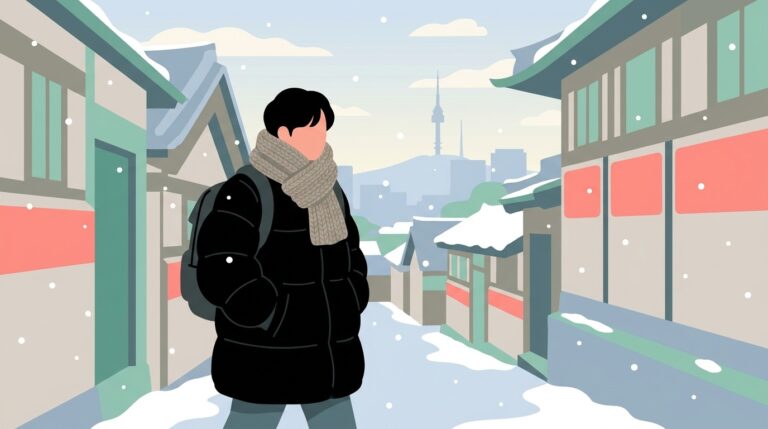
Picture this: you step off the plane at Incheon International Airport in mid-December. You are feeling confident in your stylish wool trench coat and chic leather boots. But the moment you walk out through the sliding automatic doors into the Seoul air, a gust of biting Siberian wind slaps your face. Your teeth chatter uncontrollably, your knees turn numb, and as you look around at the bus stop, you notice something surreal: ninety-nine percent of the people around you are wrapped head-to-toe in gigantic, puffy black coats, walking together like a resilient army of stylish black penguins.
Welcome to winter in Korea, where surviving the elements isn’t just about endurance—it is a collective social ritual known as arming yourself with long padding (롱패딩으로 무장하기).
Many of our B1 intermediate learners tell us: “Editor, I learned how to say ‘The weather is cold’ from textbooks, but when I stepped outside in Seoul, nobody was using that polite phrase. Koreans were laughing, shivering, and using words like ‘weapons’ and ‘freezing to death’!” That gap between sterile grammar drills and raw street reality is exactly why we created this guide. By mastering these authentic winter expressions, you will not only stay warm, but you will also instantly connect with locals over Korea’s favorite seasonal topic: surviving the infamous Siberian chill.
Phase 2: Core Expressions Deep Dive
1. 롱패딩 안 입으면 얼어 죽어요 (Longpaeding an ib-eumyeon eor-eo jug-eoyo)
- Pronunciation: [Long-pae-ding an i-beu-myeon eo-reo ju-geo-yo] (Think of “long padding” + “an” like ‘un-‘ + “ib-eumyeon” sounding like ‘ee-boo-meon’ + “jug-eoyo” like ‘joo-guh-yo’)
- Meaning: Literal: “If you don’t wear a long padding, you will freeze to death.” / Real Nuance: “A long puffer coat is non-negotiable today—trust me, you’ll regret it if you step out without one!”
- K-Culture Moment: You will hear this dramatic line in almost every slice-of-life K-Drama right before a character tries to go outside in an aesthetic autumn coat, only for their best friend to chase them down with a massive ankle-length black coat.
- Editor’s Insight: Koreans frequently use the hyperbole
~어/아 죽겠다(to death) to express sensory extremes. Pair it with conditional-으면(if), and you sound immediately fluent and relatable. - Situation Spectrum: Casual: ✅ | Semi-formal: ✅ | Formal: ⚠️ (In strict business settings, swap for ‘날씨가 매우 춥습니다’)
- 🤔 Think About It: In your culture, do people treat winter outerwear purely as fashion, or do you also have a cultural “survival uniform” that everyone wears regardless of age?
2. 완전 무장하고 나가야 돼요 (Wanjeon mujanghago nagaya dwaeyo)
- Pronunciation: [Wan-jeon mu-jang-ha-go na-ga-ya dwae-yo] (Pronounce ‘wanjeon’ like ‘one-jun’, ‘mujang’ like ‘moo-jahng’)
- Meaning: Literal: “You must go outside completely armed/armored.” / Real Nuance: “Bundle up from head to toe before heading out!”
- K-Culture Moment: Seen frequently on Korean variety shows like I Live Alone or Running Man, where cast members don heat-tech layers, long padding, beanies, earmuffs, and gloves before braving outdoor filming.
- Editor’s Insight:
무장하다(to arm/equip militarily) sounds intense, but prefixing it with완전(completely) transforms it into an everyday Korean idiom for bundling up against sub-zero weather. - Situation Spectrum: Casual: ✅ | Semi-formal: ✅ | Formal: ⚠️
- 🤔 Think About It: Why do you think Korean society metaphors harsh weather as a battlefield requiring armor?
3. 바람이 칼바람이에요 (Baram-i kalbaram-ieyo)
- Pronunciation: [Ba-ram-i kal-ba-ra-mi-e-yo] (‘Kal’ sounds sharp like the English word ‘call’ with a crisp ‘L’)
- Meaning: Literal: “The wind is a knife-wind.” / Real Nuance: “The wind is razor-sharp and cuts right to the bone.”
- K-Culture Moment: Weather forecast segments on morning news programs often display animated graphics of sharp blades blowing across the map when Siberian winds dive down the peninsula.
- Editor’s Insight: Combining
칼(knife) with바람(wind) creates an onomatopoeic emotional punch. When wind stings your cheeks near the Han River, this is the only word that truly captures the feeling. - Situation Spectrum: Casual: ✅ | Semi-formal: ✅ | Formal: ✅
- 🤔 Think About It: Does your native language compare cold wind to a physical weapon or cutting object?
Phase 3: Textbook Korean vs. Real Korean
Situation 1: Reacting to sudden sub-zero temperatures
- 📖 교과서 한국어 (Textbook): 오늘 날씨가 대단히 춥습니다. (Oneul nalssiga daedanhi chupsumnida. / The weather today is exceedingly cold.)
- 🗣️ 진짜 한국어 (Real-life): 오늘 날씨 진짜 미쳤어요! (Oneul nalssi jinjja michyeosseoyo! / The weather today is insane!)
- 💡 왜 다를까? (Why the difference?): While textbooks focus on respectful formality, real Koreans use expressive slang like
미쳤다(crazy/insane) in conversational settings to build instant empathy over shared misery.
Situation 2: Advising a friend to bundle up
- 📖 교과서 한국어 (Textbook): 따뜻한 외투를 입으십시오. (Ttatteut-han oetureul ib-eusipsio. / Please wear a warm overcoat.)
- 🗣️ 진짜 한국어 (Real-life): 패딩 꽁꽁 싸매고 나와요. (Paeding kkong-kkong ssamaego nawCurrentayo. / Wrap yourself up tightly in your padding coat before stepping out.)
- 💡 왜 다를까? (Why the difference?): The mimetic adverb
꽁꽁(tightly/frozen solid) and the descriptive verb싸매다(to bundle/wrap) convey warmth, care, and a cozy visual nuance that dry dictionary terms completely miss.
Phase 4: K-Culture Deep Dive & Non-verbal Manners
4-1. 눈치 (Nunchi) & Long Padding Etiquette
Wearing a sleeping-bag-sized coat requires tactical spatial awareness in crowded metropolitan areas:
* Subway & Bus Seating Manners: When sitting down on Seoul Metro Line 2 during rush hour, gather both flaps of your long padding inward onto your lap. If you let the coat puff out horizontally, you will occupy part of your neighbors’ seats—a clear violation of public transit nunchi.
* Staircase Navigation: When ascending subway stairs, gently lift the hem of your coat with one hand. Long coats reach past the calves, making it easy to step on your own hem and take a dramatic tumble.
* Indoor Unzipping: The moment you step into a heated café or restaurant, immediately unzip your coat. Leaving it fully zipped makes people around you feel overheated just looking at you.
4-2. Cultural Code: The “Black Penguin Army” (검은 펭귄 군단)
In Korea, the black long padding (롱패딩) transitioned from athletic bench-coats worn by idol stars on outdoor music stages to a national winter staple around 2017. Why black? Black absorbs heat, conceals winter slush stains from busy streets, and aligns with Korea’s understated urban aesthetic. Wearing it signals practical wisdom rather than conformity; it proves you respect the brutal Siberian high-pressure fronts.
Phase 5: Real-World Roleplay Scenario
Setting: Outside Hongdae Station (Exit 9) at 7:00 PM. A freezing Siberian wind howls between skyscrapers. Minji is shivering while wearing a chic black long padding, waiting for you.
- Turn 1 (Minji): 🎭 Stamping her feet, breath visible in the air
여기에요! 와, 오늘 바람 진짜 칼바람이다. (Yeogieyo! Wa, oneul baram jinjja kalbaram-ida. / Over here! Wow, today’s wind is like razor blades.) - Turn 2 (You): 🎭 Pulling your scarf tight over your chin
맞아요! 밖에 5분만 서 있어도 얼어 죽을 것 같아요. (Maj-ayo! Bakke obun-man seo iss-eodo eor-eo jugeul geot gat-ayo. / Right! Even standing outside for 5 minutes feels like freezing to death.) - Turn 3 (Minji): 🎭 Glancing at your coat with wide, concerned eyes
근데 오늘 롱패딩 안 입고 코트 입고 나왔어요? (Geunde oneul longpaeding an ipgo koteu ipgo nawasseoyo? / But did you come out wearing a wool coat instead of a long padding today?) - Turn 4 (You): 🎭 Laughing sheepishly while teeth chatter
예쁘게 보이고 싶어서 코트 입었는데 후회돼요. (Yeoppeuge bo-igo sipeoseo koteu ib-eonneunde hu-hoedwaeyo. / I wanted to look nice so I wore a coat, but I totally regret it.) - Turn 5 (Minji): 🎭 Digging into her huge padding pockets and handing you a warm packet
이럴 줄 알고 핫팩 두 개 챙겨왔어요. 하나 손에 쥐고 있어요! (Ireol jul algo hat-paek du gae chaeng-gyeowasseoyo. Hana sone jwigo isseoyo! / I anticipated this and brought two hot packs. Hold this in your hand!) - Turn 6 (You): 🎭 Clutching the warm pack to your cold palms with deep gratitude
와, 살 것 같아요! 진짜 천사네요. (Wa, sal geot gat-ayo! Jinjja cheonsaneyo. / Wow, I feel revived! You are an absolute angel.) - Turn 7 (Minji): 🎭 Zipping up her high collar all the way to her nose
빨리 실내로 들어가요. 오늘 같은 날은 완전 무장 필수예요! (Ppalli silnaero deureogayo. Oneul gateun nal-eun wanjeon mujang pilsu-yeyo! / Let’s get inside quickly. On days like this, full armor is a must!) - Turn 8 (You): 🎭 Nodding eagerly and walking briskly toward the heated café
네, 얼른 따뜻한 유자차 마시러 가요! (Ne, eolleun ttatteut-han yujacha masireo gayo! / Yes, let’s hurry up and get some warm yuja tea!)
🔀 Interactive Decision Branch
What should you reply to Minji when she hands you the hot pack?
- Choice A: “고마워요! 역시 한국 겨울엔 핫팩이랑 롱패딩이 필수네요.” (Thank you! As expected, hot packs and long padding are essentials in Korean winter.)
- Feedback (Best): Perfect cultural insight and polite intermediate grammar. Minji will be impressed by your adaptability.
- Choice B: “괜찮아요, 제 고향이 한국보다 훨씬 더 추워요.” (It’s okay, my hometown is way colder than Korea.)
- Feedback (Bad): Even if true, dismissing someone’s warm hospitality kills the bonding moment and sounds slightly arrogant.
- Choice C: “이거 얼마예요? 돈 줄게요.” (How much is this? I will pay you.)
- Feedback (Risk): Too transactional! In Korean friendship culture (정 / Jeong), sharing cheap hand warmers is a warm, uncalculated gift. Simply accept with heartfelt thanks.
Phase 6: 10-Second Emotional Shadowing Drill
Train your muscle memory with these emotional cadence markers (/ = brief breath pause):
[🥶 덜덜 떨며 극적인 한탄조로 / Shivering with dramatic complaint]- 오늘 / 날씨 진짜 미쳤어요! / 롱패딩 안 입었으면 / 큰일 날 뻔했어요.
- Oneul / nalssi jinjja michyeosseoyo! / Longpaeding an ib-eosseumyeon / keun-il nal ppeonhaesseoyo. (Today’s weather is insane! If I hadn’t worn my long padding, I would have been in serious trouble.)
[🧣 다정하고 걱정스러운 친구 톤으로 / Warm and caring friend tone]- 바람이 칼바람이니까 / 목도리 꼭 하고 / 완전 무장하고 나가요!
- Baram-i kalbaram-inikka / mokdori kkok hago / wanjeon mujanghago nagayo! (The wind is sharp as a knife, so make sure to wrap your scarf and head out fully armed!)
Phase 7: K-Culture Mini Dictionary
- 롱패딩 (Long-padding)
- Translation: Ankle-length down or synthetic padded puffer coat.
- Usage: Essential winter armor across all demographics. Wearing anything less in January marks you as either an intrepid tourist or a brave fashion victim.
- 칼바람 (Kal-baram)
- Translation: Knife wind / piercing gale.
- Usage: Used whenever the wind chill index (체감온도) drops lower than the actual thermometer reading due to Siberian air currents.
- 핫팩 (Hat-paek)
- Translation: Disposable chemical hand warmer.
- Usage: Bought at convenience stores for 1,000–1,500 KRW. Kept inside padding coat pockets to warm freezing fingers.
- 꽁꽁 (Kkong-kkong)
- Translation: Tightly / frozen rock-solid.
- Usage: Modifies freezing or bundling actions (e.g.,
꽁꽁 얼다= frozen solid;꽁꽁 싸매다= bundled up thoroughly).
Phase 8: Traveler’s Survival Kit
Top 3 Survival Expressions
- Expression 1: 핫팩 어디에 있어요? (Hat-paek eodie isseoyo? / Where are the hot packs?)
- Pro Tip: Walk into any convenience store (CU, GS25, 7-Eleven) and say this near the counter.
- Expression 2: 온열 의자 진짜 따뜻해요. (Onyeol uija jinjja ttatteut-haeyo. / The heated bench is so warm.)
- Pro Tip: Look for glowing red/orange designated heated benches at Seoul bus stops and metro platforms.
- Expression 3: 따뜻한 물 좀 주시겠어요? (Ttatteut-han mul jom jusigesseoyo? / Could you please give me some warm water?)
- Pro Tip: Korean restaurants default to ice-cold water year-round. Use this phrase when your stomach needs warmth.
Editor’s Travel Note
Before heading outdoors, make sure to check the temperature via the Weather forecast on Naver Map app for accurate real-time wind chill updates. Also, keep an eye out for heated drink warming cabinets (온장고) right inside convenience store entrances—they store warm canned coffee and sweet soy milk, serving as both delicious snacks and portable hand heaters.
Phase 9: One Step Deeper (Reflective Insight)
In many Western cultures, personal individuality often dictates winter wear—people might prioritize trench coats, leather jackets, or colorful layers over uniform warmth. In contrast, Korea’s collective adoption of the black long padding demonstrates a deep cultural pragmatism rooted in community solidarity. When everyone dresses like a puffy black penguin, vanity dissolves into a shared camaraderie of mutual survival against the Siberian cold.
💬 Your Turn: Would you prioritize staying cozy in an all-black long padding, or would you freeze a little to keep your personal fashion style intact? Let us know in the comments below!
Phase 10: FAQ & Avoiding Misunderstandings
Q: Can I wear light-colored or white long padding in Seoul?
A: Yes! White padding (화이트 롱패딩) is very popular among young people for a brighter look. However, be cautious: city dust, street food sauces (like tteokbokki), and subway crowds can easily smudge white nylon.
Q: Is it considered rude to keep my coat on inside a Korean home or restaurant?
A: In restaurants, take off your long padding and fold it neatly next to you or put it in provided storage bags so it doesn’t take up space. In private homes, always remove your outerwear at the entryway (현관) before stepping onto the heated floor (온돌).
Q: What is the ideal length for a long padding in Korea?
A: A standard long padding extends between mid-calf and just above the ankle. Anything shorter than mid-thigh is considered a ‘숏패딩’ (short padding), which locals reserve for milder late-February days.
🚨 Common Mistakes Warning Board
- Mistake: Wearing only one massive sweater under your coat.
- Correct Action: Korean indoor heating (온돌 and air heaters) is intense! Wear thin thermal base layers (히트텍) so you can easily adapt when moving between freezing streets and warm cafés.
- Mistake: Saying
얼어 죽겠습니다to a boss or senior executive.- Correct Action: The phrase
얼어 죽다contains slang-like hyperbole. Use날씨가 무척 쌀쌀합니다in formal business contexts.
- Correct Action: The phrase
- Mistake: Throwing used disposable hot packs into paper recycling.
- Correct Action: Chemical hand warmers belong in general trash (일반 쓰레기), not recyclables.
Phase 11: Action Missions
- 🥉 Bronze Mission (Solo Drill): Stand in front of your mirror in your thickest jacket and say out loud with shivering emotion: “바람이 칼바람이에요! 완전 무장하고 나가야 돼요!” 3 times.
- 🥈 Silver Mission (Social Share): Take a photo of your warmest winter outfit, post it on Instagram or your learning journal, and caption it with: #롱패딩으로무장하기 #DailyHangul.
- 🥇 Gold Mission (Real-life Execution): Walk into a Korean convenience store or restaurant and ask the staff: “따뜻한 음료 어디에 있어요?” (Where are the warm drinks?).
- 🎮 K-Culture Mission: Watch any behind-the-scenes video of your favorite K-Drama filmed in winter. Spot the actors wearing long black padding over their historical hanbok costumes during breaks!
Phase 12: Interactive Quiz Challenge
1. Situational Judgment: You meet your Korean language partner on a brutally windy day. Which opening line sounds most natural and empathetic?
* (A) 오늘 기후가 매우 저온 상태입니다.
* (B) 오늘 진짜 칼바람이네요! 롱패딩 안 입었으면 큰일 날 뻔했어요.
* (C) 당신의 외투는 매우 두껍습니다.
2. Fill in the Blank:
밖이 너무 추우니까 목도리랑 장갑 챙겨서 [ ______ ] 하고 나가세요!
* (A) 눈치보기 (B) 완전 무장 (C) 쇼핑
3. True or False: In Korea, the slang suffix ~어/아 죽겠다 is strictly offensive and should never be used with close friends when complaining about the weather. (True / False)
👉 Click to reveal the answers and explanations!
- Answer: (B)
- Explanation: Mentioning
칼바람(knife-wind) and롱패딩 안 입었으면 큰일 날 뻔했다(would have been trouble without long padding) builds instant rapport and matches intermediate conversational fluency.
- Explanation: Mentioning
- Answer: (B) 완전 무장
- Explanation:
완전 무장하다is the quintessential idiom for bundling up against harsh cold with cold-weather gear.
- Explanation:
- Answer: False
- Explanation: While inappropriate in formal business presentations,
추워 죽겠다(freezing to death) is an extremely common, non-offensive conversational idiom among friends, classmates, and family members.
- Explanation: While inappropriate in formal business presentations,







