

Why Koreans Panic When You Open the Window in Spring and What to Say
Phase 1: 공감 (Story Immersion Opening)
안녕하세요! 매일한글 에디터입니다.
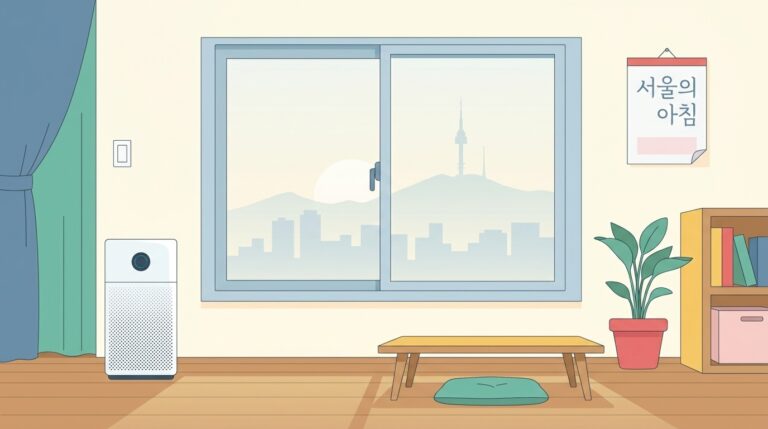
Picture this: You wake up in a stylish shared apartment in Hongdae on a bright spring morning. The sun filters into the living room, and your first instinct is to slide open the large veranda window to let in the crisp morning air. But the second your hand touches the latch, your Korean roommate gasps, rushes across the room, and waves both hands in a panicked “X” shape. You look outside, confused. The sun is out, but the skyline looks like it has been dipped in a muted, milky gray watercolor.
Welcome to spring in South Korea, where the arrival of fine dust (미세먼지) flips daily domestic habits upside down! In many countries, cracking a window open is the universal symbol of health and fresh starts. In Korea, opening a window on a yellow or red dust alert day turns your cozy home into a micro-particulate hazard zone. Foreign visitors and new expats often find this reaction shocking—or accidentally commit a major social faux pas in dorms, offices, and shared guesthouses.
Don’t worry! This survival guide is built on real classroom feedback and actual experiences from hundreds of our international learners. By learning just a few simple, polite A1-level Korean phrases, you will not only protect your lungs but also instantly prove that you possess incredible cultural intuition (눈치).
Phase 2: 핵심 표현 3선 심층 분석 (Top 3 Essential Expressions)
1. 창문 닫으세요 (Changmun dadeuseyo)
- Pronunciation: Chang-mun da-deu-se-yo (Sounds like: “Chahng-moon dah-dew-say-yo”)
- Meaning: Literal: “Please close the window” vs. Real Nuance: “Shut the window quickly before the dust blows inside!”
- K-Culture Moment: Seen in almost every contemporary family K-Drama when emergency dust alerts buzz on smartphones and parents frantically secure the apartment.
- Editor’s Insight: The ending
-세요(-se-yo) is an A1 speaker’s best friend. It transforms a basic command into a polite, considerate request that is safe to use with roommates, colleagues, and elders.- Situation Spectrum: Casual ⚠️ | Semi-formal ✅ | Formal ✅
- 🤔 Think About It: In English, we often ask “Could you close the window?” as an indirect question. Why do you think Korean uses a polite directive (
-세요) instead of a question during safety-related moments?2. 환기하지 마세요 (Hwangihaji maseyo)
- Pronunciation: Hwan-gi-ha-ji ma-se-yo (Sounds like: “Hwan-ghee-hah-jee mah-say-yo”)
- Meaning: Literal: “Do not ventilate” vs. Real Nuance: “Don’t air out the room today; the air quality outside is toxic.”
- K-Culture Moment: This exact phrase appears in bold red letters on public school bulletin boards, gym monitors, and smart-apartment wall pads across Korea.
- Editor’s Insight:
환기(hwangi) means air ventilation. The grammar pattern-지 마세요(-ji maseyo) means “please do not.” It sounds firm yet completely courteous.- Situation Spectrum: Casual ⚠️ | Semi-formal ✅ | Formal ✅
- 🤔 Think About It: Notice how technical Sino-Korean terms like
환기(換氣) become common household words because of shared environmental realities.3. 미세먼지 심해요 (Misemeonji simhaeyo)
- Pronunciation: Mi-se-meon-ji sim-hae-yo (Sounds like: “Me-say-mun-jee seem-hay-yo”)
- Meaning: Literal: “Fine dust is severe” vs. Real Nuance: “The air pollution is terrible today!”
- K-Culture Moment: You will hear neighbors muttering this in elevators while adjusting their KF94 masks before stepping out onto the street.
- Editor’s Insight:
심해요(simhaeyo) comes from심하다(to be severe/bad). It is a magic beginner adjective you can use for bad traffic, heavy rain, or splitting headaches.- Situation Spectrum: Casual ✅ | Semi-formal ✅ | Formal ✅
- 🤔 Think About It: Complaining about the weather is universal, but bonding over air quality numbers creates a uniquely Korean sense of solidarity.
Phase 3: 교과서 한국어 vs 진짜 한국어 (Textbook vs. Real Korean)
Situation 1: Warning someone that the air outside is harmful
- 📖 교과서 한국어: 대기오염 수치가 높으니 환기를 자제하십시오. (Daegioyeom suchiga nopeuni hwangireul jajehasipsio. / As air pollution levels are high, please refrain from ventilating.)
- 🗣️ 진짜 한국어: 오늘 미세먼지 대박이에요. 문 열지 마세요! (Oneul misemeonji daebagieyo. Mun yeolji maseyo! / The fine dust is insane today. Don’t open the doors or windows!)
- 💡 왜 다를까? Real Koreans bypass dry meteorological jargon like
대기오염(atmospheric pollution) and use colloquial emphasis like대박(daebak – crazy/insane) and the simple word문(mun – door/window).
Situation 2: Asking someone to hurry up and shut the window
- 📖 교과서 한국어: 외부 유해 물질이 유입되지 않도록 창문을 닫아 주시기 바랍니다. (Oebu yuhae muljiri yuipdoeji antorok changmuneul dada jusigi baramnida. / Please close the window so external harmful substances do not enter.)
- 🗣️ 진짜 한국어: 먼지 들어와요, 창문 빨리 닫아요! (Meonji deureowayo, changmun ppalli dadayo! / Dust is blowing in, shut the window quick!)
- 💡 왜 다를까? Real-life speech prioritizes immediate physical consequences (
먼지 들어와요– dust is coming in!) and action adverbs like빨리(ppalli – quickly).
Phase 4: K-Culture 딥다이브 & 비언어적 매너 (Cultural Nuance & Manners)
4-1. 눈치 (Nunchi) & Gestures
If someone moves toward a window on a hazy day in a Korean office, cafe, or bus, you will immediately see a flurry of non-verbal cues. Koreans will often widen their eyes, lift both forearms into an “X”, or gently tap their smartphone screen showing an air quality app. If you want to open a window in a shared public space, never simply open it on your own. Always pause, make brief eye contact with those nearby, and check your environment. Ignoring air quality warnings in communal settings is perceived as a serious lack of consideration.
4-2. Cultural Codes: The Myth of Samgyeopsal and KF94 Culture
During the peak fine dust season (March to May), you will witness an interesting ritual: barbecue restaurants packed with people grilling thick cuts of pork belly (삼겹살 – samgyeopsal). Decades ago, miners believed pork fat helped rinse heavy coal dust down their throats. While modern science has debunked this, Koreans still love using high-dust days as an affectionate excuse to gather with friends for sizzling pork and soju! Meanwhile, keeping a box of KF94 masks by the front door is standard practice in every Korean household.
Phase 5: 실전 롤플레이 시나리오 (Interactive Roleplay Scenario)
Setting: A sunlit shared guesthouse kitchen in Yeonnam-dong.
NPC: Ji-woo (지우), a thoughtful local guesthouse host who monitors air quality like a hawk.
- 지우: 좋은 아침이에요! 어, 창문 열려고요? (Joeun achimieyo! Eo, changmun yeollyeogoyo? / Good morning! Oh, are you trying to open the window?)
🎭 Lifts her head with wide, alarmed eyes while holding her mug. - 학습자 (You): 네, 아침 공기 마시려고요. (Ne, achim gonggi masiryeogoyo. / Yes, I wanted some fresh morning air.)
🎭 Holding the window handle with a bright smile. - 지우: 안 돼요! 오늘 미세먼지 진짜 심해요. (An dwaeyo! Oneul misemeonji jinjja simhaeyo. / No, don’t! The fine dust is really severe today.)
🎭 Quickly walks over and shows her smartphone screen glowing bright red. - 학습자 (You): 정말요? 하늘이 맑아 보이는데요? (Jeongmallyo? Haneuri malga boineundeyo? / Really? The sky looks sunny though?)
🎭 Peering outside through the glass in surprise. - 지우: 햇빛은 있어도 먼지가 꽉 찼어요. 환기하지 마세요! (Haetbicheun isseodo meonjiga kkwak chasseoyo. Hwangihaji maseyo! / There’s sunlight, but the air is packed with dust. Please don’t open the windows!)
🎭 Gently making an ‘X’ gesture with her hands. - 학습자 (You): 알겠어요. 창문 바로 닫을게요. (Algesseoyo. Changmun baro dadeulgeyo. / Understood. I will close the window right away.)
🎭 Releasing the latch and sliding the glass shut firmly. - 지우: 고마워요! 대신 공기청정기 세게 틀어둘게요. (Gomawoyo! Daesin gonggicheongjeonggi sege teureodulgeyo. / Thank you! Instead, I’ll turn the air purifier up high.)
🎭 Presses the turbo button on a tall white air purifier in the corner. - 학습자 (You): 감사해요! 나갈 때 마스크도 꼭 쓸게요. (Gamsahaeyo! Nagal ttae maseukeudo kkok sseulgeyo. / Thank you! I’ll make sure to wear a mask when going outside too.)
🎭 Pats jacket pocket to confirm the presence of a KF94 mask.
🔀 Interactive Decision Branch
What would you say next if Ji-woo offers you an extra mask before you step out?
- Choice A: “감사합니다! 미세먼지 조심할게요.” (Gamsahamnida! Misemeonji josimhalgeyo. / Thank you! I’ll be careful of the dust.)
Result (Best): Perfect 10/10! Shows immense gratitude, cultural adaptation, and warmth. - Choice B: “괜찮아요, 1분만 나갔다 올 거니까 안 쓸래요.” (Gwaenchanayo, ilbunman nagatda ol geonikka an sseullaeyo. / It’s fine, I’m only going out for 1 minute so I won’t wear it.)
Result (Bad): Makes your host worry unnecessarily and sounds dismissive of her thoughtful gesture. - Choice C: “에어컨 틀면 미세먼지 없어지나요?” (Eeokeon teulmyeon misemeonji eopseojinayo? / If we turn on the AC, does the fine dust disappear?)
Result (Risk): Confuses basic air conditioning with air filtration. Ji-woo will give you a well-intentioned 10-minute lecture on HEPA filters!
Phase 6: 10초 감정 섀도잉 드릴 (10-Second Emotional Shadowing Drill)
Practice reading these out loud, pausing at the slashes (/), and adopting the target emotion:
[😷 다급하고 걱정스럽게 - Urgent and concerned]
“창문 / 닫으세요! / 미세먼지 / 들어와요!”
(Changmun / dadeuseyo! / Misemeonji / deureowayo!)
“Close the window! / Fine dust is coming inside!”-
[🛑 단호하지만 친절하게 - Firm yet polite]
“오늘은 / 환기하지 / 마세요.”
(Oneureun / hwangihaji / maseyo.)
“Please do not / air out the room / today.” -
[😮💨 안도하며 차분하게 - Relieved and calm]
“공기청정기 / 켰으니까 / 이제 / 괜찮아요.”
(Gonggicheongjeonggi / kyeosseunikka / ije / gwaenchanayo.)
“Since we turned on / the air purifier, / it is fine / now.”
Phase 7: K-Culture 미니 사전 (Mini Dictionary)
- 미세먼지 (Misemeonji) | Fine Dust / PM10 & PM2.5 Particulate Matter
Usage: The most checked weather metric in Korea alongside temperature. Koreans track it daily using color-coded icons. - 환기 (Hwangi) | Ventilation / Airing Out
Usage: Traditionally a sacred morning ritual in Korean homes, but now strictly subject to real-time air quality reports. - 공기청정기 (Gonggicheongjeonggi) | Air Purifier
Usage: A standard appliance found in every Korean household, cafe, and classroom, often glowing blue (good) or red (polluted). - 마스크 (Maseukeu) | Face Mask (Specifically KF94)
Usage: A mandatory travel item during Asian Dust season. Sold at every pharmacy and 24-hour convenience store checkout counter.
Phase 8: 여행자를 위한 생존 키트 (Traveler’s Survival Kit)
TOP 3 Survival Phrases
- 마스크 있어요? (Maseukeu isseoyo?)
Meaning: Do you have masks?
Pro Tip: Walk into any CU, GS25, or 7-Eleven and say this at the register. The clerk will point directly to the hanging KF94 display. - 오늘 미세먼지 어때요? (Oneul misemeonji eottaeyo?)
Meaning: How is the fine dust today?
Pro Tip: A natural conversation starter with hostel staff or hotel receptionists before planning outdoor walks. - 창문 닫아도 돼요? (Changmun dadado dwaeyo?)
Meaning: May I close the window?
Pro Tip: Use this on public buses or shared workspaces when you feel dusty air blowing onto your seat.
Editor’s Travel Note
Before stepping out in Seoul or Busan, do not just check the iPhone weather app—it often underreports local Korean micro-particles. Instead, search for the MiseMise Air Quality App download on the App Store to get the famous character-based tracker (Blue smiling face = Good, Black skull mask = Stay indoors!). If the level is yellow or worse, pair your outdoor explorations with the Naver Map subway navigation to minimize walking beside busy roadways.
Phase 9: “한 발 더 깊이” (A Step Deeper)
In Korean apartment culture, personal actions rarely remain purely personal. Because air flows through shared corridors and balconies, leaving a window open during a dust storm affects indoor air filters and communal comfort. Checking the dust forecast and warning others with “환기하지 마세요” is an expression of communal care, not control. It reflects a society that values collective protection over individual convenience.
💬 Your Turn: How does your home country handle air quality or sudden seasonal changes? Have you ever had a misunderstanding over an open window? Let us know in the comments below!
Phase 10: FAQ & 오해 방지 (FAQ & Common Mistakes)
Q: Why do Koreans say “환기하지 마세요” even when the sky looks sunny?
A: Ultrafine dust (PM2.5 particles) is completely invisible to the naked eye. The sun may shine brightly while microscopic toxins reach hazardous concentrations. Koreans rely strictly on sensor readings rather than visible clouds.
Q: What does the “KF” on Korean dust masks stand for?
A: “KF” stands for Korean Filter. The number 94 indicates that it filters out more than 94% of particles with an average diameter of 0.4 micrometers. It is the gold standard for fine dust defense.
Q: Can I just say “환기 금지” instead of “환기하지 마세요”?
A: Avoid saying “환기 금지” (Hwangi geumji) to people. It translates to “Ventilation Prohibited” and sounds like a robotic warning painted onto a chemical storage door. Always use “환기하지 마세요” with people.
🚨 흔한 실수 (Common Mistakes) TOP 3
- Shouting “창문 열지 마!” (Changmun yeolji ma!) to an elder or host.
Correct Action: That is informal panmal (반말). Always add the polite ending: 창문 열지 마세요 (Changmun yeolji maseyo). - Confusing regular dust (먼지) with atmospheric fine dust (미세먼지).
Correct Action: Regular room dust is먼지(meonji). Weather-related pollution is specifically 미세먼지 (misemeonji). - Opening taxi or city bus windows during peak dust alerts.
Correct Action: Keep bus windows shut. Drivers run internal ventilation systems with industrial HEPA filters on hazardous days.
Phase 11: 액션 미션 & 참여 유도 (Action Missions)
- 🥉 Bronze Mission (Solo Shadowing): Stand in front of your room’s window, make an “X” with your hands, and say out loud three times: “창문 닫으세요! 환기하지 마세요!”
- 🥈 Silver Mission (SNS Check): Check today’s air quality in Seoul online. Share a screenshot on Instagram stories with the caption: “오늘 서울 미세먼지 심해요! #DailyHangul”
- 🥇 Gold Mission (Real Life Action): Visit your nearest Asian grocery store or Korean mart, find the personal care aisle, and ask the cashier: “KF94 마스크 있어요?”
- 🎮 K-Culture Mission: Watch any modern slice-of-life K-Drama (like Hospital Playlist or Our Blues). Spot the air purifier in the corner of the room and shout “공기청정기!”
Phase 12: 인터랙티브 퀴즈 챌린지 (Interactive Quiz Challenge)
1. Situation Decision: You are in a cozy Seoul study cafe. Another student walks toward the window to open it, but your phone just warned of a PM2.5 alert. What is the most polite and natural phrase to say?
* A) 환기 금지야! (Hwangi geumjiya!)
* B) 환기하지 마세요, 미세먼지 심해요. (Hwangihaji maseyo, misemeonji simhaeyo.)
* C) 문을 부수세요. (Muneul bususeyo.)
2. Fill-in-the-Blank: Complete the polite sentence meaning “Please close the window.”
* 창문을 [ _______ ]. (Hint: verb root 닫- + polite imperative)
3. Cultural True or False: Eating grilled pork belly (삼겹살) scientifically washes fine dust out of your internal organs.
* True or False?
👉 Click here to reveal the answers and explanations!
-
Answer: B
Explanation: Choice B combines the polite prohibition-지 마세요with the reason (미세먼지 심해요). Choice A is too blunt/informal, and Choice C means “Please smash the door!” -
Answer: 닫으세요 (dadeuseyo)
Explanation: The verb닫다(to close) ends in a consonant (ㄷ), so it takes-으세요to become닫으세요. -
Answer: False
Explanation: Scientifically, dust enters the respiratory system (lungs), while food travels to the digestive system (stomach)! However, eating Samgyeopsal remains a beloved cultural tradition on dusty days.







