

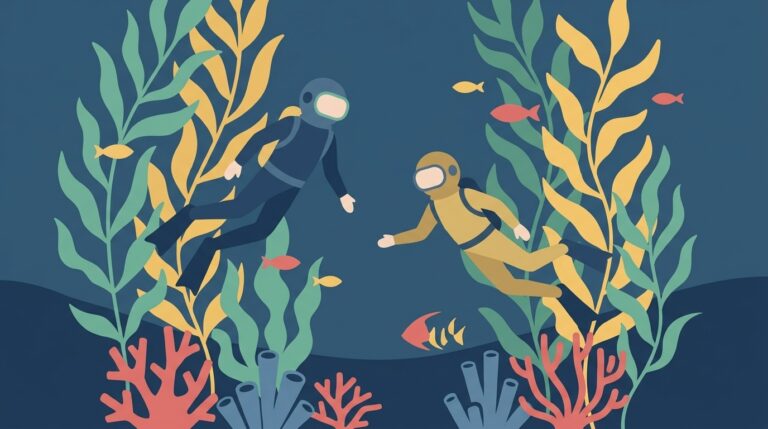
Restoring the Ocean: Master C2 Korean for Marine Forest Cultivation and Ecological Policy
Phase 1: Empathy (Story-Immersive Opening)
안녕하세요! 매일한글 에디터입니다. (Annyeonghaseyo! It’s your Daily Hangul editor.)
Imagine sitting across from senior marine biologists and policymakers in an eco-forum in Busan or alongside seasoned Jeju Haenyeo (해녀) at a coastal briefing. The discussion suddenly turns to the devastating phenomenon of Gaetnogeum (갯녹음)—the desertification of rocky sea beds. You want to contribute to the discussion on artificial reefs, sporophyte deployment, and coastal carbon sequestration. However, you find yourself stuck using basic phrases like “물고기 집을 만들어요” (making houses for fish) or generic textbook words like “환경을 보호합시다” (let’s protect the environment).
This is the definitive frustration of the C2 learner: your ecological awareness and intellectual complexity are top-tier, but your Korean register suddenly drops to an elementary school level the moment specific marine science terminology enters the chat. South Korea is home to the world’s very first government-designated “Sea Arbor Day” (바다식목일), leading sophisticated blue-carbon restoration projects across the East and South Seas. Navigating these discussions requires sophisticated vocabulary, sociolinguistic subtlety, and an understanding of Korea’s coastal ethos. Based on authentic feedback from advanced environmental researchers and diplomatic liaisons, this guide will bridge that exact gap, empowering you to participate in C2-level dialogues on marine conservation with effortless precision.
Phase 2: Core 3 Expressions In-Depth
1. 바다 숲을 조성하다 (Bada supeul joseonghada)
- Pronunciation: [Bada supeul joseonghada] (Sound analogy: imagine saying ‘bah-dah’ like a serene sea, then ‘soup-eul’, followed by ‘joe-seong-ha-da’—crisp and deliberate)
- Meaning: Literally “to construct/cultivate an ocean forest”; in context, it specifically refers to the systematic rehabilitation of subtidal macroalgal beds (kelp, wrack) through engineered artificial reefs and seed-transplantation.
- K-Culture Moment: Frequently featured on prestigious Korean environmental investigative shows like KBS Environment Special (환경스페셜) when highlighting coastal revitalization programs spearheaded by the Korea Fisheries Resources Agency (FIRA).
- Editor’s Insight: Note the Sino-Korean verb 조성하다 (造成하다 – to construct/create systematically). While you would use 심다 (to plant) for a single sapling in your garden, 조성하다 implies large-scale structural cultivation and habitat engineering. Using this verb elevates your discourse instantly to policy-grade Korean.
- Situation Spectrum: Casual: ⚠️ | Semi-formal: ✅ | Formal: ✅
- 🤔 Think About It: Notice how Korean borrows terrestrial spatial concepts (숲 – forest) to frame ocean floors. How does your native language visualize marine vegetation: as a landscape, a resource, or an alien wilderness?
2. 갯녹음 현상을 저지하다 (Gaetnogeum hyeonsangeul jeojihada)
- Pronunciation: [Gaen-nokeum hyeon-sangeul jeo-ji-hada] (Note the nasalization of ‘t’ before ‘n’: ‘gaet-nok-eum’ becomes fluidly pronounced as [gaen-nokeum])
- Meaning: Literally “to halt the tidal-rock bleaching phenomenon”; practically refers to arresting the spread of crustose coralline red algae that turns vibrant marine ecosystems into desolate, barren underwater deserts.
- K-Culture Moment: Heard in high-level press conferences with coastal mayors and eco-activists addressing the alarming decline in abalone and sea cucumber yields along the Jeju and Gangwon coasts.
- Editor’s Insight: 갯녹음 is a pure Korean compound (개 + 녹음), where gae relates to intertidal rocky shores, while jeoji-hada (沮止하다) brings an active, defensive, emergency-response weight. It’s not just “stopping”; it is repelling an existential threat before it reaches an ecological tipping point.
- Situation Spectrum: Casual: 🚫 | Semi-formal: ✅ | Formal: ✅
- 🤔 Think About It: Contrast the word “bleaching” (descriptive of color) with 갯녹음 (descriptive of the tidal rock’s structural erosion and barrenness). What does this reveal about observational perspectives across linguistic borders?
3. 해양 생태계의 자정작용을 도모하다 (Haeyang saengtae-gye-ui jajeong-jak-yong-eul domohada)
- Pronunciation: [Haeyang saeng-tae-gye-ui ja-jeong-jak-yong-eul do-mo-hada] (Glide through ‘jajeong-jak-yong’ like rhythmic clicking stones: self-cleansing action)
- Meaning: Literally “to promote the self-purification mechanism of the marine ecosystem”; conceptually, it denotes designing conservation measures that empower natural feedback loops to heal themselves without perpetual human intervention.
- K-Culture Moment: Discussed in academic panels and think-tank forums examining ESG strategies and Korea’s carbon-neutral 2050 roadmaps.
- Editor’s Insight: 자정작용 (自淨作用 – self-cleansing function) combined with the sophisticated verb 도모하다 (圖謀하다 – to intentionally plan and foster a desirable outcome). This compound signals that you view ecological stewardship not as forceful terraforming, but as empowering nature’s intrinsic equilibrium.
- Situation Spectrum: Casual: 🚫 | Semi-formal: ⚠️ | Formal: ✅
- 🤔 Think About It: Does your language conceptualize nature as an autonomous, self-healing entity or as a vulnerable system entirely reliant on technological management?
Phase 3: Textbook Korean vs. Real Korean
Situation 1: Proposing kelp bed expansion during a project meeting
- 📖 교과서 한국어 (Textbook):
바다에 해조류를 많이 심어서 물고기가 살 수 있는 환경을 만들어야 합니다.
(Bada-e haejoyureul mani simeoseo mulgogiga sal su inneun hwangyeongeul mandeureoya hamnida.)
“We must plant a lot of seaweed in the sea to create an environment where fish can live.” - 🗣️ 진짜 한국어 (Authentic C2 Professional):
연안 갯녹음 확산을 차단하고 수산자원 회복을 견인하기 위해, 대규모 해중림 조성이 시급한 실정입니다.
(Yeonan gaetnogeum hwaksaneul chadanhago susanjawon hoebogeul gyeon-inhagi wihae, daegyumo haejungnim joseongi sigeupan siljeong-imnida.)
“To stem the spread of coastal barrens and spearhead marine resource recovery, large-scale marine forest cultivation is of the utmost urgency.” - 💡 왜 다를까? (Why the shift?):
While the textbook phrasing relies on simplistic subject-verb couplings (심다, 만들다), professional Korean discourse utilizes Sino-Korean action nouns (차단, 견인, 조성) to express multifaceted ecological causality with executive gravity.
Situation 2: Explaining ocean desertification to a scientific committee
- 📖 교과서 한국어 (Textbook):
바다 바위가 하얗게 변해서 생물들이 다 죽어가고 있습니다.
(Bada bawiga hayake byeonhaeseo saengmuldeuri da jukeogago itseumnida.)
“The ocean rocks have turned white, and living creatures are all dying.” - 🗣️ 진짜 한국어 (Authentic C2 Professional):
수온 상승에 따른 백화현상과 조식동물의 과밀화로 인해 연안 암반 생태계가 괴멸적 위기에 직면했습니다.
(Su-on sangseung-e ttareun baekhwa-hyeonsanggwa josik-dongmureui gwamilhwaro inhae yeonan amban saengtae-gyega goemyeoljeok wigie jingmyeonhaesseumnida.)
“Due to climate-induced bleaching and the hyper-density of grazing herbivores, coastal rocky-reef ecosystems are confronting near-catastrophic collapse.” - 💡 왜 다를까? (Why the shift?):
C2 scientific discourse moves beyond sensory descriptions (하얗게 변하다) to articulate systemic ecological drivers (조식동물의 과밀화, 수온 상승) and acute analytical urgency (괴멸적 위기).
Phase 4: K-Culture Deep Dive & Non-Verbal Manners
4-1. 눈치 (Nunchi) & Non-Verbal Etiquette on the Docks and in the Lab
In Korea’s maritime sphere, academic researchers work in profound symbiosis with coastal fishing cooperatives (어촌계) and traditional Haenyeo (female free divers). When discussing underwater restoration:
* The Humble Posture (경청의 미덕): When an elder haenyeo speaks of shifts in subtidal currents or kelp decimation, never interrupt with abstract academic terminology. Lean slightly forward, maintain steady but soft eye contact, and nod conscientiously with deep vocal affirmations like “말씀이 맞습니다, 어르신” (You are entirely right, elder) before contextualizing your scientific findings.
* De-weaponizing Expertise: Senior maritime officials avoid didactic, dogmatic tones. Frame your ideas cooperatively using inclusive proposals like “함께 모색해 보는 것이 어떻겠습니까?” (Shall we look into exploring this together?) rather than declarative imperatives.
4-2. Cultural Code: The World’s First “Sea Arbor Day” (바다식목일)
Did you know that in 2012, South Korea enacted national legislation establishing May 10th as 바다식목일 (Sea Arbor Day)? While many nations observe conventional tree-planting days on land, Korea pioneered an official state-sanctioned day dedicated to planting underwater macroalgae along coastal shelves. This reflects the age-old Korean philosophical continuum between terrestrial mountain roots (Baekdu-daegan) and ocean trenches—the conviction that the health of the mountains directly irrigates the purity of the surrounding seas (산수화 – Sansuhwa mentality).
Phase 5: Real-World Roleplay Scenario
Setting: A policy workshop hosted at the National Institute of Fisheries Science in Yeosu.
Characters:
* Dr. Min-woo Kang (강민우 박사): Senior Marine Botanist at FIRA, pragmatist, deeply devoted to kelp transplantation.
* Learner (Marine Policy Specialist): An environmental scholar advocating for systemic marine forest expansion.
강민우 박사: 이번 동해안 연안 실태조사 결과, 무절산호조류가 암반을 뒤덮어 해조류 포자가 착생하기가 거의 불가능한 상황입니다.
(Ibeon donghaean yeonan siltae-josa gyeolgwa, mujeol-sanho-joryuga ambaneul dwideopeo haejoyu pojaga chaksaenghagiga geoi bulganeunghan sanghwang-imnida.)
“According to our recent survey of the East Sea coastline, non-geniculate coralline algae have smothered the rocky reefs, rendering the settlement of macroalgal spores nearly impossible.”
🎭 안경을 고쳐 쓰며 굳은 표정으로 모니터 화면의 백화된 해저 사진을 가리킨다.
Learner: 갯녹음의 장기화가 연안 생물다양성 붕괴로 직결되고 있군요. 단순 포자 방류를 넘어 암반 갯닦기 작업이 선행되어야 할 것 같습니다.
(Gaetnogeum-ui janggihwaga yeonan saengmul-dayangseong bunggoero jikgyeol-doe-go itgunyo. Dansun poja bangnyureul neomeo amban gaet-dakgi jagyeobi seonhaeng-doeeoya hal geot gatseumnida.)
“It seems the chronic ocean desertification is leading straight to the collapse of coastal biodiversity. Beyond simple spore dispersal, substrate scouring and rock-cleaning must precede our efforts.”
🎭 자료집을 정독하며 단호하면서도 정중하게 동의를 표한다.
강민우 박사: 정확한 지적이십니다. 다만 어민들의 조업 일정과 잠수 인력 확보 문제로 현장 실행력을 담보하기가 녹록지 않습니다.
(Jeonghwakan jijeog-isimnida. Daman eomindeur-ui jo-eop iljeong-gwa jamsu innyeok hwakbo munjero hyeonjang silhaengnyeog-eul dambohagiga nongnokji anseumnida.)
“A spot-on observation. However, securing diving personnel while balancing the local fishermen’s operating schedules makes field execution notoriously difficult.”
🎭 씁쓸한 미소를 지으며 현장 행정의 고충을 토로한다.
Learner: 어촌계와의 민관 협치를 통해 생태계 복원 작업을 유급 상생 모델로 전환하는 방안은 어떻습니까?
(Eochon-gye-wawa-ui min-gwan hyeopchireul tonghae saengtae-gye bogwon jagyeob-eul yugeup sangsaeng moder-ro jeonhwanhaneun bang-an-eun eotteoseumnikka?)
“What if we established a public-private governance framework with the local fishing co-ops, turning restoration work into a compensated, mutual-prosperity model?”
🎭 열린 손짓으로 원탁 테이블의 참석자들을 아우르며 제안한다.
강민우 박사: 바다 숲 조성을 단순 환경 사업이 아닌 지역 어업인의 소득 보전 창구와 결합하자는 말씀이시군요.
(Bada sup joseong-eul dansun hwangyeong sa-eob-i anin jiyeok eo-eob-in-ui sodeuk bojeon chang-guwa gyeolhaphajaneun malsseum-isigunyo.)
“So you are suggesting we merge marine forest cultivation with an income-stabilization mechanism for local fishers, rather than treating it as a purely ecological project.”
🎭 고개를 끄덕이며 흥미롭다는 듯 턱을 괸다.
Learner: 그렇습니다. 성게나 고둥 같은 조식동물 구제 작업에 해녀 공동체의 경험적 지혜를 접목하면 실행력과 지속가능성을 동시에 확보할 수 있습니다.
(Geureoseumnida. Seong-gena godung gateun josik-dongmul guje jagyeobe haenyeo gongdongche-ui gyeongheomjeok jihwereul jeommokhayeon silhaengnyeok-gwa jisok-ganeungseong-eul dongsi-e hwakbohal su itseumnida.)
“Precisely. Integrating the empirical wisdom of haenyeo collectives into the culling of grazing herbivores like sea urchins ensures both operational efficiency and sustainability.”
🎭 확신에 찬 목소리로 메모를 건네며 신뢰감을 준다.
강민우 박사: 아주 고무적인 접근법입니다. 당장 다음 분기 실증 사업 후보지에 해당 모델을 시험 적용해 보도록 하죠.
(Aju gomu-jeogin jeopgeunbeop-imnida. Dangjang da-eum bungi siljeung sa-eop hubo-ji-e haedang moder-eul siheom jeok-yonghae bodorok hajyo.)
“That is an exceptionally encouraging approach. Let’s pilot-test this model in our prospective demonstration sites for the upcoming quarter.”
🎭 결재판에 체크 표시를 하며 밝은 표정으로 화답한다.
Learner: 뜻을 모아주셔서 감사합니다. 건강한 해중림 조성을 위한 구체적 실행 지표 수립에 만전을 기하겠습니다.
(Tteus-eul mo-aju-syeoseo gamsahamnida. Geonganghan haejungnim joseong-eul wihan guchejeok silhaeng jipyo suribe manjeon-eul gihagesseumnida.)
“Thank you for your alignment. I will do my utmost to establish concrete performance metrics for cultivating resilient marine forests.”
🎭 양손을 단정히 모으고 목례를 나누며 회의를 성공적으로 매듭짓는다.
🔀 Interactive Branching Point
During the post-meeting roundtable, the regional director asks how you will convince skeptical municipal budget auditors. What is your response?
- Option A: “바다 숲이 가져다줄 탄소 흡수력과 블루카본(Blue Carbon) 인증을 통한 경제적 파급효과를 계량화하여 설득하겠습니다.”
(Quantify the economic impact via carbon sequestration capacity and international Blue Carbon certification.)
👉 [Best Choice – 🏆 High Executive Insight]: Brilliant. This links local restoration directly with South Korea’s sovereign climate ledger and green financial taxonomies. You win instant unanimous backing. - Option B: “물고기가 많이 잡히면 어촌 세수가 늘어나니 그냥 믿고 예산을 지원해 달라고 설득하겠습니다.”
(Tell them to simply trust us and provide the budget because fish catches will rise and boost local tax revenues.)
👉 [Risk Choice – ⚠️ Lacks Methodological Rigor]: While the sentiment is well-meaning, relying on vague optimism without empirical forecasting triggers defensive scrutiny from budget auditors. - Option C: “환경 보호는 헌법적 가치인데 경제 논리로 따지는 건 옳지 않다고 반박하겠습니다.”
(Retort that environmental protection is a constitutional value and judging it through economic logic is wrong.)
👉 [Bad Choice – 🚫 Destructive Tone Breakdown]: In Korean administrative environments, dogmatic moral lecturing instantly alienates fiscal decision-makers. You risk having your project defunded permanently.
Phase 6: 10-Second Emotional Shadowing Drill
Practice these high-stakes sentences matching the psychological state and rhythm pauses indicated by /.
- Sentence 1: [🌊 결연하고 사명감에 차서 – Resolute and deeply purposeful]
연안 갯녹음의 확산을 / 적시에 저지하지 못한다면, / 우리 연안 생태계의 자정작용은 / 완전히 마비되고 말 것입니다.
(Yeonan gaetnogeum-ui hwaksaneul / jeoksi-e jeojihaji mothandamyeon, / uri yeonan saengtae-gye-ui jajeong-jak-yong-eun / wanjeonhi mabidoego mal geosimnida.)
“If we fail to halt the spread of coastal barrens in a timely manner, / the self-cleansing capacity of our coastal ecosystems / will be utterly paralyzed.” -
Sentence 2: [🌿 학문적 확신과 진중함을 담아 – With measured scholarly conviction]
지속 가능한 바다 숲 조성을 위해서는 / 인공어초 투하뿐만 아니라 / 다각적인 조식동물 제어가 / 병행되어야 합니다.
(Jisok ganeunghan bada sup joseong-eul wihaeseoneun / ingong-eojo tuhappunman anira / dagakjeogin josik-dongmul je-eoga / byeonghaeng-doeeoya hamnida.)
“To realize sustainable marine forest creation, / not only the placement of artificial reefs / but multifaceted grazer control / must be concurrently administered.” -
Sentence 3: [🤝 공존과 상생의 따뜻한 호소 – Warmly appealing for mutual coexistence]
해양 생태계의 복원은 / 단순한 자연 보호를 넘어, / 바다를 터전으로 살아가는 어민들과의 / 필연적인 상생 과제입니다.
(Haeyang saengtae-gye-ui bogwon-eun / dansunhan jayeon bohobaereul neomeo, / badareul teojeon-euro saraganeun eomindeulgwaui / pir-yeonjeogin sangsaeng gwaje-imnida.)
“The restoration of marine ecosystems / is not mere nature preservation; / it is an imperative task of mutual coexistence / with the fishing communities whose lives depend on the sea.”
Phase 7: K-Culture Mini Dictionary (Key Ecological Terms)
-
갯녹음 (Gaetnogeum) | Subtidal Barrens / Marine Calcification / Sea Bleaching
Usage: Unlike coral reef bleaching (Baekhwa), Gaetnogeum refers explicitly to temperate and sub-tropical rocky shorelines where coralline red algae precipitate calcium carbonate, leaving rocks barren like chalk. Used broadly in fisheries policy documents. -
해중림 (Haejungnim) | Submerged Marine Kelp Bed / Underwater Forest
Usage: High-register academic counterpart to the everyday term Bada sup (바다 숲). Frequently used in grant proposals, legislative bills, and scientific papers designating marine protected zones (MPAs). -
블루카본 (Beullukabon) | Blue Carbon (Marine Carbon Sequestration)
Usage: A buzzword in contemporary Korean corporate ESG reports and maritime ministries referring to organic carbon captured by coastal wetland marshes, tidal flats, and seaweed forests. -
조식동물 (Josik-dongmul) | Grazing Herbivorous Marine Fauna (e.g., Sea Urchins, Herbivorous Gastropods)
Usage: Found in ecological culling strategies. In casual talk, people say “성게나 소라” (urchins and snails); in C2 professional strategy meetings, referring to them collectively as Josik-dongmul is standard.
Phase 8: Traveler’s Survival Kit
-
Survival Expression 1:
이 해역에서 진행 중인 바다 숲 복원 사업의 세부 추진 현황을 열람할 수 있습니까?
(I haeyeog-eseo jinhaeng jung-in bada sup bogwon sa-eob-ui sebu chujin hyeonhwang-eul yeollamhal su itseumnikka?)
Pro Tip: Use this at provincial oceanography centers or coastal science pavilions to access comprehensive technical whitepapers. -
Survival Expression 2:
해중림 조성 구역이라 다이빙 시 핀 킥(오리발 발짓)으로 인한 해조류 훼손에 각별히 유의해야 합니다.
(Haejungnim joseong guyeog-ira daibing si pin kik-euro inhan haejoyu hwesone gakbyeolhi yu-uihaeya hamnida.)
Pro Tip: Crucial etiquette sentence when diving off Ulleungdo or Jeju Island to demonstrate professional ecological awareness to divemasters. -
Survival Expression 3:
바다식목일 기념 생태 탐방 프로그램에 일반인 자원봉사자로 참여할 수 있는 절차가 마련되어 있나요?
(Bada-sikmogil ginyeom saengtae tambang peurogeuraeme ilban-in jawon-bongsa-jaro cham-yeohal su inneun jeolchaga maryeon-doeeo innayo?)
Pro Tip: Perfect inquiry for visiting travelers looking to take part in official volunteer kelp-spore planting every May. -
Editor’s Travel Note:
When heading to remote coastal hubs like Tongyeong, Pohang, or Jeju, do not rely on Western navigation apps. Make sure to complete your 네이버 지도 앱 다운로드 (Naver Map app download) beforehand to trace coastal research centers, fishing village community centers (어촌계 복지회관), and localized ferry routes accurately. Most inter-island ferries require your physical passport for boarding check-ins—never leave it at your hotel!
Phase 9: “Step Deeper” (Reflective Cultural Thought)
In traditional Korean agrarian and maritime culture, land and sea were never perceived as inanimate resources awaiting conquest, but as living extensions of the communal soul, governed by the ethic of 상생 (Sangsaeng – mutual flourishing). The ocean forest is not treated merely as an isolated carbon sink in modern Korea; it is fundamentally intertwined with the generational survival of coastal populations. When Korean society plants macroalgae, it reflects a shared communal obligation (Gongdongche-jeok chaek-im)—an understanding that when the sea’s breath falters, human communities inland will shortly wither too.
💬 Your Turn: In your home country, is marine conservation viewed strictly through an economic/scientific lens, or is there a cultural philosophy deeply rooted in the relationship between humans and the sea? Let’s discuss in the comments below!
Phase 10: FAQ & Common Mistakes
Q: Isn’t ‘백화현상’ (bleaching) the exact same term as ‘갯녹음’?
A: While colloquially used interchangeably, scientifically they differ in specificity. Baekhwa-hyeonsang (백화현상) is a broad term for any whitening/bleaching phenomenon, notably applied to warm-water coral reefs losing their symbiotic zooxanthellae. In contrast, Gaetnogeum (갯녹음) specifically defines the ecological decimation of rocky substrates along temperate coastlines caused by encrusting coralline algae. In professional C2 settings, use Gaetnogeum when discussing Korean coastlines.
Q: Can I use the verb ‘심다’ (to plant) when discussing marine forest projects?
A: In casual conversation with divers, saying “해조류를 심다” is perfectly understood. However, in governmental whitepapers, grant applications, and strategic discourse, always substitute it with professional collocations such as 조성하다 (to construct/cultivate), 이식하다 (to transplant), or 포자를 방류하다 (to disperse spores).
Q: How do I address senior leaders in coastal fishing communities?
A: Never address them with generic titles like “아저씨” or “선생님.” Use their specific societal designations: the head of a fishing collective is 어촌계장님 (Eochon-gye-jang-nim), and a senior female diver representative is 해녀회장님 (Haenyeo-hoe-jang-nim). Showing mastery of these communal titles exhibits true C2-level sociolinguistic mastery.
🚨 Common Mistakes Warning Board
| Mistake | Why It Fails | Correct Action (C2 Way) |
|---|---|---|
| “바다에 나무를 심어요.” | Literal translation of “planting trees in the sea”; sounds childish. | “연안에 해중림을 조성합니다.” (Cultivating submerged marine forests on the coast.) |
| Confusing 자생력 and 자정작용 | Jasaengnyeok is self-reliance/survival vigor; Jajeong-jak-yong is ecological self-cleansing. | Use 자정작용 when referring to water purification and nutrient cycling. |
| Using abrupt imperatives with locals | Violates relational etiquette when dealing with coastal elders. | Use cooperative proposition stems like “~하는 방안을 강구해 보고자 합니다.” |
Phase 11: Action Missions & Engagement
- 🥉 Bronze Level: Read the three Shadowing sentences from Phase 6 aloud 5 times each. Focus on cleanly linking the nasalized consonant transition in 갯녹음 [Gaen-nokeum].
- 🥈 Silver Level: Leave a comment below introducing an ocean conservation initiative in your own home country, using at least two core expressions (e.g., 바다 숲을 조성하다, 자정작용).
- 🥇 Gold Level: Find a recent Korean news article or marine documentary covering 바다식목일 or 블루카본. Identify three authentic Sino-Korean compound verbs and summarize the thesis in two complex Korean sentences.
- 🎮 K-Culture Mission: Tune into an episode of KBS 다큐 인사이트 (Docu Insight) or EBS 다큐프라임 (Docuprime) focused on Korea’s southern islands. Spot how researchers speak differently when speaking with university deans versus elderly coastal residents!
Phase 12: Interactive Quiz Challenge
Question 1: Situational Judgment
During a formal marine panel, an international consultant asserts: “우리는 물고기가 많이 살도록 바다에 풀을 많이 심는 계획을 세워야 합니다.” How can you polish this statement to suit a high-level ministerial summit?
* A) 바다에 수초를 가꾸어 수산동물을 대량 양식해야 합니다.
* B) 수산자원 증식 및 연안 생태계 복원을 위해 체계적인 해중림 조성 로드맵을 수립해야 합니다.
* C) 물고기 서식지 확충을 위해 바다 밑에 정원을 빠르게 만들어야 마땅합니다.
Question 2: Fill-in-the-Blank
기후변화로 인한 수온 상승과 조식동물의 과밀화로 인해 발생하는 ( ) 현상은 연안 암반 생태계를 황폐화시키는 주된 요인입니다.
Question 3: Cultural Fact Check (True / False)
South Korea was the first country in the world to officially establish a designated statutory holiday/observance day known as “Sea Arbor Day” (바다식목일) to cultivate ocean forests.
👉 Click here to reveal the answers and explanations!
-
Question 1 Answer: B
Explanation: Option B deploys the precise C2 registry vocabulary: 수산자원 증식 (multiplication of fisheries resources), 연안 생태계 복원 (coastal ecosystem restoration), and 해중림 조성 로드맵 (marine forest cultivation roadmap). Options A and C contain clumsy domestic framing (풀을 심다, 정원을 만들다). -
Question 2 Answer: 갯녹음 (or 백화 / 갯녹음 현상)
Explanation: Gaetnogeum refers precisely to the sea desertification of rocky reefs caused by calcareous coralline algae bloom combined with herbivore pressure. -
Question 3 Answer: True (O)
Explanation: Enacted by law in 2012, Korea designated May 10th as 바다식목일 (Sea Arbor Day), officially driving annual marine forestation projects across its coastal waters.







