

Phase 1: Empathy (Story Immersion Opening)
안녕하세요! 매일한글 에디터입니다. (Hello! It’s your Daily Hangul editor here!)
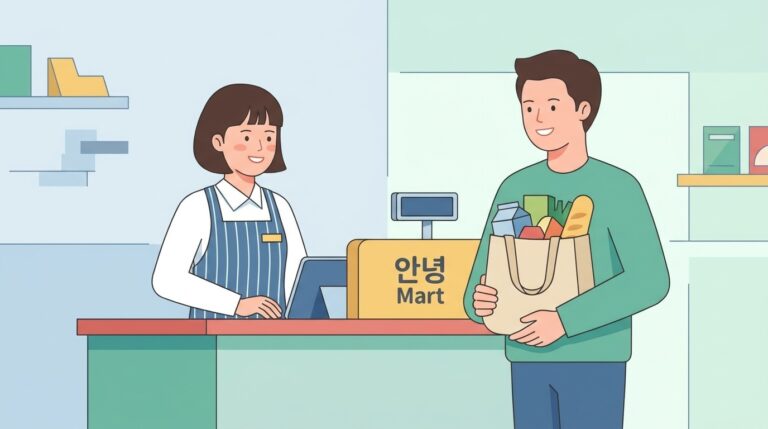
Picture this: You are standing at a bustling convenience store counter in Seoul after a long evening of sightseeing. Your arms are loaded with treasures—truffle potato chips, sweet banana milk, and a pack of spicy ramyun. The cashier rapidly beeps each barcode. You have your card ready, feeling proud of your smooth adventure so far. But suddenly, the cashier glances at your towering stack and asks with lightning speed: “봉투 필요하세요?” (Bongtu pil-yohaseyo?)
Your mind goes completely blank. Did they ask if you want a receipt? A discount card? A bag? You freeze, offer a hesitant nod, and suddenly you are paying 100 won for a gigantic 20-liter official city trash bag you have no idea how to carry. Or worse, you vigorously shake your head “no” out of panic, only to end up juggling five loose items down the streets of Hongdae like a circus performer.
Take a deep breath! You are definitely not alone. Over 85% of our beginner learners tell us that the grocery checkout counter is their very first real-world “language roadblock” in Korea. Today, we are breaking down this exact moment. By the end of this guide, you will handle cashier bag questions smoothly, naturally, and with total local confidence!
Phase 2: Core 3 Expressions In-Depth Analysis
1. 네, 봉투 하나 주세요. (Ne, bongtu hana juseyo.)
- Pronunciation: [Ne, bong-tu ha-na ju-se-yo] (Think of bong like the ringing sound of a bell, and tu like the number “two”)
- Meaning: Literal: “Yes, please give me one bag.” | Nuance: A crisp, polite, and standard way to request a bag.
- K-Culture Moment: You will see this all the time in K-Dramas like Hospital Playlist or Business Proposal when characters stop by a local mart after work to pick up canned beer and snacks.
- Editor’s Insight: Using the counter 하나 (hana – one) sounds much more natural and friendly than just saying 네, 주세요 (Yes, give it to me).
- Situation Spectrum: Casual: ⚠️ | Semi-formal (Mart/Store): ✅ | Formal: ✅
- 🤔 Think About It: In English, we often just say “Yes, please.” In Korean, specifying the item (봉투 하나) keeps the tone clear and respectful toward service workers.
2. 아니요, 괜찮아요. (Aniyo, gwaenchanayo.)
- Pronunciation: [Ah-nee-yo, gwen-chah-nah-yo] (Gwaen rhymes with “when”, chan sounds like “chahn”)
- Meaning: Literal: “No, it is fine/okay.” | Nuance: “No thank you, I don’t need one.”
- K-Culture Moment: Seen whenever someone pulls out their own canvas tote bag in lifestyle vlogs while shopping at zero-waste eco-markets in Seongsu-dong.
- Editor’s Insight: Saying just 아니요 (No) in Korean can sound curt or defensive. Adding 괜찮아요 (It’s okay) instantly softens your refusal into polite manners.
- Situation Spectrum: Casual: ✅ | Semi-formal: ✅ | Formal: ✅
- 🤔 Think About It: Notice how Korean culture favors harmony: rather than a direct rejection, you reassure the speaker that you are completely “fine” without it.
3. 종량제 봉투로 주세요. (Jongnyangje bongturo juseyo.)
- Pronunciation: [Jong-nyang-je bong-tu-ro ju-se-yo] (Break it down: Jong + Nyang + Je)
- Meaning: Literal: “Please give it to me as a volume-rate garbage bag.” | Nuance: “I’d like a standard city trash bag, please.”
- K-Culture Moment: In slice-of-life dramas like My Liberation Notes, characters living alone always ask for this bag because Korean residents must use certified district trash bags for household waste.
- Editor’s Insight: This is the ultimate insider local move! Instead of buying a regular plastic bag that you throw away, convenience stores sell district-certified white garbage bags that you can use as a shopping bag first, and then as your home trash bag.
- Situation Spectrum: Casual: ⚠️ | Semi-formal: ✅ | Formal: ✅
- 🤔 Think About It: How does your home country handle garbage collection? In Korea, waste management is tied directly into retail shopping habits!
Phase 3: Textbook Korean vs. Real-Life Korean
Situation 1: Declining a bag because you brought your own backpack or tote
- 📖 교과서 한국어 (Textbook): 저는 가방이 있으므로 봉투가 필요하지 않습니다. (Jeoneun gabang-i isseumeuro bongtuga pil-yohaji anseumnida. – Since I have a bag, a bag is not necessary.)
- 🗣️ 진짜 한국어 (Real Life): 장바구니 있어요. (Jangbaguni isseoyo. – I have a grocery shopping bag.) or 그냥 들고 갈게요. (Geunyang deulgo galgeyo. – I will just carry it in my hands.)
- 💡 왜 다를까? (Why the difference?): Nobody speaks in heavy grammar markers at convenience stores. Real native Koreans state their current situation briefly in one snappy phrase.
Situation 2: Asking the staff to pack your purchases into the bag
- 📖 교과서 한국어 (Textbook): 물건들을 비닐봉지 안에 넣어 주십시오. (Mulgeondeul-eul binilbongji ane neoeo jusipsio. – Please insert the items inside the plastic bag.)
- 🗣️ 진짜 한국어 (Real Life): 여기에 담아주세요. (Yeogie dama-juseyo. – Please put them in here.)
- 💡 왜 다를까? (Why the difference?): The verb 담다 (damda – to put into/fill) is the universal natural verb for bagging groceries. Pair it with 여기 (here) while pointing at your bag for effortless fluency.
Phase 4: K-Culture Deep Dive & Non-Verbal Manners
4-1. 눈치 (Nunchi) & Gestures
When answering a cashier in Korea, your body language speaks just as loud as your words:
* The Gentle Hand Wave (손사래 – Sonsarae): If you don’t need a bag, softly wave your hand back and forth near your chest level with a slight head bow. It universally communicates “No need, thank you!” even before you speak.
* The Two-Handed Handoff: While asking for a bag or paying, hand your card or cash using both hands (or touch your right elbow with your left hand). This shows respect and makes store clerks instantly warm up to you.
4-2. Culture Code: The Single-Use Plastic Ban & The Magic Bag
Since 2019, South Korea implemented strict environmental laws banning large supermarkets and department stores from providing disposable plastic bags (비닐봉투). Convenience stores charge around 100~200 KRW for paper or plastic bags.
Because of this, the country popularized the 종량제 봉투 (Jongnyangje bongtu) system. When shopping at mart chains like E-Mart Everyday or GS The Fresh, cashiers won’t just ask if you need a bag; they will ask “종량제 드릴까요?” (Shall I give you a waste disposal bag?). Don’t be shocked by the printed text on the bag—it’s eco-friendly multitasking at its finest!
Phase 5: Real-World Roleplay Scenario
Setting: 10:30 PM at a brightly lit CU convenience store near Hongdae Station. Cashier Minho is scanning your late-night ramyeon, drinks, and snacks.
- Turn 1 (Minho): 바코드 찍겠습니다. (Bakodeu jikgetseumnida.) — “I will scan the barcodes.”
🎭 (Quickly scans items with beeping sounds) - Turn 2 (You): 네, 감사합니다. (Ne, gamsahamnida.) — “Yes, thank you.”
🎭 (Holding card with both hands) - Turn 3 (Minho): 봉투 필요하세요? (Bongtu pil-yohaseyo?) — “Do you need a bag?”
🎭 (Looks up making brief eye contact) - Turn 4 (You): 네, 봉투 하나 주세요. (Ne, bongtu hana juseyo.) — “Yes, please give me one bag.”
🎭 (Smiles politely) - Turn 5 (Minho): 종량제로 드릴까요, 비닐로 드릴까요? (Jongnyangjero deurilkkayo, binillo deurilkkayo?) — “Would you like a trash bag or a regular plastic bag?”
🎭 (Holds two different bags under the counter) - Turn 6 (You): 비닐로 주세요. (Binillo juseyo.) — “Regular plastic, please.”
🎭 (Points lightly to the clear bag) - Turn 7 (Minho): 백 원 추가됩니다. 카드 꽂아주세요. (Baek won chugadoemnida. Kadeu kkojajuseyo.) — “That is 100 won extra. Please insert your card.”
🎭 (Motions toward the card terminal) - Turn 8 (You): 네, 여기요. 감사합니다! (Ne, yeogiyo. Gamsahamnida!) — “Yes, here it is. Thank you!”
🎭 (Inserts card smoothly)
🔀 Interactive Choice Point
The cashier asks: “봉투 필요하세요? (Bongtu pil-yohaseyo?)” but you brought your own tote bag! How do you respond?
* Choice A: 필요 없어! (Pil-yo eopseo!)
* Feedback: 🚫 Bad! This is informal panmal (banmal). Speaking this to a cashier sounds rude and dismissive.
* Choice B: 아니요, 그냥 손에 들고 갈게요. (Aniyo, geunyang sone deulgo galgeyo.)
* Feedback: ⚠️ Risk! Grammatically fine, but a bit long and awkward if you actually have a tote bag with you.
* Choice C: 아니요, 장바구니 있어요! (Aniyo, jangbaguni isseoyo!)
* Feedback: ✅ Best! Polite, crystal-clear, and instantly lets the cashier know they don’t need to charge or pack a bag for you.
Phase 6: 10-Second Emotional Shadowing Drill
Read these aloud matching the emotion and pause points (/)! Repeat three times:
- [😊 Brightly & Confidently]
네, / 봉투 하나 / 주세요! (Ne, / bongtu hana / juseyo!)
“Yes, / one bag / please!” -
[😌 Gently & Politely]
아니요, / 괜찮아요. / 가방 있어요. (Aniyo, / gwaenchanayo. / Gabang isseoyo.)
“No, / it’s okay. / I have a bag.” -
[💡 Savvy & Local-like]
종량제 봉투로 / 한 장 / 주세요! (Jongnyangje bongturo / han jang / juseyo!)
“A city trash bag, / one piece, / please!”
Phase 7: K-Culture Mini Dictionary
- 종량제 봉투 (Jongnyangje bongtu) | Pay-as-you-throw District Garbage Bag | The official trash bag authorized by specific districts (Gu) in Korea. Essential for Airbnb guests and residents!
- 장바구니 (Jangbaguni) | Grocery/Shopping Eco-Bag | Literally “market basket.” Used widely for fabric tote bags and foldable nylon shopping bags.
- 비닐봉투 (Binilbongtu) | Single-use Plastic Bag | Derived from “vinyl.” Common term for light plastic grocery bags that carry a small government fee.
- 담아주세요 (Dama-juseyo) | Please pack/put this into… | The most common phrase when you want the cashier to place items inside your own bag or an opened paper bag.
Phase 8: Traveler’s Survival Kit
Survival Expressions TOP 3
- 봉투 값 얼마예요? (Bongtu gaps eolmayeyo?)
- [Bong-tu gap eol-ma-ye-yo?]
- Pro Tip: Use this if you are calculating coins or curious about extra charges.
- 그냥 가져갈게요. (Geunyang gajyeogalgeyo.)
- [Geun-yang ga-jyeo-gal-ge-yo.]
- Pro Tip: Perfect when you bought just one coffee drink or snack and want to carry it in your hand.
- 영수증 버려주세요. (Yeongsujeung beoryeojuseyo.)
- [Yeong-su-jeung beo-ryeo-ju-se-yo.]
- Pro Tip: “Please throw away the receipt.” You’ll often be asked right after the bag question!
Editor’s Travel Note
When traveling around Korea, keep a compact foldable nylon bag clipped to your daypack. Convenience stores usually charge card payments smoothly even for a single 100-won bag, so don’t fret about having exact change. To locate nearby supermarkets, hypermarts, and 24-hour marts with foreign card support, search using the Naver Map navigation app instead of Western map apps which often lack real-time local mart inventories.
Phase 9: “한 발 더 깊이” (One Step Deeper)
In many Western countries, asking for a shopping bag is purely a matter of logistics. In Korea, however, this simple question reflects a deep community consensus around environmental responsibility and civic duty. When the cashier asks “봉투 필요하세요?”, they are participating in a nationwide green initiative designed to reduce landfill plastic. Saying “괜찮아요” with your own bag is seen as a subtle badge of civic pride.
💬 Your Turn: What does your home country do with plastic grocery bags? Do cashiers ask you every time, or do you have to bring your own? Share your shopping stories in the comments below! 따뜻한 댓글 부탁드려요! (Leave us a warm comment!)
Phase 10: FAQ & Common Mistakes
Q: What should I say if the cashier asks me something I don’t understand at the counter?
A: Most counter questions follow an exact 3-step sequence: 1. Bags (봉투 필요하세요?), 2. Loyalty points (포인트 적립하세요?), and 3. Receipts (영수증 드릴까요?). If you don’t need any of them, a polite smile with “괜찮아요, 감사합니다” (Gwaenchanayo, gamsahamnida) solves 95% of misunderstandings!
Q: Can I use a convenience store 종량제 봉투 (trash bag) in a different city or district?
A: No! Official trash bags are tied to specific districts (e.g., Mapo-gu, Gangnam-gu, or Jongno-gu). If you buy a trash bag in Hongdae (Mapo-gu), you cannot dispose of it in Gangnam. If you are moving hotels, ask for a regular 비닐봉투 (binilbongtu) instead.
Q: Is it rude to ask for two bags if my items are heavy?
A: Not at all! Just say: “두 장 주세요.” (Du jang juseyo – Please give me two sheets/bags). They will simply ring up the small extra fee twice.
🚨 흔한 실수 (Common Mistakes) Warning Board
- Mistake 1: Saying “아니요” (Aniyo) with no follow-up.
- Why it fails: It sounds blunt and irritated.
- Correct Action: Soften with “아니요, 괜찮아요” (No, I’m alright).
- Mistake 2: Confusing ‘비닐 (binil)’ with ‘비밀 (bimil)’.
- Why it fails: 비닐 is vinyl/plastic, but 비밀 means “secret”! Asking for a “secret bag” will definitely earn you puzzled looks.
- Correct Action: Pronounce clearly: Bi-nil.
- Mistake 3: Handing credit cards carelessly with one hand.
- Why it fails: In Korean customer etiquette, one-handed card tosses are viewed negatively.
- Correct Action: Always offer payment cards with both hands.
Phase 11: Action Missions
- 🥉 Bronze Level: Stand in front of your mirror with a water bottle. Practice saying “네, 봉투 하나 주세요!” and “아니요, 괜찮아요!” three times each with natural hand gestures.
- 🥈 Silver Level: Next time you watch a modern K-Drama, spot a convenience store scene. Listen closely to see if the cashier asks “봉투 필요하세요?” and mimic the actor’s reply.
- 🥇 Gold Level: Visit a local Korean supermarket (like H-Mart) or travel to Korea, buy your favorite snack, and decline or accept the bag entirely in polite Korean!
🎮 K-Culture Mission: Search YouTube for “Korean Convenience Store ASMR” or “Vlog Mart Shopping” (편의점 브이로그). Drop a comment noting how many times you hear the word 봉투!
Phase 12: Interactive Quiz Challenge
Q1. Situational Judgment:
You are buying 4 cold beers at a convenience store and want a normal plastic bag. What is the most natural thing to say?
* A) 비닐봉지 넣어!
* B) 비닐봉투 하나 주세요.
* C) 비밀 봉투 필요해.
Q2. Fill in the Blanks:
“I don’t need a bag, I have an eco-shopping bag!”
아니요, 괜찮아요. [ _______ ] 있어요! (Hint: Starts with 장-)
Q3. True or False Culture Check:
In South Korea, you can buy official government-regulated garbage bags directly at checkout counters in convenience stores and use them as grocery bags.
* (True / False)
👉 Click here to reveal the answers and explanations!
- A1 Answer: B) 비닐봉투 하나 주세요. (A is impolite informal speech; C uses the word for “secret” instead of plastic!)
- A2 Answer: 장바구니 (Jangbaguni) (Meaning grocery bag / market tote bag).
- A3 Answer: True! This is the famous 종량제 봉투 (Jongnyangje bongtu) system, one of Korea’s smartest eco-friendly policies!






