

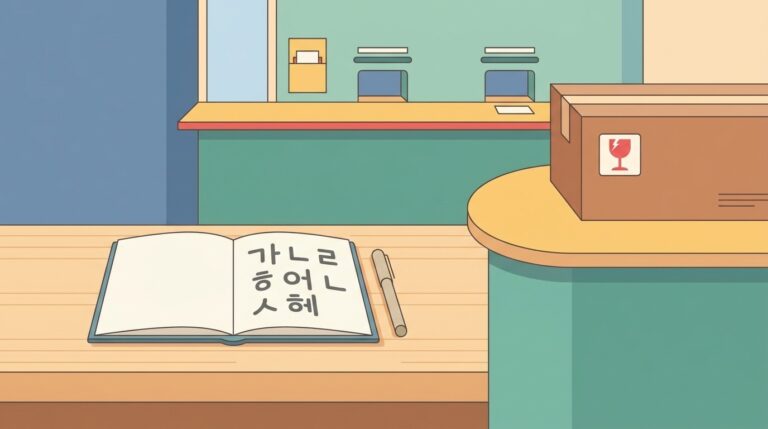
안녕하세요! 매일한글 에디터입니다. (Hello! I’m your Daily Hangul editor.)
Phase 1: Empathy (Story-Immersive Opening)
Imagine this: You have just spent an incredible afternoon wandering through the artistic alleys of Insadong. After hours of browsing, you found the crown jewel of your trip—a handcrafted, delicate ceramic tea set from an artisan studio, along with limited-edition glass skincare bottles from Olive Young and an official glow stick (응원봉 / eung-won-bong) for your favorite K-Pop group. You walk proudly into a local Korean post office (우체국 / ucheguk) to ship these treasures home safely to your family. But as the clerk lifts your box onto the scale, your heart skips a beat. How do you explain that inside this humble cardboard box lies something precious and delicate? You freeze, searching for words, while the postal stamp looms in the clerk’s hand.
Don’t worry! Every Korean learner and traveler has felt that sudden spike of panic at service counters. This step-by-step guide is built directly from real beginner feedback and 10 years of on-the-ground tutoring experience. By mastering just one core phrase and a couple of supporting words, you will never have to worry about your souvenirs being tossed around in transit again. Let’s make your post office run smooth, polite, and completely stress-free!
Phase 2: Deep Dive into 3 Core Expressions
1. 깨지는 물건이에요 (Kkaejineun mulgeon-ieyo)
- Pronunciation: [Kkae-ji-neun mool-geon-ee-yeo] (Think of ‘Kkae’ like cracking an egg, followed by ‘jeen-eun’ and ‘mul-geon’ sounding like ‘mool’ in water + ‘gun’)
- Meaning: “It’s a breakable / fragile item.” (Literal: “It is a breaking thing.”)
- K-Culture Moment: In K-Dramas like Crash Landing on You or Hospital Playlist, whenever characters box up handmade side dishes (반찬) in glass containers, they point to the box and emphasize this exact phrase so the courier handles it with gentleness.
- Editor’s Insight: The base verb is 깨지다 (kkaejida, to break/shatter). Adding ~는 물건 (neun mulgeon) turns it into an adjective-noun pair: “thing that breaks.” The ending ~이에요 (ieyo) gives it a polite, friendly, everyday tone perfect for service counters.
- Situation Spectrum: Casual (⚠️ 깨지는 거야) / Semi-formal (✅ 깨지는 물건이에요) / Formal (✅ 깨지기 쉬운 물품입니다)
- 🤔 Think About It: In English, we have a specialized Latin-derived word: “fragile.” Korean often prefers descriptive, sensory verbs rooted in everyday reality—literally saying “an object that can shatter.”
2. 조심히 다뤄 주세요 (Josimhi darwo juseyo)
- Pronunciation: [Jo-seem-hee da-rwo joo-seh-yo] (Jo-seem rhymes with ‘gleam’, da-rwo sounds like ‘da-row’, ju-se-yo is your go-to polite request)
- Meaning: “Please handle it carefully.” (Literal: “Carefully treat/handle, please give.”)
- K-Culture Moment: When idols unbox rare vinyl records or autographed merch during live streams, they gently tell the staff: “조심히 다뤄 주세요!” (Please treat it gently!).
- Editor’s Insight: If remembering 다루다 (to handle) feels overwhelming at A1 level, simply saying 조심히 해 주세요 (Josimhi hae juseyo / Please do it carefully) works like magic too!
- Situation Spectrum: Casual (🚫 조심히 다뤄) / Semi-formal (✅ 조심히 다뤄 주세요) / Formal (✅ 조심스럽게 취급해 주시기 바랍니다)
- 🤔 Think About It: The ending ~주세요 (juseyo) literally means “please give (the favor of).” Notice how Korean politeness is framed around offering interpersonal care rather than impersonal directives.
3. ‘취급주의’ 스티커 붙여 주세요 (‘Chwigeupjuui’ seutikeo buchyeo juseyo)
- Pronunciation: [Chwee-geup-joo-ui seu-tee-keo boo-chyeo joo-seh-yo]
- Meaning: “Please put a ‘Handle with Care’ sticker on it.”
- K-Culture Moment: Walking into any Korean post office, you will spot bright red stickers with bold white font reading 취급주의. Pointing to them and using this phrase instantly marks you as an experienced Korea traveler.
- Editor’s Insight: 취급 (handling) + 주의 (caution). Combine this with 붙여 주세요 (please stick/attach it) to guarantee visual warning labels across all delivery hubs.
- Situation Spectrum: Casual (⚠️ 스티커 붙여줘) / Semi-formal (✅ 스티커 붙여 주세요) / Formal (✅ 취급주의 스티커 부착 부탁드립니다)
- 🤔 Think About It: Korea’s high-speed delivery networks process millions of packages daily. Clear visual cues like bold stickers are culturally trusted more than oral reminders alone.
Phase 3: Textbook Korean vs. Real Korean
Situation 1: Asking for Protective Wrapping
- 📖 Textbook Korean: 완충재가 있습니까? (Wanchungjaega itsseumnikka?) – “Do you possess cushioning material?”
- 🗣️ Real Korean: 뽁뽁이 있어요? (Bpok-bpoki isseoyo?) – “Do you have bubble wrap?”
- 💡 Why is it different? 완충재 is a formal industrial term found in shipping manuals. Everyday Koreans use the playful onomatopoeia 뽁뽁이 (bpok-bpoki), mimicking the ‘pop-pop’ sound made when squeezing air bubbles!
Situation 2: Informing the Staff that the Item Can Break
- 📖 Textbook Korean: 파손 위험이 높은 물건입니다. (Pason wiheomi nopeun mulgeon-imnida.) – “This is an object with a high risk of breakage.”
- 🗣️ Real Korean: 안에 유리 있어서요, 깨지는 물건이에요! (Ane yuri isseoseoyo, kkaejineun mulgeon-ieyo!) – “There’s glass inside, so it’s breakable!”
- 💡 Why is it different? Natural conversational Korean avoids dry legalistic nouns (파손 위험) in favor of stating the actual cause casually with the connector ~어서요/아서요 (because/since).
Phase 4: K-Culture Deep Dive & Non-Verbal Manners
4-1. 눈치 (Nunchi) & Gestures at the Counter
When submitting a package at a Korean post office, your body language speaks volumes before you even say a word:
1. Two-Handed Delivery (두 손 매너): Always slide your package forward with both hands. It instantly signals respect and shows that the box contains something valuable.
2. The Gentle Point & Nod: When saying “깨지는 물건이에요,” lightly tap the top center of the box with your index and middle fingers together, making eye contact with the clerk and offering a gentle 15-degree head bow.
3. Post-Transaction Bow: After the clerk applies the red sticker, say “감사합니다 (Gamsahamnida)” with another small bow. Service workers deeply appreciate thoughtful customers.
4-2. Cultural Code: The Balancing Act of ‘Ppal-li Ppal-li’ and Care
Korea is world-famous for its lightning-fast courier culture (택배 / taekbae), where items often arrive the next morning. However, speed can sometimes mean parcels get jostled in sorting chutes. Koreans navigate this with proactive preparation: before going to the counter, they wrap items generously at the packaging station (자율 포장대). Communicating clearly that your package is fragile lets the sorting staff route it to special handling containers.
Phase 5: Real-Life Roleplay Scenario
Setting: Gwanghwamun Post Office in Seoul. The lobby is bright and bustling with the rhythmic sound of brown tape peeling. You walk up to Counter 3 holding a taped box with ceramic souvenirs.
Characters:
* You (민우 / Min-woo): A beginner traveler mailing gifts.
* Post Office Clerk (직원 / Jik-won): An efficient, warm postal worker in a neat blue vest.
- Turn 1 (Staff): 안녕하세요! 저울 위에 올려놓으세요. (Annyeonghaseyo! Jeoul wie ollyeonoeuseyo.) — “Hello! Please place it on the scale.”
🎭 Motions to the digital scale with an open palm. - Turn 2 (You): 네, 여기요. (Ne, yeogiyo.) — “Yes, here it is.”
🎭 Carefully places the box onto the scale using both hands. - Turn 3 (You): 저기… 깨지는 물건이에요. (Jeogi… kkaejineun mulgeon-ieyo.) — “Excuse me… it’s a fragile item.”
🎭 Looks at the clerk with a slight, cautious nod. - Turn 4 (Staff): 아, 그래요? 안에 뭐가 들었어요? (A, geuraeyo? Ane mwoga deureosseoyo?) — “Ah, really? What’s inside?”
🎭 Pauses hand on the barcode scanner. - Turn 5 (You): 컵이랑 유리병이 들었어요. 조심히 다뤄 주세요. (Keob-irang yuribyeongi deureosseoyo. Josimhi darwo juseyo.) — “There are cups and glass bottles inside. Please handle them carefully.”
🎭 Gestures gently toward the parcel. - Turn 6 (Staff): 네, 알겠습니다. 뽁뽁이로 많이 감싸셨어요? (Ne, algetseumnida. Bpok-bpok-iro mani gamssasyeosseoyo?) — “Understood. Did you wrap it thoroughly with bubble wrap?”
🎭 Reaches into a drawer under the desk. - Turn 7 (You): 네! ‘취급주의’ 스티커 붙여 주세요. (Ne! ‘Chwigeupjuui’ seutikeo buchyeo juseyo.) — “Yes! Please put a ‘Handle with Care’ sticker on it.”
🎭 Smiles politely. - Turn 8 (Staff): 네, 빨간 스티커 크게 붙여 드릴게요! (Ne, ppalgan seutikeo keuge buchyeo deurilgeyo!) — “Sure, I will put a big red sticker on it for you!”
🎭 Slaps two red caution stickers on the top and side of the box with a reassuring grin.
🔀 Interactive Decision Point
The clerk asks: “해외로 보내실 건가요? (Haeoero bonaesil geongayo? / Are you sending this overseas?)” How do you respond?
- Option A: 네, 미국으로 보내요. 항공으로 부탁해요. (Ne, migugeuro bonaeyo. Hanggong-euro butakaeyo.)
- Feedback (Best): Clear destination (USA) and shipping method (airmail). Polite and precise!
- Option B: 깨져요! 안 돼요! (Kkaejyeoyo! An dwaeyo!)
- Feedback (Bad): Saying “It breaks! No!” doesn’t answer where it is going and sounds like an emotional panic response rather than answering the clerk’s question.
- Option C: 몰라요, 알아서 해 줘. (Mollayo, araseo hae jwo.)
- Feedback (Risk): “I don’t know, just do it yourself” in informal banmal (반말). This sounds very rude to a service worker. Always stick to polite forms like ~주세요.
Phase 6: 10-Second Emotional Shadowing Drill
Read these out loud, pausing at each / mark and bringing the emotion to life!
[🥺 간절하고 조심스럽게 / Pleading & Careful]- 저기요, / 깨지는 물건이에요. (Jeogiyo, / kkaejineun mulgeon-ieyo.)
- “Excuse me, / it’s a breakable item.”
[🙏 정중하고 다정하게 / Polite & Gentle]- 조심히 / 다뤄 주세요. (Josimhi / darwo juseyo.)
- “Please / handle it carefully.”
[😊 확실하고 밝게 / Clear & Confident]- ‘취급주의’ 스티커 / 붙여 주세요! (‘Chwigeupjuui’ seutikeo / buchyeo juseyo!)
- “A ‘Handle with Care’ sticker / please attach it!”
Phase 7: K-Culture Mini Dictionary (4 Core Words)
- 뽁뽁이 (Bpok-bpoki) | Bubble wrap
- Real-world usage: Walk up to any post office counter or stationery store and say: “뽁뽁이 좀 더 주세요 (Please give me a bit more bubble wrap).” Everyone uses this friendly name.
- 취급주의 (Chwigeup-juui) | Handle with care / Fragile warning
- Real-world usage: The official classification term on logistics manifests and bright red labels. You will see it printed on delivery trucks and shipping labels.
- 택배 (Taekbae) | Courier delivery service / Parcel
- Real-world usage: Refers to both the delivery service system and the parcel itself. “택배 왔어요!” (The package is here!) is one of the sweetest sounds in any Korean apartment.
- 상자 (Sangja) | Box / Parcel carton
- Real-world usage: Korean post offices sell standardized boxes labeled 1호 through 5호 (Sizes 1 to 5). You can pick your size right from the open sample shelf.
Phase 8: Survival Kit for Travelers
Top 3 Survival Expressions
- 박스 테이프 어디 있어요? (Bakseu teipeu eodi isseoyo?)
- Romanization: Bak-seu te-ee-peu eo-dee ee-sseo-yo?
- Pro Tip: Korean post offices have dedicated packing tables equipped with complimentary tape, scissors, glue, and tape dispensers. If you can’t spot them, just ask this!
- 이거 1호 상자 맞아요? (Igeo il-ho sangja majayo?)
- Romanization: Ee-geo eel-ho sang-ja ma-ja-yo?
- Pro Tip: Box 1 (1호) is tiny (great for jewelry/small cosmetics), while Box 5 (5호) is massive (great for winter puffer jackets). Check the sample board on the wall.
- 영수증 주세요 (Yeongsujeung juseyo)
- Romanization: Yeong-soo-jeung joo-seh-yo
- Pro Tip: Essential for tracking! The receipt contains your 등기번호 (tracking number), which you can track real-time via KakaoTalk or internet postal tracking.
Editor’s Travel Note
- Locating the Nearest Branch: Before heading out, search for “우체국” directly using the Naver Map app download guide to see real-time opening hours and counter waiting times.
- Payment Manners: Korean post offices accept foreign credit cards (Visa, Mastercard) and transit/prepaid cards (T-Money/Wowpass) at checkout counters. You don’t need cash even for small box purchases!
Phase 9: One Step Deeper (Cultural Reflection)
In Korean society, adding ~해 주세요 (~hae juseyo) is more than just grammatical politeness. It stems from a communal philosophy of relational harmony (정 / Jeong) and mutual consideration (배려 / Baeryeo). When you let a postal worker know that an item is fragile, you are not issuing a strict operational demand. Instead, you are inviting them into a shared responsibility to safeguard something meaningful to you. Recognizing this shared human connection transforms a cold bureaucratic chore into a heartwarming interaction.
💬 Your Turn: Have you ever worried about shipping fragile souvenirs home while traveling abroad? What is the most delicate souvenir you’ve ever bought? Share your story in the comments below!
Phase 10: FAQ & Common Mistakes
Q: Can I buy bubble wrap directly at the Korean post office?
A: Yes! Most Korean post offices provide basic amounts of bubble wrap (뽁뽁이) for free at the self-packing table (자율 포장대). If you need large rolls for extensive packing, larger central branches sell extra bundles at the counter for a modest fee.
Q: What is the difference between 깨지다 (kkaejida) and 부서지다 (buseojida)?
A: 깨지다 is specifically used for brittle materials that crack or shatter, like glass, porcelain, ceramic, or phone screens. 부서지다 refers to objects crumbling or breaking apart structurally, like biscuits, furniture, or rocks.
Q: Does the 취급주의 sticker cost extra money?
A: No, the fragile stickers (취급주의 스티커) are completely free of charge! You can ask the clerk to attach them, or find them sitting at the open packaging station to paste on yourself.
🚨 Common Mistakes Warning Board
- Mistake 1: Saying “안전하게 보내요” (Send safely) without context.
- Correction: Say “깨지는 물건이에요, 조심히 다뤄 주세요.” It explains why the parcel needs caution.
- Mistake 2: Tapping your box aggressively while saying “노 브레이크! (No break!)”
- Correction: Use the natural phrase “유리 있어요 (There is glass inside)” or point gently to the red 취급주의 sticker.
- Mistake 3: Dropping your parcel on the counter with one hand and walking away.
- Correction: Wait until the clerk confirms weight and destinations, and always slide the parcel onto the scale using both hands.
Phase 11: Action Mission & Engagement
- 🥉 Bronze Mission (Solo Practice): Stand in front of your mirror with an empty mug or cosmetic bottle. Practice saying “깨지는 물건이에요. 조심히 다뤄 주세요!” three times with a natural two-handed gesture.
- 🥈 Silver Mission (Social Share): Take a photo of any parcel or package at home. Add a virtual red label text box saying #취급주의 and post it on your Instagram Story or X, tagging
@DailyHangul! - 🥇 Gold Mission (Field Challenge): Visit a local Korean convenience store or post office during your trip, ask for a box or bubble wrap, and use at least two phrases from this lesson.
- 🎮 K-Culture Mission: Next time you watch an unboxing video by your favorite K-Pop idol on YouTube or Weverse, listen carefully for the words 뽁뽁이 and 조심히!
Phase 12: Interactive Quiz Challenge
1. Situation Decision: You are at the post office desk mailing a handcrafted ceramic dish. The clerk reaches for your box quickly. What is the most polite and natural A1 phrase to say right now?
* A) 이거 비싸요! 만지지 마세요! (This is expensive! Don’t touch!)
* B) 깨지는 물건이에요. 조심히 다뤄 주세요. (It’s a fragile item. Please handle it carefully.)
* C) 부서졌어요. 다시 해 줘. (It crumbled. Do it again.)
2. Fill in the Blank: Complete the phrase to request a fragile caution label:
* “___________ 스티커 붙여 주세요!” (Please attach the ‘Handle with Care’ sticker!)
3. True or False: In Korea, the cute term ‘뽁뽁이 (Bpok-bpoki)’ is only baby talk and should never be used at official post office counters.
* [True / False]
👉 Click here to check the answers & explanations!
- 1. Answer: B
- Explanation: Option B is the gold standard of polite service communication. Option A sounds accusatory, and Option C is grammatically incorrect and rude.
- 2. Answer: 취급주의 (Chwigeupjuui)
- Explanation: The four-character word 취급주의 translates directly to “Handle with Care.”
- 3. Answer: False
- Explanation: While it originated as playful onomatopoeia, 뽁뽁이 is universally accepted and used by adults, staff members, and store clerks across all of South Korea!
- Explanation: While it originated as playful onomatopoeia, 뽁뽁이 is universally accepted and used by adults, staff members, and store clerks across all of South Korea!







