

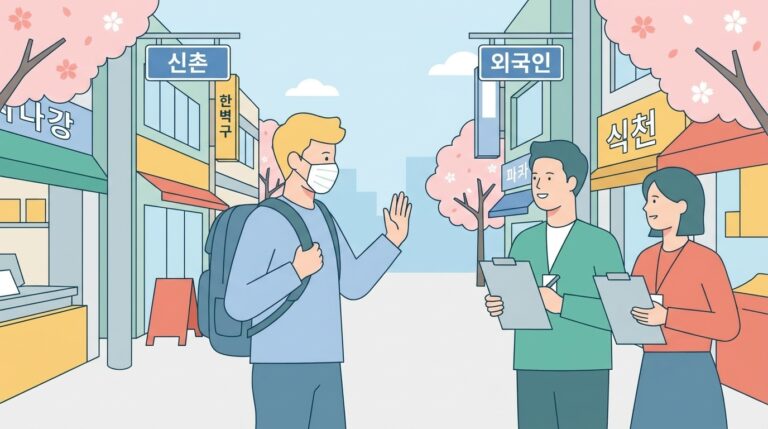
Phase 1: Empathy (Story-Immersive Opening)
안녕하세요! 매일한글 에디터입니다. (Hello! This is your Daily Hangul editor.)
Picture this: You are taking a leisurely stroll near Exit 2 of Sinchon Station or soaking in the vibrant energy of Hongdae. Suddenly, two well-dressed, remarkably polite young Koreans approach you with warm, disarming smiles. “Excuse me, are you a foreign student? You have such a clear, pure aura! We are university students working on a cultural research project regarding Korean traditional ancestry—could you spare just five minutes for a quick survey?”
It feels innocent, even flattering. You want to practice your Korean, show appreciation for the culture, and avoid seeming rude. But before you know it, five minutes turns into an hour at a nearby café, where the conversation subtly veers into spiritual blockages, your family’s ancestral debt, and an urgent invitation to an underground “cleansing ceremony” (치성) requiring a nominal cash donation.
You have just crossed paths with a classic Korean pseudo-religious proselytization team (사이비 종교 포교). For foreign residents and advanced Korean learners, this is one of the most unsettling, pervasive cultural pitfalls in South Korea. Because high-level speakers naturally pride themselves on social integration, cult recruiters deliberately exploit your politeness, loneliness, or cultural curiosity using sophisticated psychological grooming.
Drawing from a decade of field navigation and real feedback from foreign residents in Seoul, this guide provides a C2-level sociolinguistic defense system. You will master authoritative, culturally attuned linguistic boundary markers to shut down predatory recruiters instantly—without losing your composure or dignity.
Phase 2: Deep Dive into 3 Core Expressions
1. 인상이 맑으시다는 둥의 접근은 정중히 사양하겠습니다.
- Pronunciation: Insang-i malgeusidaneun dung-ui jeopgeun-eun jeongjung-hi sayanghagetseumnida. (Phonetic vibe: Think of malg-eu-shi-da flowing smoothly into dung-eui, delivered with a brisk, crisp cadence similar to a formal British barrister declaring an objection.)
- Meaning: Literal: “I politely decline approaches along the lines of having a clear impression/aura.” | Real Nuance: “I see through your pseudo-religious opening gambit, and I will not entertain this conversation for another second.”
- K-Culture Moment: Seen frequently in urban thrillers or parodied in satirical webtoons like Yumi’s Cells, where an unsolicited compliment on the street is universally recognized as the notorious calling card of groups like Daesun Jinrihoe (대순진리회).
- Editor’s Insight: The dependent noun 둥 (-다는 둥) adds a subtle, dismissive C2 edge, grouping their flattery into generic, predictable rhetoric. Pairing this dismissive nuance with the ultra-formal 정중히 사양하겠습니다 (I respectfully decline) creates an impenetrable psychological wall that leaves zero room for manipulative rebuttals.
- Situation Spectrum: Casual 🚫 | Semi-formal ⚠️ | Formal/Authoritative ✅
- 🤔 Think About It: In Western cultures, refusing someone directly is often considered basic honesty. In Korea, why does wrapping a firm refusal in hyper-polite vocabulary (정중히 사양하다) convey far more cold finality than blunt rudeness?
2. 제 의사에 반하여 계속 동행을 강요하시면 경범죄처벌법상 불안감 조성으로 신고하겠습니다.
- Pronunciation: Je uisa-e banhayeo gyesok donghaeng-eul gang-yohasimyeon gyeongbeomjoe-cheobeolbeop-sang buran-gam joseong-euro sin-gohagetseumnida. (Phonetic rhythm: Crisp and articulate, like a seasoned civil servant reciting regulatory statutes.)
- Meaning: Literal: “If you continue forcing your company against my will, I will report you under the Minor Offenses Act for causing public anxiety.” | Real Nuance: “Back off immediately; I know Korean criminal law, and I will not hesitate to summon law enforcement to deal with this harassment.”
- K-Culture Moment: Evocative of hard-hitting investigative journalism programs such as SBS’s Unanswered Questions (그것이 알고 싶다), where persistent street solicitors stalk victims until legal boundaries are explicitly articulated.
- Editor’s Insight: Pseudo-religious recruiters count on foreign targets feeling legally powerless and socially intimidated. Invoking 경범죄처벌법 제3조 (Minor Offenses Act, Article 3: persistently following someone or instigating anxiety) dismantles their assumed power dynamic instantly.
- Situation Spectrum: Casual 🚫 | Semi-formal 🚫 | Critical Legal Boundary ✅
- 🤔 Think About It: How does switching to legalistic terminology (제 의사에 반하여, 불안감 조성) alter your identity in the eyes of a predator from an “easy foreign target” to an “inconvenient risk”?
3. 학술 연구나 문화 교류를 빙자한 포교 활동에는 일절 응하지 않겠습니다.
- Pronunciation: Haksul yeon-guna munhwa gyo-ryu-reul bingjahan pogyo hwaldong-eneun iljeol eung-haji anketseumnida. (Phonetic flow: Staccato emphasis on bing-ja-han and il-jeol, projecting sharp intellectual awareness.)
- Meaning: Literal: “I will not respond in any way to proselytization activities disguised as academic research or cultural exchange.” | Real Nuance: “Your fake university survey routine is obvious. Save your breath.”
- K-Culture Moment: The thematic centerpiece of cult-exposure dramas like OCN’s Save Me (구해줘), where exploitative organizations mask indoctrination behind pseudo-academic seminars, mentorship programs, and community volunteer circles.
- Editor’s Insight: The Sino-Korean verb 빙자하다 (to use something as a pretext/guise) combined with the negative polarity adverb 일절 (absolutely not, under no circumstances) demonstrates flawless C2 command, revealing that you understand the covert mechanics of modern Korean cult recruitment.
- Situation Spectrum: Casual 🚫 | Semi-formal ⚠️ | Written/Verbal Ultimatum ✅
- 🤔 Think About It: Many cults recruit near university campuses using youth-centric pretexts. Why do you think manipulative organizations prey so heavily on the social value placed on “education” and “academic surveys” in South Korea?
Phase 3: Textbook Korean vs Real Korean
Situation 1: Declining an unsolicited street approach
- 📖 Textbook Korean: 저는 바쁩니다. 저리 가세요. (Jeoneun bappeumnida. Jeori gaseyo. – “I am busy. Go over there.”)
- 🗣️ Real Korean: 바빠서 갈 길 가겠습니다. 말 걸지 마세요. (Bappaseo gal gil ga-getseumnida. Mal geolji maseyo. – “I have somewhere to be. Do not speak to me.”)
- 💡 Why it differs: “저리 가세요” sounds childish, robotic, and emotionally uncertain. Real C2 Korean uses boundary-establishing spatial phrases like 갈 길 가겠습니다 (I am going my way) combined with the definitive directive 말 걸지 마세요 (Do not engage me in conversation), which leaves zero conversational opening for their persuasion tactics.
Situation 2: Ending contact after realizing an acquaintance is recruiting for a cult
- 📖 Textbook Korean: 당신의 종교 활동에 참여하고 싶지 않아요. (Dangsin-ui jonggyo hwaldong-e cham-yeohago sipji an-ayo. – “I do not want to participate in your religious activities.”)
- 🗣️ Real Korean: 포교 목적인 거 다 아니까 더 이상 연락하지 마세요. 계속 이러시면 차단하고 신고합니다. (Pogyo mokjeogin geo da anikka deo isang yeollakhaji maseyo. Gyesok ireosimyeon chadan-hago sin-gohamnida. – “I see right through your proselytizing intention, so stop contacting me. If you continue, I am blocking and reporting you.”)
- 💡 Why it differs: Using textbook words like “당신” sounds unnatural, and expressing personal preference (“~하고 싶지 않아요”) invites aggressive gaslighting (“It’s not religion, it’s personal wellness!”). Real native discourse cuts straight to the motive (포교 목적), followed by an uncompromising consequence (차단 및 신고).
Phase 4: K-Culture Deep Dive & Nonverbal Manners
4-1. Nunchi & Gestures: Breaking the Traps
When street recruiters approach, they exploit your innate Nunchi (눈치)—specifically your desire not to make an awkward scene. They stand in pairs: one speaks enthusiastically while the other cuts off your walking angle.
- The Nonverbal Rebuff: Do not stop walking. Even breaking your pace by one step signals vulnerability. If they step into your trajectory, raise one hand chest-high, palm facing outwards at a 45-degree angle (a definitive stop gesture in Korean social semiotics), keep your eyes fixed straight ahead rather than meeting their gaze, and shake your head slightly once.
- Vocal Tone: Never use a rising, questioning intonation (“네?”). Keep your voice low, flat, and devoid of emotional inflection. Monotone responses signal total communicative disinterest.
4-2. Cultural Code Analysis: The Cult Ecosystem in South Korea
Cult recruitment in Korea—from groups like Daesun Jinrihoe (known for their “Do you know the Tao?” / 도를 아십니까 lineage) to coercive apocalyptic movements like Shincheonji (신천지)—does not look like wild fanaticism at first glance. It leverages deep-seated cultural structures:
- Filial Piety & Ancestral Guilt (조상님의 한): Recruiters will often claim your ancestors are suffering, and that your life’s current anxieties stem from unresolved ancestral resentment (한). They offer a traditional ceremony called 치성 (Chiseong) or 제사 (Jesa) to “unblock your fortune.”
- The Weaponization of Jeong (정) and Collectivism: Foreigners often struggle with isolation. Recruiters fill this void by offering free Korean tutoring, family-style dinners, K-pop dance lessons, or personal mentoring. Once emotional dependence is forged, covert theological indoctrination begins.
Critically acclaimed Korean cultural works, such as the documentary series In the Name of God: A Holy Betrayal (나는 신이다) and the K-drama Save Me (구해줘), vividly illustrate how these groups systematically isolate individuals through social love-bombing followed by intense psychological guilt.
Phase 5: Real-Life Roleplay Scenario
Setting: A bustling afternoon in front of Sinchon Station, Exit 3. You are heading toward a bookstore. Two college-age youths with clipboards suddenly step into your path.
Characters:
* 민수 (Minsu): A deceptively charming, overly friendly recruiter carrying a clipboard.
* 지원 (Jiwon): Minsu’s partner, smiling warmly and blocking your peripheral exit route.
* You (Advanced Learner): A perceptive, boundary-confident resident who knows the routine.
민수: 실례지만 인상이 너무 선하고 맑으셔서 잠깐 멈추지 않을 수 없었습니다. (Silryejiman insang-i neomu seonhago malgeusyeoseo jamkkan meomchuji aneul su eopseotseumnida.)
🎭 [Steps directly into your walking path with an earnest, wide-eyed smile]
“Excuse me, but your impression is so pure and benevolent that I just had to stop you for a brief moment.”
You: 바빠서 갈 길 가겠습니다. 비켜주세요. (Bappaseo gal gil ga-getseumnida. Bikyeojuseyo.)
🎭 [Without stopping, maintaining a firm forward stride without meeting their eyes]
“I am in a hurry and going my way. Please step aside.”
지원: 아, 정말 딱 3분이면 돼요! 저희 대학교 동아리에서 한국 전통 심리 철학을 연구 중인데, 기운(氣)에 대한 설문만 해주시면 되거든요. (A, jeongmal ttak sambun-imyeon dwaeyo! Jeohui daehakgyo dong-ari-eseo hanguk jeontong simni cheolhak-eul yeon-gu jung-inde, gi-un-e daehan seolmunman hae-jusimyeon dwoegeodeun-yo.)
🎭 [Tilts her head gently, extending a tablet and making a pleading gesture with both hands]
“Oh, it really takes just three minutes! Our university club is researching traditional Korean psychological philosophy; we just need a quick survey about spiritual energy (Qi).”
You: 학술 조사를 빙자한 포교 활동인 거 다 아니까 더 이상 말 걸지 마세요. (Haksul josa-reul bingjahan pogyo hwaldong-in geo da anikka deo isang mal geolji maseyo.)
🎭 [Raises one hand firmly at chest height, freezing them with a sharp, piercing glare]
“I see right through your proselytization disguised as an academic survey, so stop speaking to me.”
민수: 어머, 오해세요! 저희 진짜 대학생 맞아요. 조상님의 음덕이 많으신데 지금 운이 막혀 계셔서 도와드리려는 건데… (Eomeo, ohaeseyo! Jeohui jinjja daehaksaeng majayo. Josangnim-ui eumdeok-i maneusinde jigeum un-i makyeo gyesyeoseo dowadeuriryeoneun geonde…)
🎭 [Feigns hurt innocence, lowers his voice conspiratorially, and leans in closer]
“Oh goodness, you misunderstand! We truly are college students. You have immense ancestral grace, but your fortune is blocked right now, so we just want to help you…”
You: 그 ‘조상님’, ‘도를 아십니까’ 수법 지겨우니까 그만하시죠. (Geu ‘josangnim’, ‘do-reul asimnikka’ su-beop jigyeo-unikka geumanhasijyo.)
🎭 [Voice drops into a cold, clinical flat tone with zero emotional escalation]
“That ‘ancestor’ and ‘Do you know the Tao’ routine is utterly tiresome, so wrap it up.”
지원: 인연이라 생각해서 순수한 호의로 다가간 건데, 말씀을 너무 심하게 하시네요. (In-yeon-ira saenggak-haeseo sunsuhan houiro dagagan geonde, malsseum-eul neomu simhage hasineyo.)
🎭 [Shakes her head sorrowfully, attempting to trigger guilt and social defensiveness]
“We approached out of genuine goodwill believing this was serendipitous destiny, but your words are unnecessarily harsh.”
You: 제 의사에 반해 계속 쫓아오시면 경범죄처벌법상 불안감 조성으로 경찰 부르겠습니다. 길 막지 마세요. (Je uisa-e banhae gyesok jjocha-osimyeon gyeongbeomjoe-cheobeolbeop-sang buran-gam joseong-euro gyeongchal bureu-getseumnida. Gil makji maseyo.)
🎭 [Pulls smartphone out calmly, enters the emergency keypad, and steps decisively past them]
“If you keep following me against my will, I will call the police under the Minor Offenses Act for causing public anxiety. Clear the path.”
🔀 Interactive Branch Point: What would you do if they kept following you for another block?
- Option A: Stop and debate theology with them, explaining that you already have your own personal faith and their doctrine makes no sense.
Feedback: [Risk] Terrible idea! Cult recruiters are trained specifically to exploit theological arguments to prolong engagement. Any response fuels their conversation pipeline. - Option B: Turn around, dial 112 on speakerphone or walk straight into the nearest convenience store or subway station booth, loudly stating: “경찰에 신고하겠습니다. 다가오지 마세요.”
Feedback: [Best] Perfect C2 boundary management. Convenience stores in South Korea serve as certified safe havens (여성안심지킴이집), and predatory street recruiters instantly disperse the moment third parties or police are actively engaged. - Option C: Politely apologize for being rude, explain your schedule in detail, and promise to meet them next week instead.
Feedback: [Bad] Extremely dangerous. They will record your phone number, assign senior cell leaders to harass you, and leverage your guilt to lure you into a private ceremony room.
Phase 6: 10-Second Emotion Shadowing Drill
Practice these high-impact safety phrases with precise cadence. Use the pause markers (/) and embody the indicated emotional state.
- [🧊 단호하고 차갑게 – Cold and Uncompromising]
“인상이 맑으시다는 둥의 접근은 / 정중히 사양하겠습니다. / 갈 길 가세요.”
(Insang-i malgeusidaneun dung-ui jeopgeun-eun / jeongjung-hi sayanghagetseumnida. / Gal gil gaseyo.)
Pause breakdown: Cut off “접근은” cleanly before delivering the formal dismissal. -
[🛑 엄중하고 당당하게 – Authoritative and Fearless]
“문화 교류 빙자한 거 / 다 압니다. / 더 이상 말 걸지 마십시오.”
(Munhwa gyo-ryu bingjahan geo / da amnida. / Deo isang mal geolji masipsio.)
Pause breakdown: Emphasize “다 압니다” (I know everything) with a dropping tone on the final syllable. -
[🚨 경고하듯 날카롭게 – Sharp and Alerting]
“계속 따라오시면 / 즉시 백십이(112)에 / 신고하겠습니다.”
(Gyesok ttara-osimyeon / jeuksi baek-sibi-e / sin-gohagetseumnida.)
Pause breakdown: Articulate the police emergency number “백십이” with crystalline clarity.
Phase 7: K-Culture Mini Dictionary (4 Key Terms)
-
사이비 (似而非, Sa-i-bi)
Literal Meaning: “Seemingly similar, yet completely false.”
Contextual Usage: Refers specifically to predatory pseudo-religions, cults, or quack spiritual organizations that mimic legitimate faiths while engaging in extortion, fraud, and psychological isolation. In formal contexts, the theological term 이단 (Heresy) is also used. -
포교 (布敎, Po-gyo)
Literal Meaning: Propagation/dissemination of religious doctrine.
Contextual Usage: While historically neutral in Buddhism, in modern colloquial street Korean, it overwhelmingly carries negative connotations of unwanted, aggressive proselytization (e.g., “길거리 포교” – aggressive street proselytizing). -
가스라이팅 / 심리적 지배 (Sim-ni-jeok Ji-bae)
Literal Meaning: Gaslighting / Psychological control.
Contextual Usage: Used by Korean legal scholars and media to describe how cult leaders dismantle a follower’s critical faculties through love-bombing, manufactured sleep deprivation, guilt induction over ancestral misfortune, and forced estrangement from biological family. -
치성 / 정성 (致誠 / 精誠, Chi-seong / Jeong-seong)
Literal Meaning: Devotional offering / Sincere spiritual dedication.
Contextual Usage: In cult entrapment scenarios (especially Daesun Jinrihoe variants), this is the euphemism used when coercing targets into a private room to perform ancestral rituals in traditional hanbok, invariably followed by demands for hundreds of thousands of won in “sincerity money” (정성금).
Phase 8: Survival Kit for Travelers
Top 3 Street Survival Phrases
- 1. “관심 없으니 지나가겠습니다.” (Gwansim eopseuni jinagagetseumnida.)
Pro Tip: Neutral, perfectly grammatical, and shuts down the standard sales pitch before it starts. - 2. “사진 찍거나 녹음해도 되죠? 경찰에 확인해 보게요.” (Sajin jjik-geona nog-eumhaedo doejo? Gyeongchar-e hwag-inhae bogeyo.)
Pro Tip: The ultimate deterrent. Cult recruiters dread being identified or filmed on public record. - 3. “제 몸에 손대지 마세요. 폭행으로 간주합니다.” (Je mom-e sondaeji maseyo. Pokhaeng-euro ganjuhamnida.)
Pro Tip: Use if an aggressive recruiter grabs your sleeve or wrist to prevent you from walking away.
Editor’s Travel Note
Always keep Korea’s safety infrastructure within easy reach. We strongly advise saving the emergency numbers 112 (Police) and 1330 (Korea Travel Helpline – offering 24/7 multilingual assistance) on your phone. To prepare for urban exploration, complete the 112 긴급신고 앱 다운로드 (Police Emergency App Download) on your mobile device, which enables silent reporting with automatic GPS tracking. If you are cornered in an unfamiliar alley or storefront, walk briskly into any 24-hour convenience store displaying the yellow-and-blue sign of a 여성안심지킴이집 (Safety Haven for Women & Citizens); clerks have direct emergency hotlines wired underneath the registers.
Phase 9: “한 발 더 깊이” (One Step Deeper)
South Korea’s rapid post-war modernization generated profound societal paradoxes. In the span of two generations, the nation catapulted from agrarian poverty to an ultra-dense, hyper-competitive digital powerhouse. Yet, rapid industrialization left deep psychological fissures: widespread loneliness, intense academic and career pressures, and a breakdown of traditional agrarian communal safety nets.
Pseudo-religions in Korea weaponize precisely these vulnerabilities. They mimic the traditional concept of 정 (Jeong – deep relational affection) and 효 (Hyo – filial piety), reframing personal career setbacks and familial sickness as spiritual blockages inherited from ancestors. When a foreigner is approached, recruiters exploit the visitor’s desire to experience “authentic, warm Korean hospitality.” Recognizing that their tactics are grounded in modern social anxieties—rather than harmless eccentricities—empowers you to navigate Korean society with profound empathy for its cultural complexities, without compromising your personal safety.
💬 Your Turn: Have you ever encountered someone complimenting your “aura” or inviting you to a mysterious traditional tea ceremony in Seoul? How did you respond, and what did your gut tell you? Share your experience in the comments below!
Phase 10: FAQ & Misconception Prevention
Q: Are these street recruiters genuinely dangerous, or are they just annoying?
A: While street recruiters are rarely physically violent in public, they represent the funnel for coercive organizations. If you accompany them to their office or ceremonial room, they will isolate you, apply psychological pressure, lock doors, and manipulate you into withdrawing cash from nearby ATMs. Treat any street invitation to a secondary location as an active financial and psychological safety hazard.
Q: Why do they target foreigners specifically?
A: Foreigners in Korea are prime targets because they often lack local support networks, may not be aware of these notorious cult syndicates, and are frequently too polite or hesitant to risk causing a scene in a foreign language. Furthermore, cults use foreign members in promotional materials to falsely project global legitimacy to domestic recruits.
Q: What should I do if a Korean friend or language exchange partner gradually starts introducing spiritual surveys or secret study circles?
A: This is the hallmark recruitment method of Shincheonji. If an acquaintance insists that your Bible study or cultural mentorship must be kept secret from your family, friends, or regular church, immediately sever contact. Be direct: state that you are aware of their affiliation and will block all communication channels.
🚨 Common Mistakes (흔한 실수) vs Correct Action
- ❌ Mistake 1: Explaining your schedule politely. (“I’m sorry, I have an appointment in 10 minutes at a café nearby.”)
👉 Correct Action: Never provide personal details. They will offer to walk with you to your appointment. Say: “개인 일정에 간섭하지 마시고 비켜주세요.” (Do not interfere with my schedule; step aside.) - ❌ Mistake 2: Giving a fake phone number.
👉 Correct Action: They frequently call the number right in front of you to verify it. Do not give any number. State clearly: “개인정보 제공 거부합니다.” (I refuse to provide personal information.) - ❌ Mistake 3: Feeling guilty about causing a public scene.
👉 Correct Action: Koreans around you understand the scam and will mentally applaud your refusal. Raising your voice firmly in Korean instantly strips recruiters of their predatory advantage.
Phase 11: Action Mission & Engagement
Your 3-Stage Action Mission
- 🥉 Bronze Level (Solo Drill): Stand in front of a mirror. Practice delivering Phrase 1 (“인상이 맑으시다는 둥의 접근은 정중히 사양하겠습니다.”) three times with a steady eye, cold posture, and zero hesitation.
- 🥈 Silver Level (Social Sharing): Share this guide with an expat friend, study buddy, or study-abroad chat room in Korea. Help protect your fellow international community members from street scams.
- 🥇 Gold Level (Real-Life Mastery): The next time anyone approaches you in Sinchon, Gangnam, or Hongdae with a tablet, clipboard, or “bright impression” compliment, do not pause your stride. Execute the 45-degree hand signal and deploy: “갈 길 가겠습니다. 말 걸지 마세요.”
🎮 K-Culture Mission: Watch Episode 1 of the drama Save Me (구해줘) or the investigative documentary In the Name of God: A Holy Betrayal (나는 신이다) on Netflix. Observe the manipulative linguistic patterns used by cult facilitators when grooming prospective believers.
Phase 12: Interactive Quiz Challenge
Test your situational discernment and advanced Korean defensive rhetoric!
Question 1: Situational Judgment
You are sitting in a café in Jongno. A pleasant stranger at the next table strikes up a conversation about your Korean pronunciation, praises your intelligence, and asks if you would like to participate in a traditional tea ceremony to “dispel bad luck before the New Year.” What is the most effective response?
* A) “고마워요! 차 마시는 거 좋아하는데 어디로 가면 돼요?” (Thank you! I love tea, where do we go?)
* B) “문화 체험을 빙자한 사이비 포교 활동에는 관심 없습니다. 자리 이동해 주시죠.” (I have no interest in pseudo-religious proselytization disguised as a cultural experience. Please move away.)
* C) “저는 기독교인이라서 그런 거 안 믿어요.” (I am a Christian, so I don’t believe in that stuff.)
👉 Click to reveal Answer & Explanation
Correct Answer: B
Explanation: Option A walks straight into an entrapment scam requiring thousands of dollars in ceremony fees. Option C invites counter-theological arguments (“This isn’t against Christianity, it’s just Korean cultural philosophy!”). Option B identifies their scheme with C2 precision, eliminating further manipulative rhetoric immediately.
Question 2: Fill-in-the-Blank
Complete the authoritative legal boundary statement:
“제 의사에 반하여 계속 동행을 강요하시면 경범죄처벌법상 [ ] 조성으로 경찰에 신고하겠습니다.”
* A) 행복감 (Haengbok-gam – Feeling of happiness)
* B) 불안감 (Buran-gam – Feeling of anxiety/insecurity)
* C) 자존감 (Jajon-gam – Self-esteem)
👉 Click to reveal Answer & Explanation
Correct Answer: B (불안감)
Explanation: Under Article 3 of Korea’s Minor Offenses Act (경범죄처벌법), persistent stalking, tracking, or coercing company that causes public anxiety is legally classified as 불안감 조성 (instigating anxiety/fear).
Question 3: True or False Cultural Discernment
Statement: Korean university students conducting legitimate academic surveys for graduation will frequently stop foreigners on the street, compliment their inner spirit/aura (기운), and invite them to a private traditional ceremony room for ancestry blessing.
* True
* False
👉 Click to reveal Answer & Explanation
Correct Answer: False
Explanation: Legitimate university research is conducted through verified university boards, official departmental online forms, or authorized campus booths with student identification cards displayed. Any street survey that pivots toward personal spiritual energy, ancestors, or private off-campus rituals is 100% pseudo-religious proselytization.







