

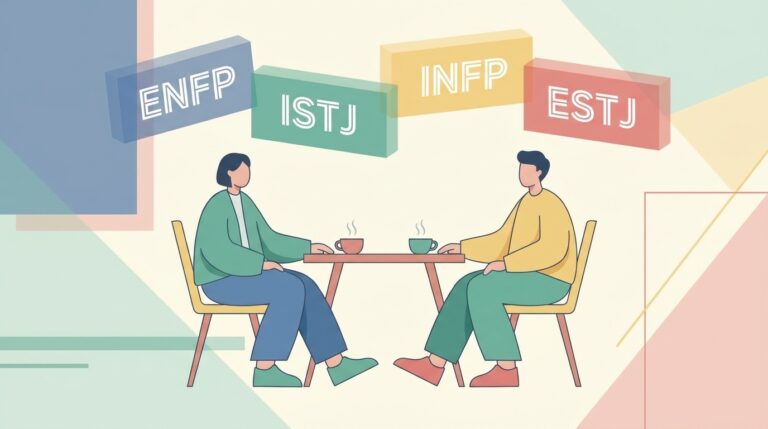
The MBTI Phenomenon in Korea: Navigating Hyper-Typology and Blind Compatibility
Phase 1: Empathy (Story-Driven Opening)
안녕하세요! 매일한글 에디터입니다.
Imagine walking into a chic, low-lit wine bar in Yeonnam-dong on a Friday evening. At the table beside you, a blind date (소개팅) is underway. Just as the couple clinks their glasses, the inevitable question drops like an anchor: “혹시… MBTI가 어떻게 되세요?” (By any chance… what is your MBTI?). When the young man sheepishly confesses he is an “ISTJ,” the woman’s eyes widen slightly. She laughs it off, but later in the restroom, she whispers to her friend on the phone: “나랑 궁합 최악인 파워 T야. 아무래도 애프터는 무리일 것 같아.” (He’s an extreme T, our compatibility is doomed. A second date is out of the question.)
If you have spent any time in contemporary South Korea, you already know that MBTI is no longer merely an introspective psychological instrument—it has metastasized into a universal social shorthand, a cultural icebreaker, and at times, a bizarre metric for romantic viability. For advanced (C2) learners of Korean, the challenge is rarely understanding what “E” or “I” stands for. The real pain point lies in the sociolinguistic pragmatics: how do you intellectually deconstruct this social phenomenon, call out someone’s absurd over-reliance on MBTI without souring the mood, and deploy the razor-sharp idioms that native speakers use to navigate this cultural landscape? Based on feedback from our high-proficiency community at Daily Hangul, mastering this discourse bridges the chasm between speaking like an academic textbook and conversing like a discerning, culturally attuned Seoul insider.
Phase 2: In-Depth Analysis of 3 Core Expressions
1. MBTI에 과몰입하다 (MBTI-e gwamoriphada)
- Pronunciation: [MBTI-e gwa-mo-rip-ha-da] (Think of ‘gwa’ as the sound in ‘guava’, ‘mo’ as in ‘motor’, and ‘rip’ pronounced crisply like ‘reap’ followed by ‘ha-da’.)
- Meaning: Literally “to excessively immerse oneself in MBTI.” In real-world colloquial usage, it translates to “to be completely hyper-fixated on MBTI” or “to take MBTI way too seriously.”
- K-Culture Moment: You will hear this phrase constantly on YouTube talk shows like Workman or Zzanbro Shin Dong-yup, whenever an idol or actor begins rationalizing their toxic dating habits through their four-letter type, prompting the host to scoff and interject.
- Editor’s Insight: The prefix 과 (過 – excess) coupled with 몰입 (immersion) creates a biting yet socially acceptable critique. It signals that while you understand the fun of personality tests, you are mature enough to recognize intellectual overreach.
- Situation Spectrum: Casual: ✅ | Semi-formal: ✅ | Formal: ⚠️
- 🤔 Think About It: In many Western societies, excessive categorization is often viewed as reductive or discriminatory. Why do you think Korean society—historically rooted in collective categorization like blood types (혈액형) and four pillars of destiny (사주)—embraced MBTI with such unprecedented institutional fervor?
2. 너 T야? (Neo T-ya?)
- Pronunciation: [Neo T-ya?] (Pronounce ‘Neo’ like ‘nut’ without the ‘t’, followed by the English letter ‘T’, ending with a rising ‘ya’ as in ‘yard’.)
- Meaning: Literally “Are you a T (Thinking type)?” Nuanced meaning: “Are you completely emotionally detached?” or “Do you lack basic empathy right now?”
- K-Culture Moment: Originating as a meme on Korean social media and sketch comedy channels (such as Psick Univ), this phrase has become the definitive, tongue-in-cheek linguistic weapon when someone gives practical, cold advice instead of emotional validation.
- Editor’s Insight: Although this sounds like an innocent classification query, tone is everything. Delivered with an incredulous look, it functions as a playful reprimand. Be cautious: when delivered flatly to a superior or an elder, it borders on an accusation of sociopathic coldness.
- Situation Spectrum: Casual: ✅ | Semi-formal: ⚠️ | Formal: 🚫
- 🤔 Think About It: Why has the “T vs. F” (Thinking vs. Feeling) axis specifically become the primary battlefield of interpersonal ethics in modern Korea, eclipsing even Extroversion vs. Introversion?
3. MBTI 궁합을 맹신하다 (MBTI gunghabeul maengsinhada)
- Pronunciation: [MBTI gung-ha-beul maeng-sin-ha-da] (Pronounce ‘gung’ like ‘goong’, ‘hab’ like ‘hub’, and ‘maeng’ like ‘mangle’ without the ‘gle’.)
- Meaning: Literally “To blindly believe in MBTI compatibility.” Nuanced meaning: “To dogmatically judge relationships or dismiss people based solely on personality compatibility charts.”
- K-Culture Moment: Frequently debated on dating shows like Transit Love (환승연애) or I Am Solo (나는 솔로), where contestants obsessively cross-reference their partner’s four-letter acronym before even having a real emotional exchange.
- Editor’s Insight: The word 맹신 (盲信 – blind faith) elevates your Korean instantly to an analytical, C2 register. By pairing a hyper-modern concept (MBTI) with a traditional concept (궁합 – marital compatibility divination), this phrase exposes the paradox of modern rationalism in Korea.
- Situation Spectrum: Casual: ✅ | Semi-formal: ✅ | Formal: ✅
- 🤔 Think About It: Does treating algorithmic or typology tests as destiny relieve individuals of the personal accountability required to truly build and negotiate a relationship?
Phase 3: Textbook Korean vs. Real Korean
Situation 1: Calling out someone who offers cold logic when you need comfort
- 📖 교과서 한국어 (Textbook Korean):
- “제 슬픔에 대해 논리적인 해결책만 제시하지 마시고, 제 감정을 먼저 헤아려 주셨으면 좋겠습니다.”
- (Please do not merely offer logical solutions to my sorrow; I would appreciate it if you could consider my feelings first.)
- 🗣️ 진짜 한국어 (Real Korean):
- “야, 지금 해결책 달라고 한 거 아니거든? 진짜 너 완전 파워 T구나? 일단 공감부터 해줘!”
- (Hey, I didn’t ask you for an action plan! Are you seriously an extreme T? Give me some empathy first!)
- 💡 왜 다를까? (Why the difference?): Native speakers rarely articulate demands for empathy through abstract psychological terminology in casual contexts; instead, invoking “파워 T (Power T)” instantly sets a playful, culturally shared boundary.
Situation 2: Critiquing someone rejecting potential dates over MBTI results
- 📖 교과서 한국어 (Textbook Korean):
- “성격 유형 검사 결과만으로 타인의 됨됨이나 인격을 예단하는 것은 비합리적인 태도입니다.”
- (Prejudging someone’s character solely based on personality test results is an irrational attitude.)
- 🗣️ 진짜 한국어 (Real Korean):
- “MBTI 궁합표 보고 사람 거르는 거, 진짜 일반화의 오류 아니야? 과몰입도 정도껏 해야지.”
- (Filtering out people based on MBTI compatibility charts is literally the fallacy of hasty generalization, don’t you think? There’s a limit to how obsessed you should get.)
- 💡 왜 다를까? (Why the difference?): The combination of “사람 거르다 (to weed out / filter people)” and “과몰입도 정도껏 해야지 (there should be moderation in hyper-fixation)” reflects the real intellectual vocabulary used in high-level banter among Korean urbanites.
Phase 4: K-Culture Deep Dive & Non-Verbal Manners
4-1. 눈치 (Nunchi) & Gestures: The Typology Battleground
When engaging in the MBTI dialogue, non-verbal cues dictate whether your critique is witty banter or an offensive attack.
* The “T-Sigh” Head Tilt: When responding with “너 T야?”, native speakers typically cock their head approximately 15 degrees, raise an eyebrow, and deliver the line with a half-smirk. A flat face makes it sound like genuine condemnation.
* The Palm Barrier (The Empathy Stop): If your conversational partner starts an elaborate analytical breakdown of an emotional dilemma, gently putting up a flat hand and laughing before uttering “잠깐, T 성향 멈춰!” (Hold up, halt the T tendencies!) acts as a culturally understood soft cushion.
* Eye-Tracking Nunchi during Dates: If someone asks your MBTI on a date, do not instantly dismiss the concept as “unscientific pseudoscience” (비과학적 유사과학). That destroys the vibe (분위기를 깨다). Instead, show initial engagement before subtly nudging the conversation toward deeper personal anecdotes.
4-2. Cultural Code: From Saju (사주) to Corporate Hiring
To understand why Korea fell into MBTI mania, one must realize that Korean society has always prioritized relational harmony within group structures. In the 2000s, it was Blood Type personality theory (혈액형 성격론). Before that, it was marital compatibility divination (사주 궁합).
MBTI repackaged ancient fortune-telling under the glossy, pseudo-scientific veneer of Western psychoanalysis. It provides immediate social relief: in a hyper-dense, fast-paced society like Seoul, people crave a rapid conversational heuristic to gauge whether an interlocutor is safe, compatible, or exhausting. Astonishingly, some conservative Korean corporations even stirred public controversy by requiring specific MBTI types (preferring “E” over “I”) on entry-level job applications—a stark testament to how systemic this obsession became.
Phase 5: Interactive Role-play Scenario
Setting: A trendy natural wine bar in Seongsu-dong. Rain patters against the industrial glass.
Characters:
* Ji-won (지원): An expressive ENFP who consults compatibility charts before going to sleep.
* Min-soo (민수): An analytical ISTJ consultant who finds personality typing anti-intellectual.
* You (학습자): A perceptive, highly articulate foreign professional bridging their heated debate.
지 원:
민수 씨, 지난주에 소개팅한 분이랑 왜 연락 끊었어요? 조건도 성격도 다 좋다면서요?
(Minsu, why did you stop texting the person from your blind date last week? Didn’t you say both her background and personality were great?)
🎭 눈을 반짝이며 와인잔을 내려놓고 상체를 앞으로 기울인다. (Eyes sparkling, puts down her wine glass and leans forward.)
민 수:
그게… 다 좋은데, 자꾸 저보고 ‘파워 T라서 감정이 메말랐다’면서 제 MBTI를 문제 삼더라고요.
(Well… everything was fine, but she kept making an issue out of my MBTI, saying I’m an ‘extreme T whose emotions are dried up’.)
🎭 피곤하다는 듯 안경을 고쳐 쓰며 한숨을 푹 쉰다. (Pushes up his glasses looking exhausted and lets out a deep sigh.)
지 원:
어머, 그분 마음이 이해되는데? ISTJ랑 ENFP는 원래 궁합 차트에서 파멸의 관계잖아요!
(Oh my, I actually understand her! ISTJs and ENFPs are literally listed as a doomed pairing on the compatibility matrix!)
🎭 휴대폰을 꺼내 무지개색 MBTI 궁합표 이미지를 당당하게 내민다. (Pulls out her phone and confidently displays a rainbow-colored MBTI compatibility chart.)
민 수:
지원 씨, 그런 유사과학에 근거해서 사람의 잠재력을 재단하는 건 너무 비합리적이지 않나요?
(Jiwon, isn’t it completely irrational to judge someone’s potential based on such pseudoscience?)
🎭 팔짱을 끼고 차가운 눈빛으로 지원을 응시한다. (Crosses his arms and stares at Jiwon with a cold demeanor.)
당 신 (You):
(Now, it’s your turn to step in and break the deadlock with C2-level grace.)
🔀 Interactive Choice Point
- Option A: “둘 다 일리 있는 말이지만, MBTI 궁합을 맹신해서 사람을 거르는 건 너무 섣부른 판단 아닐까요? 단순한 성격 지표일 뿐인데 과몰입하면 서로의 본모습을 놓치게 되잖아요.”
(Both of you make valid points, but isn’t filtering people out based on blind faith in MBTI compatibility a premature judgment? It’s just a personality indicator; if you get hyper-fixated, you miss out on who the person truly is.) - Option B: “지원 씨 말이 백번 맞아요! 민수 씨, 그러니까 연애를 못 하는 거예요. 너 진짜 T 성향 제대로 티 낸다!”
(Jiwon is one hundred percent right! Minsu, that’s precisely why you can’t date. You are really flaunting your T tendencies right now!) - Option C: “MBTI는 아무런 과학적 근거가 없으니 두 분 다 그런 비효율적인 대화는 그만두는 게 좋겠습니다.”
(Since MBTI has zero scientific backing, both of you would do well to stop this inefficient conversation immediately.)
Detailed Branch Feedback
- If you chose Option A (BEST): Exceptional sociolinguistic tact! You acknowledged both perspectives, deployed elevated academic and colloquial markers (“일리가 있다”, “맹신하다”, “과몰입”), and de-escalated the philosophical tension without dismissing anyone’s emotional experience.
- If you chose Option B (BAD): Social disaster. You weaponized the meme “너 T야?” in a genuine dispute, directly attacking Min-soo’s personal life (“연애를 못 하는 이유”), which crosses the threshold into bad manners (실례).
- If you chose Option C (RISK): Cold, overly formal, and pedantic. While scientifically accurate, calling their lively drinks banter “inefficient” mimics the exact robotic stereotype Min-soo was accused of, killing the ambiance of the evening instantly.
Phase 6: 10-Second Emotion Shadowing Drill
Practice these high-frequency sentences using the emotional milestone and pause markers (/).
[🙄 어이없다는 듯 헛웃음 치며 - Bewildered with a slight chuckle]
“아니, / 고작 네 글자 알파벳 때문에 / 사람을 거른다고? / 그건 좀 과몰입 아니야?”
(Ani, / gojak ne geulja alpabet ttaemune / sarameul geolleundago? / Geugeon jom gwamorip aniya?)
(“Wait, / you’re weeding someone out / over just four letters of the alphabet? / Isn’t that taking things a bit too far?”)-
[🥺 억울하면서도 귀엽게 항변하듯 - Playfully defensive and aggrieved]
“내가 해결책을 준 건 / 널 도와주려던 거지, / 공감 능력이 없어서가 아니거든? / 너 T야? 소리 그만해!”
(Naega haegyeolchaegeul jun geon / neol dowajuryeodeon geoji, / gonggam neungryeogi eopseoseoga anigeodeun? / Neo T-ya? sori geumanhae!)
(“The reason I offered a solution / was to help you, / not because I lack empathy! / Stop telling me ‘Are you a T?’!”) -
[🧐 차분하고 이성적으로 중재하며 - Calmly and rationally mediating]
“MBTI는 / 대화를 트는 아이스브레이킹 도구로만 쓰고, / 사람의 깊이는 / 직접 부딪히며 알아가자.”
(MBTI-neun / daehwareul teuneun aiseubeureiking doguroman sseugo, / saramui gipineun / jikjeop budithimyeo aragaja.)
(“Let’s use MBTI / strictly as an icebreaker tool to start conversations, / and discover a person’s true depth / by engaging with them directly.”)
Phase 7: K-Culture Mini Dictionary
-
과몰입러 (Gwa-mo-rip-leo)
Translation: Hyper-fixator / Someone who takes a pop-culture concept to an obsessive extreme.
Usage: Blends 과몰입 (excessive immersion) with the English suffix ‘-er’. Used playfully to identify friends who build daily life decisions, dating choices, or investment schemes around tests or fictional drama universes. -
파워 F / 파워 T (Power F / Power T)
Translation: Extreme Empath / Extreme Rationalist.
Usage: The English word “Power” is used colloquially in Korea as an intensifier (e.g., 파워 당당, 파워 E). Describing a colleague as “파워 T” means they do not sugarcoat feedback, prioritizing empirical outcome over relational sentiment. -
궁합표 (Gung-hap-pyo)
Translation: The Compatibility Matrix / Chart.
Usage: Traditionally referring to the astrological matching table made by Taoist diviners for arrange-marriages, today it universally refers to the viral red-and-green MBTI relationship grids circulating across Instagram and Naver blogs. -
일반화의 오류 (Il-ban-hwa-ui o-ryu)
Translation: The Fallacy of Hasty Generalization.
Usage: A standard rhetorical logic term in Korean, used frequently in intellectual debates among educated 20s and 30s to sharply point out that four letters cannot classify 50 million distinct human nuances.
Phase 8: Traveler’s Survival Kit
Survival TOP 3
-
“전 MBTI 검사할 때마다 바뀌어서 잘 안 믿어요.”
(Jeon MBTI geomsa-hal ttaemada bakkwieoseo jal an mideoyo.)
Pro Tip: The most elegant conversational escape hatch. If you dislike being pigeonholed, saying your test result changes every time politely invalidates the categorizing attempt without offending the inquisitor. -
“저에 대해 어떤 유형일 것 같으세요?”
(Jeoe daehae eotteon yu-hyeong-il geot gateuseyo?)
Pro Tip: Flips the spotlight. When placed on the spot, turning the question back allows you to observe what impressions Koreans have formed about your interpersonal demeanor. -
“MBTI 프레임으로 보지 마시고, 그냥 저라는 사람을 봐주세요!”
(MBTI peureim-euro boji masigo, geunyang jeoraneun sarameul bwajuseyo!)
Pro Tip: A witty, confident boundary-setter during dates or casual gatherings when people try to interpret all your behaviors through typology lenses.
Editor’s Travel Note
If you are planning to socialize or network in Korea, download the ubiquitous 네이버 지도 앱 다운로드 to easily locate trendy experiential pop-up stores in Seongsu or Hongdae, which often host bespoke MBTI-tailored fragrance or stationery workshops. Furthermore, if you exchange KakaoTalk contacts, do not be surprised to see friends listing their MBTI type in their KakaoTalk Profile status; treating it as harmless vanity rather than dogmatic identity will save your social peace.
Phase 9: “A Step Deeper” (Sociological Reflection)
The South Korean obsession with MBTI is neither superficial frivolity nor intellectual regression; it is a modern psychological defense mechanism. In an intensely competitive, compressed-modernity society characterized by structural hierarchies and relentless social comparison, defining oneself via a recognized typology provides instant belonging and psychological validation. It replaces the anxiety of existential uncertainty with a neat, externally certified identity badge. Paradoxically, by labeling oneself—for example, “I am an INFP, so large crowds drain me”—individuals carve out a socially sanctioned excuse to opt out of suffocating collective obligations. In a culture historically dominated by strict obedience to communal harmony, MBTI ironically serves as an accessible vehicle for hyper-individualism.
💬 Your Turn: Have you ever experienced an awkward encounter where your personality or character was prejudged through a test or social label? How did you respond, and what Korean expression from today’s lesson would you use now? Share your thoughts below!
Phase 10: FAQ & Avoiding Misunderstandings
Q: Is it considered rude if I refuse to disclose my MBTI type in Korea?
A: It is not outright rude, but an abrupt refusal like “그런 거 안 믿습니다” (I don’t believe in such things) can instantly make you appear rigid or uncooperative (융통성 없는 사람). Instead, soften your response with humor: “제 유형 맞히면 커피 살게요!” (If you can guess my type, I’ll buy you coffee!) to maintain conversational warmth.
Q: Why do Koreans ask for MBTI instead of blood types nowadays?
A: Blood Type personality theory (ABO) reigned supreme in the 1990s and 2000s, but it was universally discarded because it lacked nuance (only four categories) and carried uncomfortable historical baggage derived from early 20th-century eugenics. MBTI offers sixteen categories and uses positive psychological terminology, making it feel scientific, progressive, and modern.
Q: Can I use “너 T야?” to my boss or college professor if we are close?
A: Absolutely not. Even if your relationship is friendly, “너 T야?” contains low-form pronouns (“너”) and banmal endings (“~야”). Using it with a superior—even transformed into honorifics like “부장님 T세요?”—is perceived as an insolent commentary on their management style or empathy.
🚨 Common Mistakes Alert (외국인 학습자의 흔한 실수 TOP 3)
- Mistake: Translating “Thinking” literally as 생각 and asking “생각하는 사람이에요?”
- Correct Action: Always use the typology acronym directly: “T 성향이세요?” or “이성적인 편이세요?”
- Mistake: Taking the meme “너 T야?” as a grave moral insult and escalating into real conflict.
- Correct Action: Realize it is almost universally intended as comic relief; respond playfully with: “응, 나 T야. 해결책 필요하면 말해!” (Yeah, I am a T. Let me know when you want solutions!)
- Mistake: Believing that compatibility (궁합) charts represent actual societal consensus.
- Correct Action: Treat them solely as entertainment. Do not alter your dating or professional decisions based on them.
Phase 11: Action Missions & Engagement
- 🥉 Bronze Mission (Solo Practice): Stand in front of the mirror. Recite the Phase 6 Shadowing Drill sentences three times, focusing on capturing the precise eye roll and vocal cadence of “너 T야?”.
- 🥈 Silver Mission (Community Dialogue): Leave a comment under a Korean YouTube talk show clip or Korean lifestyle reel where MBTI is mentioned, writing: “MBTI에 너무 과몰입하는 것보다 그 사람의 태도를 보는 게 더 중요하지 않을까요?”
- 🥇 Gold Mission (Real World Test): During your next conversation with a native Korean speaker, when they ask for your MBTI, reply using the sophisticated framing: “저는 상황에 따라 유연하게 바뀌는 편이라 과몰입은 지양하는 편이에요.” (I tend to adapt flexibly depending on the situation, so I try to avoid hyper-fixation.)
🎮 K-Culture Mission: Watch an episode of a Korean reality dating show (e.g., I Am Solo or Heart Signal). Spot how many minutes pass before the contestants ask about MBTI, and write down the exact reaction words used when they discover each other’s types.
Phase 12: Interactive Quiz Challenge
Test your mastery of Korean pop-culture sociolinguistics! Try answering without peeking at the explanations.
1. Situational Judgment Quiz
Your close Korean friend just had their flight canceled, lost their luggage, and calls you crying. Which of the following responses would definitively get you labeled as an insensitive “파워 T”?
(A) “진짜 속상하겠다… 몸은 다친 데 없어? 너무 놀랐지?”
(B) “일단 분실물 센터 번호랑 여행자 보험 약관부터 확인해 봐. 울고 있을 시간 없어.”
(C) “세상에, 어떻게 그런 일이 있어? 내가 지금 데리러 갈까?”
2. Fill-in-the-Blank
다음 빈칸에 들어갈 가장 자연스러운 어휘를 고르세요:
“혈액형이나 MBTI 같은 성격 유형 지표에 너무 (________) 사람을 대하면, 편견이 생겨서 그 사람의 진가를 알아보기 어렵다.”
(A) 과몰입하여
(B) 무관심하여
(C) 솔직하여
3. True or False Cultural Quiz
In modern Korean professional workplace culture, it is completely normative, universally encouraged, and legally protected to decline hiring an applicant based on an Introverted (“I”) MBTI result. (True / False)
👉 Click to reveal answers & deep explanations
Answers & Explanations:
-
Answer: (B)
Explanation: Option (B) jumps instantly to rational triage and administrative problem-solving (“울고 있을 시간 없어” – There’s no time to cry) completely bypassing emotional attunement. This is the textbook behavioral archetype that triggers the retort “너 T야?”. Options (A) and (C) demonstrate deep empathetic solidarity (F style). -
Answer: (A) 과몰입하여
Explanation: The sentence discusses the danger of developing prejudice (편견) by excessively obsessing over personality metrics. “과몰입하다” (to hyper-fixate / overly immerse) fits the syntactic and cultural context perfectly. (B) means indifferent, and (C) means honest. -
Answer: False
Explanation: While some companies made controversial headlines by asking for MBTI types, this practice was met with overwhelming public criticism and reprimand from the National Human Rights Commission of Korea as unscientific discrimination. It is emphatically not legally protected or considered an acceptable norm.







