

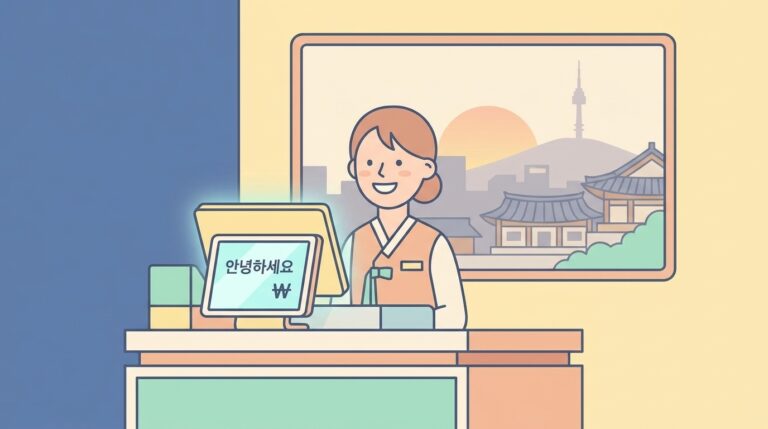
안녕하세요! 매일한글 에디터입니다. (Hello! I’m your Daily Hangul editor.)
Picture this: It’s 8:30 AM on a crisp Monday morning in Sinchon. You just landed your very first alba (알바 – part-time job) at a sparkling clean GS25 convenience store right next to a university subway exit. You’re wearing the branded blue vest, your heart is racing, and suddenly, the automatic doors chime with that iconic chime: Ding-dong! A flood of sleepy university students and busy office workers in puffer jackets rush toward the counter. Three people line up instantly. The first customer sets down an iced Americano and a triangle kimbap (samgak-gimbap), quickly sliding a sleek credit card toward you across the counter.
You stare down at the glowing screen of the POS machine (포스기 – poseugi). There are dozens of colorful square buttons: Barcode, Member Discount, Cash, Credit Card, Bag, Receipt. Your mind goes completely blank. “What button do I push first? What do I say so I don’t look totally lost?” You feel a drop of sweat run down your neck. The customer gives you that classic Korean ppalli-ppalli (hurry-hurry) look, tapping their foot lightly. If you’ve ever felt that icy knot of panic when facing a cash register in a foreign country, take a deep breath. You are not alone! Over the past decade, hundreds of our students have stood frozen right where you are. Today, we are turning that terrifying screen into your playground. By the end of this guide, you will master the three golden sentences that make up 90% of every register interaction in Korea, unlock the secrets of polite Korean body language, and breeze through your shift like a seasoned local clerk.
Phase 2: Core Expressions Deep Dive
1. 결제 도와드릴게요 (Gyeolje dowadeurilgeyo)
- Pronunciation: [Gyeol-je do-wa-deu-ril-ge-yo] (Think of it like: “Gyul” like tangerine + “jeh” + “dough-wah” + “dew-reel-geh-yo”)
- Meaning:
- Literal: “I will help your payment.”
- Natural Nuance: “I can help you check out right here!” / “Ready to ring you up!”
- K-Culture Moment: You hear this constantly in Korean slice-of-life dramas like Work Later, Drink Now or Convenience Store Saet-byul. When a cashier spots you hovering with a basket near the counter, they wave their hand slightly and chime this out with an upbeat, welcoming melody.
- Editor’s Insight: In Korean service culture, transactions are framed as “helping” (도와드리다 – dowadeurida) rather than “taking money.” It instantly establishes a warm, courteous relationship with the guest.
- Situation Spectrum:
- Casual (반말): 🚫 (Never use with customers)
- Semi-formal (해요체): ✅ (Perfect for friendly cafes/boutiques)
- Formal (하십시오체): ✅ (결제 도와드리겠습니다 – Gyeolje dowadeurigesseumnida, standard for department stores/franchises)
- 🤔 Think About It: In English, we often ask “Are you ready to order?” or say “I can take the next person.” Why do you think Korean uses the verb “to help” (도와주다) for ringing up purchases?
2. 봉투 필요하세요? (Bongtu piryohaseyo?)
- Pronunciation: [Bong-tu pi-ryo-ha-se-yo?]
- Meaning:
- Literal: “Is a bag necessary?”
- Natural Nuance: “Would you like a bag?” / “Do you need a shopping bag?”
- K-Culture Moment: Seen in almost every modern Korean variety show when idols go on errand runs. In Korea, single-use plastic bags cost between 100 to 200 KRW by law. Asking this is not just polite customer service—it’s a legal requirement before charging for one!
- Editor’s Insight: Don’t worry about complicated grammar here. Bongtu means bag, and piryohaseyo? is the honorific form of “do you need?”. It’s simple, punchy, and crystal clear.
- Situation Spectrum:
- Casual: 🚫
- Semi-formal: ✅ (Everyday standard in convenience stores and supermarkets)
- Formal: ✅ (봉투 필요하십니까? – Bongtu piryohasimnikka?)
- 🤔 Think About It: Korea introduced strict plastic bag bans and paid bag fees long before many other countries. How does language adapt when social laws change?
3. 영수증 버려드릴까요? (Yeongsujeung beoryeodeurilkkayo?)
- Pronunciation: [Yeong-su-jeung beo-ryeo-deu-ril-kka-yo?]
- Meaning:
- Literal: “Shall I discard the receipt for you?”
- Natural Nuance: “Do you need your receipt, or should I toss it?”
- K-Culture Moment: In K-dramas, busy office workers tap their card and immediately walk away without taking a slip of paper. That’s because the clerk asks this magic question, and the customer usually nods or says “Nee, beoryeo-juseyo!” (Yes, please throw it away!).
- Editor’s Insight: Instead of asking “Do you want the receipt?” (영수증 드릴까요?), savvy Korean clerks proactively ask if they should throw it away. Why? Because 80% of urban Koreans prefer not to hold onto paper receipts!
- Situation Spectrum:
- Casual: 🚫
- Semi-formal: ✅ (Super standard, highly appreciated by customers)
- Formal: ✅ (영수증 버려드릴까요?)
- 🤔 Think About It: Notice how Korean customer service anticipates the customer’s convenience before the customer even has to make an effort.
Phase 3: Textbook Korean vs. Real Korean
Situation 1: Asking the customer to insert their payment card
- 📖 Textbook Korean: 신용카드를 단말기에 넣어 주십시오. (Sinyongkadeureul danmalgie neoeo jusipsio. – “Please insert your credit card into the terminal.”)
- 🗣️ Real Korean: 카드 꽂아주세요~ (Kadeu kkoja-juseyo~ – “Please insert your card right here~”)
- 💡 왜 다를까? (Why is it different?): Textbook Korean loves long Sino-Korean words like 신용카드 (credit card) and 단말기 (terminal device). Real-life registers move at lightning speed! Everyday Koreans shorten 신용카드 to just 카드 and use the vivid, everyday verb 꽂다 (to poke in / plug in).
Situation 2: Informing the customer of a plastic bag charge
- 📖 Textbook Korean: 비닐봉투는 100원의 추가 요금이 발생합니다. (Binilbongtuneun baegwonui chuga yogeumi balsaenghamnida. – “Plastic bags incur an additional fee of 100 won.”)
- 🗣️ Real Korean: 봉투 100원인데 괜찮으세요? (Bongtu baegwoninde gwaenchaneuseyo? – “The bag is 100 won, is that okay with you?”)
- 💡 왜 다를까? (Why is it different?): Koreans prefer gentle questions ending in 괜찮으세요? (“Are you okay with this?”) rather than blunt informational statements about additional fees. It softens the transaction instantly.
Phase 4: K-Culture Deep Dive & Non-Verbal Manners
4-1. 눈치 (Nunchi) & Gestures at the Register
When you are running a Korean POS system, your hands and eyes do half the talking. Master these two unspoken rules, and customers will swear you were born in Seoul:
1. The Two-Handed Hand-off (두 손 매너): Never, ever hand back a credit card or receipt with one floppy hand. Use both hands—or support your right forearm with your left fingertips. It signals respect (jeongseong).
2. The Scanner Scan-and-Eye Contact: As you scan the barcode, glance up once to catch the customer’s eye, give a micro-nod (a tiny head bow of about 5 degrees), and state the total amount.
4-2. Cultural Code: The ‘Ppalli-Ppalli’ (빨리빨리) Speed & Empathy
In Seoul’s busy business hubs like Gangnam and Yeouido, lunchtime at a convenience store is an Olympic sport. Customers are watching the POS screen closely. Efficiency isn’t viewed as cold or rude; in fast-paced K-culture, speed is the ultimate form of kindness. Knowing your buttons and speaking short, crisp phrases shows deep respect for the other person’s precious time.
Phase 5: Real-Life Roleplay Scenario
Setting: 8:45 AM at a university campus GS25.
NPC: Minho (민호), a 22-year-old college sophomore holding a can of cold brew and a banana, anxiously looking at his smartwatch before his morning quiz.
- Turn 1 (Clerk): 🎭 Smiling with an open posture, gesturing towards the counter.
안녕하세요! 결제 도와드릴게요. (Annyeonghaseyo! Gyeolje dowadeurilgeyo. – “Hello! I can help you check out here.”) - Turn 2 (Minho): 🎭 Places items briskly on the counter and pulls out a card.
네, 이거 두 개 찍어주세요. (Ne, igeo du gae jjigeojuseyo. – “Yes, please ring these two up.”) - Turn 3 (Clerk): 🎭 Scans the barcode of the cold brew, then the banana. BEEP! BEEP!
총 3,500원입니다. (Chong samcheon-obaegwon-imnida. – “That will be 3,500 won in total.”) - Turn 4 (Minho): 🎭 Holds his card over the terminal.
카드 돼요? (Kadeu dwaeyo? – “Does card work?”) - Turn 5 (Clerk): 🎭 Points politely with an open palm toward the IC chip slot.
네! 카드 꽂아주세요. (Ne! Kadeu kkoja-juseyo. – “Yes! Please insert your card here.”) - Turn 6 (Minho): 🎭 Inserts card. The POS screen beeps.
봉투도 하나 주세요. (Bongtudo hana juseyo. – “Please give me a bag too.”) - Turn 7 (Clerk): 🎭 Quickly opens a medium bag and rings up the 100 won key on the POS.
봉투 100원 추가됩니다! 영수증 버려드릴까요? (Bongtu baegwon chugadoemnida! Yeongsujeung beoryeodeurilkkayo? – “100 won added for the bag! Shall I toss the receipt?”) - Turn 8 (Minho): 🎭 Grabs the bag with both hands, nodding gratefully.
네, 버려주세요! 수고하세요! (Ne, beoryeojuseyo! Sugohaseyo! – “Yes, please toss it! Have a good shift!”)
🔀 Interactive Branching Point
Minho asks: “봉투도 하나 주세요” (Bongtudo hana juseyo – Please give me a bag too) right after his card already processed. How do you handle this on the POS?
- Choice A: You shake your head and say, “안 돼요. 이미 끝났어요.” (An dwaeyo. Imi kkeutnasseoyo. – No. It’s already finished.)
- ❌ Bad: Extremely blunt and unhelpful. In Korea, bag fees can easily be charged as a separate tiny 100 won cash transaction or quick second tap.
- Choice B: You say, “아, 봉투 백 원 결제 한 번 더 도와드릴게요!” (A, bongtu baeg-won gyeolje han beon deo dowadeurilgeyo! – “Ah, I’ll help you pay 100 won for the bag one more time!”) and tap the bag button.
- 🌟 Best: Professional, friendly, solves the customer’s problem smoothly without friction.
- Choice C: You hand him a bag for free under the table without ringing it up on the POS.
- ⚠️ Risk: While seemingly kind, store inventory and environmental audits check bag counts. Giving away bags can get you into trouble with store owners (jeomjang-nim)!
Phase 6: 10-Second Emotion Shadowing Drill
Read these out loud! Break where you see /, and embody the mood tag.
[😊 Bright and Welcoming]
안녕하세요! / 결제 / 도와드릴게요~
(An-nyeong-ha-se-yo! / Gyeol-je / do-wa-deu-ril-ge-yo~)-
[🤔 Attentive and Soft]
봉투 / 필요하세요? / 백 원이에요~
(Bong-tu / pi-ryo-ha-se-yo? / baeg-won-i-e-yo~) -
[⚡ Crisp, Efficient, Helpful]
결제 끝났습니다! / 영수증 / 버려드릴까요?
(Gyeol-je kkeun-nat-seum-ni-da! / Yeong-su-jeung / beo-ryeo-deu-ril-kka-yo?)
Phase 7: K-Culture Mini Dictionary
- 포스기 (Poseugi) | POS Machine / Cash Register
- Usage: The central nervous system of any Korean store. Clerks say: “포스기가 잠깐 멈췄어요” (The POS froze for a second).
- 알바 (Alba) | Part-time Job
- Usage: Short for the German word Arbeit. In Korea, working part-time is practically a cultural rite of passage for 20-somethings.
- 영수증 (Yeongsujeung) | Receipt
- Usage: Used at the end of every transaction: “영수증 드릴까요?” (Would you like the receipt?).
- 포인트 적립 (Pointeu jeongnip) | Loyalty Point Accumulation
- Usage: Customers often tap their CJ ONE, Happy Point, or telecom barcode. You’ll ask: “포인트 적립 있으세요?” (Do you have points to save?).
Phase 8: Survival Kit for Travelers & Part-Timers
TOP 3 Survival Phrases
- 카드 돼요? (Kadeu dwaeyo?) – “Does card work here? / Can I pay by card?”
- Pro Tip: Korea is practically a cashless society. 99% of places accept card or mobile pay (Samsung Pay / Apple Pay).
- 봉투 주세요. (Bongtu juseyo.) – “Please give me a bag.”
- Pro Tip: Say this early before you tap your card so the clerk can ring up the 100 won bag fee in a single swipe.
- 영수증 버려주세요. (Yeongsujeung beoryeojuseyo.) – “Please throw away my receipt.”
- Pro Tip: Saves your pockets from accumulating endless white paper slips!
Editor’s Travel & Life Note
- If you plan on working or navigating stores across Korea, make sure to read our comprehensive Naver Map app download and transit guide to find late-night 24-hour convenience store hubs.
- Don’t forget that public transport and retail can be linked! You can check your balance using our T-Money transportation card recharge tips right at the very same POS terminal.
Phase 9: 한 발 더 깊이 (One Step Deeper)
In many Western cultures, a cashier interaction can be chatty—asking about someone’s weekend plans or commenting on the weather. In Korea, however, register interactions are a quiet dance of reciprocal consideration (배려 – baeryeo). Honorific endings like -드리다 (-deurida) elevate the counter into a shared space of mutual respect. Even in a 15-second purchase of a bottle of green tea, the clerk’s two-handed card return and the customer’s polite nod demonstrate that both individuals value harmony and dignity. It isn’t just about selling snacks; it is a micro-ritual of urban Korean civility.
💬 Your Turn: In your home country, what is the customary interaction between a cashier and a customer? Do you prefer fast and silent transactions, or friendly small talk? Share your thoughts in the comments below!
Phase 10: FAQ & Common Mistakes
Q: Can foreign cards always be inserted into Korean POS terminals?
A: Yes! Most international Visa, Mastercard, and Amex cards with IC chips work seamlessly. Simply insert the chip face up into the front slot of the card reader. If it has tap-to-pay (contactless), look for the wave symbol on top of the terminal.
Q: What should I say if a customer asks for a plastic bag after paying?
A: Don’t panic! Simply smile and say: “봉투 100원 결제 도와드릴게요” (Bongtu baegwon gyeolje dowadeurilgeyo – I will help you pay 100 won for the bag), ring up the bag key on the POS screen, and let them tap their card or pay cash.
Q: Why do clerks ask about receipts so quickly?
A: Korean environmental policies and digital banking apps send instant push notifications for card spending. Because most people view paper receipts as immediate trash, clerks proactively ask to save you the hassle of throwing it away yourself.
🚨 Common Mistakes Alert Board
- Mistake: Throwing the customer’s card onto the counter surface.
- Correct Action: Always hand the card back directly toward their hands using both hands or with your right hand supported by your left wrist.
- Mistake: Speaking informal Korean (반말 – Banmal) because the customer is younger.
- Correct Action: At the register, every customer is a guest. Always use polite speech (존댓말 – Jondaetmal), ending in -요 (-yo) or -습니다 (-seumnida).
- Mistake: Freezing up when the POS makes an error beep.
- Correct Action: Calmly say: “잠시만 기다려주세요” (Jamsiman gidaryeojuseyo – Please wait just a moment) while pressing the cancel or re-scan button.
Phase 11: Action Mission & Engagement
- 🥉 Bronze Mission: Stand in front of your mirror with any plastic card in hand. Practice saying “결제 도와드릴게요!” and “영수증 버려드릴까요?” three times with a bright voice.
- 🥈 Silver Mission: Take a photo of your favorite Korean snack or drink, post it on your Instagram Story, tag
@DailyHangul, and write the caption: “봉투 필요하세요? No, I have my eco-bag!” - 🥇 Gold Mission: Next time you step into a Korean mart, cafe, or convenience store, proactively answer the clerk with: “영수증 버려주세요!” (Yeongsujeung beoryeojuseyo!). Notice their relieved smile!
🎮 K-Culture Mission: Watch an episode of any recent K-drama featuring a convenience store scene (such as Backstreet Rookie or My Liberation Notes). Listen closely: Did the cashier use 도와드릴게요 or 영수증 드릴까요? Write down the timestamp and let us know!
Phase 12: Interactive Quiz Challenge
Q1. [Situational Judgment] A customer places a milk carton on your register and holds out a card. What is the most polite and natural opening sentence?
* A) 돈 내세요. (Don naeseyo.)
* B) 결제 도와드릴게요. (Gyeolje dowadeurilgeyo.)
* C) 빨리 주세요. (Ppalli juseyo.)
Q2. [Fill-in-the-Blank] Complete the phrase asking if the customer wants you to throw away their receipt:
영수증 __________? (Yeongsujeung __________?)
* A) 먹을까요? (meogeulkkayo?)
* B) 버려드릴까요? (beoryeodeurilkkayo?)
* C) 노래할까요? (noraehalkkayo?)
Q3. [True / False Cultural Quiz] In Korea, clerks are legally allowed to hand out single-use plastic bags for free without charging any fee.
* (True / False)
👉 Click to view answers and explanations!
- Q1 Answer: B) 결제 도와드릴게요. (A is rude, meaning ‘Pay money,’ and C means ‘Give it to me quickly!’)
- Q2 Answer: B) 버려드릴까요? (버리다 means to throw away, and -어 드릴까요 means ‘shall I do this for you?’. A means ‘shall I eat it?’ and C means ‘shall I sing?’)
- Q3 Answer: False! Under Korean environmental resource regulations, convenience stores and supermarkets must charge a designated fee (typically 100–200 KRW) for single-use plastic bags.







