

Master Korean Veranda Gardening: C1 Fluency for Urban Green Thumbs
Phase 1: Empathy (Immersive Story Opening)
안녕하세요! 매일한글 에디터입니다.
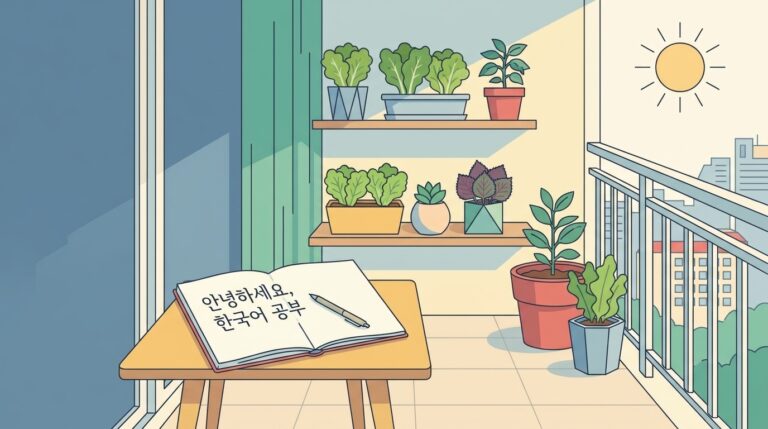
Picture this: You are standing on the narrow balcony (베란다) of a sun-drenched Seoul apartment. You’ve just returned from the local nursery (화원) with tender young seedlings of crisp Korean lettuce (상추) and aromatic perilla leaves (깻잎). You are eager to replicate that rustic farm-to-table lifestyle you saw on Three Meals a Day (삼시세끼). Yet, within two weeks, your lush greenery starts drooping. The stems look freakishly long and pale, the leaves are yellowing, and when you desperately try asking the local garden supply ahjumma for advice using beginner textbook phrases like “식물이 아파요” (The plant is sick), she gives you a well-meaning but puzzled stare.
Urban balcony gardening—known in Korea as 베란다 텃밭 가꾸기—is a national passion, especially among city-dwellers striving for tranquility within concrete high-rises. However, talking about plants at an advanced level requires moving past simplistic vocabulary. To truly diagnose issues, swap propagation tips with Korean neighbors, and bargain for premium soil at the Yangjae Flower Market, you need technical nuance, horticultural metaphors, and genuine linguistic reflex. This guide is crafted from real classroom feedback and native horticultural wisdom to transform your conversational Korean from basic textbook grammar to effortless, earthy C1 fluency.
Phase 2: Core Expressions Deep Dive
1. 웃자라다 (Utjarada)
- Pronunciation: [Utjarada] (oot-jah-rah-dah; think of the sharp onset of “boot” followed by “jar-ah-dah”)
- Meaning: Literal: to overgrow upward | Nuance: to grow spindly, leggy, or structurally weak due to insufficient sunlight
- K-Culture Moment: Home-gardening vloggers on YouTube lamenting their balcony greens during the monsoon season (장마철): “햇빛이 부족해서 상추가 너무 웃자랐어요!” (My lettuce grew way too leggy because of the lack of sunlight!)
- Editor’s Insight: While beginner speakers say “너무 빨리 컸어요” (It grew too fast), native gardeners use 웃자라다 to signal poor health and structural fragility. Beyond botany, Koreans playfully use this verb for children who shot up in height suddenly without filling out physically.
- Situation Spectrum: Casual ✅ | Semi-formal ✅ | Formal ⚠️
- 🤔 Think About It: Notice the prefix 웃- (denoting upward/excess). How does having a single organic verb for “stretching weakly toward light” reflect Korea’s agrarian sensitivity to sun cycles?
2. 곁순을 따주다 (Gyeotsuneul ttajuda)
- Pronunciation: [Gyeotsuneul ttajuda] (gyuht-soo-neul ttah-joo-dah; “gyuht” rhymes with “shut”)
- Meaning: Literal: to pluck off side shoots | Nuance: to pinch out suckers or lateral shoots so the main stem bears richer fruit
- K-Culture Moment: Reality TV shows set in the countryside, where village elders scold novice city guests: “토마토 곁순을 제때 안 따주면 알맹이가 안 열려!” (If you don’t pinch out tomato suckers on time, the fruit won’t form!)
- Editor’s Insight: 곁 means side or flanking, while 순 means a budding sprout. Pruning off unnecessary growth to concentrate nutrition is deeply ingrained in Korean culture—often mirrored in business metaphors about shedding unproductive side projects.
- Situation Spectrum: Casual ✅ | Semi-formal ✅ | Formal ✅
- 🤔 Think About It: English uses the technical verb “to prune” or “pinch suckers.” Does framing this action as “caringly picking out side-buds” (따주다) soften the labor into an act of nurturing?
3. 분갈이 몸살 (Bung-gari momsal)
- Pronunciation: [Bung-gari momsal] (boon-gah-ree mom-sahl; “momsal” rhymes with “calm-sal”)
- Meaning: Literal: repotting body-ache | Nuance: transplant shock; post-repotting wilting and lethargy
- K-Culture Moment: Healing lifestyle dramas where an exhausted protagonist moving into a new apartment sighs: “나 지금 새 동네에서 분갈이 몸살 겪는 중인가 봐.” (I guess I’m going through transplant shock in this new neighborhood.)
- Editor’s Insight: 몸살 is a distinctly Korean psychosomatic concept describing systemic fatigue and flu-like aches after intense exertion. Applying 몸살 to plants anthropomorphizes them as living companions (반려식물), acknowledging their emotional and physical adaptation stress.
- Situation Spectrum: Casual ✅ | Semi-formal ✅ | Formal ⚠️
- 🤔 Think About It: Why does Korean extend human somatic conditions to plants rather than using clinical diagnostic jargon?
Phase 3: Textbook Korean vs. Real Korean
Situation 1: Diagnosing Soil Moisture & Watering Strategy
- 📖 교과서 한국어: 흙이 마르면 물을 충분히 주세요. (Heulgi mareumyeon mureul chungbunhi juseyo.) — When the soil is dry, give it enough water.
- 🗣️ 진짜 한국어: 겉흙만 보고 주지 마시고, 속흙까지 바싹 말랐을 때 저면관수로 흠뻑 적셔주세요. (Geotheulman bogo juji masigo, sokheulkkaji bassak marasseul ttae jeomyeongwansuro heumppeok jeoksyeojuseyo.) — Don’t just check the topsoil; once the deeper soil is bone-dry, soak it thoroughly via bottom watering.
- 💡 왜 다를까?: Apartment verandas in Korea suffer from poor airflow. Experienced 식집사 (plant butlers) differentiate 겉흙 (topsoil) from 속흙 (subsoil) to avoid root rot (과습) and recommend 저면관수 (bottom watering) rather than surface pouring.
Situation 2: Managing Balcony Ventilation and Pest Hazards
- 📖 교과서 한국어: 식물에게 햇빛과 공기는 매우 중요합니다. (Singmurege haetbitgwa gonggineun maeu jung-yohamnida.) — Sunlight and air are very important to plants.
- 🗣️ 진짜 한국어: 베란다는 통풍 안 되면 응애나 깍지벌레 생기기 십상이니까 맞바람 통하게 창문 꼭 열어두세요. (Berandaneun tongpung an doemyeon eung-aena kkakjibeolle saenggigi sipsang-inikka matbaram tonghage changmun kkok yeoreoduseyo.) — If the balcony lacks ventilation, you’re bound to get spider mites or scale bugs, so make sure to leave windows open for a cross-breeze.
- 💡 왜 다를까?: C1 speakers specify microclimate challenges. Instead of generic “air” (공기), natives emphasize 통풍 (airflow/ventilation), cross-breezes (맞바람), and specific indoor pests (응애, 깍지벌레).
Phase 4: K-Culture Deep Dive & Non-Verbal Nuance
4-1. 눈치 (Nunchi) & Gestures in the Greenhouse
When walking through a Korean nursery or traditional seed boutique (종묘상), never poke delicate shoots with your index finger. Instead, lift the pot gently from the bottom with both hands to gauge its dry weight—this demonstrates to the vendor that you know how moisture retention works. When asking for advice, slightly tilt your head and point with an open hand rather than an outstretched single finger. Demonstrating deference to an elderly greenhouse owner’s decades of experience (내공) earns you free seedlings (서비스 모종) and insider soil mixes.
4-2. Cultural Codes: From “파테크” to “반려식물”
During inflationary spikes, South Korea saw the viral emergence of 파테크 (대파 [scallion] + 재테크 [financial investment])—growing green onions on kitchen windowsills to save money while sharing rooting progress on Instagram. This shifted how urbanites view balconies. What was once a laundry-drying storage zone has evolved into a sanctuary. South Koreans don’t just keep decorative flowers; they nurture 반려식물 (companion plants). In a society governed by hyper-paced digital demands, tending to slow-growing perilla leaves on a high-rise balcony represents mindful grounding and silent emotional resilience.
Phase 5: Real-World Roleplay Scenario
Setting: A bustling stall at Yangjae Flower Market on a Saturday morning. Pots of aromatic herbs, seed trays, and nutrient bags line the walkway.
Characters:
* You: An ambitious veranda gardener seeking to upgrade your edible greens.
* 사장님 (Store Owner): A cheerful, sharp-eyed plant specialist in her 60s wearing gardening aprons and sun visors.
[Turn 1]
You: 사장님, 안녕하세요! 베란다에서 키우기 좋은 쌈채소 모종 좀 보러 왔는데요. (Sajangnim, annyeonghaseyo! Beranda-eseo kiugi joeun ssamchaeso mojong jom boreo wanneundeyo.)
“Hello boss! I came to check out some leafy green seedlings that do well on an apartment balcony.”
🎭 두 손을 모으고 진열된 모종판을 호기심 어린 눈빛으로 둘러보며
[Turn 2]
사장님: 아이고 어서 와요! 베란다면 남향이에요, 동향이에요? 해는 몇 시간이나 들어와? (Aigo eoseo wayo! Berandamyeon namhyang-ieyo, donghyang-ieyo? Haeneun myeot sigan-ina deureowa?)
“Well, welcome! Is your veranda south-facing or east-facing? How many hours of direct sun do you get?”
🎭 분무기를 내려놓고 모종 트레이를 가리키며 친근하게 다가오며
[Turn 3]
You: 동남향이라 오전 해는 쨍쨍한데, 오후엔 그늘져서 웃자랄까 봐 걱정이에요. (Dongnamhyang-ira ojeon haeneun jjaengjjaenghande, ohuen geuneuljyeoseo utjaralkka bwa geokjeong-ieyo.)
“It’s southeast-facing, so the morning sun is blazing, but afternoon shade makes me worry they’ll grow leggy.”
🎭 이마에 손을 얹어 햇빛을 가리는 시늉을 하며 차분하게 설명한다
[Turn 4]
사장님: 아유, 뭘 좀 아네! 그럼 대파랑 깻잎부터 시작해 봐. 상추는 웃자라면 볼품없어도 깻잎은 곁순 따주면서 키우면 쏠쏠하거든. (Ayu, mwol jom ane! Geureom daeparang kkaennipbuteo sijakhae bwa. Sangchuneun utjaramyeon bolpumeopseodo kkaennipeun gyeotsun ttajumyeonseo kiumyeon ssolssoelhageodeun.)
“Oh, you know your stuff! Then start with scallions and perilla. Lettuce looks sad when it stretches, but perilla yields bountifully if you keep picking the suckers.”
🎭 흐뭇한 미소를 지으며 튼실한 깻잎 모종 포트를 톡톡 두드린다
[Turn 5]
You: 그렇군요! 모종 데려가서 바로 큰 화분에 분갈이해도 몸살 안 앓을까요? (Geureokgunyo! Mojong deryeogaseo baro keun hwabune bung-garihaedo momsal an aleulkkayo?)
“I see! If I bring these seedlings home and repot them into bigger pots right away, will they avoid transplant shock?”
🎭 조심스럽게 화분 포트를 들어 뿌리 밑동을 확인하며
[Turn 6]
사장님: 집에 가서 반그늘에서 하루이틀 적응시키고 옮겨 심어. 흙 배합할 때 펄라이트 넉넉히 섞어서 배수 잘되게 해주고! (Jibe gaseo ban-geuneureseo haruiteul jeogeungsikigo omg-yeo simeo. Heuk baehaphal ttae peollaito neokneokhi seokkeoseo baesu jaldoege haejugo!)
“Let them acclimate in partial shade at home for a day or two before transferring. When mixing soil, mix in plenty of perlite so the drainage is crisp!”
🎭 손가락으로 흙을 쥐어짜는 시늉을 하며 배수의 중요성을 강조한다
[Turn 7]
You: 사장님 말씀대로 상토랑 펄라이트도 한 포대씩 챙겨주세요. 통풍 신경 써서 실하게 키워볼게요! (Sajangnim malsseumdaero sangtorang peollaitodo han podaessik chaeng-gyeojuseyo. Tongpung singyeong sseoseo silhage kiwobolgeyo!)
“Please pack me a bag each of potting mix and perlite as advised. I’ll watch the ventilation and grow them robustly!”
🎭 활짝 웃으며 결제 카드를 양손으로 정중히 건넨다
[Turn 8]
사장님: 아이고 이뻐라, 정성껏 키우면 밥상 차릴 때마다 뿌듯할 거야. 서비스로 고추 모종 두 포기 끼워줄게! (Aigo ippeora, jeongseongkkeot kiumyeon bapsang charil ttaemada ppudeuthal geoya. Seobiseuro gochu mojong du pogi kkiwojulge!)
“How lovely! Tending them with care will make you so proud every time you set the dinner table. I’ll toss in two pepper seedlings for free!”
🎭 흐뭇하게 웃으며 덤으로 고추 모종을 봉투에 쏙 넣어준다
🔀 Interactive Branching Decision
Imagine the store owner warns you: “Our balcony herbs often get scale bugs if windows stay closed. How will you treat them?”
- Option A (Best): “친환경 난황유나 마요네즈 희석액을 잎 앞뒤로 꼼꼼히 분무해주려고요.” (I plan to spray eco-friendly egg-yolk oil or diluted mayonnaise solution thoroughly under and over the leaves.)
Feedback: Best! Demonstrates authentic Korean organic kitchen remedies (난황유). The vendor will respect your expertise instantly. - Option B (Risk): “그냥 약국에서 소독용 에탄올 사다가 흠뻑 뿌리면 벌레 죽지 않나요?” (Can’t I just buy rubbing alcohol from the pharmacy and drench them to kill bugs?)
Feedback: Risky. Spraying high-concentration alcohol directly scorches fragile indoor foliage (잎이 타들어감). The vendor will intervene to save the plant. - Option C (Bad): “벌레 생기면 귀찮으니까 그냥 전부 뽑아서 버릴래요.” (If bugs appear, it’s annoying, so I’ll just yank them out and throw them away.)
Feedback: Bad. Disregards the spirit of companionship (반려) toward living greens and ruins conversational camaraderie.
Phase 6: 10-Second Emotion Shadowing Drill
Master the rhythm of native botanical conversation with these cadence-marked drill sentences:
[🌿 자신감 넘치고 꼼꼼하게 | Confident & Methodical]
“겉흙이 말랐다고 / 냅다 물 주지 마시고, / 화분 바닥까지 / 통풍되는지 / 먼저 확인하세요.”
(Geotheulgi marattago / naepda mul juji masigo, / hwabun badakkaji / tongpungdoe-neunji / meonjeo hwaginhaseyo.)
Don’t just pour water blindly because the topsoil looks dry; check first whether airflow reaches all the way to the pot’s drainage holes.
Tip: Emphasize the colloquial adverb 냅다 (recklessly/blindly) with a sharp, punchy descent.-
[😟 걱정스럽고 조심스럽게 | Anxious & Earnest]
“장마철에 / 빛을 통 못 봤더니 / 줄기가 기형적으로 웃자라서 / 지지대를 받쳐줘야겠어요.”
(Jangmacheore / bicheul tong mot bwatdeoni / julgiga gihyeongjeogeuro utjaraseo / jijidaereul batchyeojwoyagesseoyo.)
Since it barely caught any sunlight during the rainy season, the stems grew awkwardly spindly, so I need to support them with stakes.
Tip: Linger mournfully on 통 못 봤더니 to reflect sympathy for the starved plant. -
[😊 감격스럽고 뿌듯하게 | Proud & Delighted]
“분갈이 몸살 이겨내고 / 새순 돋아나는 거 보니까 / 진짜 식집사 다 된 것 같네요!”
(Bung-gari momsal igyeonaego / saesun dodananeun geo bonikka / jinjja sikjipsa da doen geot gannyo!)
Seeing new buds sprout after overcoming transplant shock makes me feel like a true plant guardian!
Tip: Elevate pitch on 새순 (fresh bud) with a warm crescendo on 다 된 것 같네요.
Phase 7: K-Culture Mini Dictionary
-
식집사 (Sik-jipsa)
Literal: Plant + Butler (식물 + 집사)
Usage: Refers to dedicated houseplant parents who treat their potted flora with royal, attentive devotion, akin to cat owners serving their pets. Common across Instagram hashtags and apartment hobby forums. -
파테크 (Pa-tekeu)
Literal: Green Onion + Investment Tech (대파 + 재테크)
Usage: The viral practice of planting cut scallion roots in jars or pots to harvest endless green shoots. Metaphorically used for quirky, micro-level self-sufficiency hacks. -
물주기 3년 (Muljugi Samnyeon)
Literal: Three years to master watering
Usage: A traditional horticultural proverb stating that it takes three full years of trial, error, and killed plants to understand the seasonal moisture demands of different soils and roots. -
잎샤워 (Ip-syawo)
Literal: Leaf shower
Usage: Taking potted veranda plants into the bathroom to hose down their foliage with lukewarm mist, removing accumulated urban microdust (미세먼지) and hydrating pore respiration.
Phase 8: Traveler’s Survival Kit
Top 3 Survival Expressions for Plant & Seed Markets
-
“베란다 텃밭용으로 배수 잘되는 배양토 추천해 주실 수 있나요?”
(Beranda teotbat-yong-euro baesu jaldoeneun baeyangto chucheonhae jusil su innayo?)
Pro Tip: Specifying 베란다 텃밭용 (for veranda vegetable garden) and 배수 (drainage) prevents vendors from giving you heavy outdoor garden dirt that packs like concrete in pots. -
“이 작물은 겉흙 마르면 흠뻑 주는 편인가요, 건조하게 관리하나요?”
(I jangmureun geotheuk mareumyeon heumppeok juneun pyeon-ingayo, geonjohage gwanrihanayo?)
Pro Tip: Avoid asking “How often do I water?” Pro plant sellers judge watering by dryness states, not calendar days. -
“해외 출국용이 아니라 국내 거주지 베란다에서 키울 모종이에요.”
(Hae-oe chulguk-yong-i anira guknae geojuji beranda-eseo kiul mojong-ieyo.)
Pro Tip: Reassures vendors around international transit hubs that you aren’t attempting to take live soil/plants through airport quarantine.
Editor’s Travel Note
- Transport & Logistics: If visiting the massive 양재 꽃시장 네이버 지도 경로 확인, note that live soil and raw potted plants cannot be carried on international flights due to strict biosecurity quarantine regulations. However, packaged culinary seeds (종자 씨앗) with official quarantine certification seals are permitted in reasonable personal quantities.
- Local Payment: Market vendors overwhelmingly prefer domestic debit cards or mobile pay. Use the 네이버페이 현장결제 가이드 to ensure swift mobile transactions at indie seed stalls.
Phase 9: One Step Deeper (Reflective Essay)
In modern Korean urban architecture, the apartment veranda holds an intriguing liminal identity. It is neither fully outside like an American front lawn nor purely indoors like a living room carpet. It is a buffer zone where concrete high-rises negotiate with the elements—a pocket of wind, thermal variance, and morning light. Cultivating a balcony vegetable patch is more than a culinary hobby; it is a subconscious reclamation of rural memory (흙냄새) inside industrialized hyper-density. When Koreans share harvested perilla leaves with their neighbors over the apartment hallway divider, the balcony garden bridges solitary apartment boxes, reigniting the communal warmth of 정 (Jeong).
💬 Your Turn: Have you ever tried growing edible greens or herbs in an apartment setting? Which plant variety in your culture corresponds to the resilient, indispensable Korean perilla leaf? Share your garden stories in the comments below!
Phase 10: FAQ & Avoiding Misunderstandings
Q: Can I use mountain soil or park dirt for my Korean apartment veranda pots?
A: Absolutely not. Natural outdoor soil contains unsterilized bug larvae, weed seeds, and dense clay that compacts indoors without earthworms. Always purchase commercial potting mix (상토 or 배양토) mixed with perlite (펄라이트) to ensure aeration and prevent insect outbreaks in enclosed balcony quarters.
Q: Why do my Korean perilla leaves taste tough and bitter rather than tender?
A: Bitterness and tough texture are classic signs of heat stress, over-maturity, or underwatering. Perilla leaves require frequent harvesting; pick lower leaves consistently (아랫잎 수확) so the plant channels moisture to fresh, fragrant top leaves.
Q: What is the fastest way to save seedlings suffering from transplant shock (분갈이 몸살)?
A: Remove them from direct sunlight immediately into bright, indirect shade (반음지). Refrain from adding synthetic fertilizer—weakened roots will burn (비료 과다 비료해). Mist the leaves gently and let the root system recover moisture equilibrium over 3 to 5 days.
🚨 Common Mistakes Alert Board
| Mistake | Why It Harms Fluency/Plant | Correct Action |
|---|---|---|
| Asking “며칠에 한 번 물 줘요?” (How many days between watering?) | Exposes beginner mindset; indoor evaporation varies wildly by season and humidity. | Ask “물주기 주기보다 흙 상태를 어떻게 보고 판단할까요?” (How should I assess soil condition rather than fixed days?) |
| Referring to dead side branches as “나쁜 가지” (bad branches) | Sounds unnatural and childlike. | Use the proper botanical term: “웃자란 줄기” (spindly stems) or “곁순” (suckers). |
| Calling root rot “뿌리 감기” (root cold) | Inaccurate metaphor that confuses vendors. | Say “과습으로 뿌리가 무르다/썩다” (roots decaying due to overwatering). |
Phase 11: Action Missions
- 🥉 Bronze Mission (Solo Practice): Stand before a mirror or record a voice note diagnosing an imaginary leggy plant using the three words: 웃자라다, 통풍, and 속흙. Maintain the cadence practiced in Phase 6.
- 🥈 Silver Mission (Community Sharing): Snap a photo of a balcony garden or your windowsill houseplant. Post it to social media or a language exchange forum with the caption: “우리 집 반려식물 분갈이 완료! 통풍 잘 시켜서 실하게 키워볼게요 🌱” (Finished repotting my companion plant! I’ll ventilate it well and grow it sturdy).
- 🥇 Gold Mission (Real-World Engagement): Visit a local flower shop (화원) or message a Korean gardening creator on YouTube or Instagram. Inquire about soil drainage recipes using 상토 and 마사토 (decomposed granite soil) entirely in Korean.
- 🎮 K-Culture Mission: Watch an episode of MBC’s reality show I Live Alone (나 혼자 산다) featuring a celebrity tending their balcony patch or buying flora at Yangjae Market. Note how many times they use the term 식집사 or 새순.
Phase 12: Interactive Quiz Challenge
Test your C1 horticultural mastery! Work through these three challenges, then check your answers below.
1. Situational Judgment:
Your friend complains: “베란다 텃밭 상추 줄기가 힘없이 위로만 길게 삐죽 솟구치고 잎이 연약해요.” What is the most precise botanical diagnostic diagnosis?
* (A) 과습으로 잎샤워가 필요한 상태이다.
* (B) 일조량 부족으로 상추가 웃자란 상태이다.
* (C) 곁순을 제때 따주어서 알맹이가 맺힌 상태이다.
2. Fill-in-the-Blank:
“새 화분으로 옮겨 심은 뒤 며칠 동안 잎이 축 처지는 현상을 가리켜 식물이 ( )을 겪는다고 표현한다.”
3. True or False Cultural Nuance:
In Korean apartment verandas, keeping windows permanently closed during early spring protects seedlings from freezing and is universally recommended by expert 식집사.
* [True / False]
👉 Click to reveal answers & detailed explanations!
Answer Key & Explanations
-
Correct Answer: (B)
Explanation: When stems stretch thinly and weakly toward insufficient sunlight, they are experiencing 웃자람 (the nominal form of 웃자라다). (A) refers to overwatering/leaf showering, and (C) describes healthy sucker pruning. -
Correct Answer: 분갈이 몸살
Explanation: The somatic idiom for transplant shock is 분갈이 몸살 (literally “repotting body-ache”). -
Correct Answer: False
Explanation: Lack of airflow (통풍 불량) is the number-one cause of spider mites (응애), scale bugs (깍지벌레), and damp fungal mold in Korean high-rises. Even in chilly early spring, experienced gardeners open cross-breeze windows (맞바람) for short periods daily to cycle stale air!







