

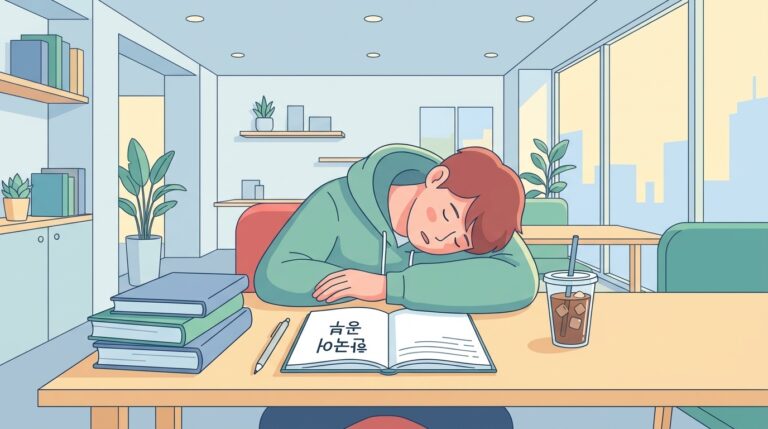
How to Express Study Stress in Korean Like a True Local
안녕하세요! 매일한글 에디터입니다.
Picture this: It is 10:45 PM on a freezing Thursday night in Daechi-dong, Seoul’s legendary cram school district. The neon signs of private academies (hagwons) glow through the dark, and double-parked yellow shuttle buses line the streets awaiting thousands of exhausted teenagers. If you have ever watched K-dramas like Crash Course in Romance, SKY Castle, or True Beauty, you know that Korea’s “Education Fever” (Gyoyukyeol) is intense.
Many of our daily learners tell us: “When I feel overwhelmed by Korean grammar drills, TOPIK preparation, or university exams, I want to vent to my Korean friends. But whenever I look up phrases in a dictionary, I end up saying robotic sentences like ‘저는 공부 때문에 슬픕니다’ (I am sad because of study).”
In Korea, complaining about study exhaustion is not just venting; it is an essential bonding ritual. Sharing study stress builds instant solidarity, turning awkward classmates into lifelong study buddies. Based on hundreds of real coaching sessions with A2 beginners, this comprehensive guide will give you natural, punchy expressions to share your academic fatigue without sounding dramatic or awkward. Let’s dive into the authentic language of Korean study culture!
Phase 2: Core Expressions Deep Dive
1. 머리가 터질 것 같아요 (Meoriga teojil geot gat-ayo)
- Pronunciation: Meo-ri-ga teo-jil geot ga-ta-yo (Think of the rhythm: “Muh-ree-gah toe-jeel gut gah-tah-yo”)
- Meaning: Literally “My head seems like it will burst.” Culturally, it translates to “My brain is totally fried” or “I have severe cognitive overload.”
- K-Culture Moment: You will hear high school characters in youth dramas slam their heads onto a mountain of workbooks right after solving a monstrous calculus problem.
- Editor’s Insight: While “my head will burst” sounds alarming in English, in Korean it is a standard, daily hyperbolic idiom. It expresses mental saturation rather than medical danger. It immediately evokes sympathetic smiles.
- Situation Spectrum: Casual: ✅ | Semi-formal: ✅ | Formal: ⚠️
- 🤔 Think About It: In your native tongue, do you describe mental fatigue through physical sensations (like bursting or burning)? Why do you think Korean leans heavily on visceral physical metaphors?
2. 시험 스트레스가 장난 아니에요 (Siheom seuteureseuga jangnan anieyo)
- Pronunciation: Si-heom seu-teu-re-seu-ga jang-nan a-ni-e-yo (“See-hum stew-less-gah jahng-nahn ah-nee-eh-yo”)
- Meaning: Literally “Exam stress is not a joke.” In reality, it means “The exam stress is absolutely insane!”
- K-Culture Moment: College freshmen at a university cafe during finals week (gimalgosa), collapsing into booth seats surrounded by cold brew cups.
- Editor’s Insight: The phrase 장난 아니에요 (jangnan anieyo) is one of the most versatile spoken formulas at the A2 level. You can attach it to spicy food, Seoul’s winter chill, or workload to express that something is “no joke.”
- Situation Spectrum: Casual: ✅ | Semi-formal: ✅ | Formal: 🚫
- 🤔 Think About It: How does qualifying stress as “no game/joke” change how seriously people validate your emotional struggle?
3. 공부가 너무 안 돼요 (Gongbuga neomu an dwaeyo)
- Pronunciation: Gong-bu-ga neo-mu an dwae-yo (“Gong-boo-gah nuh-moo ahn dweh-yo”)
- Meaning: Literally “Studying really doesn’t become.” It naturally conveys: “I just can’t focus on studying at all.”
- K-Culture Moment: Slumping over a tablet in a 24-hour study cafe, hopelessly re-reading the exact same sentence five times.
- Editor’s Insight: Notice the grammar: instead of saying “I cannot study” (내가 공부를 못해요), Korean uses the passive-reflexive structure “study is not happening.” This removes personal guilt—it frames the lack of focus as an external slump rather than a moral failure!
- Situation Spectrum: Casual: ✅ | Semi-formal: ✅ | Formal: ✅
- 🤔 Think About It: Does shifting the blame from “I am lazy” to “study is not working out today” make you feel gentler toward your own burnout?
Phase 3: Textbook Korean vs. Real Korean
Situation 1: Saying your brain stopped working
- 📖 교과서 한국어 (Textbook): 저는 공부를 많이 해서 매우 피곤합니다. (Jeoneun gongbureul mani haeseo maeu pigonhamnida. – I am very tired because I studied a lot.)
- 🗣️ 진짜 한국어 (Real-life): 머리가 하얘졌어요. (Meoriga hayaejyeosseoyo. – My mind went completely blank.)
- 💡 왜 다를까? (Why is it different?): Textbook Korean focuses on declarative statements of physical tiredness. Real Koreans describe the cognitive “whiteout” (하얘지다) when their brain shuts down under exam pressure.
Situation 2: Calling it quits for the day
- 📖 교과서 한국어 (Textbook): 오늘은 공부를 중단하겠습니다. (Oneureun gongbureul jungdanhagesseumnida. – I shall cease studying today.)
- 🗣️ 진짜 한국어 (Real-life): 오늘은 멘붕 와서 여기까지 할래요. (Oneureun menbung waseo yeogikkaji hallaeyo. – I hit a mental breakdown, so I’m calling it a day.)
- 💡 왜 다를까? (Why is it different?): The textbook phrasing sounds like an official military broadcast. Using the slang 멘붕 (menbung – mental breakdown) paired with the gentle boundary phrase 여기까지 할래요 (I will stop here) sounds warm, self-aware, and natural.
Phase 4: K-Culture Deep Dive & Non-Verbal Manners
4-1. 눈치 (Nunchi) & Gestures in Study Spaces
When expressing study burnout in Korea, your non-verbal cues must match the environment:
* The Double-Temple Rub & Whisper-Sigh: In public study spots like Dokseosil (single-seat reading rooms) or modern Study Cafes, pin-drop silence is mandatory. If you are venting to a friend, press your pointer and middle fingers to both temples, release a barely audible breath (“Hyu…”), and tilt your head.
* The Validating Nod: If a classmate sighs and whispers that their head hurts, never offer logical solutions like “You should manage your schedule better.” In Korean conversational etiquette, emotional resonance precedes logic. Nod three times with a pained expression and whisper: “맞아요, 진짜 힘들죠?” (Majayo, jinjja himdeuljyo? / I know, right? It’s so tough.).
4-2. Cultural Codes: The Study Cafe & Kagongjok Ecosystem
Korea has institutionalized exam preparation into a unique cafe subculture. You will encounter the 카공족 (Kagongjok)—people who study in coffee shops for hours.
To accommodate them, modern 스터디 카페 (Study Cafes) offer cubicles equipped with white-noise generators, lap blankets (dam-yo), ergonomic laptop stands, and endless free instant iced Americanos. Venting about study stress inside these modern sanctuaries is communal: you drink your iced coffee, exchange a glance of mutual suffering with the stranger across from you, and return to memorizing vocabulary.
Phase 5: Real-Life Roleplay Scenario
Setting: 1:15 AM at a 24-hour study cafe near Sinchon, Seoul. Soft yellow desk lamps glow beneath ambient white noise.
Characters: You (an A2 Korean learner) and Minji (a Korean university classmate cramming for midterms).
- Minji: 혹시 몇 시까지 공부할 거예요? (Hoksi myeot sikkaji gongbuhal geoyeyo?)
Translation: By any chance, until what time are you going to study?
🎭 [Minji stretches her aching shoulders, grimacing at her notes] -
You: 원래 새벽 세 시까지 하려고 했는데, 머리가 터질 것 같아요. (Wonrae saebyeok se sikkaji haryeogo haenneunde, meoriga teojil geot gat-ayo.)
Translation: I originally planned until 3 AM, but my head feels like it will explode.
🎭 [Gently rubbing your temples with an exhausted smile] -
Minji: 아, 완전 공감해요! 이번 시험 범위 진짜 너무 많죠? (A, wanjeon gonggamhaeyo! Ibeon siheom beomwi jinjja neomu manjyo?)
Translation: Ah, I totally relate! The exam scope is way too wide this time, right?
🎭 [Nodding vigorously and resting her chin in her hands] -
You: 네, 맞아요. 시험 스트레스가 장난 아니에요. (Ne, majayo. Siheom seuteureseuga jangnan anieyo.)
Translation: Yes, exactly. Exam stress is no joke.
🎭 [Shaking your head slowly while tapping the textbook] -
Minji: 저도 지금 한 시간째 같은 페이지만 보고 있어요. (Jeodo jigeum han siganjjae gateun peijiman bogo isseoyo.)
Translation: Me too, I’ve been staring at the exact same page for an hour now.
🎭 [Drops her highlighter and leans back in defeat] -
You: 저도요! 공부가 너무 안 돼요. 커피 한잔 마실래요? (Jeodoyo! Gongbuga neomu an dwaeyo. Keopi hanjan masillaeyo?)
Translation: Same here! Studying is just not working out. Do you want to grab a coffee?
🎭 [Pointing quietly toward the break lounge with a tumbler] -
Minji: 좋아요! 로비 자판기에서 시원한 캔커피 마시면서 머리 좀 식혀요. (Joayo! Robi japangieseo siwonhan kaenkeopi masimyeonseo meori jom sikhyeoyo.)
Translation: Sounds great! Let’s get an iced canned coffee from the lounge vending machine and cool down our heads.
🎭 [Pushes her chair back silently so as not to disturb others] -
You: 네, 잠깐 쉬고 다시 힘내요! (Ne, jamkkan swigo dasi himnaeyo!)
Translation: Yes, let’s take a quick rest and gather strength again!
🎭 [Whispering softly with an encouraging thumb up]
🔀 Interactive Decision Branch
During your break, Minji sighs: “저 이번 시험 망칠 것 같아요…” (I feel like I am going to ruin this exam…). How do you respond?
- Option A: “공부 더 열심히 해야죠! 포기하지 마세요.” (Gongbu deo yeolsimhi haeyajyo! Pogihaji maseyo. / You should study harder! Don’t give up.)
- Feedback: [BAD] While well-intentioned, telling an already exhausted Korean student to “study harder” sounds patronizing and invalidating.
- Option B: “진짜요? 저도 머리가 터질 것 같아요. 그래도 민지 씨는 잘할 거예요!” (Jinjjayo? Jeodo meoriga teojil geot gat-ayo. Geuraedo Minji ssineun jalhal geoyeyo! / Really? My head feels like exploding too. Still, you will do great, Minji!
- Feedback: [BEST] Perfect empathy-first approach! You validate her stress by sharing your own vulnerability, followed by a warm word of encouragement.
- Option C: “저는 이미 다 외웠는데요?” (Jeoneun imi da oewonneundeyo? / I already memorized everything though?)
- Feedback: [RISK] Bragging while someone is venting will instantly freeze the mood and end your friendship.
Phase 6: 10-Second Emotion Shadowing Drill
Repeat these lines out loud. Match the rhythm pauses marked by / and channel the emotional cues!
- [😩 지치고 한숨 쉬며 – Exhausted, sighing deeply]
머리가 / 터질 것 / 같아요.
(Meoriga / teojil geot / gat-ayo.) -
[🤯 멘붕 와서 멍하니 – Dazed from a mental breakdown]
시험 스트레스가 / 진짜 / 장난 아니에요.
(Siheom seuteureseuga / jinjja / jangnan anieyo.) -
[🥺 답답하고 속상하게 – Frustrated and stuck]
오늘따라 / 공부가 / 너무 안 돼요.
(Oneulttara / gongbuga / neomu an dwaeyo.)
Phase 7: K-Culture Mini Dictionary
- 야자 (Yaja)
Short for 야간 자율 학습 (Night Autonomous Study). Traditionally mandatory evening self-study sessions in Korean high schools lasting until 10:00 PM. - 멘붕 (Menbung)
Compound of 멘탈 (Mental) + 붕괴 (Collapse). Slang for an acute mental breakdown caused by an unexpected test question or overwhelming study workload. - 카공족 (Kagongjok)
Blend of 카페 (Cafe) + 공부 (Study) + 족 (Tribe). Students or telecommuters who occupy cafe tables for extended study sessions. - 불수능 (Bulsuneung)
Fire CSAT. A College Scholastic Ability Test that is notoriously brutal and difficult, leaving examinees scorched in its wake.
Phase 8: Survival Kit for Travelers & Expats
Top 3 Survival Phrases for Study Spots
- 콘센트 자리 있나요? (Konsenteu jari innayo?)
Translation: Is there a seat with a power outlet?
Pro Tip: Essential when hunting for laptop-friendly desks in busy Seoul university cafes. - 와이파이 비밀번호가 뭐예요? (Wa-i-pa-i bimilbeonhoga mwoyeyo?)
Translation: What is the Wi-Fi password?
Pro Tip: Often printed on the bottom of your payment receipt (yeongsujeung). - 여기 자리 비어 있나요? (Yeogi jari bieo innayo?)
Translation: Is this seat empty / available?
Pro Tip: Ask this politely before taking an unoccupied chair in crowded areas.
Editor’s Travel Note: Navigating Study Cafes in Seoul
If you want to experience Korea’s high-tech study culture, look for unstaffed 24-hour study cafes (like Chosim or Jaksim) in student districts like Sinchon, Hyehwa, or Anam. You register at a touchscreen kiosk at the entrance, select your seat, and pay via credit card or T-money. If you want to reserve dedicated seminar rooms or quiet cubicles across the city, check out the 스페이스클라우드 앱 다운로드 service to discover indie study lounges near you.
Phase 9: “한 발 더 깊이” (A Deeper Look)
In Western cultures, complaining about stress can sometimes carry a stigma of weakness or inefficiency. In Korea, however, stress caused by learning or working hard is viewed through the philosophical lens of 고생 (Gosaeng)—meaningful suffering that precedes achievement.
When you tell a Korean friend “머리가 터질 것 같아요”, you are not seen as a slacker; you are seen as someone striving with wholehearted passion. This collective struggle creates an intimate bond known as Jeong (정). By learning to express your study limits in Korean, you are participating in one of modern Korea’s most sacred social contracts: mutual survival.
💬 Your Turn: What is your biggest hurdle when studying Korean grammar? Have you ever felt like your head was going to burst? Drop your thoughts in the comments below using one of today’s expressions!
Phase 10: FAQ & Avoiding Misunderstandings
Q: Can I say “머리가 터질 것 같아요” to my university professor?
A: It is a bit too casual and graphic for a formal academic email. To an elderly professor or boss, soften it to: “학업 부담이 조금 큽니다” (Hageop budami jogeum keumnida / The academic burden is somewhat heavy) or “요즘 과제가 많아서 조금 힘듭니다” (Yojeum gwajega manhaseo jogeum himdeumnida / I am struggling a bit because there are many assignments lately).
Q: What is the difference between “스트레스 받아요” and “스트레스 장난 아니에요”?
A: 스트레스 받아요 (seuteureseu badayo) is a neutral, factual statement: “I receive/feel stress.” In contrast, 스트레스 장난 아니에요 (seuteureseu jangnan anieyo) emphasizes the dramatic intensity: “The stress is unreal!”
Q: Does “공부가 안 돼요” mean I am bad at studying?
A: No! “공부를 못해요” means you lack the skill. “공부가 안 돼요” simply means your brain is in a temporary slump or unable to concentrate at this particular moment.
🚨 Common Mistakes Warning Board
- Translating “I am stressed” literally: Saying “나는 스트레스이다” literally means “I AM stress itself.” Always use the verb phrase 스트레스를 받다 (to receive stress): 스트레스 많이 받아요.
- Using 반말 (informal speech) prematurely: When venting to a study partner you just met, don’t drop the polite -요 ending. Expressing pain politely keeps the interaction respectful.
- Giving unsolicited advice instead of empathy: When a peer vents about exams, resist offering study tips. Simply offer commiseration: “진짜 힘들겠다… 힘내요!” (That must be so tough… Hang in there!).
Phase 11: Action Mission
- 🥉 Bronze Level: Stand before a mirror and practice saying “머리가 터질 것 같아요” with a dramatic temple massage 3 times.
- 🥈 Silver Level: Write a 2-sentence study status on your language exchange profile or social media: “오늘 한국어 공부가 너무 안 돼요. 멘붕 왔어요!”
- 🥇 Gold Level: The next time your Korean tutor or language exchange partner asks how your week went, use “시험 스트레스가 장난 아니에요” naturally in conversation.
- 🎮 K-Culture Mission: Watch an episode of a school-based K-drama (like School 2021 or Twenty-Five Twenty-One) and spot how many times characters sigh or complain about exams!
Phase 12: Interactive Quiz Challenge
Question 1 (Scenario Judgment)
You have been memorizing vocabulary for four straight hours and your brain has stopped processing information. Your Korean friend asks: “공부 잘돼요?” (Is studying going well?) How do you reply naturally?
1. 저는 나쁜 학생입니다.
2. 공부가 너무 안 돼요. 머리가 터질 것 같아요.
3. 시험을 그만두겠습니다.
Question 2 (Fill in the Blank)
Complete the expression meaning “Exam stress is no joke!”:
시험 스트레스가 [ ] 아니에요.
Question 3 (True or False)
In Korea, complaining about study fatigue to a classmate is considered rude and offensive. (True / False)
👉 Click here to reveal the answers and explanations!
- Answer 1: (2) 공부가 너무 안 돼요. 머리가 터질 것 같아요. (Accurately expresses mental burnout while remaining natural and polite).
- Answer 2: 장난 (Jangnan). The full phrase is 장난 아니에요 (is no joke).
- Answer 3: False. In Korean student culture, commiserating over academic stress is a core social bonding ritual that fosters mutual empathy and friendship.







