

Phase 1: Empathy (Story Immersion Opening)
안녕하세요! 매일한글 에디터입니다.
Imagine this: you finally touch down at Incheon Airport, drop your bags off at your hotel, and follow the irresistible scent of sizzling Korean BBQ into a lively neighborhood restaurant. The energy is buzzing, the aroma is mouthwatering, and you are ready for the meal of your dreams. You sit down at a cozy wooden table, take a deep breath, and… pause.
There is no menu in sight.
Across the room, there is a giant wooden board covered with handwritten Hangul, but the fonts are stylized and moving too fast for your eyes. The servers are bustling past your table with sizzling hot stone bowls, and your mind goes completely blank. What if I sound impolite? How do I get their attention without causing a scene?
Take a deep breath! You are definitely not alone. Nearly every beginner learner we mentor at Daily Hangul shares this exact hesitation. But here is the secret: you do not need to memorize complex grammar to get treated like an honored guest. All it takes is one simple, polite three-word phrase—메뉴판 주세요 (Menupan juseyo)—to unlock warm smiles and delicious food. Let’s make sure you never feel frozen at a Korean table again!
Phase 2: Deep Dive into 3 Key Expressions
1. 메뉴판 주세요 (Menupan juseyo)
- Pronunciation: Menupan juseyo (Sounds like: “Meh-noo-pahn joo-seh-yo” — think of ‘menu’, add ‘pan’ like a frying pan, and ‘juseyo’ like ‘juice-say-yo’)
- Meaning: Literal: “Menu board, please give.” | Real Nuance: “Could I please have the menu?”
- K-Culture Moment: Think of K-dramas like Weightlifting Fairy Kim Bok-joo, where the athletic squad sits down at a grill house and immediately asks for the menu to plan their epic multi-course feast.
- Editor’s Insight: In Korean, the word 판 (pan) means a board, plate, or flat surface. Adding 주세요 (juseyo) is the golden key of Korean politeness—it softens any request into an instant, respectful phrase.
- Situation Spectrum: Casual: 🚫 | Semi-formal: ✅ | Formal: ✅
- 🤔 Think About It: In English, we ask permission: “Can I see the menu?” In Korean, the focus is on the partner’s action: “Please give me the menu.” How does this subtle shift reflect Korean mutual hospitality?
2. 저기요 (Jeogiyo)
- Pronunciation: Jeogiyo (Sounds like: “Juh-ghee-yo” — rhymes with ‘yo-yo’)
- Meaning: Literal: “Over there!” | Real Nuance: “Excuse me! (to call someone’s attention)”
- K-Culture Moment: Seen in almost every contemporary drama—the protagonist is seated at a pocha (street pub) and calls out gently across the room to summon the server.
- Editor’s Insight: Never snap your fingers or yell “Server!” in Korea. Saying 저기요 (Jeogiyo) is polite, humble, and perfectly draws attention without sounding demanding.
- Situation Spectrum: Casual: ⚠️ | Semi-formal: ✅ | Formal: ✅
- 🤔 Think About It: Why do you think Korean uses a spatial word meaning “over there” instead of shouting a person’s job title?
3. 이거 뭐예요? (Igeo mwoyeyo?)
- Pronunciation: Igeo mwoyeyo? (Sounds like: “Ee-guh mwoh-yeh-yo?”)
- Meaning: Literal: “This, what is it?” | Real Nuance: “What is this dish / item?”
- K-Culture Moment: Picture wandering through Gwangjang Market in Seoul, spotting a bubbling stew, pointing at the pot, and asking the smiling market vendor what magical dish is cooking.
- Editor’s Insight: Pair this phrase with a gentle two-finger point to a menu picture or another customer’s appetizing table.
- Situation Spectrum: Casual: 🚫 | Semi-formal: ✅ | Formal: ✅
- 🤔 Think About It: English puts the question word at the start (“What is this?”), while Korean reveals the subject first (“This, what is?”). What does this tell you about Korean communication priorities?
Phase 3: Textbook Korean vs. Real Korean
Situation 1: Asking the Staff for a Menu
- 📖 교과서 한국어 (Textbook Korean): 메뉴를 주시겠습니까? (Menyureul jusigesseumnikka? / Would you bestow the menu upon me?)
- 🗣️ 진짜 한국어 (Real Korean): 저기요, 메뉴판 좀 주세요! (Jeogiyo, menupan jom juseyo! / Excuse me, could we please get a menu?)
- 💡 왜 다를까?: The textbook version sounds like you are addressing royalty in a historical drama! Real locals add the tiny word 좀 (jom), meaning ‘a little’, which naturally cushions the request and makes you sound friendly.
Situation 2: Calling Staff to Your Table
- 📖 교과서 한국어 (Textbook Korean): 실례합니다, 이리 와 주십시오. (Sillyehamnida, iri wa jusipsio. / Excuse me, please step over this way.)
- 🗣️ 진짜 한국어 (Real Korean): 사장님, 여기요~ (Sajangnim, yeogiyo~ / Boss/Owner, over here please~)
- 💡 왜 다를까?: Calling restaurant owners 사장님 (Sajangnim – CEO/Boss) is an endearing cultural compliment that instantly builds rapport with shopkeepers of all ages.
Phase 4: K-Culture Deep Dive & Non-Verbal Manners
4-1. 눈치 (Nunchi) & Table Gestures
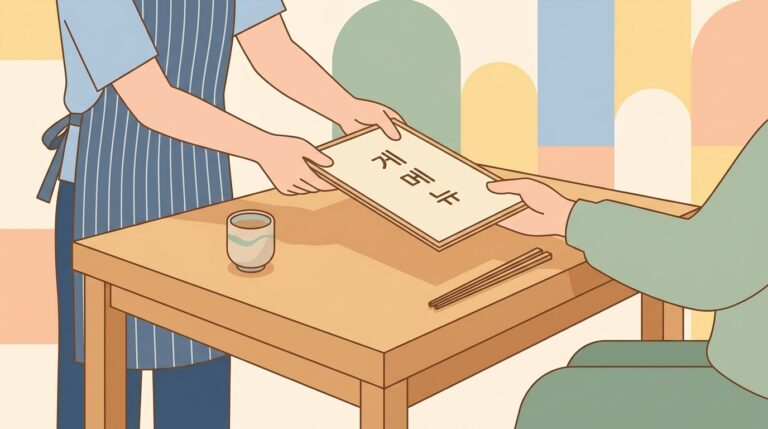
In Korean dining, body language does half the talking. When calling someone, do not wave your entire arm high in the air. Instead, catch brief eye contact, lift one hand slightly above chest level, and deliver a gentle 저기요 (Jeogiyo). When the server hands you the physical menu, receive it using both hands (or hold your right forearm lightly with your left hand). This tiny gesture showcases immense cultural awareness and instantly earns warm compliments!
4-2. Cultural Code: The Table Call Bell & Wall Menus
Look closely at your dining table before calling out. You might spot a small circular call button (벨 – bel) attached to the corner or wall. In modern Korean restaurants, pressing this once emits a melodic chime and displays your table number at the counter—no shouting required! Furthermore, traditional spots often hang their full selection on huge wall posters. If the wall text is confusing, asking for 메뉴판 주세요 (Menupan juseyo) signals to staff to bring you a handheld printed sheet or a tourist-friendly English book.
Phase 5: Real Roleplay Scenario
- Setting: A bustling noodle diner near Euljiro, Seoul. The air smells of rich beef broth and sesame oil.
- Characters:
- Alex (An adventurous A1 Korean learner visiting Seoul)
- Imo (The warm, energetic restaurant ‘Auntie’ running the dining hall)
Dialogue:
1. Alex: (🎭 Looks around the table, spots no menu, raises right hand slightly) 저기요! (Jeogiyo! / Excuse me!)
2. Imo: (🎭 Wipes hands on her apron, walks over with a welcoming smile) 네~ 뭐 드릴까요? (Ne~ mwo deurilkkayo? / Yes~ what can I get you?)
3. Alex: (🎭 Smiles politely, speaking clearly) 메뉴판 좀 주세요. (Menupan jom juseyo. / Could I please get a menu?)
4. Imo: (🎭 Nods enthusiastically, pulling a laminated sheet from under the counter) 네, 여기 있어요! (Ne, yeogi isseoyo! / Sure, here you go!)
5. Alex: (🎭 Receives the menu using both hands with a slight head bow) 감사합니다! (Gamsahamnida! / Thank you!)
6. Imo: (🎭 Points at a photo on the front page) 우리 집 칼국수 아주 맛있어요. (Uri jip kalguksu aju masisseoyo. / Our hand-cut noodles are very delicious.)
7. Alex: (🎭 Nods excitedly, pointing at the picture) 칼국수 하나 주세요! (Kalguksu hana juseyo! / One bowl of knife-cut noodles, please!)
8. Imo: (🎭 Gives a reassuring pat on the table) 네! 금방 나와요~ (Ne! Geumbang nawayo~ / Yes! Coming right up~)
🔀 Interactive Decision Point
Imagine you sit down and need to get the server’s attention. What is your move?
* Option A: Raise your hand gently and say, “저기요, 메뉴판 좀 주세요!” (Jeogiyo, menupan jom juseyo!)
* Option B: Shout loudly across the room, “야! 메뉴 가져와!” (Ya! Menyu gajyeowa!)
* Option C: Stand up, walk to the kitchen counter, and bow deeply saying, “실례합니다만 메뉴를 주시겠습니까?” (Sillyehamnidaman menyureul jusigesseumnikka?)
Feedback Breakdown:
* Option A (Best): Perfect! Natural, courteous, and exactly how everyday Koreans communicate.
* Option B (Bad): Yikes! 야 (Ya) is very rude slang used only with close childhood friends. The auntie might scold you!
* Option C (Risk): A bit too stiff! While grammatically polite, leaving your seat and speaking like a period drama actor feels unnecessarily rigid for casual dining.
Phase 6: 10-Second Emotion Shadowing Drill
Practice reading these aloud. Pause briefly at every / slash to capture natural Korean rhythm!
[🙋 Cheerful & Clear]저기요! / 메뉴판 좀 / 주세요! (Jeogiyo! / menupan jom / juseyo!)[🤔 Curious & Inquiring]이거 / 뭐예요? (Igeo / mwoyeyo?)[🙏 Warm & Grateful]네, / 감사합니다! (Ne, / gamsahamnida!)
Phase 7: K-Culture Mini Dictionary
- 메뉴판 (Menupan): Handheld or printed menu board. Crucial in traditional eateries where only Korean wall menus exist.
- 저기요 (Jeogiyo): The ultimate attention-getter. Universally acceptable in shops, subways, and casual restaurants.
- 사장님 (Sajangnim): Means ‘CEO’ or ‘President’, but universally used as an affectionate, respectful title for shop and restaurant owners.
- 벨 (Bel): The electronic call button built into dining tables. Look for it before calling aloud!
Phase 8: Traveler’s Survival Kit
Survival Expressions TOP 3
- 물 좀 주세요 (Mul jom juseyo) — Pro Tip: Water is almost always complimentary (and often self-service) in Korea. If you see a water cooler with cups stacked nearby, you can grab it yourself!
- 이거 주세요 (Igeo juseyo) — Pro Tip: Simply point your finger at an appetizing photo or menu item and say this sentence.
- 계산해 주세요 (Gyesanhae juseyo) — Pro Tip: Say this at the counter when you are ready to settle the bill.
Editor’s Travel Note
- The Hidden Drawer: Can’t find cutlery or napkins on the table? Slide your hand under the edge of your table. Most Korean restaurants feature a built-in drawer holding spoons, chopsticks, and tissues!
- Digital Lifelines: Before flying over, make sure to [download Naver Map app for dining] for real-time reviews and [install Papago translation app for photo menus] to scan challenging wall boards on the fly.
Phase 9: “One Step Deeper” (Reflective Essay)
In Korean culture, ordering food is not a cold commercial transaction; it is an interpersonal connection. Notice how words like 사장님 (Sajangnim) or 이모 (Imo – Auntie) transform a service interaction into a mini-relationship. By speaking with the polite ending ~요 (~yo) and asking with 주세요 (juseyo), you aren’t just placing an order—you are expressing warmth and respect within Korea’s community-driven dining culture.
💬 Your Turn: What is the customary way to call a waiter in your home country? Share your dining culture stories in the comments below!
Phase 10: FAQ & Common Mistakes
Q: Can I just say “메뉴 주세요 (Menyu juseyo)” without “판 (pan)”?
A: Yes, absolutely! Koreans will understand you perfectly. However, adding 판 (pan) specifically clarifies that you are asking for the physical menu item list, not the actual food itself.
Q: What should I do if nobody comes after I press the table bell?
A: Wait about 15 to 20 seconds. If the restaurant is bustling with lunchtime crowds, make eye contact with passing staff and call out gently: “저기요~” (Jeogiyo~).
Q: Is it rude to split the bill in a Korean restaurant?
A: While casual spots accommodate separate card payments, older neighborhood places prefer one person paying the whole amount. Asking politely at the counter is key!
🚨 Common Mistakes Warning Board
- Calling staff “웨이터 (Waiter)”: Avoid this! It sounds outdated and overly Western. Use 저기요 (Jeogiyo) or 사장님 (Sajangnim) instead.
- Grabbing items with one hand: Always accept menus and receipts with both hands to display basic respect.
- Snapping fingers to call someone: Snapping fingers or waving both hands overhead is considered very impolite in Korea.
Phase 11: Action Missions & Community
- 🥉 Bronze Mission: Stand in front of your mirror and practice saying “저기요, 메뉴판 좀 주세요!” three times with a bright smile.
- 🥈 Silver Mission: Post an Instagram story or note using the phrase and tag our learning handle #DailyHangul.
- 🥇 Gold Mission: Visit your local Korean restaurant or grocery food court this weekend and order entirely using Korean phrases!
- 🎮 K-Culture Mission: Put on any food-related Korean drama episode (like Let’s Eat) and count how many times you hear the word 주세요 (juseyo)!
Phase 12: Interactive Quiz Challenge
Test your new skills before your next dining adventure!
- Situation Question: You sit at a table in a Hongdae pork belly restaurant. There is no call button, and you want to look at the food options. What should you say?
- Fill-in-the-blank: 저기요, ______ 좀 주세요! (Excuse me, please give me the menu board!)
- True / False: In Korea, it is considered polite to shout “웨이터! (Waiter!)” at the top of your lungs.
👉 Click to reveal answers & explanations!
- Answer: “저기요, 메뉴판 좀 주세요!” (Jeogiyo, menupan jom juseyo!)
Explanation: This is the most polite and natural way to call staff and ask for the menu sheet. - Answer: 메뉴판 (menupan)
Explanation: 메뉴판 literally means ‘menu board/sheet’. - Answer: False!
Explanation: Shouting ‘Waiter’ is frowned upon. Use “저기요” (Jeogiyo) or press the table call bell!







