

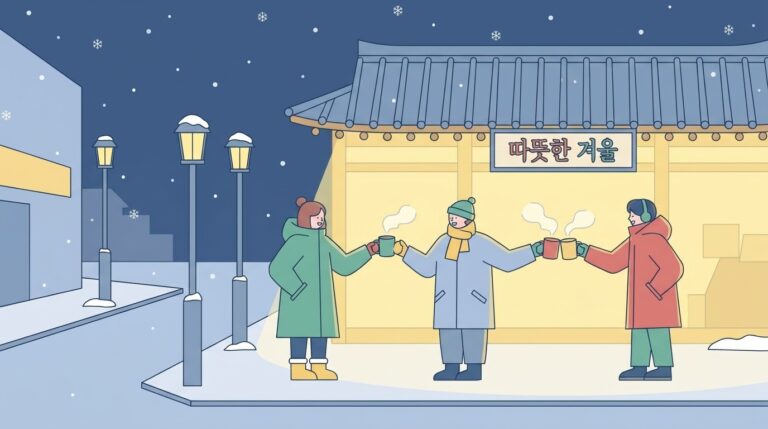
Master the Korean Year-End Gathering: Essential Winter Expressions & Etiquette
Phase 1: Empathy (Story-Immersive Opening)
안녕하세요! 매일한글 에디터입니다.
Picture this: It is mid-December in Seoul. The temperature outside has dropped to minus ten degrees Celsius, and your breath plumed like smoke as you walked through the neon-lit alleyways of Euljiro. You step through the vinyl curtain of a bustling Korean BBQ restaurant. The rush of warmth hits your face along with the savory sizzle of pork belly (samgyeopsal) and the laughter of twenty people crowded around small circular steel tables. Everyone is cheering, clinking small green bottles, and celebrating the year’s end.
Suddenly, your Korean colleague turns to you, fills your glass with two hands, and beams: “Now, let’s hear a few words from you!” Your heart drops. What do you say? Do you bow? Should you down the whole drink? How do you express heartfelt appreciation for the past twelve months without sounding like a robotic textbook from 2005?
Over the past decade of coaching foreign professionals, exchange students, and K-culture enthusiasts in Korea, I have seen so many brilliant learners freeze at this exact moment. Year-end gatherings—known as 송년회 (Songnyeonhoe)—are the ultimate proving ground for practical Korean. When done right, this single evening can turn distant acquaintances into lifelong friends. In this guide, tailored specifically for intermediate (B1) learners, we will break down the essential phrases, unspoken body language, and cultural survival hacks you need to navigate Korean winter gatherings with charm and confidence.
Phase 2: Core Expressions Deep Dive (Top 3)
1. 올 한 해도 수고 많으셨습니다 (Ol han haedo sugo maneusyeotseumnida)
- Pronunciation: [Ol han hae-do soo-go mah-neu-syeot-seum-ni-da] (Think of ‘sugo’ like the sauce ‘sugo’ in Italian, spoken with gentle respect)
- Meaning: Literal: “You suffered/labored much this year as well.” / Real Nuance: “Thank you for all your dedication, hard work, and endurance over the past year.”
- K-Culture Moment: In corporate K-Dramas like Misaeng or office slice-of-life scenes, the team leader raises their glass at the end of December, looks at the exhausted junior staff, and says this sentence to validate everything they survived together.
- Editor’s Insight: The word 수고 (sugo) carries deep emotional weight in Korea. It recognizes that living and working through a full year is an uphill battle. Using honorifics (
-셨습니다) shows immense respect for older colleagues or seniors. - Situation Spectrum: Casual: ⚠️ (Use ‘올해도 고생했어’ instead) | Semi-formal: ✅ | Formal: ✅
- 🤔 Think About It: In English, we often say “Happy Holidays” or focus on celebration, while Koreans acknowledge shared struggle first. What does this reveal about Korea’s collective resilience?
2. 우리 2차 가요! (Uri icha gayo!)
- Pronunciation: [Oo-ree ee-cha gah-yo!] (Sounds like ‘Ooh-ree’ + the letter ‘E’ + ‘cha’ like ‘chai tea’ without the ‘i’ + ‘gah-yo’)
- Meaning: Literal: “Let’s go to the second round!” / Real Nuance: “The night is still young—let’s hit the next spot!”
- K-Culture Moment: Seen in nearly every romance or comedy K-Drama where the initial awkward dinner breaks into a fun, informal chicken-and-beer (Chimaek) or karaoke (Noraebang) joint.
- Editor’s Insight: Korean social gatherings rarely stop at one venue. ‘1차’ (il-cha) is for dinner, ‘2차’ (i-cha) is for light drinks, and ‘3차’ (sam-cha) might be singing or coffee. Suggesting 2차 signals that you are genuinely enjoying their company.
- Situation Spectrum: Casual: ✅ | Semi-formal: ✅ | Formal: ⚠️ (Say ‘2차 가시죠’ to your boss)
- 🤔 Think About It: Moving venues multiple times during an evening changes the hierarchy and seating order, allowing different people to talk. How does your culture encourage mingling at large parties?
3. 새해 복 많이 받으세요 (Saehae bok mani badeuseyo)
- Pronunciation: [Sae-hae bok mah-nee bah-deu-seh-yo] (Pronounce ‘bok’ like ‘boke’, crisp and short)
- Meaning: Literal: “Please receive lots of good fortune in the New Year.” / Real Nuance: “Wishing you health, wealth, and immense happiness in the coming year.”
- K-Culture Moment: The closing credits of year-end music award shows (like KBS Song Festival or MAMA), where K-Pop idols bow 90 degrees to the camera and chorus this line in unison.
- Editor’s Insight: Even though the Solar New Year is January 1st and the Lunar New Year (Seollal) is in January or February, Koreans begin exchanging this blessing freely starting mid-December as gatherings conclude.
- Situation Spectrum: Casual: ⚠️ (Use ‘새해 복 많이 받아’ with close peers) | Semi-formal: ✅ | Formal: ✅ (Use ‘새해 복 많이 받으십시오’)
- 🤔 Think About It: Notice the passive nature: 받으세요 means “receive.” Luck is seen as a blessing given by the universe or ancestors rather than simply “made” on your own.
Phase 3: Textbook Korean vs Real Korean
Situation 1: Proposing a Toast at the Table
- 📖 교과서 한국어 (Textbook):
“우리 다 함께 잔을 들어 건배합시다!”
(Uri da hamkke janeul deureo geonbaehapsida! – Let us all lift our glasses and cheer!) - 🗣️ 진짜 한국어 (Real-Life B1):
“자, 다들 올 한 해 정말 고생 많으셨어요. 짠 할까요?”
(Ja, dadeul ol han hae jeongmal gosaeng maneusyeosseoyo. Jjan halkkayo? – Alright everyone, you all really endured so much this year. Shall we clink?) - 💡 왜 다를까?
The phrase 건배합시다 sounds like an announcement made by an MC at an international summit. In real settings, native speakers use lively discourse markers like 자 (ja) and sound words like *짠 (jjan – the clinking sound of glasses) to create immediate intimacy.
Situation 2: Politely Pacing Yourself or Declining Another Round of Alcohol
- 📖 교과서 한국어 (Textbook):
“저는 취했기 때문에 술을 더 마실 수 없습니다.”
(Jeoneun chwihaetgi ttaemune sureul deo masil su eopseumnida. – Because I am intoxicated, I cannot drink more liquor.) - 🗣️ 진짜 한국어 (Real-Life B1):
“저 오늘은 여기까지 사릴게요! 내일 일정이 있어서요.”
(Jeo oneureun yeogikkaji sarilgeyo! Naeil iljeongi isseoseoyo. – I’ll pace myself and stop here for tonight! I have plans tomorrow.) - 💡 왜 다를까?
Saying flatly “I am drunk, so I cannot drink” sounds cold and halts the mood. The colloquial verb 사리다 (sarida – to hold back/protect oneself) signals respect for the social atmosphere while firmly setting your boundary.
Phase 4: K-Culture Deep Dive & Non-verbal Manners
4-1. 눈치 (Nunchi) & Table Gestures
At a year-end dinner, what you do with your hands matters just as much as what comes out of your mouth:
* The Two-Handed Pour & Receive: Never hold a bottle or your cup with just one hand if someone older or higher-ranking is serving you. Support your right forearm or wrist with your left hand, or place your left palm flat against your chest. This ancient custom comes from tucking away the long sleeves of traditional Hanbok so they wouldn’t dip into food.
* The 45-Degree Head Turn: When taking a drink in front of seniors or bosses, turn your torso and face slightly away from them (about 45 degrees), shielded by your non-drinking hand. Gulping alcohol directly face-to-face with a superior is seen as confrontational.
* The Glass Height Rule: When clinking glasses (짠!), position the rim of your glass slightly lower than the other person’s rim if they are older than you. If both people keep lowering their glasses out of mutual politeness, it turns into a hilarious “limbo” competition!
4-2. Cultural Code: Songnyeonhoe vs. Mangnyeonhoe
You might hear both terms: 송년회 (Songnyeonhoe – Sending off the year gathering) and 망년회 (Mangnyeonhoe – Forgetting the year gathering). While Mangnyeonhoe stems from a Japanese linguistic influence and emphasizes drinking away painful memories, modern Koreans actively prefer Songnyeonhoe—a reflective occasion to honor mutual growth and renew bonds before winter settles in.
Phase 5: Real-Life Roleplay Scenario
Setting: A steamy, dimly lit Korean barbecue restaurant in Mapo on December 28th.
Characters:
* Minji (민지): Your warm, energetic Korean teammate.
* Team Leader Park (박 팀장님): The seasoned, well-respected department head who loves dad jokes.
* You (당신): Intermediate foreign professional attending your first official Korean year-end dinner.
- Turn 1 (Minji):
“벌써 12월 말이라니 믿겨져요? 시간 진짜 빠르다!”
(Beolsseo sibi-wol marirani mitgyeojyeoyo? Sigan jinjja ppareuda!)
“Can you believe it’s already the end of December? Time flies so fast!”
🎭 Shivering slightly while rubbing hands together near the hot charcoal grill. -
Turn 2 (You):
“그러게요. 한국에서 보낸 첫 겨울인데 팀원분들 덕분에 따뜻했어요.”
(Geureogeyo. Hanguk-eseo bonaen cheot gyeourinde tim-won-bundeul deokbune ttatteuthaesseoyo.)
“Indeed. It’s my first winter in Korea, but thanks to the team, it felt warm.”
🎭 Smiling and slightly nodding toward Minji and the team. -
Turn 3 (Team Leader Park):
“자자, 고기 다 익었네. 다들 한 해 동안 고생 많았어. 한잔 채워줄게!”
(Jaja, gogi da igeonne. Dadeul han hae dong-an gosaeng manasseo. Hanjan chaewojulge!)
“Now now, the meat is fully cooked. Everyone endured so much this year. Let me pour you a drink!”
🎭 Picking up the green bottle with both hands, looking toward you. -
Turn 4 (You):
“감사합니다, 팀장님! 저도 한잔 올리겠습니다.”
(Gamsahamnida, timjangnim! Jeodo hanjan olligesseumnida.)
“Thank you, Team Leader! Allow me to pour you a cup in return.”
🎭 Holding your small glass with both hands to receive, then picking up the bottle to reciprocate. -
Turn 5 (Team Leader Park):
“오, 예의 바른데? 자, 우리 팀의 내년을 위해서! 건배사 하나 멋지게 해봐!”
(O, yeui bareunde? Ja, uri tim-ui naenyeoneul wihaeseo! Geonbaesa hana meotjige haebwa!)
“Oh, look at these manners! Alright, for our team’s upcoming year, give us a cool toast!”
🎭 Clapping enthusiastically and gesturing toward the entire table. -
Turn 6 (You):
“올 한 해 많이 배웠습니다. 내년에도 잘 부탁드립니다! 위하여!”
(Ol han hae mani baewotseumnida. Naenyeonedo jal butakdeurimnida! Wihayeo!)
“I learned so much this past year. Please take good care of me next year as well! To our success!”
🎭 Raising your glass to chest height, making eye contact with everyone, and clinking with glasses lower than Park's. -
Turn 7 (Minji):
“와, 완벽하다! 자, 짠~ 원샷 아니어도 되니까 편하게 마셔요!”
(Wa, wanbyeokhada! Ja, jjan~ wonsyat anieodo doenikka pyeonhage masyeoyo!)
“Wow, that was perfect! Alright, cheers~ You don’t have to down it in one shot, drink at your own pace!”
🎭 Laughing brightly as the glasses clink loudly over the grill. -
Turn 8 (Team Leader Park):
“고기 다 먹고 2차는 내가 쏜다! 오늘 막차 걱정하지 마!”
(Gogi da meokgo ichaneun naega ssonda! Oneul makcha geokjeonghaji ma!)
“Once we finish this meat, Round 2 is on me! Don’t worry about the last subway tonight!”
🎭 Tapping his chest proudly with a broad grin.
🔀 Interactive Choice Point
At Round 2, Team Leader Park pours you another glass of draft beer, but you already feel dizzy. What do you do?
- Choice A: Wave your hand dismissively and say: “아니요, 저 술 싫어요. 그만 마실래요.” (No, I hate alcohol. I will stop drinking.)
- Choice B: Hold your cup with two hands, smile, and say: “팀장님, 저 오늘은 사이다로 건배해도 될까요? 분위기는 끝까지 함께하겠습니다!” (Team Leader, may I cheer with cider tonight? I will stay for the atmosphere until the end!)
- Choice C: Quietly put your coat on while everyone is singing and slip out the back door without saying goodbye to catch the subway.
Feedback:
* Choice A (Bad): Too blunt! It breaks the collective harmony (gibun) and makes the host feel defensive.
* Choice B (Best): Pure cultural mastery! Prioritizing presence (분위기) over forced drinking earns immense respect while keeping your boundaries intact.
* Choice C (Risk): Leaving without a word (도망치다) causes everyone to worry about whether you arrived home safely in freezing weather.
Phase 6: 10-Second Emotion Shadowing Drill
Repeat these lines aloud with the emotional rhythm markers. Slash marks (/) indicate a natural breathing pause.
[😊 Proud and Warm]
올 한 해도 / 정말 고생 많으셨어요! / 짠 할까요?
(Ol han haedo / jeongmal gosaeng maneusyeosseoyo! / Jjan halkkayo?)-
[🔥 Excited and Encouraging]
분위기 너무 좋은데, / 우리 2차 / 가볍게 가요!
(Bun-wigi neomu joeunde, / uri icha / gabyeopge gayo!) -
[🥺 Polite and Tactful]
저 오늘은 / 살짝 사릴게요! / 대신 끝까지 / 자리 지키겠습니다!
(Jeo oneureun / saljjak sarilgeyo! / Daesin kkeutkkaji / jari jikigesseumnida!)
Phase 7: K-Culture Mini Dictionary
- 송년회 (Songnyeonhoe) | Year-End Party | A formal or informal gathering held in December to review achievements and strengthen communal bonds.
- 2차 (Icha) | Round Two / The Second Venue | Moving to a different pub, café, or karaoke room to shift the energy of a party.
- 건배사 (Geonbaesa) | Toast Speech | A short, rhythmic phrase declared before clinking glasses, often ending with a spirited keyword like 위하여 (Wihayeo).
- 막차 (Makcha) | The Last Train/Bus | The final public transit run of the night (usually around midnight). A major cultural benchmark for when gatherings conclude.
Phase 8: Traveler’s Survival Kit
Top 3 Survival Expressions
- “따뜻한 물 좀 주시겠어요?” (Ttatteuthan mul jom jusigesseoyo? / Could I get some warm water?)
Pro Tip: Korean restaurants default to serving ice-cold water even in sub-zero winter. Ask for warm water to settle your stomach during parties. - “막차 시간 다 돼서 먼저 일어나보겠습니다.” (Makcha sigan da dwaeseo meonjeo ireonabogesseumnida. / It’s near last-train time, so I will excuse myself first.)
Pro Tip: The ultimate polite escape phrase that nobody can argue against. - “새해 복 많이 받으시고 건강하세요!” (Saehae bok mani badeusigo geonganghaseyo! / Receive much New Year fortune and stay healthy!)
Pro Tip: The golden exit farewell to use with taxi drivers, restaurant owners, or colleagues in late December.
Editor’s Travel Note
- Late-Night Transit: Catching a taxi at 1 AM in Hongdae or Gangnam in late December is notoriously tough. Make sure you set up the 카카오 T 택시 호출 앱 with an international credit card in advance.
- Route Navigation: Google Maps does not provide walking transit accurately in Korea. Keep the 네이버 지도 길찾기 서비스 downloaded to locate hidden alleyway restaurants and check live bus timetables.
Phase 9: 한 발 더 깊이 (Deep Dive Reflection)
Korean drinking culture at the year’s end is rarely about the beverage itself; it is a mechanism for emotional reset. In Korean psychology, unresolved misunderstandings or unspoken resentments (han) that accumulated over the work year are symbolically “washed away” (풀다 – pulda) across a shared pot of stew and mutual toasts. The phrase 다 잊고 새로 시작하자 (Let us forget everything and start anew) embodies this unique brand of relational forgiveness (jeong). By sharing a table, you become part of that shared clean slate.
💬 Your Turn: Does your home country have an equivalent custom where people intentionally reset their relationships before the new year arrives? Drop your stories in the comments!
Phase 10: FAQ & Misunderstanding Prevention
Q: What should I do if I cannot drink alcohol for religious or health reasons?
A: You will never be forced to consume alcohol in modern Korea. Simply say: “건강상의 이유로 술을 못 마십니다. 대신 음료수로 함께하겠습니다!” (I cannot drink alcohol for health reasons. I will join with a soft drink instead!). Keep your glass filled with soda or tea so people can still clink glasses with you.
Q: Who usually pays the bill at a Songnyeonhoe?
A: In corporate settings, the company card or the highest-ranking manager covers the entire bill. Among peers or university friends, “1/N” (n-ppang / splitting the bill) is common. If a senior pays for 1차, juniors often offer to buy coffee or dessert at 2차.
Q: Can I leave early without offending everyone?
A: Yes! Never sneak away silently. Wait for a natural pause between rounds, approach the organizer or senior discreetly, bow slightly, and thank them warmly for the food before stating your commute reason.
🚨 Common Mistakes Warning Board
- Mistake: Clinking your glass higher than your boss or elder’s glass.
Correct Action: Always keep the rim of your glass slightly lower when clinking. - Mistake: Pouring your own alcohol while sitting next to others.
Correct Action: Korean table etiquette dictates that you pour for others and let others pour for you. If someone’s glass is empty, offer a refill first! - Mistake: Leaving the table completely silent during a toast.
Correct Action: Echo the final word of the toast (e.g., shouting “위하여!” or “짠!”) with energy.
Phase 11: Action Mission & Engagement
- 🥉 Bronze Level (Solo Drill): Stand in front of a mirror with a glass of water. Practice the 45-degree head turn and recite: “올 한 해도 수고 많으셨습니다!” three times with a steady smile.
- 🥈 Silver Level (Social Share): Comment below with your best toast line using one of our vocabulary words from Phase 7.
- 🥇 Gold Level (Real-Life Mastery): The next time you dine with a Korean speaker or attend a winter meetup, initiate the clink with “짠 할까요?” instead of standard textbook phrases.
🎮 K-Culture Mission: Watch an episode of an office-themed K-Drama (like Misaeng or Business Proposal). Spot the exact moment someone turns their head away to drink or pours with two hands. Note down what they say!
Phase 12: Interactive Quiz Challenge
1. Situation Judgement
You are sitting next to Team Leader Kim at a December dinner. His glass has been empty for two minutes. What is the most culturally savvy action?
A) Wait until he asks you for a refill.
B) Pick up the bottle with two hands and ask gently: “팀장님, 한잔 더 채워드릴까요?”
C) Pour your own glass first to hint that he should pour his.
2. Fill in the Blank
Complete this classic year-end blessing:
“올 한 해도 수고 많으셨습니다. 새해 ____ 많이 받으세요!”
3. True / False Cultural Check
True or False: Turning your face 45 degrees away while drinking in front of someone older is considered rude because you are avoiding direct eye contact.
👉 Click here to reveal answers and explanations!
- Answer: B.
Explanation: Noticing an empty cup (Nunchi) and offering a refill with two hands shows attentiveness and genuine respect. - Answer: 복 (Bok – fortune/luck).
Explanation: The complete phrase is 새해 복 많이 받으세요. - Answer: False.
Explanation: Turning your face away is an ancient sign of deep respect, indicating you are not flaunting indulgence directly before an elder.







