

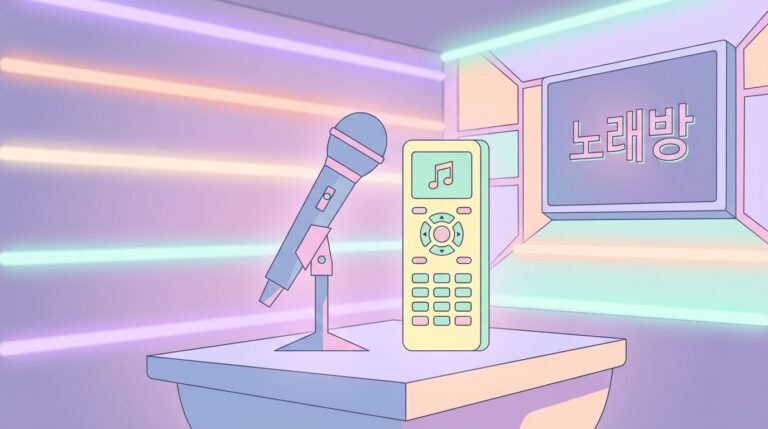
Phase 1: Empathy (Opening)
안녕하세요! 매일한글 에디터입니다.
Imagine this: You are standing in a cozy, neon-lit room in Hongdae with your Korean friends. The opening beat of your favorite ballad kicks in, the lyrics scroll across the screen, and you bring the mic to your lips, ready to pour your heart out. But the moment you sing the first note, a deafening, underwater reverberation booms through the speakers. Your voice sounds like it is bouncing off the walls of a giant stalactite cave. You panic, glance around, and realize the previous group cranked the mic echo up to maximum level. You want to fix it, but staring at that gigantic, button-heavy remote control (or the confusing knobs on the amplifier) freezes you completely. How do you tell your friends to tone down the echo without awkwardly ruining the party mood?
Navigating Korean karaoke (noraebang, 노래방) is an essential social rite of passage, but mastering the sound settings is what separates a timid beginner from a confident, respected room captain. In this guide, backed by actual learner field trials, we will give you the exact real-life phrases and cultural etiquette to fix your audio on the fly.
Phase 2: Top 3 Core Expressions
1. 에코 좀 줄여 줄래? (Eko jom jul-yeo jul-lae?)
- Pronunciation: [E-ko jom jool-yeo jool-lae?] (Sounds like: ‘Echo’ + ‘johm’ like ‘chum’ + ‘jool-yeo’ like ‘julienne’ without the n + ‘jool-leh’)
- Meaning: “Could you turn down the echo a bit?” (Literal: “Echo a bit decrease will you do?”)
- K-Culture Moment: Often heard when transitioning from an energetic dance track (which thrives on heavy reverb) to an emotional indie song where raw, crisp vocals matter.
- Editor’s Insight: Adding 좀 (jom) softens the request tremendously. Without it, the sentence can sound like a direct order. The B1 ending ~아/어 줄래? shows intermediate warmth among peers.
- Situation Spectrum: Casual ✅ | Semi-formal (에코 좀 줄여 줄래요?) ✅ | Formal (에코를 조금 줄여 주시겠습니까?) ⚠️
- 🤔 Think About It: Why does Korean frequently insert softening words like 좀 before action requests? How does your native language cushion potential impositions?
2. 마이크 볼륨 좀 올려줘. (Ma-i-keu bol-lyum jom ol-lyeo-jwo.)
- Pronunciation: [Ma-i-keu bol-lyoom jom ohl-lyeo-jwo]
- Meaning: “Please raise the mic volume a bit.” (Actual nuance: “The background music is drowning me out, help me be heard!”)
- K-Culture Moment: When singing a powerful rock anthem where the synthesized guitar track is simply too loud for your vocal register.
- Editor’s Insight: Many beginners mistakenly say 마이크 소리 크게 해줘, which works, but using 볼륨 (bol-lyum) paired with 올리다 (ol-li-da, to raise) is how urban youth phrase it instantly.
- Situation Spectrum: Casual ✅ | Semi-formal (마이크 볼륨 좀 올려줘요) ✅ | Formal 🚫
- 🤔 Think About It: In English, we often say “turn up the mic.” In Korean, the physical metaphor is directional: “raise” (올리다) or “lower” (내리다/줄이다).
3. 하울링 나니까 조심해! (Ha-ul-ling na-ni-kka jo-sim-hae!)
- Pronunciation: [Ha-wool-ling nah-nee-kka joh-sheem-hae!]
- Meaning: “Watch out, it’s making feedback/howling!”
- K-Culture Moment: When someone gestures wildly with the mic and points it straight at the wall-mounted speakers, causing that ear-piercing squeal.
- Editor’s Insight: Koreans use the Konglish term 하울링 (howling) for acoustic audio feedback. The phrase 하울링 나다 literally means “howling is occurring.”
- Situation Spectrum: Casual ✅ | Semi-formal (하울링 나니까 조심하세요) ✅ | Formal ⚠️
- 🤔 Think About It: Notice how sound artifacts are personified in Korean slang—feedback becomes an animal howling!
Phase 3: Textbook Korean vs. Real Korean
Situation 1: Asking someone to dial down the echo
- 📖 Textbook Korean: 마이크의 울림 효과를 낮추어 주십시오. (Ma-i-keu-ui ul-lim hyo-gwa-reul nat-chu-eo ju-sip-si-o.)
- 🗣️ Real Korean: 에코 한 칸만 내려줘. (E-ko han kan-man nae-ryeo-jwo.)
- 💡 Why is it different?: Nobody says “reverberation effect” (울림 효과) in a noraebang. Real Koreans measure electronic levels in visual steps or bars called 칸 (kan), meaning “drop it by one notch/bar.”
Situation 2: Asking if your vocals are muffled
- 📖 Textbook Korean: 제 음성이 잘 들리지 않는 것 같습니다. (Je eum-seong-i jal deul-li-ji an-neun geot gat-seum-ni-da.)
- 🗣️ Real Korean: 내 목소리 반주에 묻히지 않아? (Nae mok-so-ri ban-ju-e mut-hi-ji an-a?)
- 💡 Why is it different?: At B1 level, replace clinical words like 음성 (voice/audio) with 목소리 (voice) and use the vivid descriptive verb 묻히다 (to be buried/drowned out) by the instrumental track (반주).
Phase 4: K-Culture Deep Dive & Non-Verbal Etiquette
4-1. Nunchi & Soundboard Gestures
In a crowded Korean noraebang, music is roaring at 90 decibels. Verbal communication often takes a backseat to 눈치 (nunchi, situational awareness) and expressive physical gestures:
* The Remote Pass: Never grab the giant remote control while someone is in the emotional climax of their song. If you need echo adjusted, point your index finger downward with a subtle questioning nod toward the person holding the remote.
* Two-Handed Volume Adjust: If tweaking the physical amplifier buttons below the screen, use two hands (or place your left hand supporting your right wrist) if an elder or senior colleague is singing. It turns a sound tweak into an act of polite service.
4-2. Cultural Code: Coin Noraebang (코노) vs. Traditional Noraebang
While older rooms use manual knobs on heavy metal amplifiers, modern youth flock to 코인 노래방 (Coin Noraebang or ‘Kono’). Here, echo controls are digital. Pressing 에코 (Echo) on the remote brings up an onscreen slider. Ballad lovers keep echo at 20-30% for vocal clarity, whereas high-energy idol songs get bumped to 50% for that glossy stadium sound.
Phase 5: Real-Life Roleplay Scenario
Setting: A stylish Coin Noraebang in Sinchon. Neon lights reflect off mirror tiles. Your Korean university friend Minwoo (민우) is browsing the song catalog while you grab the mic for your turn.
- Turn 1 (Minwoo): 🎭 Tossing you the tambourine
야, 다음 곡 네 차례야! 뭐 부를래?
(Ya, da-eum gok ne cha-rye-ya! Mwo bu-reul-lae?)
“Hey, next track is your turn! What do you want to sing?” -
Turn 2 (You): 🎭 Looking worriedly at the mic
나 발라드 부를 건데, 잠깐만!
(Na bal-la-deu bu-reul geon-de, jam-kkan-man!)
“I’m going to sing a ballad, but wait a second!” -
Turn 3 (Minwoo): 🎭 Pausing with remote in hand
왜 그래? 반주 시작됐어!
(Wae geu-rae? Ban-ju si-jak-dwaes-seo!)
“What’s up? The backing track already started!” -
Turn 4 (You): 🎭 Tapping the mic gently
마이크 에코가 너무 심해. 동굴 같아.
(Ma-i-keu e-ko-ga neo-mu sim-hae. Dong-gul gat-a.)
“The mic echo is way too heavy. It sounds like a cave.” -
Turn 5 (Minwoo): 🎭 Smirking as he inspects the screen
아, 앞사람이 최대로 해놨네. 내가 조절해 줄게.
(A, ap-sa-ram-i choe-dae-ro hae-nwan-ne. Nae-ga jo-jeol-hae jul-ge.)
“Ah, the last person set it to max. I’ll adjust it for you.” -
Turn 6 (You): 🎭 Showing two fingers
고마워! 에코 두 칸만 줄여 줄래?
(Go-ma-wo! E-ko du kan-man jul-yeo jul-lae?)
“Thanks! Could you lower the echo by two bars?” -
Turn 7 (Minwoo): 🎭 Clicking the remote buttons quickly
자, 됐지? 아- 아- 마이크 테스트 해봐!
(Ja, dwaet-ji? A- a- ma-i-keu te-seu-teu hae-bwa!)
“There, done! Say ‘ah, ah’ and test the mic!” -
Turn 8 (You): 🎭 Beaming into the mic
와, 깔끔하다! 이제 시작하자!
(Wa, kkal-kkeum-ha-da! I-je si-jak-ha-ja!)
“Wow, it’s so clean now! Let’s get it started!”
🔀 Interactive Choice Point
The screen starts flashing feedback warning. How do you respond?
* Option A: “하울링 나니까 스피커에서 떨어져!” (Ha-ul-ling na-ni-kka seu-pi-keo-e-seo tteol-eo-jyeo!)
* Option B: “소리 끄십시오!” (So-ri kkeu-sip-si-o!)
* Option C: Stand silently and cover your ears with your hands.
Feedback:
* Option A [Best]: Natural, quick B1 warning telling them to step away from the speaker before everyone’s eardrums explode.
* Option B [Bad]: Excessively formal and awkward during an emergency among peers.
* Option C [Risk]: Fails to communicate and lets the piercing feedback continue.
Phase 6: 10-Second Emotion Shadowing Drill
[🥺 Frustrated & Playful]
아 / 에코가 너무 심해서 / 내 목소리가 하나도 안 들려!
(A / e-ko-ga neo-mu sim-hae-seo / nae mok-so-ri-ga ha-na-do an deul-lyeo!)
“Ah / the echo is so heavy / I can’t hear my voice at all!”-
[🤝 Helpful & Casual]
리모컨 이리 줘 봐, / 내가 에코 줄여 줄게.
(Ri-mo-keon i-ri jwo bwa, / nae-ga e-ko jul-yeo jul-ge.)
“Pass the remote over here, / I will turn down the echo for you.” -
[🎤 Satisfied & Pumped Up]
오, 딱 좋다! / 이제 내 노래 제대로 들어봐!
(O, ttak jot-da! / I-je nae no-rae je-dae-ro deu-reo-bwa!)
“Oh, that’s just right! / Now listen closely to my song!”
Phase 7: K-Culture Mini Dictionary
- 에코 (E-ko): Sound reverberation / echo. Used constantly in casual entertainment and studio settings.
- 하울링 (Ha-ul-ling): High-pitched acoustic feedback occurring when a mic gets too close to a monitor.
- 코노 (Ko-no): Short for 코인 노래방 (Coin Noraebang). Highly popular among students and solo singers for cheap, short karaoke sessions.
- 간주 점프 (Gan-ju jeom-peu): “Interlude jump.” Skipping the instrumental bridge between verse and chorus to save precious minutes.
Phase 8: Survival Kit for Travelers
Survival Expressions TOP 3
- 에코 꺼주세요. (E-ko kkeo-ju-se-yo.)
Pro Tip: If you are practicing a rap track where zero reverb is ideal, this turns the echo completely off. - 마이크 배터리 없어요. (Ma-i-keu bae-teo-ri eop-seo-yo.)
Pro Tip: Hand the dead mic to counter staff; they will swap it for a freshly charged wireless mic immediately. - 리모컨 어디 있어요? (Ri-mo-keon eo-di it-seo-yo?)
Pro Tip: Remote controls easily slide between plush cushions in noraebang couches.
Editor’s Travel Note
- Tech Guide: Install the Naver Map application and search for “코인노래연습장” near any university station for cheap singing rooms ($0.50 per song or $4 per hour).
- Cash vs Card: While modern coin noraebangs accept cards, bringing 1,000 KRW bills ensures you can load songs into vintage coin slots without fuss.
Phase 9: One Step Deeper
In Korean culture, the noraebang is not a performance where audiences silently judge you; it is a shared vessel for releasing accumulated stress (Han, 한) and igniting communal excitement (Heung, 흥). When you ask someone to adjust the echo or volume, you are not being a fussy sound engineer—you are actively participating in shaping the room’s energy. Taking care of your friends’ audio shows attentiveness (배려, baeryeo), ensuring everyone sounds their absolute best.
💬 Your Turn: What is your absolute go-to song when you step into a karaoke room? Would you prefer your mic with heavy echo or crystal-clear raw sound? Let us know in the comments below!
Phase 10: FAQ & Mistake Prevention
Q: Can I adjust the echo directly on the amplifier instead of the remote?
A: Yes! Most Korean noraebang rooms have an amplifier unit directly beneath the monitor. Look for the dial labeled ECHO or 에코. Turning it counter-clockwise decreases the effect instantly.
Q: What is the ideal echo level for singing modern K-Pop?
A: For rhythmic K-Pop and hip-hop, keep echo between 20% and 30%. For sweeping drama OST ballads, 40% to 50% gives that dreamy, cinematic finish without blurring your diction.
Q: How do I ask the staff if a microphone seems broken?
A: Approach the front desk and say politely: “마이크 소리가 잘 안 나와요. 확인해 주시겠어요?” (The mic sound isn’t coming out well. Could you check it?)
🚨 Common Mistakes Warning Board
- Mistake 1: Saying 에코를 작게 해주세요. While understandable, native speakers use 줄이다 (to reduce) or 내리다 (to lower) rather than 작게 하다.
- Mistake 2: Pointing the mic at the floor speaker while waiting for your song. This causes severe feedback. Always hold the mic pointing upward or rest it in the cradle.
- Mistake 3: Shouting without 좀 (jom). Saying 에코 줄여! sounds aggressive and rude, even between acquaintances. Always cushion with 좀.
Phase 11: Action Mission & Community Engagement
- 🥉 Bronze Mission: Say 에코 좀 줄여 줄래? aloud 5 times in your room using the rhythm drill from Phase 6.
- 🥈 Silver Mission: Next time you listen to a K-Pop track, post an Instagram story or note with the caption: “이 노래 부를 땐 에코 줄여야 해!” (When singing this song, echo must be lowered!).
- 🥇 Gold Mission: Visit a local Korean noraebang or coin noraebang, find the echo button on the remote, and adjust it while singing your first song.
- 🎮 K-Culture Mission: Watch an episode of a Korean variety show like I Live Alone (나 혼자 산다) or Hangout with Yoo (놀면 뭐하니) and spot whenever a member clutches a noraebang remote control to tweak settings!
Phase 12: Interactive Quiz Challenge
1. Situational Judgment
You are about to sing a fast rap verse, but the echo makes your words unintelligible. What is the most natural B1 phrase to say to your friend holding the remote?
(a) 에코를 취소하십시오.
(b) 에코 한 칸만 내려줘.
(c) 마이크 소리를 삭제해 줘.
2. Fill-in-the-Blank
스피커 가까이 가면 (________) 나니까 조심해! (Feedback will happen if you get close to the speaker, so be careful!)
3. True or False Culture Check
In a Korean Coin Noraebang (코노), touching the remote while another person is singing is considered a criminal offense. (True / False)
Click to reveal answers & explanations!
-
Answer: (b)
Explanation: (b) 에코 한 칸만 내려줘 is the exact colloquial way to say “Drop the echo down by one notch.” (a) sounds like an automated robot command, and (c) mistakenly uses “delete.” -
Answer: 하울링 (ha-ul-ling)
Explanation: The standard Korean term for audio feedback is the loanword 하울링. -
Answer: False
Explanation: While you should avoid cancelling their song or blocking the lyrics screen, subtly adjusting sound balance (echo/volume) to help your friend sound better is welcomed as thoughtful teamwork (배려)!







