

Phase 1: Empathy (Story-Driven Opening)
안녕하세요! 매일한글 에디터입니다. (Annyeonghaseyo! I am the Daily Hangul editor.)
If you have ever watched the iconic workplace K-drama Misaeng (Incomplete Life) or Agency, you know that a Korean office conference room can turn ice-cold in a fraction of a second. Picture this: It is 4:00 PM on a Thursday in Teheran-ro, Gangnam. Your team leader asks for your take on an unfeasible project timeline. You know the deadline is physically impossible, so you blurt out textbook Korean: “제 생각은 다릅니다. 그 일정은 불가능합니다” (My thought is different. That schedule is impossible).
Suddenly, the soft clatter of mechanical keyboards halts. The air freezes. Your teammates stare at their screens with wide eyes, and your team leader’s face hardens. In your native language, you were merely being objective and efficient; in a Korean office, you accidentally dropped a social grenade that shattered team harmony and caused your senior colleague to lose face (체면, che-myeon).
Navigating disagreement in a Korean corporate setting is one of the toughest hurdles for intermediate learners. You are past the basic greetings, but you haven’t yet mastered the delicate art of diplomatic friction. Resolving friction wisely without burning bridges or looking overly aggressive is what separates an amateur from a true professional. Today, drawing from over a decade of coaching expatriates and foreign professionals across Seoul’s top firms, I will show you how to stand your ground, negotiate compromises, and protect office relationships using elegant, high-level B2 Korean.
Phase 2: Deep Dive into 3 Core Expressions
1. 조율이 조금 필요할 것 같습니다 (Joyuri jogeum piryohal geot gatseumnida)
- Pronunciation: [Joh-yool-ee joh-geum pee-ryo-hal geot gat-seum-nee-da] (Think of ‘joyul’ as rhyming smoothly with ‘soul’ plus ‘wool’ – tuning an instrument)
- Meaning: Literally “It seems a bit of tuning/harmonizing is needed,” but nuanced as “We have a disagreement, and we must compromise immediately.”
- K-Culture Moment: In corporate dramas, whenever two department heads hit an impasse over project budgets, a savvy mediator steps in with this line to pause the confrontation before voices are raised.
- Editor’s Insight: The word 조율 (joyul) originally refers to tuning musical instruments. By framing conflict not as an error or a clash, but as two sound notes requiring harmonized tuning, you completely eliminate personal attack from the conversation.
- Situation Spectrum: Casual 🚫 | Semi-formal ⚠️ | Formal ✅
- 🤔 Think About It: Why does Korean corporate etiquette prefer musical or architectural metaphors over direct, confrontational terms like “disagreement” (이견) or “objection” (반대)?
2. 다시 한번 검토해 주실 수 있을까요? (Dasi hanbeon geomtohae jusil su isseulkkayo?)
- Pronunciation: [Da-see han-beon geom-toh-hae joo-shil soo ees-seul-kka-yo?] (The syllable ‘geom’ snaps crisp like ‘gum’)
- Meaning: Literally “Could you review this once again?” but nuanced as “Your proposal contains critical issues or unfeasible terms; please reconsider before an official rejection is needed.”
- K-Culture Moment: A sharp, poised senior manager in Search: WWW sliding a drafted proposal back across the desk with a warm smile, signaling that the junior made a mistake without scolding them in public.
- Editor’s Insight: The secret here is 다시 한번 (once more). It offers the other person a face-saving exit ramp. It implies: I know you are smart and competent, and this was likely an oversight, so here is your chance to fix it gracefully.
- Situation Spectrum: Casual ⚠️ | Semi-formal ✅ | Formal ✅
- 🤔 Think About It: In your native workplace culture, does asking someone to “re-check” their work convey polite deference or does it sound passive-aggressive? How does intentional ambiguity function differently in Korea?
3. 말씀하신 부분도 이해하지만, 현실적인 제약이 있습니다 (Malsseumhasin bubundo ihaeha-jiman, hyeonsiljeogin jeyagi itseumnida)
- Pronunciation: [Mal-sseum-ha-shin boo-boon-doh ee-hae-ha-jee-man, hyeon-shil-jeok-in jae-yak-ee eet-seum-nee-da]
- Meaning: Literally “I understand the part you mentioned, but realistic constraints exist,” nuanced as “Your idea sounds wonderful in theory, but we simply lack the budget, staff, or time to execute it.”
- K-Culture Moment: The pragmatic project manager gently reigning in a visionary, blue-sky startup CEO during a high-stakes pitch meeting in Start-Up.
- Editor’s Insight: This follows the classic “cushion first, pivot second” strategy. Using the honorific noun 말씀 (malsseum) elevates the other person’s input, while attributing the blockage to 제약 (objective constraints) rather than human error.
- Situation Spectrum: Casual 🚫 | Semi-formal ✅ | Formal ✅
- 🤔 Think About It: Notice how the blame is transferred entirely to external circumstances rather than individual capability. How does this protect interpersonal warmth (정, jeong) in the office?
Phase 3: Textbook Korean vs. Real Korean
Scenario 1: Rejecting an Impossible Deadline
- 📖 교과서 한국어 (Textbook Korean): 그 일정은 불가능합니다. 날짜를 바꿉시다. (Geu iljeongeun bulganeunghamnida. Naltjareul bakkupsida. – That schedule is impossible. Let’s change the date.)
- 🗣️ 진짜 한국어 (Real Korean): 마감 일정이 조금 빠듯한 편이라, 일정 조율이 가능할지 여쭙고 싶습니다. (Magam iljeongi jogeum ppadeutan pyeon-ira, iljeong joyuri ganeunghalji yeojjutgo sipseumnida. – The deadline is on the tighter side, so I would like to ask if adjusting the schedule might be possible.)
- 💡 왜 다를까? (Why is it different?): Direct declaratives like 불가능합니다 (impossible) sound like a unilateral shutdown. Native Korean professionals deploy softeners like -는 편이다 (tending toward / on the side of) and humble honorific verbs like 여쭙다 (to ask a superior) to lower the conversational temperature.
Scenario 2: Declining Work Outside Your Assigned Role
- 📖 교과서 한국어 (Textbook Korean): 이것은 제 일이 아닙니다. 다른 사람에게 시키세요. (Igeoseun je iri animnida. Dareun saramege sikiseyo. – This is not my work. Order someone else to do it.)
- 🗣️ 진짜 한국어 (Real Korean): 이 부분은 현재 제 업무 R&R 범위를 조금 벗어나는 것 같아서요, 유관 부서와 사전 확인이 선행되어야 할 것 같습니다. (I bubuneun hyeonjae je eommu R&R beomwireul jogeum beoseonaneun geot gataseoyo, yugwan buseowa sajeon hwagani seonhaengdoeeoya hal geot gatseumnida. – It seems this part slightly falls outside my current R&R scope, so verification with the relevant department should probably come first.)
- 💡 왜 다를까? (Why is it different?): Flatly refusing tasks with 제 일이 아닙니다 paints you as uncooperative. Real Korean professionals cite R&R (Roles and Responsibilities) or business procedures, using the gentle speculative ending -ㄹ 것 같습니다 (it seems that…) to depersonalize the boundary.
Phase 4: K-Culture Deep Dive & Non-Verbal Manners
4-1. 눈치 (Nunchi) & Office Body Language
When expressing disagreement in a Korean workspace, your body speaks louder than your words:
* The Softened Gaze: Never hold an unbroken, laser-focused stare when questioning a senior’s directive. In Korean non-verbal grammar, intense eye contact during friction is perceived as open hostility or defiance. Instead, look at their eyes for 2–3 seconds, then drop your gaze naturally to the document or table while speaking.
* The Head Tilt of Deliberation: Tilting your head slightly to one side while making an “음…” (eum) sound shows that you are deeply pondering their proposal rather than instantly shooting it down.
* Two-Handed Posture: When offering a counter-document or laptop screen, always hold it or point to it using both hands, or support your right wrist lightly with your left hand.
4-2. Cultural Code Analysis: The Power of “Coffee-Time” (커피 타임)
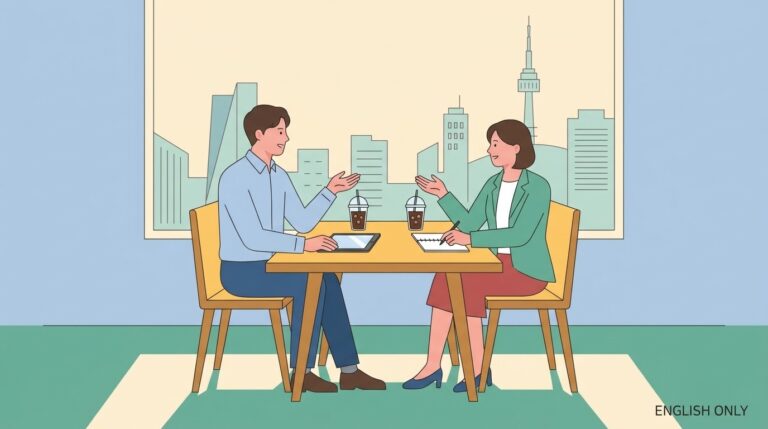
In Korean corporate life, major conflicts are almost never settled in open, crowded boardrooms. Open confrontations force people to defend their pride. Instead, Koreans practice 사전 조율 (pre-coordination). If you see a clash brewing, invite the colleague out for a quick 15-minute iced Americano before the official review: “과장님, 잠시 커피 한잔하러 가실 수 있을까요?” (Manager, could we grab a quick cup of coffee?). Breaking out of the physical office boundary into a neutral café immediately softens hierarchies, allowing you to address concerns candidly as human beings rather than corporate ranks.
Phase 5: Real-Life Roleplay Scenario
Setting: Pangyo Tech Valley, Friday 4:30 PM. The open-plan office is filled with the hum of monitors. Manager Min (민 과장), a brilliant but overworked team leader, calls you over to his desk after reviewing your revised marketing deck.
- Turn 1 (Manager Min): 이번 신규 캠페인 보고서 봤는데, 타깃 연령층 설정을 왜 이렇게 바꿨어요? 기존 기획안이랑 완전히 충돌하잖아요. (Ibeon singyu kaempein bogoseo bwanneunde, tagit yeollyeongcheung seoljeongeul wae ireoke bakkweosseoyo? Gijon gihoegan-irang wanjeonhi chungdolhajanayo. – I saw the new campaign report; why did you change the target demographic like this? It clashes completely with our existing proposal.)
🎭 [미간을 찌푸리며 보고서 창을 모니터에 띄운다 / Frowning as he pulls up the report on his screen] -
Turn 2 (You): 아, 과장님. 지난주 유저 데이터 분석 결과 2030 세대의 전환율이 급감해서, 보완 차원에서 수정한 내용입니다. (A, gwajangnim. Jinanju yujeo deiteo bunseok gyeolgwa isamsip sedae-ui jeonhwanyuri geupgamhaeseo, bowan chawoneseo sujeonghan naeyong-imnida. – Ah, Manager Min. The user analytics from last week showed a steep drop in 20-30s conversion, so this was adjusted as a supplementary measure.)
🎭 [차분하게 두 손을 모으고 모니터의 그래프 수치를 조심스럽게 짚는다 / Calmly clasping both hands and carefully pointing out the graph figures] -
Turn 3 (Manager Min): 그래도 임원 보고가 다음 주 월요일인데, 지금 와서 기본 방향을 틀어버리면 디자인팀 일정이 다 꼬여버립니다. (Geuraedo imwon bogoga daeum ju woryoirinde, jigeum waseo gibon banghyangeul teureobeorimyeon dijainteem iljeongi da kkoyeobeorimnida. – Still, the executive briefing is next Monday. Pivoting direction now completely derails the design team’s schedule.)
🎭 [한숨을 푹 쉬며 볼펜을 책상 위에 내려놓는다 / Sighing heavily and putting his pen down on the desk] -
Turn 4 (You): 말씀하신 디자인팀의 마감 부담에 대해서는 저도 전적으로 공감하고 있습니다. (Malsseumhasin dijainteem-ui magam budam-e daehaeseoneun jeodo jeonjeogeuro gonggamhago itseumnida. – I completely share your concern regarding the design team’s deadline burden.)
🎭 [진지한 표정으로 고개를 끄덕이며 공감을 표한다 / Nodding with a serious, empathetic expression] -
Turn 5 (Manager Min): 그럼 이걸 어떻게 해요? 데이터를 무시할 수도 없고, 그렇다고 일정을 미룰 수도 없는데. (Geureom igeol eotteoke haeyo? Deiteoreul musihal sudo eopgo, geureotdago iljeongeul mirul sudo eomneunde. – Then what do we do? We can’t ignore data, but we can’t push back deadlines either.)
🎭 [턱을 괴고 난감하다는 듯 모니터를 응시한다 / Resting his chin in his hand, staring at the screen with concern] -
Turn 6 (You): 과장님, 전체 교체 대신 메인 랜딩 페이지만 2030 타깃으로 수정하고, 나머지는 원안을 유지하는 선에서 조율하면 어떨까요? (Gwajangnim, jeonche gyoche daesin mein raending peijiman isamsip tagiseuro sujeonghago, nameojineun won-aneul yujihaneun seoneseo joyulhamyeon eotteolkkayo? – Manager Min, instead of a full overhaul, what if we coordinate a compromise where we update only the main landing page for 20-30s while keeping the rest as the original plan?)
🎭 [시선을 부드럽게 유지하며 메모지에 타협안 구조를 그려 보여준다 / Maintaining a calm gaze while sketching the compromise structure on a notepad] -
Turn 7 (Manager Min): 흠… 그렇게 가면 디자인팀 추가 작업도 최소화되고, 임원진 설득 명분도 생기겠네요. (Heum… geureoke gamyeon dijainteem chuga jageopdo choesohwadoego, imwonjin seoldeuk myeongbundo saenggigenneyo. – Hmm… doing it that way minimizes extra design workload and gives us solid rationale for the executives.)
🎭 [표정이 한결 풀리며 메모를 유심히 살펴본다 / His expression noticeably softens as he studies the notes] -
Turn 8 (You): 네, 제가 디자인팀에 바로 공유해서 무리 없도록 사전 조율해 두겠습니다. 걱정 끼쳐 드려 죄송합니다. (Ne, jega dijainteeme baro gongyuhaeseo muri eopdorok sajeon joyulhae dugetseumnida. Geokjeong kkichyeo deuryeo joesonghamnida. – Yes, I will share this with the design team right away and pre-align everything so there are no roadblocks. Apologies for causing concern.)
🎭 [깍듯하게 목례하며 부드러운 미소를 짓는다 / Giving a polite, deferential head nod with a gentle smile]
🔀 Interactive Decision Branching
What would you say if Manager Min rejected your compromise at Turn 7 and insisted on doing nothing?
- Option A: “과장님 말씀이 맞으니 데이터는 무시하고 그냥 원안대로 올리겠습니다.” (Manager, you’re right, let’s ignore data and proceed with the original.)
❌ Risk: Passive-aggressive. Shows a total lack of strategic ownership and marks you as an employee who sulks under feedback. - Option B: “데이터가 이렇게 명확한데 원안대로 올리는 건 회사 손해라고 생각합니다.” (The data is this clear; submitting the original is a loss for the company.)
🚫 Bad: Too confrontational. You are publicly calling your senior’s decision detrimental to the company, backing him into an ego corner. - Option C: “과장님, 그럼 월요일 보고 전까지 A/B 테스트 지표만 간단히 첨부하는 방식으로 보완해 봐도 괜찮을까요?” (Manager, could we perhaps supplement it by briefly appending an A/B test metric before Monday’s report?)
✅ Best: Diplomatic triumph! It respects his pacing while keeping the crucial insights intact without derailing team labor.
Phase 6: 10-Second Emotion Shadowing Drill
Practice reading these sentences aloud, matching the pitch, pause marks (/), and emotional milestones:
[🤝 경청하고 공감하며 / Attentive & Empathetic]
“말씀하신 우려 사항도 / 충분히 일리가 있습니다.”
(Malsseumhasin uryeo sahangdo / chungbunhi illiga itseumnida. – The concerns you mentioned also / make plenty of sense.)-
[💡 차분하고 단호하게 / Calm & Firmly Diplomatic]
“다만 이번 프로젝트의 핵심 목표를 고려할 때, / 우선순위 조율이 조금 필요할 것 같습니다.”
(Daman ibeon peurojekteu-ui haeksim mokpyoreul goryeohal ttae, / useonsunwi joyuri jogeum piryohal geot gatseumnida. – However, considering the core objectives of this project, / prioritizing adjustments seems somewhat necessary.) -
[☕ 부드럽고 친근하게 / Warm & Soft-landing]
“과장님, / 커피 한잔하시면서 / 잠시 세부 방향성에 대해 상의드릴 수 있을까요?”
(Gwajangnim, / keopi hanjanhasimyeonseo / jamsi sebu banghyangseonge daehae sang-uideuril su isseulkkayo? – Manager Min, / while having a cup of coffee, / could I consult with you briefly regarding the detailed direction?)
Phase 7: K-Culture Mini Dictionary
-
조율 (Joyul)
Translation: Coordination / Fine-tuning / Mediation.
Usage: In corporate settings, never say “let’s fight or negotiate” (협상/싸움). Say “일정을 조율하다” (fine-tune the schedule) or “의견을 조율하다” (coordinate differing views). -
이견 (Igyeon)
Translation: Divergence of opinions / Discrepancy.
Usage: High-register business Korean for “disagreement.” Instead of saying “우리는 생각이 다릅니다” (we think differently), use “부서 간에 약간의 이견이 있습니다” (there is a slight difference of opinions between departments). -
완곡하다 (Wan-gokhada)
Translation: Euphemistic / Diplomatic / Circumlocutory.
Usage: The golden virtue of Korean speech. A phrase like “완곡하게 거절하다” means to decline an offer so politely that nobody feels rejected or insulted. -
타협점 (Tahyeopjeom)
Translation: Common ground / Point of compromise.
Usage: Used when concluding a stressful meeting: “양측이 만족할 만한 타협점을 찾아보겠습니다” (We will search for a compromise point that satisfies both parties).
Phase 8: Expat & Professional Survival Kit
Survival Phrases TOP 3
- 제가 혹시 오해한 부분이 있다면 바로잡아 주십시오.
(Jega hoksi oehan bubuni itdamyeon barojaba jusipsio.)
Pro Tip: Use this when a senior misinterprets your intent. It puts the responsibility on you first, giving them psychological safety to explain. - 다른 유관 부서의 피드백도 함께 수렴해 보는 건 어떨까요?
(Dareun yugwan buseo-ui pideubaekdo hamkke suryeomhae boneun geon eotteolkkayo?)
Pro Tip: An elegant way to stall an impulsive bad decision by bringing third-party data and team consensus into the room. - 서로 무리가 없는 선에서 합의점을 도출해 보고 싶습니다.
(Seoro muriga eomneun seoneseo habuijeomeul dochulhae bogo sipseumnida.)
Pro Tip: The ultimate phrase to end deadlocks. “무리 없는 선” (a line that strains no one) shows high emotional intelligence.
Editor’s Workplace Note
- When setting up 1-on-1 conflict resolutions, avoid sudden Slack or email ultimatums. Check your colleague’s status, walk by their desk, or coordinate a quick catch-up. For scheduling outside lunch, many foreign professionals download KakaoTalk business channels or check company shared calendars via the KakaoTalk messenger app for corporate chats to ensure you aren’t interrupting high-priority executive tasks.
- If you face serious systemic workplace harassment (직장 내 괴롭힘) rather than normal work conflict, remember that Korea has strict statutory labor protections. Familiarize yourself with formal procedures via the Ministry of Employment and Labor English consultation service.
Phase 9: A Step Deeper (한 발 더 깊이)
In Western corporate philosophies rooted in debate culture, conflict is often viewed as a catalytic furnace: you pit ideas against one another, critique weaknesses bluntly, and the best idea survives. However, in the Korean linguistic and corporate sphere, language is structurally interwoven with 체면 (Che-myeon – social face) and 공동체 의식 (communal harmony).
When you openly tear down a colleague’s proposal in a group meeting, you are not simply critiquing an abstract slide; you are disrupting the social equilibrium of the entire collective. That is why Korean has developed sophisticated grammatical softening cushions—speculative verb endings (-ㄹ 것 같다), passive nominalizations, and instrument-tuning metaphors. True intermediate-to-advanced mastery does not mean knowing how to say “no”; it means knowing how to say “let us look together in this direction” while preserving everyone’s dignity.
💬 Your Turn: How does your native workplace culture handle public disagreement compared to Korea? Have you ever experienced a cultural misunderstanding during a meeting? Share your story in the comments below!
Phase 10: FAQ & Common Mistakes
Q: What should I do if my Korean boss gives conflicting directions and I cannot fulfill both?
A: Never say “지난번 말씀과 다릅니다” (This contradicts what you said last time). That sounds like an accusation. Instead, frame it as your own need for prioritization: “과장님, 두 업무 모두 중요하다고 생각합니다. 다만 현재 리소스상 더 집중해야 할 업무의 우선순위를 정해 주실 수 있을까요?” (Manager, I believe both tasks are vital. Given our current resources, could you clarify which priority we should focus on first?).
Q: Is it ever acceptable to say a plain “아니요” (No) in an office meeting?
A: In casual peer chats, yes. But in formal or semi-formal meetings, a flat “아니요” followed by silence feels abrupt. Always cushion it: “아, 그 부분은 조금 어렵습니다만…” (Ah, that part is a bit difficult, however…) or “현재로서는 지원이 제한적인 상황입니다” (As of now, resources are in a constrained state).
Q: How do I resolve a conflict with a peer who has higher seniority (선배/선임) even if we have the same job title?
A: Seniority by tenure (기수/입사 연도) carries subtle weight in Korea. Approach them privately rather than challenging them in front of juniors. Use the phrase: “선배님 조언을 구하고 싶습니다” (I would like to seek your advice, senior). When they feel respected as a mentor, their defensive walls drop immediately.
🚨 흔한 실수 (Common Mistakes) Danger Board
- Mistake: Using “틀렸습니다” (That is wrong / incorrect).
- Correct Action: Say “그 방향도 일리가 있지만, 다른 관점도 고려해 볼 수 있을 것 같습니다” (That direction has merit, but we could also consider another perspective).
- Mistake: Sending a cold, defensive bullet-pointed email when a dispute arises.
- Correct Action: In Korea, text carries no facial tone. Step over to their desk or ask for a 5-minute coffee chat first, then follow up with written meeting notes.
- Mistake: Dropping to informal speech (반말) when frustrated or emotional during late-night overtime.
- Correct Action: Never drop the honorific line (-시-, -ㅂ니다, -요). Keeping formal grammar during emotional tension is your absolute protective shield.
Phase 11: Action Missions
- 🥉 Bronze Mission (Solo Shadowing): Stand in front of a mirror. Practice the 3 Core Expressions from Phase 2 three times each, deliberately softening your facial muscles and nodding with a head tilt.
- 🥈 Silver Mission (Community Connection): Write one sentence in the comments below using the phrase “~는 선에서 조율하다” (coordinate within a line of…) to resolve a hypothetical disagreement.
- 🥇 Gold Mission (Real-Life Execution): During your next workplace conversation or language exchange, replace “안 돼요” (cannot do it) or “제 생각은 달라요” (my thought is different) with “말씀하신 부분도 이해하지만, 현실적인 제약이 있습니다”.
- 🎮 K-Culture Mission: Watch Episode 3 or 4 of the drama Misaeng (미생). Watch how Chief Oh (오과장) talks to the executive directors when he refuses an unfair order. Spot the exact moment his voice drops into polite deference while holding his stance.
Phase 12: Interactive Quiz Challenge
Test your real-world workplace nunchi!
- Situation Judgment: You realize your department’s teammate made a mathematical calculation error in a shared presentation slide 30 minutes before a meeting. What is the best immediate response?
- A) Raise your hand in the pre-meeting and say, “철수 씨, 계산이 완전히 틀렸어요.” (Cheolsu, your math is totally wrong.)
- B) Send a private message or pull them aside quietly: “철수 님, 이 부분 수치를 다시 한번 검토해 주실 수 있을까요?”
- C) Ignore it so you don’t hurt their feelings.
- Fill-in-the-Blank: Complete the diplomatic phrase:
“이번 프로젝트 마감 일정이 조금 ________ 편이라, 일정 ________이 필요할 것 같습니다.”
(Hint: ‘tight’ and ‘tuning/coordination’) -
True or False: True or False? In Korean business culture, looking directly into a senior’s eyes without blinking while explaining why their strategy is wrong is considered a sign of high confidence and honesty.
👉 Click to reveal answers and detailed explanations!
-
Answer: B
Explanation: Publicly calling out an error destroys 체면 (face). Discreetly asking them to review it (다시 한번 검토해 주실 수 있을까요?) allows them to correct their own mistake with dignity. -
Answer: 빠듯한 / 조율
Sentence: “이번 프로젝트 마감 일정이 조금 빠듯한 편이라, 일정 조율이 필요할 것 같습니다.” (The project deadline is on the tighter side, so tuning/adjusting the schedule seems necessary.) -
Answer: False!
Explanation: An unblinking, direct stare while contradicting a senior is seen as confrontational defiance. Soften your gaze toward the document or desk to project thoughtful deliberation.







