

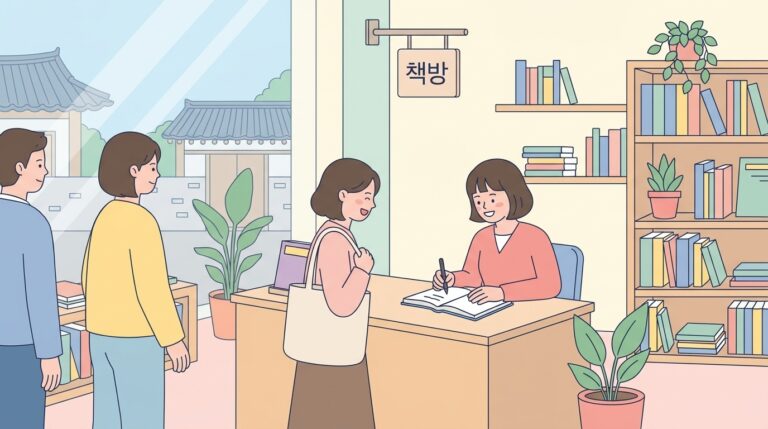
Phase 1: 공감 (Story-Immersive Opening)
안녕하세요! 매일한글 에디터입니다.
Picture this: You are wandering through the towering wooden bookshelves of Kyobo Bookstore in Gwanghwamun, Seoul. The rich scent of roasted coffee beans from the in-store café blends with the crisp aroma of freshly printed paper. Suddenly, you spot an elegant poster displaying a familiar book cover—the bestselling essayist whose webtoon or drama adaptation you fell in love with on Netflix! Next to the cover, large Hangul letters announce an upcoming event: 저자 사인회 (Author Book Signing).
Your heart races. You want to ask the bookstore clerk when it begins, whether you can still get a ticket, and how to participate. But suddenly, your mind freezes. Is this a lottery? Do I need to buy the book right here today? What if I line up and get turned away?
If you have ever felt nervous trying to decipher event notices in Korea, take a deep breath. You are definitely not alone! Many of our international learners at Daily Hangul tell us that bookstore and pop-up events in Seoul feel exciting yet intimidating because ticketing rules move fast. In this guide, tailored specifically for A2 elementary learners, I will show you the exact, natural phrases to ask bookstore staff about signing events—straight from the streets of Seoul to your travel toolkit. Let’s explore together!
Phase 2: 핵심 표현 3선 심층 분석 (3 Core Expressions)
1. 사인회 언제 해요? (Sainhoe eonje haeyo?)
- Pronunciation: Sainhoe eonje haeyo? (Sounds like: Sign-hweh un-jeh hae-yo?)
- Meaning: Literal: “Signing meeting, when do [you] do it?” | Actual Nuance: “When is the author’s book signing taking place?”
- K-Culture Moment: You will hear fans whisper this excitedly at Kyobo Bookstore or Youngpoong Bookstore customer desks whenever a trending celebrity or webtoon artist drops a new release.
- Editor’s Insight: In Korean, the English word “sign” combines with the Sino-Korean root 회 (hoe, meaning meeting/gathering) to form 사인회 (sainhoe). Koreans drop complex subject markers in daily speech; simply pairing the noun with 언제 해요? (eonje haeyo – when do you do it?) creates an instant, natural question.
- Situation Spectrum: Casual ⚠️ | Semi-formal ✅ | Formal ✅
- 🤔 Think About It: Notice how Korean creates smooth hybrid words combining English loanwords with Korean roots. Does your native language create portmanteaus like this when adopting foreign words?
2. 번호표 받아야 돼요? (Beonhopyo bad-aya dwaeyo?)
- Pronunciation: Beonhopyo bad-aya dwaeyo? (Sounds like: Bun-ho-pyo bah-dah-yah dway-yo?)
- Meaning: Literal: “Must [I] receive a numbered ticket?” | Actual Nuance: “Do I need to pick up a numbered waiting ticket for this?”
- K-Culture Moment: Seen throughout Korean banks, pop-up stores in Seongsu-dong, and bookstore signings. Even if an event looks quiet, staff usually manage crowd flow using automated or paper number tickets.
- Editor’s Insight: The pattern -아/어야 돼요 (-a/eoya dwaeyo) means “have to” or “should.” It is the friendliest, most natural way to verify entry rules without sounding demanding.
- Situation Spectrum: Casual ⚠️ | Semi-formal ✅ | Formal ✅
- 🤔 Think About It: Korea has an exceptionally structured queuing system designed to prevent cutting in line. How does queuing for special events in your home country compare to this ticket-first custom?
3. 선착순이에요? (Seonchak-sun-ieyo?)
- Pronunciation: Seonchak-sun-ieyo? (Sounds like: Sun-chahk-soon-ee-eh-yo?)
- Meaning: Literal: “Is it arrival order?” | Actual Nuance: “Is it first-come, first-served?”
- K-Culture Moment: Essential whenever a limited edition book, goodie bag, or signing slot is announced. If an event is 선착순 (seonchaksun), you want to arrive early in the morning!
- Editor’s Insight: 선착 (seonchak, first arrival) + 순 (sun, order). When you add 이에요 (ieyo, is it?), you instantly sound like someone who understands the fast-paced pulse of Korean city life.
- Situation Spectrum: Casual ⚠️ | Semi-formal ✅ | Formal ✅
- 🤔 Think About It: Korean pop culture events often balance two systems: 선착순 (seonchaksun, first-come, first-served) and 추첨 (chucheom, lucky draw lottery). Which method feels fairer to you?
Phase 3: 교과서 한국어 vs 진짜 한국어 (Textbook vs. Real-Life Korean)
Scenario 1: Asking where to get the queue ticket
- 📖 교과서 한국어 (Textbook): 번호표는 어디에서 배부합니까? (Beonhopyoneun eodieseo baebuhapnikka? – “Where is the numbered ticket distributed?”)
- 🗣️ 진짜 한국어 (Real-Life): 번호표 어디서 받아요? (Beonhopyo eodiseo bad-ayo? – “Where do I get the number ticket?”)
- 💡 왜 다를까? (Why the difference?): The Sino-Korean verb 배부하다 (baebuhada, to distribute) is common on written posters, but native speakers in conversation prefer the light, active everyday verb 받다 (batda, to receive/get).
Scenario 2: Asking if the event capacity is already full
- 📖 교과서 한국어 (Textbook): 정원이 모두 마감되었습니까? (Jeong-woni modu magam-doeeotseumnikka? – “Has the quota completely closed?”)
- 🗣️ 진짜 한국어 (Real-Life): 혹시 벌써 끝났어요? (Hoksi beolsseo kkeut-nasseoyo? – “By any chance, is it already over / full?”)
- 💡 왜 다를까? (Why the difference?): Real Koreans soften their inquiry with 혹시 (hoksi, by any chance) and use the warm conversational word 끝나다 (kkeutnada, to finish) instead of bureaucratic corporate terms like 정원 마감 (jeong-won magam).
Phase 4: K-Culture 딥다이브 & 비언어적 매너 (Culture Deep Dive)
4-1. 눈치 (Nunchi) & Gestures at the Information Desk
- Two-Handed Presentation (두 손): When you hand over the book or present an event receipt, always support your right forearm with your left hand or use both hands. This immediately shows politeness toward bookstore staff.
- Subtle Nodding (목례): Before asking your question, make brief eye contact and give a slight 15-degree nod. Starting directly with questions without a nod can feel abrupt in Korean customer service interactions.
- Post-it Etiquette (포스트잇): At Korean author signings, staff will often ask you to write your name on a sticky note (이름 적어주세요 – Ireum jeogeojuseyo) so the author doesn’t misspell your name. Have your preferred name written clearly in Hangul ready on your phone notepad!
4-2. Cultural Code: From K-Pop Fansigns to Literary Salons
In South Korea, author signings share vibrant DNA with K-Pop fansigns (팬사인회). Readers do not just walk up, grab a scrawl, and leave; there is often brief friendly chit-chat (스몰토크), commemorative photo moments, and specially stamped event merchandise. Because spaces are neat and organized, knowing keywords like 현장 접수 (on-site signup) vs 사전 예약 (pre-registration) keeps you calm and confident.
Phase 5: 실전 롤플레이 시나리오 (Role-Play Scenario)
Setting: Gwanghwamun Kyobo Information Counter on a breezy Saturday afternoon. Staff member Minji (민지) is arranging promotional leaflets.
- Turn 1 (You): 저기요, 실례지만 저자 사인회 정보 좀 알 수 있을까요?
(Jeogiyo, sillyejiman jeoja sainhoe jeongbo jom al su isseulkkayo? / “Excuse me, could I get some information about the author signing?”)
🎭 Bowing slightly while pointing politely toward the promotional stand. -
Turn 2 (Minji): 네, 고객님! 이번 주 일요일 오후 두 시에 진행돼요.
(Ne, gogaeknim! Ibeon ju iryoil ohu du sie jinhaeng-dwaeyo. / “Yes, customer! It will take place this Sunday at 2:00 PM.”)
🎭 Smiling warmly and pulling out the official event sheet. -
Turn 3 (You): 혹시 선착순이에요?
(Hoksi seonchak-sun-ieyo? / “Is it first-come, first-served by any chance?”)
🎭 Leaning in slightly with an inquisitive, friendly expression. -
Turn 4 (Minji): 네, 당일 오전 열 시부터 번호표를 나눠드려요.
(Ne, dang-il ojeon yeol sibuteo beonhopyoreul nanwo-deuryeoyo. / “Yes, we will distribute number tickets starting from 10:00 AM on that day.”)
🎭 Tapping on the 10:00 AM timestamp printed on the leaflet. -
Turn 5 (You): 책을 여기서 오늘 사야 번호표를 받아요?
(Chaegeul yeogiseo oneul saya beonhopyoreul bad-ayo? / “Do I have to buy the book here today to get the number ticket?”)
🎭 Holding the book gently in both hands. -
Turn 6 (Minji): 행사 당일에 여기서 구매하신 영수증이 있어야 돼요.
(Haengsa dang-ire yeogiseo gumaehasin yeongsujeung-i isseoya dwaeyo. / “You must have a purchase receipt from this store on the day of the event.”)
🎭 Pointing gently to the receipt policy section. -
Turn 7 (You): 아, 그렇군요! 번호표 어디서 받아요?
(A, geureokunyo! Beonhopyo eodiseo bad-ayo? / “Ah, I see! Where do I get the number ticket?”)
🎭 Nodding in clear understanding. -
Turn 8 (Minji): 일요일 아침에 저쪽 정문 안내데스크로 오시면 됩니다!
(Iryoil achime jeojjok jeongmun annaedesukeuro osimyeon doepnida! / “If you come to the main entrance information desk over there on Sunday morning, you will be all set!”)
🎭 Pointing toward the revolving glass doors near the central lobby.
🔀 인터랙티브 분기점 (Interactive Choice)
Now, how would you reply to Minji’s final instruction?
- Choice A: “알겠습니다! 정말 감사합니다. 일요일에 올게요!” (Algetseumnida! Jeongmal gamsahamnida. Iryoire olgeyo!)
👉 Feedback [Best]: Polite, natural, and clear! The staff member will feel appreciated and pleased to welcome you back. - Choice B: “야, 표 지금 줘.” (Ya, pyo jigeum jwo!)
👉 Feedback [Bad]: Dangerously rude! Using informal speech (banmal) and demanding a ticket now breaks societal manners. - Choice C: “일요일에 오면 무조건 사인 받을 수 있죠?” (Iryoire omyeon mujogeon sain badeul su itjyo?)
👉 Feedback [Risk]: A bit aggressive. Since it is first-come first-served (seonchaksun), claiming “unconditional” guarantee puts the clerk on the spot.
Phase 6: 10초 감정 섀도잉 드릴 (Emotional Shadowing Drill)
Practice these pauses (/) and tones aloud to build muscle memory:
- [😊 Polished & Curious]
저기요, / 저자 사인회 / 언제 해요?
(Jeogiyo, / jeoja sainhoe / eonje haeyo?)
“Excuse me, / author book signing / when is it?” -
[🤔 Careful & Inquiring]
혹시 / 선착순이에요? / 번호표 받아야 돼요?
(Hoksi / seonchak-sun-ieyo? / beonhopyo bad-aya dwaeyo?)
“By any chance, / is it first-come, first-served? / Do I need to get a ticket?” -
[✨ Relieved & Grateful]
친절하게 알려주셔서 / 정말 감사해요!
(Chinjeolhage allyeojusyeoseo / jeongmal gamsahaeyo!)
“For explaining so kindly / thank you so much!”
Phase 7: K-Culture 미니 사전 (4 Mini Dictionary Terms)
- 번호표 (Beonhopyo) | Numbered ticket
A physical slip or digital SMS queue voucher that secures your order in line at events, clinics, and pop-ups. - 선착순 (Seonchaksun) | First-come, first-served
The gold standard rule for high-demand Seoul gatherings where the earliest attendees get priority. - 현장 접수 (Hyeonjang Jeopsu) | On-site registration
Enrolling in person on the event day rather than pre-booking via an app or website. - 당첨 (Dangcheom) | Winning / Selected in a raffle
When signings have high competition, bookstores use a lottery system; check if the poster says “추첨 (draw)” and look out for your “당첨” notification!
Phase 8: 여행자를 위한 생존 키트 (Traveler’s Survival Kit)
Survival TOP 3 Phrases
- 사인회 끝났어요? (Sainhoe kkeut-nasseoyo?)
Has the book signing ended?
💡 Pro Tip: Ask this before you wait in a long corridor line to save your precious travel energy! - 사진 찍어도 돼요? (Sajin jjigeodo dwaeyo?)
May I take photos?
💡 Pro Tip: Some authors allow photos, while others request no close-up camera flashes. Asking shows utmost respect. - 여기에 이름 써주세요. (Yeogie ireum sseojuseyo.)
Please write my name here.
💡 Pro Tip: Point to your sticky note so the author writes your Korean or Romanized name correctly.
Editor’s Travel Note
Before heading out to major bookstores, open the [네이버 지도 앱 다운로드 (Download Naver Map App)] to search for branches like “교보문고 광화문점” (Kyobo Gwanghwamun) or “영풍문고 종각종로본점” (Youngpoong Jongno). Korean bookstores offer rapid public Wi-Fi, and credit/debit cards (as well as mobile pay) are accepted virtually everywhere. If you plan to attend a signing on a weekend morning, arrive 30 to 45 minutes before ticket distribution begins!
Phase 9: “한 발 더 깊이” (Cultural Reflection)
In Korean culture, orderly queuing is more than just organization—it represents mutual consideration for the collective space (baeryeo). At an author signing, you will notice readers standing peacefully without loud chatter, holding their books with respect. Korean society seamlessly blends its fast ppalli-ppalli (hurry-hurry) efficiency with deep reverence for creators and literature. When you follow these event procedures politely, you become part of this harmonious cultural rhythm.
💬 Your Turn: Have you ever attended an author or artist event in your home country? What is the one book you would love to bring to Korea to get signed? Share your thoughts below!
Phase 10: FAQ & 오해 방지 (FAQ Schema & Common Pitfalls)
Q: Can I bring a book I bought from overseas or online to the bookstore signing?
A: In most Korean bookstore events, queue tickets are only issued to customers who purchase the book at that specific bookstore branch on or right before the event day with proof of receipt. Always confirm by asking: “여기서 산 책만 돼요?” (Only books bought here?)
Q: Is taking videos of the author permitted during the session?
A: It depends on the agency or publisher guidelines. Signs saying 촬영 금지 (No Photography/Filming) mean cameras must stay down. If you are unsure, simply ask a nearby staff member: “동영상 찍어도 돼요?” (May I take a video?)
Q: What should I say when I finally sit in front of the author?
A: Keep it heartfelt and simple! Try: “작가님, 팬이에요! 책 정말 잘 읽었어요.” (Author-nim, I’m a fan! I really enjoyed reading your book.) It will brighten their whole day.
🚨 흔한 실수 (Common Mistakes) TOP 3
- Mistake: Assuming all signings allow walk-in entry right when the event starts.
Correct Action: Check whether tickets are distributed hours earlier under the 선착순 (first-come, first-served) rule. - Mistake: Addressing the author as “선생님” or “아저씨/아줌마”.
Correct Action: Always address the author as 작가님 (Jakganim – Respected Writer/Author). - Mistake: Shoving an open book forward with one hand while holding a smartphone with the other.
Correct Action: Place your smartphone in your pocket, bow slightly, and present the opened title page with both hands.
Phase 11: 액션 미션 & 참여 유도 (Action Missions)
- 🥉 Bronze Level: Read our 3 core expressions aloud five times in front of your mirror, practicing the two-handed gesture.
- 🥈 Silver Level: Screenshot your favorite Korean book cover, post it to your Instagram story, and caption it: “사인회 언제 해요?”
- 🥇 Gold Level: Visit a Korean bookstore in person or go to the official Kyobo Bookstore website, find the ‘이벤트 (Event)’ tab, and locate one signing event date on your own!
🎮 K-Culture Mission: Next time you watch a K-Drama featuring an author character (like in It’s Okay to Not Be Okay or Romance is a Bonus Book), spot whether the attendees have numbered tickets in hand!
Phase 12: 인터랙티브 퀴즈 챌린지 (Interactive Quiz)
1. Situational Judgment
You want to ask the staff if you must wait in line immediately or if you can take a numbered ticket. What do you say?
* (A) 선착순이에요? (Seonchak-sun-ieyo?)
* (B) 번호표 받아야 돼요? (Beonhopyo bad-aya dwaeyo?)
* (C) 책 어디 있어요? (Chaek eodi isseoyo?)
2. Fill-in-the-Blank
“Excuse me, when is the book signing held?”
저기요, 저자 ________ 언제 해요?
* Clue: The Korean word for signing event.
3. Cultural True or False
At Korean author signings, it is totally acceptable to push to the front of the line if you already own the book.
* [ True / False ]
🔍 Click here to view Answers & Explanations
- Answer: (B) 번호표 받아야 돼요? (Beonhopyo bad-aya dwaeyo? asks specifically whether a numbered ticket is required). (A asks if it is first-come-first-served, and C asks where the book is located.)
- Answer: 사인회 (sainhoe). The complete phrase is: 저기요, 저자 사인회 언제 해요?
- Answer: False. Korean public events strictly follow queuing order, usually managed via 선착순 numbered tickets. Cutting in line is considered a major cultural breach!







