

Phase 1: Empathy (스토리 몰입형 오프닝)
안녕하세요! 매일한글 에디터입니다.
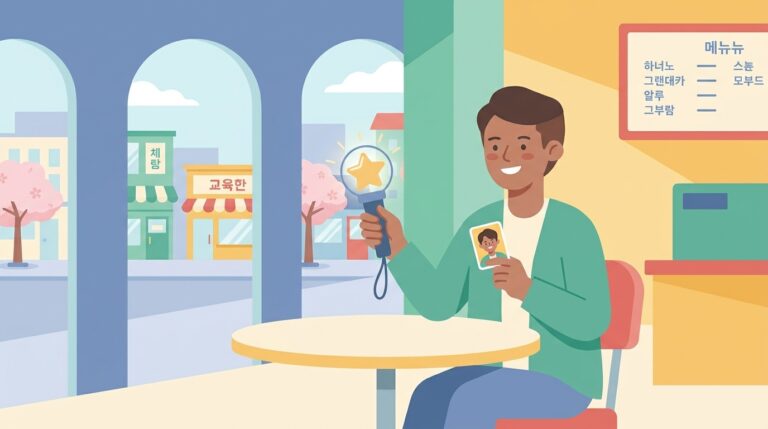
Imagine this: You finally fly to Seoul, step into a buzzing, aesthetic cafe near Hongdae covered in banners, photocard racks, and celebration posters for your favorite idol’s birthday. The air smells like sweet vanilla lattes, and fans around you are squealing with joy over limited-edition cup sleeves. You want to connect with the Korean fan sitting next to you. You smile, clear your throat, and say what your textbook taught you: “저는 케이팝을 좋아합니다 (Jeoneun keipab-eul joahamnida – I like K-pop).”
Suddenly, the lively room feels awkward. While polite, it sounds like an excerpt from an immigration interview! You don’t just like K-Pop—you stream music videos at 3 AM, collect photocards, and celebrate birthdays for someone who lives across the world. You need the authentic Korean word that captures this burning passion: 덕질하다 (Deokjilhada). Today, we’re sharing field-tested insider vocabulary backed by over 10 years of real student experiences so you can make local fandom besties instantly!
Phase 2: 핵심 표현 3선 심층 분석
1. 덕질하다 (Deokjilhada)
- Pronunciation: deok-jil-ha-da (Sounds like “duck” with a crisp ‘k’ + “jill” + “ha-da”)
- Meaning: Literally derived from the Japanese loanword otaku (오덕후) combined with the suffix 질 (doing an activity) and 하다 (to do). Nuance: To actively live the fan life—buying merchandise, streaming songs, voting, and cheering for your bias.
- K-Culture Moment: In the drama Her Private Life (그녀의 사생활), the lead character leads a double life: an art museum curator by day, and someone who says, “I am 덕질-ing!” by night.
- Editor’s Insight: Saying “케이팝 좋아해요” means you casually listen on Spotify. Saying “덕질해요” tells native speakers, “I am fully invested in the fandom culture!”
- Situation Spectrum:
- Casual (Friends/Fandom): ✅
- Semi-formal (Friendly colleagues): ⚠️
- Formal (Job Interview): 🚫
- 🤔 Think About It: In English, “fangirling” or “geek” historically had slightly nerdy or obsessive connotations. How does Korean culture’s creation of a warm, universal verb like 덕질하다 reflect its acceptance of passionate hobbies?
2. 최애 (Choeae)
- Pronunciation: choe-ae (Sounds like “choy” in “choice” combined with “eh” in “echo”)
- Meaning: Sino-Korean compound of 最 (choe – most) and 愛 (ae – love). Nuance: Your “ultimate bias”—the single member who holds the key to your heart.
- K-Culture Moment: On idol reality shows like Going Seventeen or variety programs like Amazing Saturday, hosts constantly ask guests, “누가 최애예요? (Nuga choeae-yeyo? / Who is your ultimate bias?)”
- Editor’s Insight: You can also have a 차애 (Cha-ae), which means your second favorite member (bias wrecker)!
- Situation Spectrum:
- Casual: ✅
- Semi-formal: ✅
- Formal: ⚠️
- 🤔 Think About It: While English speakers use “bias,” Koreans adapted an ancient Hanja compound (최애) into trendy street slang. How does this blend old traditions with modern pop culture?
3. 입덕하다 (Ipdeokhada)
- Pronunciation: ip-deok-ha-da (Sounds like “eep” in “deep” + “duck” + “ha-da”)
- Meaning: Literal combination of 入 (ip – to enter) and 덕 (deok – fandom). Nuance: To “fall down the rabbit hole” or become a devoted fan of a group.
- K-Culture Moment: You will often see YouTube compilations titled “입덕 영상 (Ipdeok yeongsang)”—clips engineered to pull non-fans straight into the fandom.
- Editor’s Insight: Use this with the past tense: “입덕했어요! (Ipdeok-haesseoyo! – I fell into the fandom!)”
- Situation Spectrum:
- Casual: ✅
- Semi-formal: ✅
- Formal: 🚫
- 🤔 Think About It: Notice the verb uses “enter” (입). In Korean thinking, being a fan isn’t just an opinion; it is stepping into a whole community space.
Phase 3: 교과서 한국어 vs 진짜 한국어
Situation 1: Asking someone about their favorite member
- 📖 교과서 한국어: 어떤 멤버를 가장 좋아합니까? (Eotteon membeo-reul gajang joahamnikka? / Which member do you like the most?)
- 🗣️ 진짜 한국어: 최애가 누구예요? (Choeae-ga nugu-yeyo? / Who is your bias?)
- 💡 왜 다를까?: Textbook phrases sound like a formal survey questionnaire. In everyday Seoul conversations, simply asking for someone’s 최애 sounds effortless, natural, and instantly relatable.
Situation 2: Explaining when you became a fan
- 📖 교과서 한국어: 저는 작년에 이 그룹의 팬이 되었습니다. (Jeoneun jagnyeone i geurup-ui paen-i doeeotseumnida. / I became a fan of this group last year.)
- 🗣️ 진짜 한국어: 저 작년에 입덕했어요! (Jeo jagnyeone ipdeokhaesseoyo! / I fell for them last year!)
- 💡 왜 다를까?: Native Korean speakers prefer vivid, slang-rooted verbs like 입덕하다 over stiff descriptive passive phrases like 팬이 되었습니다.
Phase 4: K-Culture 딥다이브 & 비언어적 매너
4-1. 눈치 (Nunchi) & Gestures in Fandom Spaces
When visiting fan-run “Birthday Cafes” (생카 – Saeng-ka) or photo card trade tables:
1. Two-Handed Photocard Reception: When someone trades or hands you a photo card (포카 – Po-ka), always receive it with both hands or with your right hand supported by your left forearm. It shows respect to both the trader and the artist!
2. Whispered Excitement (Inner Squeal): While Koreans are intensely passionate, cafes are shared public spaces. Keep your loud squeals contained to respectful gasps like “대박… (Daebak…)” with a hand over your mouth to demonstrate considerate nunchi.
4-2. Cultural Code: The Art of 생카 (Birthday Cafes)
In Korea, fans rent entire cafes around an idol’s birthday, funding custom cupsleeves, photo zones, and lucky draws. It isn’t run by the agency; it is 100% grassroots fan dedication. Ordering a beverage allows you to get a special “특전 (Teukjeon – special gift set)”. If you understand this culture, you aren’t just a spectator—you are part of the support system.
Phase 5: 실전 롤플레이 시나리오
Setting: A cozy, pastel-lit cafe near Hongik University Station decorated with photocards and banners.
NPC Character: Minji (민지), a friendly Korean fan seated at the adjacent table holding a binder of photocards.
- 민지: 저기 혹시… 몬스타엑스 팬이세요?
(Jeogi hoksi… Monseuta-ekseu paen-iseyo?)
“Excuse me… are you by chance a Monsta X fan?”
🎭 Leaning forward with a shy, welcoming smile. -
나: 네! 맞아요. 저 덕질하고 있어요!
(Ne! Majayo. Jeo deokjilhago isseoyo!)
“Yes! That’s right. I’m deep into the fandom!”
🎭 Nodding proudly while showing the phone lockscreen. -
민지: 우와, 반가워요! 최애가 누구예요?
(Uwa, bangawoyo! Choeae-ga nugu-yeyo?)
“Wow, so glad to meet you! Who is your ultimate bias?”
🎭 Clapping hands together in genuine excitement. -
나: 제 최애는 형원이에요! 민지 씨는요?
(Je choeae-neun Hyungwon-ieyo! Minji ssi-neun-yo?)
“My bias is Hyungwon! What about you, Minji?”
🎭 Smiling warmly and reciprocating the question. -
민지: 저는 셔누요! 혹시 언제 입덕하셨어요?
(Jeoneun Shownu-yo! Hoksi eonje ipdeokhasyeosseoyo?)
“Mine is Shownu! When did you join the fandom?”
🎭 Tilting head curiously with gleaming eyes. -
나: 저 작년에 입덕했어요. 노래가 진짜 좋아요.
(Jeo jagnyeone ipdeokhaesseoyo. Norae-ga jinjja joayo.)
“I joined last year. Their songs are truly great.”
🎭 Expressing heartfelt enthusiasm with hands over heart. -
민지: 맞아요! 이 포토카드 중복인데… 가질래요?
(Majayo! I potokadeu jungbog-inde… gajillaeyo?)
“I know right! I have a duplicate of this photocard… would you like it?”
🎭 Offering a shiny photocard with two hands. -
나: 정말요? 대박, 너무 감사해요!
(Jeongmalyo? Daebak, neomu gamsahaeyo!)
“Really? Amazing, thank you so much!”
🎭 Bowing politely and accepting with both hands.
🔀 인터랙티브 분기점 (Interactive Choice)
At Turn 4, if you didn’t know your bias’s Korean name, how would you respond?
- Choice A: “몰라요. 그냥 다 좋아요. (Mollayo. Geunyang da joayo. / I don’t know. I just like all.)”
- Choice B: “저는 올팬이에요! 다 멋있어요. (Jeoneun olpaen-ieyo! Da meosisseoyo. / I am an all-member fan! Everyone is cool.)”
- Choice C: “이름은 관심 없어요. (Ireum-eun gwansim eopseoyo. / I don’t care about names.)”
Decision Feedback:
* Choice A (Risk): A bit blunt! While true for many, “몰라요” sounds dismissive in Korean conversation.
* Choice B (Best 🎉): Perfect! “올팬 (Ol-paen)” means an “OT-all fan” (someone who loves all members equally). Minji will love your respect for the entire group.
* Choice C (Bad 🚫): Major culture faux pas. This sounds rude and breaks the fandom harmony instantly.
Phase 6: 10초 감정 섀도잉 드릴
Repeat these lines out loud, tuning into the emotional pause marks (/):
[✨ Exciting & Proud]
저 / 작년에 / 입덕했어요!
(Jeo / jagnyeone / ipdeokhaesseoyo!)
“I / fell into the fandom / last year!”-
[💖 Sweet & Affectionate]
제 최애는 / 민규예요!
(Je choeae-neun / Mingyu-yeyo!)
“My ultimate bias / is Mingyu!” -
[🤝 Cheerful & Bonding]
우리 / 같이 / 덕질해요!
(Uri / gachi / deokjilhaeyo!)
“Let’s / do fan activities / together!”
Phase 7: K-Culture 미니 사전 (핵심 키워드 4개)
-
덕후 (Deokhu)
Translation: A hardcore enthusiast / fan.
Usage: Originated from “otaku,” but now proudly used everywhere. If you love coffee immensely, you are a “커피 덕후 (Coffee deokhu).” -
굿즈 (Gutjeu)
Translation: Official or fan-made merchandise.
Usage: Refers to lightsticks, t-shirts, keyrings, and photocards: “이번 굿즈 진짜 예뻐요! (Ibeon gutjeu jinjja yeppeoyo! / This merch is so pretty!)” -
스밍 (Seuming)
Translation: Streaming songs on music charts (short for 스트리밍).
Usage: Fandoms coordinate “스밍 인증 (Streaming verification)” on X (formerly Twitter) to push their idols to #1 on Melon. -
어덕행덕 (Eodeokhaengdeok)
Translation: “어차피 덕질할 거 행복하게 덕질하자” (Since we are going to fan anyway, let’s fan happily!).
Usage: The ultimate golden rule for K-Pop fans whenever stress, ticketing wars, or internet drama arises.
Phase 8: 여행자를 위한 생존 키트
Top 3 Survival Phrases
- 특전 아직 있어요? (Teukjeon ajik isseoyo?)
Pro Tip: Ask this at the counter in birthday cafes to check if the limited photocard/cup sleeve pack is still in stock before ordering your drink. - 포카 교환할래요? (Poka gyohwanhallaeyo?)
Pro Tip: Walk up gently to fans trading outside concert venues with your photocard binder open and say this sentence. - 사진 찍어 주실 수 있나요? (Sajin jjigeo jusil su innayo?)
Pro Tip: Great for asking fellow fans to take a photo of you in front of the giant birthday cafe photo wall.
Editor’s Travel Note
- Navigate Hongdae and Seongsu birthday cafes with pinpoint accuracy using the [Naver Map app download for iOS and Android]. Global map apps often fail with small Korean indie cafes!
- Want a custom souvenir? Stop by subway stations like Hongik University Station or Gangnam Station to find automated photo card printing kiosks where you can print your favorite idol selfie directly onto an active Korean transit card.
Phase 9: “한 발 더 깊이” (생각 질문)
In many Western cultures, intense fandom was once stereotyped as an isolated or quirky obsession. In contrast, Korean 덕질 (Deokjil) has evolved into a vibrant social ritual and a healthy celebration of joy. It revitalizes neighborhood cafes, sparks creative fan-art economies, and builds a sense of unified 정 (Jeong – affection and communal bond) among strangers. When you say 덕질하다, you are not just saying you are a consumer; you are joining a collective cultural journey.
💬 Your Turn: Who is your 최애 (Choeae) right now, and what song made you 입덕 (Ipdeok)? Drop your favorite group and bias in the comments below in Korean!
Phase 10: FAQ & 오해 방지 (FAQ Schema)
Q: Can I use “덕질하다” with hobbies other than K-Pop idols?
A: Absolutely! You can use it for K-Dramas (드라마 덕질), anime, musical theater, or even niche hobbies like vintage keyboards and specialty coffee roasting. It applies to anything you dedicate your heart and time to.
Q: Is calling someone a “덕후 (Deokhu)” an insult?
A: In the early 2000s, it carried a slightly negative nuance similar to “nerd.” However, today it is a badge of honor signifying expertise and passion. Just avoid using it in strictly formal business settings.
Q: What is the difference between “팬 (Paen)” and “덕후 (Deokhu)”?
A: A 팬 (Fan) enjoys the music and goes to concerts. A 덕후 knows the members’ blood types, collects photocards, streams every release, and visits birthday cafes. A 덕후 is the advanced level of a 팬!
🚨 흔한 실수 (Common Mistakes) 경고판
- Mistake: Saying “내 편 (Nae pyeon)” instead of “내 최애 (Nae choeae)”.
Correction: 내 편 means “on my side/supporter.” Always use 최애 when referring to your bias! - Mistake: Writing “덕질해요” to a company executive or professor.
Correction: It is informal slang. In formal interviews, use “열정적으로 응원하고 있습니다 (I am passionately cheering for them).” - Mistake: Forgetting honorifics when asking about someone’s bias (최애가 누구야?).
Correction: Always add -예요 (최애가 누구예요?) to fellow fans you have just met to maintain polite manners.
Phase 11: 액션 미션 & 참여 유도
- 🥉 Bronze Mission (Solo): Stand in front of your mirror and practice saying: “제 최애는 [Idol Name]이에요!” 3 times with a bright smile.
- 🥈 Silver Mission (Social): Go to your X (Twitter) or Weverse account and make a post with the sentence: “저 오늘부터 한국어 덕질 시작해요! (I’m starting my Korean language fangirling from today!)”
- 🥇 Gold Mission (Real-world): Visit a local K-Pop store or Korean cafe and use the phrase “최애가 누구예요?” with a staff member or fellow fan.
🎮 K-Culture Mission: Watch a behind-the-scenes video or V-Log of your favorite group on YouTube. See if you can spot the word 입덕 or 덕후 in the Korean subtitles!
Phase 12: 인터랙티브 퀴즈 챌린지
1. Situation Quiz
You are talking with a fellow ARMY at a concert line. You want to ask who their favorite member is. Which phrase is the most natural?
* A) 가장 좋아하는 가수는 누구입니까?
* B) 최애가 누구예요?
* C) 멤버를 선택하세요.
2. Fill-in-the-blank Quiz
Fill in the blank with the correct slang:
“I fell in love with SEVENTEEN last week! = 저 지난주에 세븐틴에 (________)했어요!”
3. True or False Cultural Quiz
In Korea, it is polite to hold and receive idol photocards with just one hand like a playing card. (True / False)
🔍 Click here to reveal the answers and explanations!
-
Answer: B) 최애가 누구예요?
Explanation: Choice A is stiff textbook speech, and Choice C sounds like an automated video game prompt. Choice B is warm, natural, and authentic! -
Answer: 입덕 (Ipdeok)
Explanation: The sentence becomes “입덕했어요” (I fell into the fandom / joined the fandom). -
Answer: False
Explanation: Always receive photocards with both hands to display thoughtful non-verbal nunchi and respect!







