

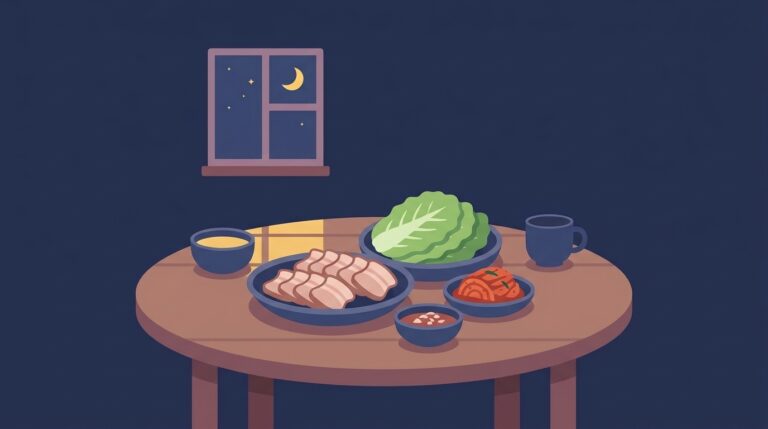
Phase 1: 공감 (Late-Night Craving in Seoul)
안녕하세요! 매일한글 에디터입니다.
Imagine this: It is 11:30 PM in Seoul. You have walked over 18,000 steps exploring the lively alleys of Hongdae, and your stomach lets out an undeniable rumble. You notice glowing neon signs on every corner, filled with laughter and sizzling sounds. Welcome to Korea’s legendary yasik (late-night snack) culture! Among all the midnight delicacies, one dish reigns supreme as the ultimate comforting king: 보쌈 (Bossam – tender, boiled pork belly wrapped in crisp greens with spicy radish kimchi).
However, entering a packed traditional bossam restaurant late at night can feel daunting for beginner learners. How do you specify portion sizes? What should you say when you run out of fresh lettuce leaves? Do you get cold noodles automatically? Many of our A2 learners shared that they once pointed awkwardly at pictures or missed out on free vegetable refills simply because they lacked the right phrases.
Fret not! As your Korean best friend and 10-year cultural guide, I have crafted this practical field handbook based on real learner experiences. By mastering today’s lesson, you will walk into any late-night eatery or tap open a delivery app with total confidence, ordering and eating bossam like a true local.
Phase 2: 핵심 표현 3선 심층 분석 (3 Core Expressions)
1. 보쌈 소(小) 자 하나 주세요
- Pronunciation: [Bossam so-ja hana juseyo] (Think of ‘so’ as the ‘so’ in ‘solar’, and ‘ja’ as the ‘ja’ in ‘jar’)
- Meaning: Literal: “Bossam small size one please” / Natural nuance: “We’d like one small order of bossam, please!”
- K-Culture Moment: Seen frequently in food variety shows and K-Dramas like Let’s Eat when two best friends step into a bossam place after overtime work and order the perfect starter size.
- Editor’s Insight: In Korean sharing dishes, restaurants don’t usually say ‘small, medium, large’ in pure Korean. They use Hanja (Sino-Korean) terms: 소 (So – Small), 중 (Jung – Medium), and 대 (Dae – Large) followed by 자 (Ja – size/type).
- Situation Spectrum: Casual: ⚠️ (Say 보쌈 소 자 줘 only to close friends) | Semi-formal: ✅ | Formal: ✅
- 🤔 Think About It: In English, we often order individual plates. Why do you think Korean late-night meals are categorized into shared sizes (소/중/대) rather than single portions?
2. 쌈채소 좀 더 주실 수 있나요?
- Pronunciation: [Ssamchaeso jom deo jusil su innayo?] (Say ‘ssam’ with a tight ‘s’ sound like ‘psst’, and ‘chaeso’ like ‘chai-so’)
- Meaning: Literal: “Can you give a little more wrap vegetables?” / Natural nuance: “Could we please get some more wrapping greens?”
- K-Culture Moment: That satisfying scene where a protagonist piles pork, garlic, and kimchi onto a giant cabbage leaf, only to realize the green basket is empty!
- Editor’s Insight: The word 좀 (jom – a little) is your golden politeness softener in Korean. Adding 좀 prevents your request from sounding like a direct demand.
- Situation Spectrum: Casual: ⚠️ | Semi-formal: ✅ | Formal: ✅
- 🤔 Think About It: In many Western countries, extra greens or bread baskets cost extra. In Korea, ssam refills are almost always complimentary. How does this reflect the cultural concept of jeong (affectionate generosity)?
3. 막국수도 같이 나와요?
- Pronunciation: [Makguksudo gachi nawayo?] (Say ‘mak’ like ‘muck’, ‘guksu’ like ‘gook-soo’, and ‘gachi’ sounds like ‘ga-chee’)
- Meaning: Literal: “Do buckwheat noodles come out together too?” / Natural nuance: “Does the spicy buckwheat noodle dish come with the set?”
- K-Culture Moment: Every late-night Bossam delivery unboxing in Korean vlogs features tangy, chilled buckwheat noodles (막국수) mixed with plastic-gloved hands right beside the pork.
- Editor’s Insight: Bossam sets often include 막국수 (spicy chilled noodles) as a combo, but smaller neighborhood spots might sell it separately. Asking this ensures you know whether to order noodles on the side!
- Situation Spectrum: Casual: ⚠️ | Semi-formal: ✅ | Formal: ✅
- 🤔 Think About It: Why is a cold, spicy, acidic noodle dish paired with warm, fatty steamed pork? Notice how Korean culinary philosophy balances temperature, texture, and grease.
Phase 3: 교과서 한국어 vs 진짜 한국어 (Textbook vs. Real Korean)
Situation 1: Ordering a small size
- 📖 교과서 한국어: 저는 작은 크기의 보쌈을 원합니다. (Jeoneun jageun keugiui bossameul wonhamnida. – “I desire a small-sized bossam.”)
- 🗣️ 진짜 한국어: 사장님, 저희 보쌈 소 자로 주세요! (Sajangnim, jeohui bossam so-jaro juseyo! – “Boss, we’ll take a small bossam, please!”)
- 💡 왜 다를까? Textbook Korean uses literal descriptive adjectives (작은 크기), but real diners call the owner 사장님 (Sajangnim) and specify sizes with the Sino-Korean terms 소/중/대 자.
Situation 2: Asking for extra side kimchi
- 📖 교과서 한국어: 김치를 추가로 제공해 주시겠습니까? (Gimchireul chugaro jegonghae jusigesseumnikka? – “Would you provide additional kimchi?”)
- 🗣️ 진짜 한국어: 이모님, 무말랭이 김치 조금만 더 주세요~ (Imonim, mumallaengi gimchi jogeumman deo juseyo~ – “Auntie, could we get a bit more crunchy radish kimchi, please~?”)
- 💡 왜 다를까? Formal verbs like 제공하다 (to provide) sound stiff and robotic. Calling the female server warmly as 이모님 (Imonim – Auntie) and naming the specific side dish (무말랭이 김치) creates instant warmth and faster service!
Phase 4: K-Culture 딥다이브 & 비언어적 매너 (Deep Dive & Manners)
4-1. 눈치 (Nunchi) & Table Etiquette
- The One-Bite Rule (한입만): When you assemble a ssam (lettuce or boiled napa cabbage leaf + pork + salted shrimp sauce + spicy radish + garlic), fold it tightly into a compact pouch. In Korean culture, biting a wrap in half causes it to spill and looks messy! Pop the whole bundle into your mouth at once. Puffing your cheeks while chewing is seen as a sign of enjoying the food enthusiastically.
- The Ssam Gift of Love: You will often see Koreans wrap a giant parcel and hand-feed it directly to a friend or partner. If someone offers you a wrap, accept it with both hands or lean forward slightly to receive it in your mouth—never refuse it abruptly, as it is a gesture of heartfelt friendship!
4-2. Midnight Culture Code: Why Bossam for Yasik?
Koreans often joke that bossam is “guilt-free late-night food” (다이어트 야식) because the pork is boiled in aromatic herbs, coffee beans, and ginger rather than deep-fried like chicken. Whether after a late study session or a night out drinking soju, bossam delivers pure restorative comfort.
Phase 5: 실전 롤플레이 시나리오 (Real-Life Roleplay)
Setting: It is 11:45 PM at 원조할머니보쌈 (Original Grandma Bossam) in Jongno. Neon lights reflect on wet pavement outside. You and your friend step inside. The air smells of steamed herbs and sesame oil. An energetic middle-aged owner (Sajangnim) greets you.
- 사장님: 어서 오세요! 두 분이세요? (Eoseo oseyo! Du bun-iseyo?) 🎭 Wipes table with a clean cloth and smiles warmly.
- You: 네, 두 명이에요. 편한 데 앉으면 돼요? (Ne, du myeong-ieyo. Pyeonhan de anjeumyeon dwaeyo? – Yes, two of us. Can we sit anywhere comfortable?)
- 사장님: 네, 안쪽 편한 자리에 앉으세요! 메뉴 보시고 불러주세요. (Ne, anjjok pyeonhan jarie anjeuseyo! Menyu bosigo bulleojuseyo.) 🎭 Hands you a laminated menu.
- You: 저기요, 사장님! 저희 보쌈 소 자 하나 주세요. (Jeogiyo, sajangnim! Jeohui bossam so-ja hana juseyo.) 🎭 Raises hand slightly without waving excessively.
- 사장님: 네~ 막국수는 같이 드릴까요? (Ne~ Makguksuneun gachi deurilkkayo? – Sure, shall I bring buckwheat noodles together?)
- You: 막국수도 세트에 같이 나와요? 아니면 따로 시켜야 해요? (Makguksudo seteue gachi nawayo? Animyeon ttaro sikyeoya haeyo? – Does makguksu come with the set? Or do we order separately?)
- 사장님: 소 자에는 기본으로 조금 나와요! 드셔보시고 추가하세요. (So-jaeneun giboneuro jogeum nawayo! Deusyeobosigo chugahaseyo. – A small portion comes with the small set! Try it first and add more if you like.) 🎭 Nods reassuringly.
- You: 좋아요! 그리고 쌈채소 좀 더 주실 수 있나요? 처음부터 넉넉히 부탁드려요! (Johayo! Geurigo ssamchaeso jom deo jusil su innayo? Cheoeumbuteo neongneokhi butakdeuryeoyo! – Great! And could you give us extra wrapping greens generously from the start?)
🔀 Interactive Decision Point
The bossam arrives on a steaming plate. You devour the meat happily, but you ran out of 무말랭이 (crunchy seasoned radish). What do you say?
- Option A: “저기요! 무말랭이 김치 좀 더 갖다주세요~” (Jeogiyo! Mumallaengi gimchi jom deo gatdajuseyo~)
- Feedback (Best Choice): Perfect! Polite, direct, and names the exact banchan you want. The server will gladly bring a fresh mountain of radish!
- Option B: “야! 김치 더 줘!” (Ya! Gimchi deo jwo!)
- Feedback (Bad Choice): Danger! 야 (Hey) and 반말 (informal talk) to an elder or restaurant owner will create instant awkwardness and offend the staff.
- Option C: “익스큐즈 미, 김치 원 모어 플리즈?” (Excuse me, kimchi one more please?)
- Feedback (Risk Choice): They will understand the gesture, but you miss a prime opportunity to build local rapport and practice your A2 Korean!
Phase 6: 10초 감정 섀도잉 드릴 (Emotion Shadowing Drill)
Read these out loud! Focus on the rhythm slashes / and match the emotional tags:
[😊 배고프고 신나게 - Hungry & Excited]- 사장님! / 보쌈 소 자 하나 / 얼른 주세요!
(Sajangnim! / Bossam so-ja hana / eolleun juseyo! – Boss! Please give us one small bossam quickly!)
- 사장님! / 보쌈 소 자 하나 / 얼른 주세요!
[🥺 조심스럽고 공손하게 - Polite & Gentle]- 저기요, / 쌈채소 조금만 / 더 주실 수 있나요?
(Jeogiyo, / ssamchaeso jogeumman / deo jusil su innayo? – Excuse me, could you give us a little more wrap greens?)
- 저기요, / 쌈채소 조금만 / 더 주실 수 있나요?
[😋 감탄하며 만족스럽게 - Delighted & Savoring]- 와, / 고기가 진짜 부드러워요! / 막국수랑 / 딱이에요!
(Wa, / gogiga jinjja budeureowoyo! / Makguksurang / ttagieyo! – Wow, the meat is so tender! It goes perfectly with the cold noodles!)
- 와, / 고기가 진짜 부드러워요! / 막국수랑 / 딱이에요!
Phase 7: K-Culture 미니 사전 (Mini Dictionary)
- 쌈 (Ssam) | Noun
- Literal meaning: “Wrap”. Culturally, it refers to wrapping savory cooked meat, rice, and banchan in edible leaves like lettuce, sesame leaves (깻잎), or boiled napa cabbage (배추).
- 야식 (Yasik) | Noun
- Midnight feast or late-night snack eaten typically between 10:00 PM and 3:00 AM. A foundational pillar of Korean 24-hour lifestyle culture.
- 무말랭이 (Mumallaengi) | Noun
- Dried, seasoned radish strips. Specially prepared for bossam with sweet-and-spicy chili paste, offering an addictive crunchy counterpoint to the tender steamed pork.
- 새우젓 (Sae-u-jeot) | Noun
- Tiny salted fermented shrimp sauce. Koreans always dip boiled pork in 새우젓 because enzymes in the shrimp aid in digesting pork fat easily!
Phase 8: 여행자를 위한 생존 키트 (Traveler’s Survival Kit)
Top 3 Survival Phrases
- 고기 추가해 주세요. (Gogi chugahae juseyo. – “Please add an extra portion of meat.”)
- Pro Tip: Finished all your pork slices but still have lots of kimchi and leaves left? Use this phrase to order just the meat without paying for a full new set.
- 남은 음식 포장해 주세요. (Nameun eumsik pojanghae juseyo. – “Please pack the leftovers to go.”)
- Pro Tip: Portions can be huge! Bossam packs neatly into takeout containers for a great breakfast in your hotel room.
- 덜 맵게 해 주세요. (Deol maepge hae juseyo. – “Please make it less spicy.”)
- Pro Tip: Useful when ordering 막국수 (spicy buckwheat noodles) if your spice tolerance is still at beginner level.
Editor’s Travel Note
- If you want to find authentic late-night bossam spots open until 4:00 AM, avoid generic search engines. Install and search on the Naver Map Navigation App with the keyword “보쌈 맛집”.
- For delivery straight to your hotel room, check apps that support international credit cards or cash on arrival (현장 결제). At the table, look for the silver call button (호출벨) mounted on the side of the wooden table—press it once instead of shouting across the room!
Phase 9: “한 발 더 깊이” (Cultural Reflection)
In Korean culinary history, the act of making a 쌈 (Ssam) is intimately connected with the concept of 복 (Bok – Good Fortune). In ancient Korea, people believed that gathering various treasures of the earth—greens, grain, seasoned roots, and meat—and folding them tightly into a single bundle symbolized wrapping up blessings and ingesting good luck into your body. Bossam is rarely eaten in isolation; it is designed to be shared from a central platter. When we pass leafy greens and assemble customized bites for our dining companions, food ceases to be mere nutrition and becomes an act of communal care.
💬 Your Turn: Have you ever tried Korean Bossam or built a traditional lettuce wrap before? What is your favorite late-night comfort food in your hometown? Share your story in the comments below!
Phase 10: FAQ & 오해 방지 (FAQ & Common Mistakes)
Q: Is Bossam the same dish as Suyuk (수육)?
A: They are close cousins, but not identical! Both feature boiled meat. However, 수육 (Suyuk) refers generally to sliced boiled beef or pork served simply with dipping sauces. 보쌈 (Bossam) specifically refers to boiled pork served as a complete wrapping experience accompanied by specially prepared sweet-spicy bossam kimchi, pickled radish (무말랭이), and fresh leaves.
Q: Do I have to pay extra for vegetable and kimchi refills?
A: In 95% of traditional restaurants, standard wrapping leaves (상추, 깻잎) and sauces (된장, 새우젓) are refilled completely free of charge! However, high-end artisanal bossam kimchi made with raw oysters or specialty radish might have a small re-order fee listed on the menu as 김치 추가.
Q: What is the tiny pink sauce served in little bowls next to the pork?
A: That is 새우젓 (Sae-u-jeot – salted fermented baby shrimp). It is not just seasoning; Korean traditional medicine notes that fermented shrimp contains rich lipases that break down pork fat quickly, preventing indigestion during late-night dining.
🚨 흔한 실수 (Common Mistakes) 경고판
- Mistake: Biting a large ssam wrap halfway and putting it back on the plate.
- Correct Action: Make the wrap slightly smaller so you can consume it in one clean bite without sauce dripping onto the table.
- Mistake: Asking for “one person portion” (1인분) at a traditional bossam house late at night.
- Correct Action: Bossam is usually sold by portion sizes: 소 (Small / 2 people), 중 (Medium / 3 people), 대 (Large / 4 people). Order 소 자 even if you are eating solo or with one friend.
- Mistake: Eating the boiled pork plain without dipping or wrapping.
- Correct Action: Bossam meat is gently simmered without heavy salt. Always pair each slice with salted shrimp sauce (새우젓), ssamjang, or spicy radish to bring out its full flavor profile.
Phase 11: 액션 미션 & 참여 유도 (Action Missions)
- 🥉 Bronze Mission: Stand in front of your mirror and practice saying: “사장님, 보쌈 소 자 하나 주세요!” with a bright, welcoming smile 3 times.
- 🥈 Silver Mission: Next time you watch a K-Drama featuring a dining scene, spot whether the characters use lettuce or boiled cabbage for their wraps, and post a screenshot on Instagram tagging #DailyHangulBossam!
- 🥇 Gold Mission: Visit a local Korean restaurant or order delivery this weekend. Use at least two Korean phrases: ask for size (소 자 주세요) and request extra greens (쌈채소 더 주세요)!
- 🎮 K-Culture Mission: Search for a clip of the popular show Delicious Guys (맛있는 녀석들) eating Bossam. Observe how they build monumental wraps using the ‘one-bite challenge’ (한입만)!
Phase 12: 인터랙티브 퀴즈 챌린지 (Interactive Quiz)
Test what you have learned today! Click each question to reveal the answers and detailed explanations.
Q1. [Situational Judgment] You are at a late-night bossam restaurant with one friend. What is the most natural way to place your order?
- A) 보쌈 1인분 주세요. (Bossam il-inbun juseyo.)
- B) 보쌈 소 자 하나 주세요. (Bossam so-ja hana juseyo.)
- C) 보쌈 작은 크기로 하나 가져오세요. (Bossam jageun keugiro hana gajyeo-oseyo.)
Answer: B) 보쌈 소 자 하나 주세요.
Explanation: Sharing meals like Bossam are measured by Sino-Korean sizes: 소 (small), 중 (medium), and 대 (large). Option A is unnatural because bossam is rarely sold as individual 1-person portions in dinner restaurants, and Option C sounds overly formal and stiff.
Q2. [Fill in the Blank] Fill in the missing polite particle to soften your request: “사장님, 쌈채소 _____ 더 주실 수 있나요?”
- Answer: 좀 (jom) or 조금만 (jogeumman)
Explanation: Adding 좀 (a little) or 조금만 (just a little) acts as a polite social lubricant in Korean, transforming a blunt request into a warm, considerate question.
Q3. [True or False Culture Quiz] It is polite table manners in Korea to bite a Bossam lettuce wrap in half if it is too big for your mouth. (T / F)
- Answer: False (F)
Explanation: In Korean culture, ssam should be eaten in one single bite (한입에 먹기). Biting it in half spills juices and fillings onto your fingers and table. If it feels too big, adjust the amount of pork and rice before wrapping!






