

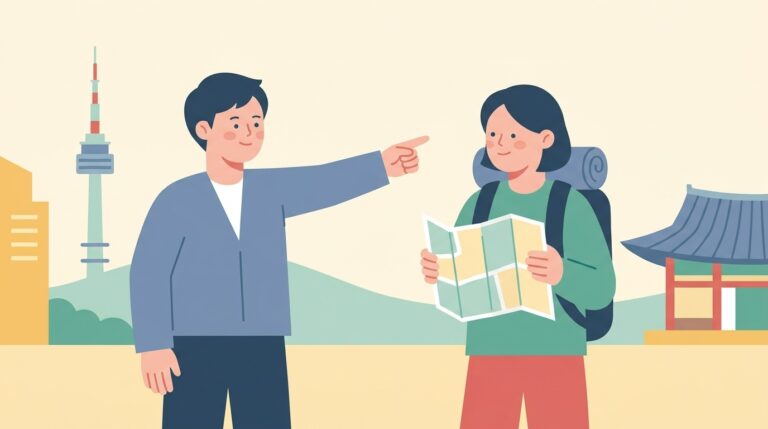
Master Asking for Help in Korean: Your Friendly A1 Survival Guide
Phase 1: Empathy (Story-Immersive Opening)
안녕하세요! (Annyeonghaseyo!) I’m your editor at Daily Hangul, your trusted cultural navigator and Korean study bestie.
Picture this: You just touched down at Incheon Airport, hopped on the AREX train, and arrived at the sprawling labyrinth that is Hongdae Station. Your suitcase weighs twenty kilograms, your phone battery is hovering at a terrifying 3%, and suddenly you realize you are facing a massive flight of stairs with no escalator in sight. You see busy locals zooming past in stylish long coats, completely immersed in their AirPods. You want to ask for a hand, but your mind goes blank. In Hollywood movies, people might just yell, “Hey, can someone help me?” But here, you freeze up wondering: Will I sound rude? What if they don’t speak English? What if I use the wrong honorific and embarrass myself?
Take a deep breath—I have been there, and so have thousands of our A1 beginner students! In Korean culture, asking for help isn’t seen as a burden; it is an invitation to experience 정 (Jeong), the warm bond of community care that powers everyday life in Korea. By learning just a few magical, polite phrases, you transform from an overwhelmed bystander into an empowered traveler who connects authentically with locals. Let’s unlock your voice so you never feel stranded in Seoul again!
Phase 2: Top 3 Essential Expressions for Asking for Help
1. 도와주세요 (Dowajuseyo)
- Pronunciation: [Do-wa-ju-se-yo] (Think of it like: “Dough-wah-joo-say-yo”, smooth and flowing)
- Meaning: Literal: “Please give help” | Real Nuance: “Please help me” (Polite, clear, and universally understood)
- K-Culture Moment: You will hear this in almost every K-Drama when a character drops an armload of documents in a bustling office hallway, or when a runaway puppy dashes toward the Han River!
- Editor’s Insight: This is your primary survival button. The base verb is 돕다 (dopda, to help) combined with the polite imperative ending -아/어 주세요 (-a/eo juseyo, please do for me). It strikes the ideal balance between humility and urgency.
- Situation Spectrum: Casual: ⚠️ (too formal for close peers) | Semi-formal: ✅ (perfect for everyday public encounters) | Formal: ✅
- 🤔 Think About It: In English, we often frame requests as questions: “Could you help me?” In Korean, straightforward politeness using “주세요 (juseyo – please give)” is considered warmer and more humble than passive phrasing.
2. 저기요, 잠깐만요 (Jeogiyo, jamkkanmanyo)
- Pronunciation: [Jeo-gi-yo, jam-kkan-man-yo] (Sound it out like: “Chuh-ghee-yo, jahm-kahn-mahn-yo”)
- Meaning: Literal: “Over there! Just a brief moment!” | Real Nuance: “Excuse me, pardon me for a second!”
- K-Culture Moment: The iconic sound of any Korean restaurant or busy street market! A patron raises their hand slightly to catch the attention of the server without shouting rudely.
- Editor’s Insight: Before you blurt out your request, you need an opener. In Korea, jumping straight to “도와주세요 (Dowajuseyo)” without an initial “저기요 (Jeogiyo)” can startle someone. Use this pair to softly tap on someone’s attention radar.
- Situation Spectrum: Casual: ✅ | Semi-formal: ✅ (best for strangers and store staff) | Formal: ⚠️
- 🤔 Think About It: Why does “저기요 (Jeogiyo)” literally mean “over there”? It shifts the spotlight away from the speaker’s ego, making the initial contact indirect and gentle.
3. 이것 좀 도와주실 수 있어요? (Igeot jom dowajusil su isseoyo?)
- Pronunciation: [I-geot jom do-wa-ju-sil su i-sseo-yo?] (Think: “Ee-got johm dough-wah-joo-sheel soo ee-ssuh-yo?”)
- Meaning: Literal: “Can you give a little help with this?” | Real Nuance: “Could you possibly give me a quick hand with this?”
- K-Culture Moment: A traveler trying to decipher an automated subway ticketing machine turns to a nearby commuter with a warm smile.
- Editor’s Insight: The secret weapon here is the little syllable 좀 (jom), which literally means “a little bit.” In Korean, inserting “좀 (jom)” is like sprinkling verbal fairy dust that instantly softens your request, making it sound polite and non-demanding.
- Situation Spectrum: Casual: ⚠️ | Semi-formal: ✅ (super polite & sweet) | Formal: ✅
- 🤔 Think About It: How does your native language downplay the weight of a favor? Comparing “좀 (jom)” to “just a quick hand” reveals a shared human desire to respect each other’s time.
Phase 3: Textbook Korean vs. Real-World Korean
Situation 1: Calling out to a stranger for help on the street
- 📖 Textbook Korean: 실례하지만, 저를 도와주시겠습니까? (Sillyehajiman, jeoreul dowajusigesseumnikka? – Excuse me, will you assist me?)
- 🗣️ Real Korean: 저기요, 죄송한데 이것 좀 도와주세요! (Jeogiyo, joesonghande igeot jom dowajuseyo! – Excuse me, so sorry to bother, but please help me with this!)
- 💡 Why is it different? Textbook phrases sound like an 18th-century royal court decree! Real Koreans soften interactions with an apology like “죄송한데 (joesonghande – I am sorry, but…)” rather than stiff bureaucratic grammar.
Situation 2: When your hands are full and you need someone to hold an elevator
- 📖 Textbook Korean: 문을 열어 주시기를 간청합니다. (Muneul yeoreo jusigireul gancheonghamnida. – I petition you to hold open the door.)
- 🗣️ Real Korean: 잠깐만요! 문 좀 잡아주세요! (Jamkkanmanyo! Mun jom jabajuseyo! – Wait a second! Please hold the door!)
- 💡 Why is it different? Spoken Korean values quick, efficient momentum. Using “잡아주세요 (jabajuseyo – please hold)” gets right to the point while remaining completely courteous.
Phase 4: K-Culture Deep Dive & Non-Verbal Manners
4-1. 눈치 (Nunchi) & Body Language Etiquette
In Korea, non-verbal cues carry as much weight as spoken words. When you approach someone for help, keep these three golden rules in mind:
1. The Subtle 15-Degree Nod: Do not bow to a 90-degree angle unless you have committed a colossal mistake! A gentle, respectful 15-degree nod while saying “저기요 (Jeogiyo)” shows humility without feeling awkward.
2. The Two-Hand Rule: If you are handing your phone to someone to show a map, always hold your phone with both hands, or support your right wrist/forearm with your left hand. It conveys immense respect.
3. Soft Eye Contact: Avoid intense, unblinking eye contact, which can feel confrontational. Look at their eyes, then gently glance toward the item or direction you need help with.
4-2. Cultural Code: The Warm Power of “정 (Jeong)”
If you watch variety shows like You Quiz on the Block or feel-good dramas like Hospital Playlist, you will notice that Koreans often go out of their way to assist strangers. There is a deep-seated cultural instinct known as 정 (Jeong)—an invisible thread of warmth, empathy, and collective responsibility. Even if older Koreans (아저씨 / Ajeossi or 아주머니 / Ajumeoni) look stern at first glance, the moment an earnest foreigner politely says, “저기요, 도와주세요 (Jeogiyo, dowajuseyo),” their maternal or paternal instincts kick in. Many will literally walk three blocks out of their way to guide you to your destination!
Phase 5: Real-Life Roleplay Scenario
Setting: Hongdae Station, Exit 9. It is raining, and Sarah is stuck in front of a broken T-Money transit card recharge kiosk. Min-woo, a friendly university student holding a yellow umbrella, is walking past.
- Sarah: 🎭 (Hesitant, bowing slightly) 저기요, 죄송한데 잠깐만요! (Jeogiyo, joesonghande jamkkanmanyo! – Excuse me, I am so sorry, but just one moment!)
- Min-woo: 🎭 (Pauses, taking out an earbud and smiling warmly) 네? 무슨 일이세요? (Ne? Museun iriseyo? – Yes? What is going on?)
- Sarah: 🎭 (Points at the blinking red screen with both hands) 기계가 안 돼요. 이것 좀 도와주세요. (Gigyega an dwaeyo. Igeot jom dowajuseyo. – The machine isn’t working. Please help me with this.)
- Min-woo: 🎭 (Looks at the machine screen and nods) 아, 카드가 걸렸네요! 제가 역무원 불러드릴게요. (A, kadeuga geollyeonneyo! Jega yeongmuwon bulleodeurilgeyo. – Ah, your card got jammed! I will call the station attendant for you.)
- Sarah: 🎭 (Clasping hands in relief) 정말요? 감사합니다! (Jeongmalyo? Gamsahamnida! – Really? Thank you so much!)
- Min-woo: 🎭 (Presses the emergency call button on the wall and speaks into the intercom) 역무원님, 여기 9번 출구 기계에 카드 걸렸어요! (Yeongmuwonnim, yeogi gubeon chulgu gigyee kadeu geollyeosseoyo! – Station manager, a card is stuck in the machine by Exit 9!)
- Min-woo: 🎭 (Turns back to Sarah reassuringly) 이제 오실 거예요. 걱정하지 마세요. (Ije osil geoyeyo. Geokjeonghaji maseyo. – They will be here shortly. Don’t worry at all.)
- Sarah: 🎭 (Deeply grateful, bowing 30 degrees) 도와주셔서 정말 감사합니다! (Dowajusyeoseo jeongmal gamsahamnida! – Thank you so very much for helping me!)
🔀 Interactive Choice Point: How Should Sarah Respond If Min-woo Were In a Rush?
If Min-woo had looked at his watch and looked slightly apologetic, what should you do?
- Option A: Grasp his sleeve and insist: “안 돼요! 도와주세요! (An dwaeyo! Dowajuseyo! – No! Help me!)”
- Feedback: [Bad] 🚫 Touching a stranger’s clothes or demanding help crosses boundaries and will cause discomfort.
- Option B: Smile gracefully, step back, and say: “괜찮아요, 감사합니다! (Gwaenchanhayo, gamsahamnida! – It is okay, thank you!)”
- Feedback: [Best] ✅ Exemplary Korean manners! Recognizing someone’s lack of time displays supreme 눈치 (Nunchi).
- Option C: Say nothing, look down at your shoes, and heave a deep sigh.
- Feedback: [Risk] ⚠️ Min-woo might feel guilty and miss his appointment, or leave feeling awkward. A polite release is always best!
Phase 6: 10-Second Emotional Shadowing Drill
Read these out loud with rhythm and intention! The slash / indicates a brief breath pause.
[🥺 Urgent yet respectful]
저기요! / 죄송한데 / 저 좀 도와주세요.
(Jeogiyo! / Joesonghande / jeo jom dowajuseyo.)
“Excuse me! / I am sorry, but / please give me a hand.”-
[💡 Polite inquiry]
이것 좀 / 도와주실 수 / 있어요?
(Igeot jom / dowajusil su / isseoyo?)
“With this / could you possibly / help me out?” -
[😊 Deep heartfelt relief]
정말 감사합니다! / 복 받으실 거예요!
(Jeongmal gamsahamnida! / Bok badeusil geoyeyo!)
“Thank you so much! / May you receive many blessings!”
Phase 7: K-Culture Mini Dictionary
- 도움 (Doum) [Do-um]: Noun. Assistance, help.
Real-World Context: Often paired with the verb 요청하다 (yocheonghada, to request) or 받다 (batda, to receive). You will see “도움이 필요하세요? (Do-umi piryohaseyo? – Do you need help?)” on information desks across Korean airports. - 길치 (Gilchi) [Geel-chee]: Noun. Directionally challenged person / someone with no sense of direction.
Real-World Context: A lighthearted, self-deprecating slang term! Saying “제가 길치라서요… (Jega gilchiraseoyo… – Because I’m terrible with directions…)” instantly wins empathetic smiles from locals. - 저기요 (Jeogiyo) [Jeo-gi-yo]: Interjection. Excuse me (literally: over there).
Real-World Context: The undisputed king of public attention-getters in Korea. Perfect for restaurants, subways, and bustling crosswalks. - 정 (Jeong) [Jeong]: Noun. Deep affection, human bonding, communal warmth.
Real-World Context: The cultural engine behind why total strangers in Korea will gladly stop their day to help carry your heavy bag up a flight of stairs.
Phase 8: Traveler’s Survival Kit
Top 3 Survival Phrases on the Go
- 1. 영어 할 수 있으세요? (Yeongeo hal su isseuseyo?)
- Pro Tip: Don’t say “Do you speak English?” abruptly. Asking “Can you speak English?” politely with honorifics lowers stress for the local.
- 2. 여기가 어디예요? (Yeogiga eodiyeyo?)
- Pro Tip: Pull out your phone map, point to your screen, and say this. It directly asks, “Where is this place?”
- 3. 천천히 말씀해 주세요 (Cheoncheonhi malsseumhae juseyo)
- Pro Tip: When locals answer you in blazing-fast conversational Korean, use this phrase (“Please speak slowly”) to dial down the speed!
Editor’s Travel Note
- Essential Navigation: Forget Google Maps in South Korea—due to local mapping regulations, it rarely displays walking routes accurately. Make sure to download the Naver Map application before departing for your trip.
- Transit & Taxis: If you ever get stranded late at night when the subway lines close, install Kakao T ride-hailing service to call a taxi with upfront fare estimates and no language barrier.
Phase 9: Going Deeper (Cultural Reflection)
In Western languages, asserting individuality and solving problems independently is celebrated. However, Korean linguistic structures are grounded in 우리 (Uri – We/Our) consciousness. When you ask a Korean for help using respectful honorifics, you are not imposing an unwanted burden; you are validating their role within a shared community. Asking for help with sincerity and humility bridges social distance in seconds, turning an anonymous street into a warm human encounter.
💬 Your Turn: Have you ever hesitated to ask for help while traveling in a foreign country? What made you nervous, and how would knowing “도와주세요 (Dowajuseyo)” change that experience? Share your stories in the comments below!
Phase 10: FAQ & Common Mistakes
Q: Can I use “도와줘 (Dowajwo)” instead of “도와주세요 (Dowajuseyo)”?
A: Only if you are speaking to someone younger than you or a very close friend! “도와줘 (Dowajwo)” is intimate informal speech (반말, Banmal). Using it with strangers, elders, or store clerks will come across as rude and demanding.
Q: What is the difference between “실례합니다 (Sillyehamnida)” and “저기요 (Jeogiyo)”?
A: “실례합니다 (Sillyehamnida)” literally means “I am committing a discourtesy.” It is very formal, commonly used when squeezing past someone in a packed train or entering a boardroom. For grabbing someone’s attention to ask a favor on the street or in a shop, “저기요 (Jeogiyo)” is vastly more natural.
Q: What should I say right after someone helps me?
A: Always say “감사합니다! (Gamsahamnida! – Thank you!)” with a neat nod. If they went above and beyond, you can say “정말 감사합니다, 복 받으세요! (Jeongmal gamsahamnida, bok badeuseyo! – Thank you so much, please receive many blessings!)”.
🚨 Common Mistakes Warning Board
| Mistake | Why It Fails | Correct Action |
|---|---|---|
| ❌ Yelling “Help!” in English loudly | Causes people to panic or avoid contact out of English anxiety | ⭕ Softly say “저기요, 도와주세요 (Jeogiyo, dowajuseyo)” with an approachable posture |
| ❌ Tapping someone’s shoulder from behind | Touching a stranger without warning triggers shock | ⭕ Wave your hand slightly at waist height and say “저기요 (Jeogiyo)” from the front or side |
| ❌ Forgetting to use “좀 (jom)” | Requests can feel somewhat blunt or commanding | ⭕ Always insert “좀 (jom)”: “이것 좀 도와주세요 (Igeot jom dowajuseyo)” |
Phase 11: Action Mission & Engagement
- 🥉 Bronze Level: Stand in front of your mirror. Practice the 15-degree head nod while smoothly uttering: “저기요, 이것 좀 도와주세요 (Jeogiyo, igeot jom dowajuseyo)” 5 times in a row.
- 🥈 Silver Level: Record an audio voice memo or short video saying the phrase with genuine emotion, and share it in your language study group or post it on Instagram tagging
@DailyHangul. - 🥇 Gold Level: Next time you visit a local Korean grocery mart or restaurant, ask the clerk for help locating an item using “저기요, 이것 좀 도와주세요! (Jeogiyo, igeot jom dowajuseyo!)” in real life!
🎮 K-Culture Mission: Watch an episode of your favorite K-Drama this week (such as Crash Landing on You or Business Proposal). Grab a notebook and pause the screen whenever a character says “도와주세요 (Dowajuseyo)” or “잠깐만요 (Jamkkanmanyo)”. Notice their facial expression and posture!
Phase 12: Interactive Quiz Challenge
Test your instincts below! Try answering before unfolding the answers.
Q1. Scenario Judgment
You are at Seoul Station with two giant suitcases. You see an elderly grandfather (할아버지 / Harabeoji) resting on a bench. How should you ask for help?
* A) Shouting “도와줘! (Dowajwo!)”
* B) Bowing gently and saying “저기요, 죄송한데 이것 좀 도와주실 수 있으세요? (Jeogiyo, joesonghande igeot jom dowajusil su isseuseyo?)”
* C) Pulling his sleeve and pointing to your luggage
Q2. Fill-in-the-Blank
Inserting the word “____” into your request magically softens the tone to mean “a little bit” or “a quick hand.”
* Hint: (ㅈ + ㅗ + ㅁ)
Q3. True or False
In Korean culture, maintaining continuous, intense eye contact while requesting a favor from an elder is considered polite and confident.
* [True / False]
👉 Click here to reveal answers and explanations!
- Q1 Answer: B — Always use honorifics and soften your approach with “죄송한데 (joesonghande)” when speaking to elders. Never use casual talk (A) or physical tugging (C)!
- Q2 Answer: 좀 (Jom) — This tiny magic syllable makes any request instantly courteous and humble.
- Q3 Answer: False — Unbroken direct eye contact can feel aggressive or challenging in Korea. Keep your gaze gentle and slightly lowered to show genuine respect.






