

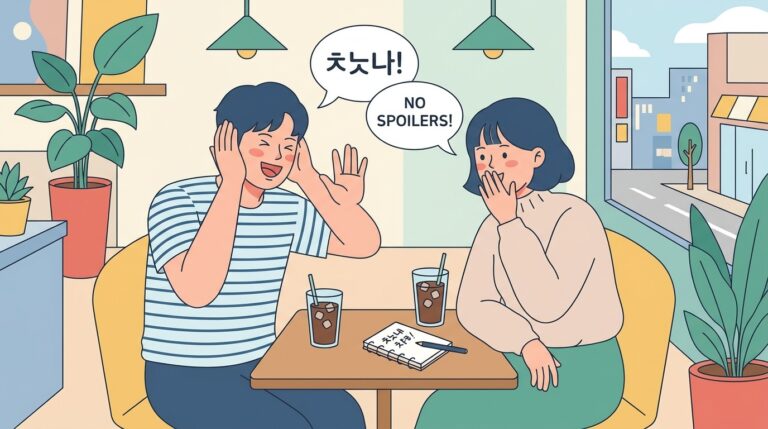
Phase 1: 공감 (Story Opening)
안녕하세요! 매일한글 에디터입니다.
Imagine this: It is Friday night in Seoul. You just rushed home from a long week, brewed a steaming cup of tea, grabbed your favorite snack, and curled up on your sofa to stream the grand finale of this month’s biggest hit K-drama. You have successfully dodged Twitter and Instagram all week long. Then, your phone pings. It’s your Korean friend, buzzing with pure adrenaline: “OMG, did you see the killer in episode 16?! I can’t believe the detective’s brother was—”
Panic sets in! You freeze. You try to remember that rigid sentence from your old textbook: “스포일러를 하지 마십시오” (Please do not commit spoilers). But by the time your brain tries to assemble that robotic phrase, your friend has already texted the whole plot twist. The climax is ruined.
Over my ten years coaching Korean learners and navigating K-drama fan communities in Seoul, I have heard this exact complaint countless times. Textbook Korean gives you stiff grammar that sounds like a subway announcement, not the playful, fast-reflex defense you need when spoilers are flying across KakaoTalk or your dinner table. Learning real-life spoiler defense phrases does more than just protect your drama watchlist—it gives you an effortless way to banter, set boundaries, and connect with native speakers in a fun, natural voice. Let’s dive into how natives actually shut down spoilers!
Phase 2: 핵심 표현 3선 심층 분석
1. 스포하지 마! (Spo-ha-ji ma!)
- Pronunciation: [Seu-po-ha-ji ma] (Sounds like: “Spo” from sports + “ha” + “jee” + “mah”)
- Meaning: Literal: “Don’t do spo!” | Actual Nuance: “Don’t spoil it!” / “No spoilers!”
- K-Culture Moment: Used constantly among close friends at a cafe or university lounge when someone threatens to reveal who gets together at the end of a romance series.
- Editor’s Insight: Koreans love abbreviation blends (축약어). Rather than pronouncing the full four-syllable word “스포일러” (seupoilleo), natives almost always shorten it to “스포” (seupo). Pairing it with “-하지 마” (don’t do) creates an immediate, snappy reaction.
- Situation Spectrum: Casual: ✅ | Semi-formal: ⚠️ | Formal: 🚫
- 🤔 Think About It: Notice how clipping English loanwords into quick two-syllable bites (like spo, selca, or eocon) builds immediate informal closeness. Does your native language shorten pop culture terms similarly?
2. 아직 말하지 마세요, 저 아직 안 봤어요. (Ajik malhaji maseyo, jeo ajik an bwasseoyo.)
- Pronunciation: [Ah-jeek mal-ha-jee mah-seh-yo, jeo ah-jeek an bwah-sseo-yo] (Rhythm hint: emphasize both “ah-jeek” sounds softly)
- Meaning: Literal: “Please do not speak yet, I have not seen it yet.” | Actual Nuance: “Please don’t tell me yet, I haven’t watched it!”
- K-Culture Moment: Used during Monday morning watercooler chats at Korean offices when colleagues start analyzing the weekend’s blockbuster series.
- Editor’s Insight: Doubling the word “아직” (still / yet) conveys genuine anticipation while creating a polite, respectful boundary. The “-세요” ending ensures you sound considerate rather than demanding.
- Situation Spectrum: Casual: ✅ | Semi-formal: ✅ | Formal: ⚠️
- 🤔 Think About It: In Korean communication, stating your personal circumstance (“I haven’t watched it yet”) softens a negative request (“don’t tell me”). How does this compare to how you make requests in your own culture?
3. 결말 알고 보면 재미없어! (Gyeolmal algo bomyeon jaemieopseo!)
- Pronunciation: [Gyeol-mal al-go bo-myeon jae-mee-eop-seo] (Sounds like: “Gyeol-mal” + “al-go” + “bo-myeon” + “jeh-me-up-suh”)
- Meaning: Literal: “If I watch knowing the ending, there is no fun!” | Actual Nuance: “It ruins all the fun if I know the ending!”
- K-Culture Moment: Yelled dramatically while playfully pushing a friend’s arm away when they hint at a major plot twist.
- Editor’s Insight: Rather than commanding the person to stop talking, this phrase appeals to the shared emotional goal of entertainment: “재미” (fun). It reminds the other person that they would be stealing your joy.
- Situation Spectrum: Casual: ✅ | Semi-formal: ⚠️ | Formal: 🚫
- 🤔 Think About It: Why do you think appealing to shared enjoyment is often more persuasive than a direct command?
Phase 3: 교과서 한국어 vs 진짜 한국어
Situation 1: Warning your friend who is itching to tell the villain’s identity
- 📖 교과서 한국어: 스포일러를 유출하지 마십시오. (Seupoilleoreul yuchulhaji masipsio. – Please do not leak spoilers.)
- 🗣️ 진짜 한국어: 야, 입 닫아! 스포 금지! (Ya, ip dada! Seupo geumji! – Hey, zip it! No spoilers allowed!)
- 💡 왜 다를까?: The textbook term “유출” (leak) belongs in news broadcasts about state secrets, not drama chats. In real life, friends use the punchy banner phrase “스포 금지” (Spo-geumji; Spoiler Prohibited) paired with playful teasing.
Situation 2: Stopping someone from dropping hints about the plot’s ending
- 📖 교과서 한국어: 결말을 미리 이야기하지 않는 것이 좋겠습니다. (Gyeolmareul miri iyagihaji anneun geosi jokessseumnida. – It would be preferable if you did not discuss the conclusion beforehand.)
- 🗣️ 진짜 한국어: 쉿! 결말 스포하면 절교야. (Swit! Gyeolmal spohamyeon jeolgyoya. – Shh! If you spoil the ending, our friendship is over!)
- 💡 왜 다를까?: Korean friends frequently use dramatic exaggeration like “절교야” (we are ending our friendship!) as friendly hyperbole. It adds humor while making your boundary crystal clear.
Phase 4: K-Culture 딥다이브 & 비언어적 매너
4-1. 눈치 (Nunchi) & Gestures
When a Korean speaker is about to spoil a scene, they will almost always preface it with: “근데 거기서…” (Geunde geogiseo… – But in that scene…) or “진짜 충격적인 게 뭐냐면…” (Jinjja chunggyeokjeogin ge mwonyamyeon… – You know what was truly shocking…?).
The instant you hear this cue, deploy your Nunchi and body language:
* The Crossed Arm ‘X’: Cross your forearms in front of your chest to form a firm ‘X’ while shaking your head.
* The Ear Block: Cup both hands tightly over your ears, squeeze your eyes shut, and hum playfully: “아아아 안 들린다!” (Aaa an deullinda! – La la la, can’t hear you!).
* The Finger to Lips: A single index finger pressed to your lips accompanied by an expressive “쉿!” (Swit! – Shh!).
4-2. Cultural Code: 본방사수 vs 정주행
In South Korea, drama viewing is an intense social experience. There are two major ways people watch: 본방사수 (Bonbangsasu)—watching the live terrestrial/cable broadcast on the exact minute it airs—and 정주행 (Jeongjuhaeng)—binge-watching an entire series from episode one once it finishes airing.
Because social media and group chats buzz with real-time reactions during Bonbangsasu, Koreans observe strict community etiquette. Online bulletin boards (like Theqoo or DC Inside) mandate tagging posts with [스포주의] (Spoiler Warning). If you mention a twist without that tag, you will face swift backlash from the community!
Phase 5: 실전 롤플레이 시나리오
Setting: A stylish, sunny cafe in Seongsu-dong. You are having an iced Americano with Minji (민지), your drama-obsessed Korean friend who stayed up until 3:00 AM watching the weekend drama finale.
- 민지 (Minji): 너 어제 그 드라마 마지막 회 봤어? 진짜 대박이었잖아! (Neo eoje geu deureama majimak hoe bwasseo? Jinjja daebagieotjana! – Did you watch the finale of that drama yesterday? It was totally insane!)
🎭 Leaning across the small wooden table with wide, eager eyes - 나 (Me): 아직 못 봤어! 이번 주말에 정주행하려고 아껴두는 중이야. (Ajik mot bwasseo! Ibeon jumare jeongjuhaengharyeogo akkyeoduneun jung-iya. – I haven’t watched it yet! I’m saving it to binge-watch this weekend.)
🎭 Holding both palms up defensively - 민지 (Minji): 대박… 근데 그 주인공 삼촌이 사실은… (Daebak… geunde geu ju-ingong samchoni sasireun… – Wow… but actually, that main character’s uncle is…)
🎭 Lowering voice to a whisper, leaning closer - 나 (Me): 잠깐, 스포하지 마! 제발 입 다물어줘! (Jamkkan, seupohaji ma! Jebal ip damureojwo! – Wait, don’t spoil it! Please zip your lips!)
🎭 Covering ears with both hands dramatically - 민지 (Minji): 알겠어, 알겠어! 근데 결말이 진짜 상상도 못 할 반전이라니까? (Algesseo, algesseo! Geunde gyeolmari jinjja sangsangdo mot hal banjeon-iranikka? – Okay, okay! But the ending has a plot twist you couldn’t even imagine!)
🎭 Shaking hands in excitement - 나 (Me): 쉿! 결말 알고 보면 재미없단 말이야. 절대 힌트도 주지 마! (Swit! Gyeolmal algo bomyeon jaemieopdan mariya. Jeoldae hinteudo juji ma! – Shh! Knowing the ending takes all the fun out of it. Don’t even give me hints!)
🎭 Smiling while pointing a mock-serious warning finger - 민지 (Minji): 알았어, 꾹 참을게. 다 보고 나면 꼭 바로 카톡해, 알았지? (Arasseo, kkuk chameulge. Da bogo namyeon kkok baro katokhae, aratji? – Fine, I’ll hold it in. Message me on KakaoTalk the second you finish, deal?)
🎭 Laughing and miming locking her lips - 나 (Me): 약속! 다 보고 나서 같이 밤새도록 수다 떨자. (Yaksok! Da bogo naseo gachi bamsaedorok suda tteolja. – Promised! Once I finish, let’s chat all night about it.)
🎭 Clinking iced coffee glasses together
🔀 인터랙티브 분기점 (Choose Your Move!)
Minji suddenly fidgets and blurts: “근데 범인 정체 하나만 힌트 줄까?” (Shall I give you just one hint about the killer’s identity?)
- Choice A: “스포 금지! 더 말하면 나 지금 집에 갈 거야!” (Seupo geumji! Deomalhamyeon na jigeum jibe gal geoya!)
- Choice B: “네, 조용히 해 주십시오.” (Ne, joyonghi hae jusipsio.)
- Choice C: “아아아 안 들린다! 귀 막았지롱!” (Aaa an deullinda! Gwi magatjirong!)
Feedback:
* Choice A (Best!): Perfect natural banter! The playful ultimatum shows you mean business while matching her excited energy.
* Choice B (Bad): Overly robotic and uncomfortably formal. Saying “조용히 해 주십시오” to a friend sounds cold and reprimanding, instantly killing the mood.
* Choice C (Risk): Very cute and humorous among best friends! However, if Minji is an older colleague or senior acquaintance, using children’s playful slang (-지롱) will sound immature.
Phase 6: 10초 감정 섀도잉 드릴
Practice these lines out loud. Pause at the slashes (/) and match the emotion tag in brackets!
[🛑 단호하고 다급하게 - Urgent & firm boundary]
잠깐만! / 스포하지 마! / 나 아직 안 봤단 말이야!
(Jamkkanman! / Seupohaji ma! / Na ajik an bwatdan mariya!)
“Wait! / Don’t spoil it! / I told you I haven’t watched it yet!”-
[🥺 애원하듯이 장난스럽게 - Playful pleading]
제발 결말은 / 말하지 말아주세요. / 기대 중이에요!
(Jebal gyeolmareun / malhaji marajuseyo. / Gidae jung-ieyo!)
“Please / don’t tell me the ending. / I’m looking forward to it so much!” -
[😂 웃으면서 강력하게 - Laughing, but dead serious]
쉿! / 스포하면 / 오늘 커피 네가 사는 거다?
(Swit! / Seupohamyeon / oneul keopi nega saneun geoda?)
“Shh! / If you spoil it / you’re buying coffee today, deal?”
Phase 7: K-Culture 미니 사전
- 스포 (Seupo) | Noun / Slang | Short for “스포일러” (Spoiler). Frequently combined into compound words like “스포러” (a person who spoils) or “스포 당하다” (to get spoiled).
- 본방사수 (Bonbangsasu) | Noun / Cultural Phrase | Lit. “Defend the original broadcast.” Refers to tuning in live at the exact time a drama or variety show airs to avoid social media spoilers.
- 떡밥 (Tteokbap) | Noun / Metaphor | Lit. “Fish bait.” Refers to narrative foreshadowing, hidden easter eggs, or plot clues dropped by drama writers that fans analyze online.
- 정주행 (Jeongjuhaeng) | Noun / Verb | Lit. “Driving in the correct direction.” In modern media slang, it means binge-watching a series sequentially from season 1, episode 1 to the end.
Phase 8: 여행자를 위한 생존 키트
Survival Expressions TOP 3
- 스포주의 부탁드려요! (Seupojuui butakdeuryeoyo!)
- Meaning: “Please be careful with spoilers!”
- Pro Tip: Use this when joining a meetup group, language exchange, or K-pop/drama fan gathering.
- 어디까지 보셨어요? (Eodikkaji bosyeosseoyo?)
- Meaning: “How far along have you watched?”
- Pro Tip: The golden question natives ask before starting any drama discussion to calibrate safe conversation topics.
- 비밀로 해주세요! (Bimillo haejuseyo!)
- Meaning: “Please keep it a secret!”
- Pro Tip: A warm, polite alternative when you want someone to stay tight-lipped about a plot point without sounding bossy.
Editor’s Travel Note
When traveling in South Korea, drama discussions are ubiquitous in subways and cafes. If you want to follow along with local broadcasting schedules, check the official television schedules directly on the Naver mobile portal site guide. To visit famous filming spots without accidental story spoilers, plan your routes ahead using the Naver Map navigation app guide instead of searching drama fan forums where unflagged spoilers often appear.
Phase 9: “한 발 더 깊이” (Cultural Essay)
In Korean society, media consumption is fundamentally communal. Because of Jeong (정)—the deep psychological bond of shared emotion—Koreans naturally crave collective experience. When an episode leaves everyone in shock, the immediate cultural instinct is not solitary reflection, but mutual validation: “Did you feel what I felt?!”
Paradoxically, this passionate drive to connect is the exact reason spoilers happen so frequently in Korea. It rarely stems from malice; rather, it is an uncontrollable overflow of enthusiasm. When you warn a Korean friend not to spoil a show, framing your defense playfully honors this shared passion while protecting your own emotional journey.
💬 Your Turn: Have you ever had a K-drama or movie ruined by an overexcited friend? How did you respond, and how would you handle it now in Korean? Share your story in the comments below!
Phase 10: FAQ & 오해 방지
Q: Can I say “스포하지 마세요” to my boss or an older colleague at work?
A: While grammatically polite due to “-세요”, “스포하지 마세요” can still feel slightly direct to superiors. In professional or formal company, it is much safer and softer to say: “팀장님, 저 아직 못 봤는데 결말은 비밀로 해주세요!” (Team leader, I haven’t watched it yet, so please keep the ending a secret!).
Q: What is the exact difference between “스포” and “스포일러”?
A: Meaning-wise, they are identical. However, “스포일러” (four syllables) feels slightly academic or formal, commonly used in print news or movie reviews. “스포” (two syllables) is what 99% of native speakers use in casual text messages, everyday speech, and online forums.
Q: Is telling someone “입 닫아” (Zip your mouth) considered offensive?
A: Yes, if used with acquaintances, elders, or colleagues! “입 닫아” literally means “close your mouth” and carries a sharp bite. Only use it with close friends with whom you regularly exchange playful banter, accompanied by a laugh or smile.
🚨 Common Mistakes Warning Board
- Mistake: Saying “스포일러를 만들지 마세요” (Do not make spoilers).
- Correct Action: In Korean, spoilers are not “made” (만들다); they are “done” (하다). Always say: 스포하지 마세요 (Don’t do spoilers).
- Mistake: Shouting “말을 멈추세요!” (Halt your speech!).
- Correct Action: This sounds like a police officer commanding a suspect. Say: 아직 말하지 마세요! (Please don’t speak yet!).
- Mistake: Translating “I haven’t seen it yet” as “아직 보지 않았습니다” in casual chat.
- Correct Action: Use natural everyday past tense: 아직 안 봤어요 (I haven’t watched it yet).
Phase 11: 액션 미션 & 참여 유도
- 🥉 Bronze Mission (Solo Shadowing): Stand in front of your mirror, cross your forearms into an ‘X’, and say out loud three times: “스포 금지! 아직 말하지 마!”
- 🥈 Silver Mission (SNS Practice): Head to your favorite K-drama community or Instagram post. Comment on a drama still with: “저 아직 안 봤어요, 스포주의 부탁드려요! 🤫”
- 🥇 Gold Mission (Real-Life Defense): The next time a friend or language partner starts chatting about a show you are currently watching, interrupt them using our Phrase 2: “아직 말하지 마세요, 저 아직 안 봤어요!”
🎮 K-Culture Mission: Watch an episode of a Korean variety show (like Running Man or Knowing Bros). Notice how captions insert “[스포주의]” on screen whenever cast members discuss upcoming movies. Snap a screenshot when you spot it!
Phase 12: 인터랙티브 퀴즈 챌린지
Test your real-world instincts with these three quick questions!
1. Situation Judgment: You are having lunch with a senior colleague (선배) who is about to reveal the ending of a trending thriller. Which reaction is the most natural and polite?
* A) 야! 입 닫아! 스포하지 마!
* B) 선배님, 저 아직 안 봤는데 결말은 비밀로 해주세요!
* C) 스포일러 방출을 중단하십시오.
2. Fill-in-the-blank: Complete the common Korean internet warning used to caution readers before plot details:
* [ ________ 주의 ]
3. True / False Cultural Check:
* True or False: In Korean, the slang term “스포” can only be used for movies and TV dramas, never for books or webtoons.
👉 Click here to check the answers and explanations!
Answers & Explanations:
1. Answer: B.
* Explanation: Choice A is rude to a senior colleague. Choice C is robotic textbook language. Choice B strikes the exact balance of politeness, warmth, and clear boundary-setting.
2. Answer: 스포 (or 스포일러)
* Explanation: Posts containing major plot reveals are universally titled [스포주의] across Korean internet communities.
3. Answer: False.
* Explanation: “스포” is universally used across all media formats, including webtoons (웹툰), novels, sports match replays, and video games!







