

Korean Funeral Etiquette: How to Light Incense with Confidence
Phase 1: Empathy & Real-Life Context
안녕하세요! 매일한글 에디터입니다. (Hello! I’m your Daily Hangul editor.)
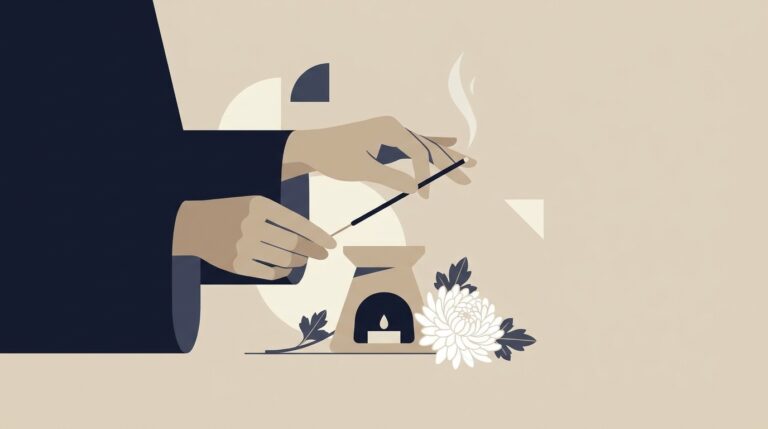
Imagine this scene: You receive a sudden message that a Korean colleague or friend’s family member has passed away. You put on a neat black outfit and arrive at the funeral hall (장례식장 – Jangnyesikjang). As you enter the solemn altar room filled with white chrysanthemums and the scent of burning wood, your heart starts pounding. Everyone steps forward to pay respects, and someone gently gestures for you to light an incense stick (향 피우기 – Hyang piugi).
Suddenly, your mind goes blank. Which hand do I use? Do I blow out the flame? What should I say to the grieving family?
If you have watched K-dramas like My Mister or Goblin, you have probably seen these emotional memorial scenes. Yet, standing in front of a real altar feels completely different. You want to show heartfelt respect, but fear making an accidental cultural mistake. Based on real questions from dozens of foreign residents and students, this guide breaks down the step-by-step etiquette and simple phrases for lighting incense, so you can offer sincere comfort without second-guessing yourself.
Phase 2: Top 3 Core Expressions
1. 삼가 고인의 명복을 빕니다
- Pronunciation: Samga goin-ui myeongbogeul bimnida (Pronounce like: Sahm-gah go-een-wee myung-bok-eul beem-nee-dah)
- Meaning: Literal: “Respectfully, I pray for the blessings of the deceased in the next world.” / Nuance: “May they rest in peace / My deepest condolences.”
- K-Culture Moment: This is the universal, most respectful condolence phrase heard in news broadcasts, formal text messages, and drama funeral halls whenever anyone pays tribute.
- Editor’s Insight: Even if your Korean is at the A1 beginner stage, memorizing this exact phrase shows the highest degree of respect. It carries a heavy, dignified tone.
- Situation Spectrum: Casual: 🚫 | Semi-formal: ⚠️ | Formal: ✅
- 🤔 Think About It: In English, we often say “I am so sorry for your loss,” focusing on our shared sorrow with the survivor. Why do you think the Korean phrase focuses directly on wishing peace for the departed soul?
2. 향 피워도 될까요?
- Pronunciation: Hyang piwodo doelkkayo? (Sounds like: Hyahng pee-woh-doh dwel-kkah-yoh?)
- Meaning: Literal: “Is it okay to light incense?” / Nuance: “May I light an incense stick?”
- K-Culture Moment: When visitors arrive at an altar where both flowers (헌화) and incense (분향) are available, or when you are unsure if the family prefers incense or flowers due to their religious beliefs (e.g., Christian families often use flowers instead of incense).
- Editor’s Insight: Use this polite question if you are standing before the altar and need a quick signal from the family or assistant before proceeding.
- Situation Spectrum: Casual: 🚫 | Semi-formal: ✅ | Formal: ✅
- 🤔 Think About It: Asking before acting in solemn rituals shows great humility (Nunchi). How do rituals in your home culture adapt to different religious backgrounds?
3. 편히 쉬세요
- Pronunciation: Pyeonhi swiseyo (Sounds like: Pyuhn-hee swee-seh-yoh)
- Meaning: Literal: “Please rest comfortably.” / Nuance: “Rest in peace.”
- K-Culture Moment: Said in a very soft whisper or thought internally in your mind right after placing the incense stick into the incense burner and bowing your head.
- Editor’s Insight: This is a warm, gentle phrase. While 삼가 고인의 명복을 빕니다 is spoken out loud to the chief mourner (상주), 편히 쉬세요 is a quiet farewell directed to the deceased portrait.
- Situation Spectrum: Casual: ⚠️ | Semi-formal: ✅ | Formal: ✅
- 🤔 Think About It: Korean culture places deep value on relieving the earthly burdens of the departed. What final parting words are common in your language?
Phase 3: Textbook Korean vs. Real Korean
Situation 1: Offering Condolences to the Chief Mourner
- 📖 Textbook Korean: 당신의 슬픔에 대해 진심으로 위로합니다. (Dangsin-ui seulpeume daehae jinsimeuro wirohamnida. – “I sincerely comfort your sadness.”)
- 🗣️ Real Korean: 얼마나 상심이 크세요. 삼가 고인의 명복을 빕니다. (Eolmana sangsimi keuseyo. Samga goin-ui myeongbogeul bimnida. – “You must be heartbroken. May they rest in peace.”)
- 💡 Why is it different?: Textbook phrases using “당신” (you) sound unnaturally translated and robotic. Real native speakers acknowledge the mourner’s pain (얼마나 상심이 크세요) or simply bow silently with formal condolences.
Situation 2: Asking What Step to Take Next
- 📖 Textbook Korean: 제가 지금 무엇을 해야 합니까? (Jega jigeum mueoseul haeya hamnikka? – “What must I do right now?”)
- 🗣️ Real Korean: 어떻게 하면 돼요? (Eotteoke hamyeon dwaeyo? – “What should I do? / How should I do this?”)
- 💡 Why is it different?: In emotional moments, short, polite conversational phrases sound far more natural and humble than rigid textbook grammar.
Phase 4: K-Culture Deep Dive & Non-Verbal Manners
4-1. Nunchi & Gestures: The Incense Ritual Step-by-Step
When it is your turn to approach the altar portrait (영정):
1. Approach Calmly: Walk slowly to the table and stand straight.
2. Pick up the Incense: Take 1 (or 3) incense stick with your right hand. Support your right wrist or forearm lightly with your left hand. This two-handed posture expresses absolute deference.
3. Light the Tip: Light the tip of the stick using the candle on the table.
4. Extinguish the Flame without Blowing: 🚨 CRITICAL RULE: Never blow on the flame with your mouth! In Korean ritual tradition, human breath is considered impure for altar offerings. Instead, gently wave the stick with your hand or make a soft downward flicking motion with your wrist to put out the fire so it only smokes.
5. Place in the Burner: Insert the stick upright into the incense burner (향로 – Hyangno).
6. Pay Respects: Step back one pace. If not of a specific faith that forbids bowing, make two deep bows (큰절 – Keunjeol) down to the floor, followed by one half-bow standing. If Christian, you may stand with hands clasped and bow your head in silent prayer for 5 seconds.
4-2. Cultural Code: Incense (향) vs. White Chrysanthemums (국화)
In modern Korean funeral halls, you will see a tray of white chrysanthemums alongside the incense burner. White chrysanthemums symbolize purity and grief, popularized through Western influence, while incense comes from Buddhist and Confucian traditions to cleanse the air and invite good spirits. If the family is Christian, you will usually see people placing a chrysanthemum flower (with the stem pointing toward the mourners and the blossom toward the portrait) instead of burning incense.
Phase 5: Interactive Roleplay Scenario
Setting: You arrive at a peaceful funeral hall in Seoul to comfort your Korean coworker Minjun (민준), who is the chief mourner (상주).
- Turn 1 (Minjun): 와 주셔서 감사합니다. (Wa jusyeoseo kamsahamnida.)
🎭 Minjun bows his head slightly with red eyes.
(Thank you for coming.) - Turn 2 (You): 삼가 고인의 명복을 빕니다. (Samga goin-ui myeongbogeul bimnida.)
🎭 You bow respectfully with hands together in front.
(My deepest condolences.) - Turn 3 (Minjun): 감사합니다. 앞에 향 하나 피워주세요. (Kamsahamnida. Ape hyang hana piwojuseyo.)
🎭 Minjun gestures softly toward the altar table.
(Thank you. Please light an incense stick in front.) - Turn 4 (You): 네, 알겠습니다. (Ne, algetseumnida.)
🎭 You step carefully toward the candle and incense stand.
(Yes, understood.) - Turn 5 (You):
🎭 You pick up one stick with your right hand, light it with the candle, and the flame catches fire.
(What do you do next?) - Turn 6 (You):
🎭 You gently wave your hand to put out the flame, leaving only the soft smoke.
(Quietly placing the stick in the burner) - Turn 7 (You): 편히 쉬세요. (Pyeonhi swiseyo.)
🎭 You whisper quietly in your mind and step back to do two bows.
(Rest peacefully.) - Turn 8 (Minjun): 정말 고마워요. 식사 꼭 하고 가세요. (Jeongmal gomawoyo. Siksa kkok hago gaseyo.)
🎭 Minjun bows to you in gratitude and points to the dining area.
(Thank you so much. Please make sure to have a meal before you leave.)
🔀 Interactive Choice Point
When the incense catches fire on the candle in Turn 5, what is your next action?
* Choice A: Blow hard with your mouth like a birthday candle to extinguish it quickly.
Feedback: [Bad 🚫] Blowing human breath directly on altar incense is considered a major taboo in Korean funeral customs.
* Choice B: Wave the stick gently through the air or use your free hand to fan out the flame.
Feedback: [Best ✅] Perfect! Fanning or waving the stick lets the flame die naturally without your breath touching it.
* Choice C: Drop the stick immediately into the water bowl nearby.
Feedback: [Risk ⚠️] The water bowl is only for finished remnants; you need the stick to smoke inside the incense burner.
Phase 6: 10-Second Emotion Shadowing Drill
Practice reading these sentences aloud. Notice the rhythm slashes (/) indicating short pauses.
[🕊️ 경건하고 차분하게 - Reverent & Calm]
삼가 / 고인의 / 명복을 빕니다.
(Samga / goin-ui / myeongbogeul bimnida.)-
[🖤 조용하고 정중하게 - Soft & Courteous]
향 / 피워도 / 될까요?
(Hyang / piwodo / doelkkayo?) -
[🥺 따뜻한 위로를 담아 - Warm & Sympathetic]
얼마나 / 상심이 / 크세요.
(Eolmana / sangsimi / keuseyo.)
Phase 7: K-Culture Mini Dictionary
- 향 (Hyang) | Incense stick | In Korean funerals and ancestral rites (Jesa), lighting incense is believed to guide the spirit and purify the ceremonial room.
- 상주 (Sangju) | Chief Mourner | The eldest son or primary family member organizing the funeral, typically wearing a black suit with a black armband (완장).
- 조의금 / 부의금 (Jouigeum / Bu-uigeum) | Condolence Money | Cash gift placed in a white condolence envelope before entering the altar, symbolizing community financial support.
- 절 (Jeol) | Traditional Deep Bow | At funerals, non-Christian mourners perform two full floor bows to the deceased and one standing bow to the family.
Phase 8: Survival Kit for Travelers
Top 3 Survival Phrases
- 향은 어디에 둬요? (Hyangeun eodie dwoyo?)
Meaning: Where do I place the incense?
Pro Tip: If you are unsure which pot to use, point to the burner and ask this politely. - 절은 두 번 하나요? (Jeoreun du beon hanayo?)
Meaning: Do I bow twice?
Pro Tip: Remember: 2 bows for the deceased (고인), 1 bow for the living family (상주). - 식당은 어디예요? (Sikdangeun eodiyeyo?)
Meaning: Where is the dining hall?
Pro Tip: Korean funeral halls always serve food (like spicy beef soup Yukgaejang). Eating there is an essential part of paying respects!
Editor’s Travel Note
- Finding Locations: When an acquaintance sends a funeral address link via KakaoTalk, use the download KakaoMap navigation app to check the exact hospital funeral annex (장례식장).
- Dress Code: Dark black, charcoal, or dark navy attire is required. Avoid bare ankles; always wear black or dark socks.
- Condolence Envelopes: Most hospital funeral lobbies feature automated cash ATMs and envelope dispensers. Learn more through our check Korea ATM cash withdrawal guide before heading to the hall.
Phase 9: “One Step Deeper” (Cultural Reflection)
In traditional Korea, grief is never carried alone. Funerals operate under the ancestral spirit of Pumasi (품앗이)—an age-old system of communal mutual aid. Friends, coworkers, and distant relatives gather not only to mourn quietly, but to eat, drink, and stay awake late into the night so the bereaved family is never left alone in silence.
By lighting an incense stick and sharing a simple bowl of Yukgaejang soup, you are participating in one of Korea’s most profound expressions of community solidarity.
💬 Your Turn: Does your culture have a tradition of bringing food, money, or lighting candles for grieving families? Share your thoughts in the comments below!
Phase 10: FAQ & Common Mistakes
Q: What should I do if my religion does not allow me to bow to an altar portrait?
A: It is completely accepted to omit the floor bow. Instead, place a white flower on the table or light an incense stick, step back, and stand with your head bowed in silent prayer for 5 to 10 seconds. Then turn to the chief mourner and give a respectful slight waist bow.
Q: How many sticks of incense should I light?
A: Usually, lighting one stick is standard for individual guests. If several sticks are already burning, lighting just one is more than enough.
Q: Do I need to wear a full black suit if I am a tourist or student without formal clothes?
A: If you do not own a black suit, neat dark-colored clothing (navy, dark gray, or plain dark brown) with no loud patterns or bright logos is considered acceptable. Avoid sandals, shorts, or bright jewelry.
🚨 Common Mistakes Board
- ❌ Mistake 1: Blowing out the incense flame with your mouth.
➡️ Correct Action: Fan it out with your hand or wave the stick gently. - ❌ Mistake 2: Doing only 1 floor bow to the deceased portrait.
➡️ Correct Action: Bow 2 full times to the deceased portrait, then 1 bow to the living chief mourner (1 bow is for living greetings on holidays like Seollal; 2 bows are reserved for funerals/ancestors). - ❌ Mistake 3: Clinking drink glasses (건배 – Geonbae) in the funeral dining room.
➡️ Correct Action: While you can drink with colleagues in the reception room, never clink glasses or shout “Cheers!”
Phase 11: Action Missions
- 🥉 Bronze Mission: Practice holding a pen with your right hand supported by your left wrist and fanning it gently as if extinguishing an incense flame.
- 🥈 Silver Mission: Record yourself saying 삼가 고인의 명복을 빕니다 (Samga goin-ui myeongbogeul bimnida) in one calm, steady breath.
- 🥇 Gold Mission: Write a mock condolence message in Korean to practice spelling the formal expressions correctly.
- 🎮 K-Culture Mission: Watch a funeral scene in a K-drama (like My Mister Ep 16 or Hospital Playlist) and observe how characters hold the incense and bow.
Phase 12: Interactive Quiz Challenge
1. Situation Decision: You light an incense stick, and a bright flame appears at the tip. How do you put it out?
* (A) Blow on it quickly with your breath.
* (B) Wave it gently with your hand.
* (C) Pinch the burning ember with your fingers.
2. Fill-in-the-Blank: Complete the most famous Korean condolence phrase:
삼가 고인의 ________ 빕니다. (Samga goin-ui ________ bimnida.)
3. True or False: You should bow twice (2번) to the chief mourner (상주) and once (1번) to the altar portrait.
👉 Click to reveal answers & explanations!
- Answer: (B) – Never blow breath onto ceremonial incense; wave it gently to put out the flame.
- Answer: 명복을 (myeongbogeul) – Full phrase: 삼가 고인의 명복을 빕니다 (May the deceased rest in peace).
- Answer: False – It is the exact opposite! You perform 2 bows to the deceased altar portrait (고인), and 1 bow to the living family mourner (상주).







