

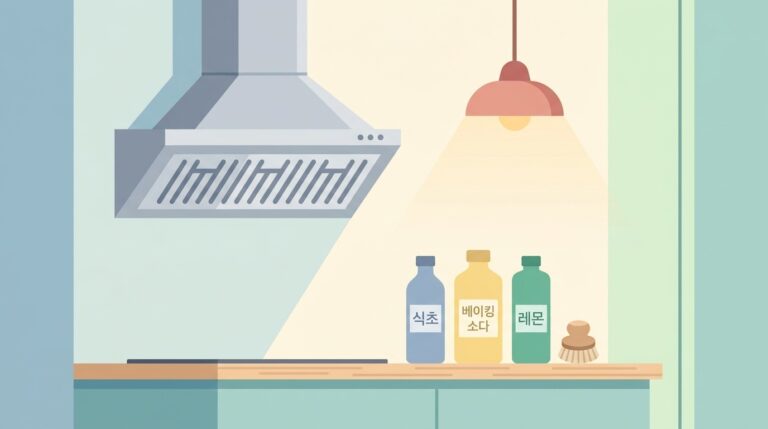
Phase 1: Empathy (Story Immersion Opening)
안녕하세요! 매일한글 에디터입니다.
Imagine this: you have finally settled into your dream officetel in the vibrant alleyways of Mapo-gu. You spent the weekend searing thick cuts of samgyeopsal (pork belly) and sizzling up savory pajeon to celebrate with your friends. But on Sunday evening, as you glance up while wiping the counter, horror strikes: your stainless steel range hood filter is encrusted in a thick, amber layer of oxidized grease. You spray standard kitchen cleaner, scrub with all your might, and… nothing. The sponge merely glides over the stubborn, tacky film.
In Korean domestic culture, this nightmare is universally known as 찌든 때 (jjideun ttae)—grime so deeply embedded that conventional scrubbing feels futile. For advanced learners navigating life, tenancy contracts, or deep cultural immersion in Korea, mastering the lexicon of domestic upkeep isn’t just about chores; it is about mastering the art of Korean 살림 (sal-lim)—the profound craft of running a clean, harmonious household. Based on real-world feedback from long-term expatriates and C2 learners who have faced the dreaded Korean apartment move-out inspection (원상복구 의무), this comprehensive guide unlocks the exact high-register vocabulary, vivid idioms, and cultural chemistry hacks that will make your kitchen gleam and your Korean sound indistinguishable from a seasoned native.
Phase 2: Deep Dive into 3 Core Expressions
1. 찌든 때를 말끔히 벗겨내다 (Jjideun ttaereul malkkeumhi beotgyeonaeda)
- Pronunciation: [Jji-deun ttae-reul mal-kkeum-hi beot-gyeo-nae-da] (Think: ‘Jji’ like the sharp click in ‘jeep’, ‘ttae’ rhyming with ‘bed’, ‘malkkeumhi’ sounding crisp like snapping fresh celery).
- Meaning: Literal: “To cleanly peel off deeply caked-on grime.” / Actual Nuance: To completely eradicate chronic, stubborn dirt or grease that has built up over a long time, restoring the surface to its original pristine state.
- K-Culture Moment: Seen on home organization variety shows like Salimnam or lifestyle vlogs when a host tackles an inherited kitchen filter, holding it up to the light to reveal sparkling, grease-free aluminum mesh.
- Editor’s Insight: The verb 벗겨내다 (to peel/strip away) denotes that the grease acts like a second skin adhering to the metal, while the adverb 말끔히 emphasizes an immaculate, frictionless finish. At the C2 level, pairing 찌든 때 with 말끔히 벗겨내다 demonstrates sophisticated colocation competence.
- Situation Spectrum: Casual: ✅ | Semi-formal: ✅ | Formal: ✅
- 🤔 Think About It: Notice how Korean uses physical action verbs like ‘peeling’ (벗겨내다) rather than abstract verbs like ‘cleansing’ (세척하다) in expressive speech. How does your native language conceptualize chronic grime?
2. 만능 세제 비율로 배합하다 (Manneung seje biyullo baehaphada)
- Pronunciation: [Man-neung se-je bi-yul-ro bae-hap-ha-da] (Pronounce ‘man-neung’ with a smooth nasal resonance, ‘se-je’ like ‘say-jay’, and ‘bae-hap’ with a brisk, crisp release).
- Meaning: Literal: “To blend according to the all-purpose miracle detergent ratio.” / Actual Nuance: To formulate a DIY, highly effective household cleaning solution—typically combining baking soda, dishwashing liquid, vinegar, or sodium percarbonate—celebrated in Korean home-hacks.
- K-Culture Moment: Frequently trended across Korean “Mom-cafes” (맘카페) and YouTube cleaning gurus referencing the legendary “Baek Jong-won style” universal cleaning recipes.
- Editor’s Insight: 배합하다 is a refined, technical verb used when mixing precise chemical or culinary components. Employing 배합하다 instead of the generic 섞다 (to mix) elevates your utterance to an authoritative, near-expert register.
- Situation Spectrum: Casual: ⚠️ | Semi-formal: ✅ | Formal: ✅
- 🤔 Think About It: Why has the concept of ‘만능’ (all-capable/universal) become such a quintessential marketing and domestic trope in fast-paced modern Korea?
3. 묵은 기름때가 감쪽같이 지워지다 (Mugeun gireumttaega gamjjokgachi jiwojida)
- Pronunciation: [Mu-geun gi-reum-ttae-ga gam-jjok-ga-chi ji-wo-ji-da] (Enunciate ‘mu-geun’ heavily like an aged oak, and snap the ‘gam-jjok’ with quick, seamless transition).
- Meaning: Literal: “Old oil grime disappears without a trace.” / Actual Nuance: Age-old, polymerized grease lifts away so seamlessly that it looks as if it was never there in the first place.
- K-Culture Moment: The iconic reaction shot in Korean morning infotainment programs (생생정보통) where the host rubs a finger across a cleaned stove hood and hears a sharp, squeaky ppodeuk sound.
- Editor’s Insight: 묵은 is derived from 묵다 (to age/ferment over time, as in 묵은지). When applied to grease, it evokes a stubborn layer cured by months of cooking heat. The idiomatic adverb 감쪽같이 (flawlessly, without leaving a trace) perfectly captures the almost magical transformation.
- Situation Spectrum: Casual: ✅ | Semi-formal: ✅ | Formal: ✅
- 🤔 Think About It: How does the linguistic crossover between culinary aging (묵은지) and domestic dirt (묵은 때) reflect the Korean worldview of time and residue?
Phase 3: Textbook Korean vs Real Native Korean
Situation 1: Describing a Heavily Soiled Range Hood Filter
- 📖 교과서 한국어 (Textbook): 주방 환풍기 필터가 매우 더럽고 기름이 많습니다. (Jubang hwanpung-gi pilteoga maeu deoreopgo gireumi manseumnida.) — The kitchen ventilation filter is very dirty and has a lot of oil.
- 🗣️ 진짜 한국어 (Native C2): 후드 필터에 묵은 기름때가 누렇게 쩔어 있네요. (Hudeu pilteoe mugeun gireumttaega nureoke jjeoreo inne-yo.) — The hood filter is completely caked in yellowed, stubborn grease.
- 💡 왜 다를까? Natives rarely use the sterile term 환풍기 for a stovetop hood—preferring 후드—and deploy the vivid sensory verb 쩔어 있다 (to be thoroughly steeped/caked in grime) alongside the color descriptor 누렇게 (yellowish) to convey physical texture.
Situation 2: Praising the Efficacy of a DIY Solution
- 📖 교과서 한국어 (Textbook): 이 세정제는 기름때를 제거하는 효과가 우수합니다. (I sejeongjeneun gireumttaereul jegeohaneun hyogwaga usuhapnida.) — This detergent has superior efficacy in removing oil grime.
- 🗣️ 진짜 한국어 (Native C2): 이 배합 세제 한 방이면 찌든 기름때가 흔적도 없이 싹 녹아내려요. (I baehap seje han bang-imyeon jjideun gireumttaega heunjeokdo eopsi ssak noganaeryeoyo.) — Just one shot of this custom formula melts away stubborn grease without a single trace.
- 💡 왜 다를까? Native discourse replaces dry clinical descriptors with dynamic adverbs like 싹 (cleanly/completely) and colloquial power phrases like 한 방이면 (with just one definitive move).
Phase 4: K-Culture Deep Dive & Non-verbal Manners
4-1. 눈치 (Nunchi) & Sensory Etiquette in Domestic Cleaning
In Korean apartment culture (아파트/오피스텔), residential ventilation ducts are interconnected. When attacking intense range hood grease with hot water and alkaline solutions like sodium percarbonate (과탄산소다), you must exhibit 눈치 (Nunchi): ensure your windows are cracked open and your kitchen hood is turned off during the initial chemical foaming so toxic vapors do not back-draft into neighboring units.
When evaluating cleanliness, Koreans perform the universal tactile check: pressing a bare thumb against the dry metal mesh and sliding it. If it slides silently, oil remains. If it produces a distinct, high-pitched 뽀득뽀득 (ppodeuk-ppodeuk) squeak, it has met the gold standard of Korean cleanliness.
4-2. Cultural Code: The ‘Salim’ (살림) Phenomenon
In Korea, domestic maintenance is elevated to an art form known as 살림. It is not viewed simply as dull housekeeping, but as a discipline of life-cultivation. The explosion of 살림 꿀팁 (domestic life hacks) across Korean media stems from the cultural value placed on resourcefulness, chemical minimalism, and immaculateness before handing over a rented space. Knowing how to concoct 만능 세제 is a badge of domestic adulthood that earns immediate respect from landlords and peers alike.
Phase 5: Real-World Roleplay Scenario
Setting: You are inspecting your rented officetel kitchen with your meticulous Korean landlord, Mr. Park, who is notorious for deducting cleaning deposits over hood grease.
- Turn 1 (Mr. Park): 학생, 후드 필터 보니까 기름때가 누렇게 쩔어 있던데, 이건 일반 퐁퐁으로는 안 지워져요. (Haksaeng, hudeu pilteo bonikka gireumttaega nureoke jjeoreo itdeonde, igeon ilban pongpong-eoroneun an jiwojyeoyo.)
- 🎭 Frowning slightly while pointing a gloved finger at the amber-colored metal mesh.
- “Look here, the hood filter is completely caked in yellow grease. Regular dish soap won’t touch this.”
- Turn 2 (You): 아, 사장님 걱정 마세요. 제가 과탄산소다랑 주방세제를 황금 비율로 배합해서 말끔히 세척해 둘게요. (A, sajangnim geokjeong maseyo. Jega gwatansansodarang jubangseang-jereul hwanggeum biyullo baehaphaeseo malkkeumhi secheokhae dulgeyo.)
- 🎭 Nodding reassuringly with a confident, polite posture.
- “Ah, don’t worry, Mr. Park. I will mix sodium percarbonate and dish soap in the golden ratio and strip it completely clean.”
- Turn 3 (Mr. Park): 오, 과탄산소다 쓸 줄 알아요? 뜨거운 물 부으면 부글부글 끓어오르니까 환기 철저히 해야 해. (O, gwatansansoda sseul jul arayo? Tteugeoun mul bueumyeon bugeulbugeul kkeulheo-oreunikka hwan-gi cheoljeohi haeya hae.)
- 🎭 Raising an eyebrow in pleasant surprise.
- “Oh, you know how to use sodium percarbonate? It will foam vigorously when hot water hits it, so ventilate thoroughly.”
- Turn 4 (You): 네, 창문 열고 후드 틀어서 환기 확실히 시킨 상태에서 불려둘 생각입니다. (Ne, changmun yeolgo hudeu teureoseo hwan-gi hwaksilhi sikin sangtaeseo bullyeodul saeng-gak-imnida.)
- 🎭 Making an open-window gesture with your hand.
- “Yes, I plan to open the windows and ensure proper ventilation while letting it soak.”
- Turn 5 (Mr. Park): 기름때가 워낙 두꺼워서 적어도 15분은 푹 담가둬야 때가 싹 불어 터져 나올 텐데. (Gireumttaega wonak dukkeowoseo jeogeodo sibobin-eun puk damgadwoya ttaega ssak bureo teojyeo naol tende.)
- 🎭 Rubbing his chin thoughtfully.
- “The grease is so thick you’ll need to submerge it for at least 15 minutes for the grime to soften and burst loose completely.”
- Turn 6 (You): 네, 비닐봉투에 온수랑 세제를 채워서 밀봉해 두면 묵은 때가 감쪽같이 불어나더라고요. (Ne, binilbongtue onsurang seangjereul chaewoseo milbonghae dumyeon mugeun ttaega gamjjokgachi bureonadeoragoyo.)
- 🎭 Demonstrating the plastic bag wrapping motion.
- “Yes, sealing it inside a heavy plastic bag filled with hot water and cleaner makes the old grime swell up effortlessly.”
- Turn 7 (Mr. Park): 허허, 한국 사람 다 됐네! 그렇게 해서 뽀득뽀득 소리 나게 헹궈놓으면 보증금 차감은 전혀 없어요. (Heoheo, hanguk saram da dwaenne! Geureoke haeseo ppodeuk-ppodeuk sori nage heng-gwonoh-eumyeon bojeunggeum chagam-eun jeonhyeo eopseoyo.)
- 🎭 Chuckling warmly, patting your shoulder.
- “Haha, you’re practically Korean now! Rinse it until it squeaks cleanly and there will be zero deduction from your deposit.”
- Turn 8 (You): 믿고 맡겨주세요. 퇴실 전까지 새것처럼 원상복구 해놓겠습니다! (Mitgo matgyeojuseyo. Toesil jeonkkaji saegeotcheoreom wonsangbokgu haenokgetseumnida!)
- 🎭 Bowing slightly with an energetic smile.
- “Trust me on this. I’ll restore it like brand new before checking out!”
🔀 Interactive Branching Choice
When Mr. Park warns you about the harsh reaction of hot water and sodium percarbonate, how do you reply?
- Choice A: “그냥 락스 들이부어서 철수세미로 박박 문지를게요.” (I’ll just pour bleach and scrub vigorously with steel wool.)
- Choice B: “과탄산소다 용액에 충분히 불린 뒤 솔로 부드럽게 결 따라 닦아내겠습니다.” (I will soak it sufficiently in sodium percarbonate solution, then gently brush it along the mesh grain.)
- Choice C: “환풍기 필터는 소모품이니까 그냥 버리고 새로 하나 사드릴게요.” (The filter is a consumable, so I’ll just toss it and buy you a new one.)
Feedback Analysis:
* Choice A [Bad]: 🚫 Bleach (락스) generates harmful gases when mixed incorrectly, and steel wool (철수세미) permanently scratches and disfigures aluminum mesh filters, guaranteeing a deposit deduction.
* Choice B [Best]: 🌟 Demonstrates profound knowledge of delicate aluminum cleaning chemistry and shows deep respect for property upkeep.
* Choice C [Risk]: ⚠️ Replacing older Korean apartment range hoods can be tricky due to custom legacy sizing, and discarding it without landlord consent creates unnecessary friction.
Phase 6: 10-Second Emotion Shadowing Drill
Sentence 1:
[😤 Frustrated & Overwhelmed]
기름때가 / 하도 쩔어 있어서 / 일반 세제로는 / 끄떡도 안 하네요.
(Gireumttaega / hado jjeoreo isseoseo / ilban sejeroneun / kkeutteokdo an haneyo.)
“The grease / is so heavily caked on / that with regular soap / it doesn’t even budge.”
Sentence 2:
[🤩 Confident & Enthusiastic]
과탄산소다를 풀고 / 뜨거운 물을 붓자마자 / 묵은 때가 / 싹 녹아내렸어요!
(Gwatansansodareul pulgo / tteugeoun mureul bjutjamaja / mugeun ttaega / ssak noganaeryeosseoyo!)
“The moment I dissolved the percarbonate / and poured hot water / the built-up grime / completely melted away!”
Sentence 3:
[✨ Satisfied & Proud]
손으로 문질러보니까 / 미끌거림 없이 / 뽀득뽀득 소리가 나요.
(Soneuro munjilleobonikka / mikkeulgeorim eopsi / ppodeuk-ppodeuk soriga nayo.)
“When I rub it with my finger / without any greasiness / it makes a crisp squeaky sound.”
Phase 7: K-Culture Mini Dictionary
- 찌든 때 (Jjideun ttae) | Chronic embedded grime
Context: Used in domestic life, laundry (collar grime: 목 찌든 때), and automotive care. Represents dirt compounded over time. - 뽀득뽀득하다 (Ppodeuk-ppodeukhada) | To be squeaky clean to the touch
Context: The ultimate mimetic word (의성어/의태어) used after doing dishes, scrubbing tiles, or washing face cleansers. - 만능 세제 (Manneung seje) | Universal DIY cleaning concoction
Context: Ubiquitous across Korean lifestyle blogging; typically refers to 1:1:1 ratios of baking soda, detergent, and vinegar/water. - 원상복구 (Wonsangbokgu) | Restoration to original condition
Context: Vital real estate term in Korean lease agreements (임대차 계약서). Failure to restore the stove hood to this state causes deposit deductions.
Phase 8: Survival Kit for Travelers & Expats
Top 3 Survival Expressions
- “기름때 제거용 과탄산소다는 몇 번 코너에 있나요?”
(Gireumttae jegeoyong gwatansansodaneun myeot beon koneoe innayo?)
Pro Tip: Ask this at large marts to immediately locate heavy-duty cleaning salts. - “후드 필터 사이즈가 표준 규격인가요?”
(Hudeu pilteo saijeuga pyojun gyugyeogingayo?)
Pro Tip: Essential when measuring your filter before shopping at Daiso or hardware stores. - “뜨거운 물에 10분 정도 불려두면 때가 잘 빠집니다.”
(Tteugeoun mure 10bun jeongdo bullyeodumyeon ttaega jal ppajimnida.)
Pro Tip: Perfect phrasing when explaining your cleaning method to a flatmate or landlord.
Editor’s Travel & Living Note
When hunting for cleaning supplies in Korea, skip the upscale convenience stores and head directly to Daiso or large local marts (식자재마트). Use the Daiso Mall app download to verify aisle availability for 과탄산소다 (sodium percarbonate) and heavy-duty zip bags (대형 지퍼백), which are the secret tools for the plastic bag soaking hack.
Phase 9: “A Step Deeper” (Reflective Humanities Essay)
In traditional Korean culture, the hearth (아궁이) was watched over by Jowangshin (조왕신), the deity of the kitchen fire who demanded supreme cleanliness as a prerequisite for household fortune. Today, while gas stoves and induction cooktops have replaced the wood-burning hearth, the cultural subtext remains unchanged: a pristine cooking area symbolizes family health and personal integrity.
Furthermore, the shared architecture of modern Korean apartment complexes fosters an ethos of collective hygiene. Grease odors in a duct or oily residues left upon lease termination are not merely individual domestic oversights; they are viewed as a disruption of community harmony (배려). Mastering the meticulous art of kitchen degreasing is therefore an initiation into the deeper communal values of contemporary Korean society.
💬 Your Turn: Have you ever encountered a chore in Korea that felt bound up with subtle cultural rules or tenant expectations? Share your experience in the comments below!
Phase 10: Structured FAQ & Common Mistakes
Q: Is sodium percarbonate safe for all range hood filters?
A: Aluminum mesh filters can discolor or darken if soaked in boiling water and high-concentration sodium percarbonate for over 20 minutes due to alkaline oxidation. Keep the water temperature around 60–70°C and limit soaking to 10–15 minutes, or use a baking soda and dish soap paste instead.
Q: Can I pour the leftover grease sludge directly down the kitchen sink?
A: Absolutely not. Emulsified kitchen grease will resolidify in cold municipal pipes, causing catastrophic blockages. Wipe heavy sludge out with old newspapers or paper towels first, discard that in the general trash (일반쓰레기), and flush the sink only with hot soapy water.
Q: What is the difference between 베이킹소다 and 과탄산소다 in Korean cleaning hacks?
A: 베이킹소다 (Baking soda) is mildly alkaline and serves as a gentle abrasive for light daily grease. 과탄산소다 (Sodium percarbonate) is a powerful oxygen-bleaching alkaline agent that vigorously breaks down polymerized, yellowed grease bonds upon contact with hot water.
🚨 Common Mistakes Warning Board
- Mistake: Scrubbing aluminum mesh with a coarse green scouring pad (초록 수세미).
Correct Action: Use a soft-bristled brush (부드러운 솔) or an old toothbrush (헌 칫솔) along the diagonal direction of the mesh. - Mistake: Mixing chlorine bleach (락스) with hot water or acidic vinegar (식초).
Correct Action: Never mix bleach with acid or boiling water due to dangerous gas emission. Rely on simple dish soap (주방세제) + baking soda (베이킹소다) formulations. - Mistake: Discarding grease water into toilet bowls.
Correct Action: Let the water cool, skim floating grease layers into waste bags, and discard liquid only after diluting.
Phase 11: Action Missions
- 🥉 Bronze Level: Take a look at your kitchen range hood right now. Whisper aloud in Korean: “기름때가 쩔어 있네, 주방세제로 불려야겠다.”
- 🥈 Silver Level: Next time you visit a Korean mart or Daiso, find the cleaning section and identify 과탄산소다, 베이킹소다, and 구연산 (citric acid). Take a picture and post it to your study log with Korean labels.
- 🥇 Gold Level: Actually perform the 15-minute hood degreasing hack! Record a 5-second video of your thumb testing the dry filter and post it saying: “기름때 말끔히 벗겨내고 뽀득뽀득해졌어요!”
- 🎮 K-Culture Mission: Watch an episode of a Korean living program or search
#살림꿀팁 #후드청소on Instagram Reels. Identify at least two mimetic words used in the captions.
Phase 12: Interactive Quiz Challenge
1. Situation Judgment
You are moving out of your Seoul apartment. The landlord points to a yellowish film on the stainless range hood. Which response showcases native-level politeness and practical competence?
a) “이거 그냥 낡아서 그런 거니까 신경 쓰지 마세요.”
b) “묵은 기름때네요. 제가 만능 세제로 불려서 뽀득뽀득하게 닦아놓겠습니다.”
c) “어차피 다음 세입자가 청소할 텐데 그냥 둘게요.”
🔍 View Answer & Explanation
Correct Answer: b)
Explanation: Option b demonstrates high-register idiomatic command (묵은 기름때, 만능 세제, 뽀득뽀득하게) while taking responsibility under lease handover norms. Option a dismisses the damage rudely, while c completely violates Korean tenant etiquette (원상복구 의무).
2. Fill in the Blanks
뜨거운 물에 과탄산소다를 풀고 후드 필터를 담가두면 찌든 때가 흔적도 없이 [ ] 지워집니다. (hint: idiom meaning ‘flawlessly without a trace’)
🔍 View Answer & Explanation
Correct Answer: 감쪽같이
Explanation: 감쪽같이 is the essential idiomatic adverb used when something vanishes or transforms so perfectly that no previous trace remains.
3. Cultural True / False Quiz
Statement: In Korea, discarding solidified range hood grease directly into the kitchen sink drain is acceptable as long as you run cold water simultaneously.
🔍 View Answer & Explanation
Correct Answer: False
Explanation: Grease congeals inside pipes, leading to severe blockages. Thick grease must be wiped away with paper towels and discarded in general waste (일반쓰레기).






