

안녕하세요! 매일한글 에디터입니다.
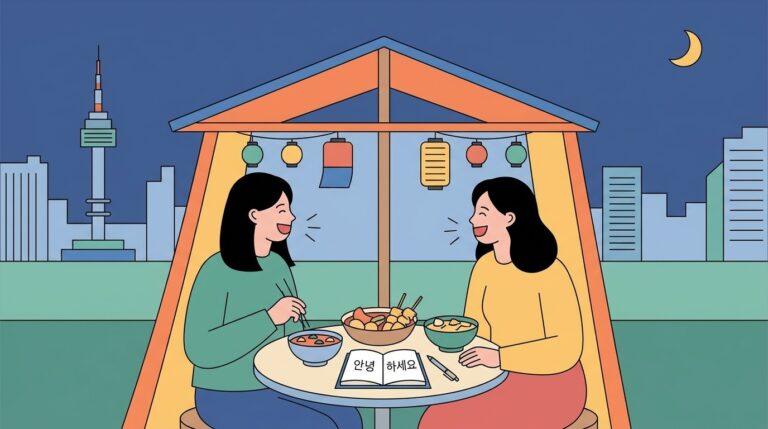
Picture this: You’ve just survived a relentless 10-hour day under fluorescent office lights in Yeouido, or sat through an exhausting university lecture where everything went over your head. Your shoulders feel like concrete blocks, and your chest is tight with pent-up frustration. In Korea, you don’t bottle that energy up. Instead, you immediately message your closest friend: “야, 오늘 술 한잔하자. 할 말 진짜 많아.” (Hey, let’s grab a drink tonight. I have so much to tell you.) Within an hour, you’re nestled under the orange vinyl tent of an Euljiro pojangmacha (street cart bar), steam rising from a bowl of spicy soup, clinking glasses, and pouring your heart out.
Many intermediate Korean learners hit a frustrating wall here. You know textbook grammar like -아서/어서 and -기 때문에, but when you try to vent in Korean, you sound like a polite news anchor reporting on your own breakdown. In natural Korean friendships, stress relief is an art form driven by specific slang, emotional rhythm, and deep camaraderie. This guide brings you field-tested expressions gathered from real conversations across Seoul so you can express your emotions authentically and connect on a deeper level.
Phase 2: Deep Dive into 3 Core Venting Expressions
1. 속이 다 시원하다 (Sogi da siwonhada)
- Pronunciation: [Sogi da siwonhada] (Think: “So-gee dah see-one-ha-dah” – imagine letting out a long, cool breath)
- Meaning: Literally “My inside is totally cool,” but naturally means “What a huge relief!” or “I feel so unburdened!”
- K-Culture Moment: Think of classic K-dramas where a corrupt boss finally gets scolded in public, and the main characters cheer while downing cold beer: “아, 속이 다 시원하네!”
- Editor’s Insight: In Korean, the chest/stomach area (속) holds emotional tension. When you express bottled-up anger or solve a nagging problem, your internal heat cools down, giving you that refreshing 시원하다 feeling.
- Situation Spectrum: Casual (✅) | Semi-formal (⚠️ – when used neutrally about tasks) | Formal (🚫)
- 🤔 Think About It: English speakers say “a weight off my chest” (focusing on physical weight/pressure), whereas Koreans describe the emotional temperature turning cool (시원하다). How does your native language describe relief?
2. 오늘 진짜 멘붕 왔잖아 (Oneul jinjja menbung watjana)
- Pronunciation: [Oneul jinjja men-bung watjana] (Rhymes with “men-boong” like a dramatic sound effect)
- Meaning: Literally “Mental breakdown arrived today,” used casually as “I had a total mental breakdown today!”
- K-Culture Moment: Frequently seen in variety shows like Running Man with purple swirl captions over a cast member’s head when things go hilariously wrong.
- Editor’s Insight: 멘붕 is a compound portmanteau of 멘탈 (Mental) and 붕괴 (Collapse). Adding -잖아 at the end turns it into a conversational plea: “You know what I mean, right?”
- Situation Spectrum: Casual (✅) | Semi-formal (🚫) | Formal (🚫)
- 🤔 Think About It: Why do modern Korean slang terms often abbreviate English loanwords with Sino-Korean words to express dramatic daily stress?
3. 내 말이 그 말이야 (Nae mari geu mariya)
- Pronunciation: [Nae mari geu mariya] (Rhythm: “Nae-mari / geu-mariya”)
- Meaning: Literally “My words are those words,” meaning “That’s exactly what I’m saying!” or “Preach!”
- K-Culture Moment: The quintessential reaction line whenever two friends in a cafe are gossiping about an unfair situation over iced Americanos.
- Editor’s Insight: This is the ultimate 맞장구 (agreement reaction). It validates your friend’s feelings instantly and keeps the conversational momentum flowing.
- Situation Spectrum: Casual (✅) | Semi-formal (⚠️ – use “제 말이 그 말이에요”) | Formal (🚫)
- 🤔 Think About It: In Korean venting culture, agreeing intensely is far more valued than offering logical solutions. Does your culture prioritize empathy or problem-solving when listening to a friend?
Phase 3: Textbook Korean vs. Real Korean
Situation A: Expressing Extreme Work Stress
- 📖 Textbook Korean: 저는 오늘 회사 업무 때문에 스트레스를 많이 받았습니다. (Jeoneun oneul hoesa eommu ttaemune seuteureseureul mani badatseumnida. / I received a lot of stress today due to company work.)
- 🗣️ Real Korean: 오늘 회사에서 진짜 머리 터지는 줄 알았어. (Oneul hoesa-eseo jinjja meori teojineun jul arasseo. / My head felt like it was literally going to explode at work today.)
- 💡 Why it differs: Native speakers use visceral physical exaggerations (머리가 터지다 – head explodes) rather than clinical terms like 스트레스를 받다 when talking to friends.
Situation B: Validating an Annoying Experience
- 📖 Textbook Korean: 당신의 기분을 충분히 이해할 수 있습니다. (Dangsinui gibuneul chungbunhi ihaehal su itseumnida. / I can fully understand your feelings.)
- 🗣️ Real Korean: 진짜 어이없었겠다! 나라면 가만 안 있었어. (Jinjja eoieopseotgetda! Naramyeon gaman an isseosseo. / That’s so ridiculous! If that were me, I wouldn’t have let it slide.)
- 💡 Why it differs: Genuine empathy in Korean venting involves taking your friend’s side emotionally and matching their indignation.
Phase 4: K-Culture Deep Dive & Non-Verbal Manners
4-1. Nunchi & Body Language
When having a 수다 (chat/vent) session with a Korean friend:
1. The Exaggerated Sigh (하아…): Dropping your shoulders and exhaling audibly before you start talking signals that you’re about to open up.
2. Hand Clapping & Leaning In: When your friend says something shocking or relatable, clap your hands once and lean forward across the table to show total engagement.
3. Pouring Drinks for Each Other: If you notice your friend’s glass is empty after a heated story, fill it up immediately. Never let a venting friend pour their own drink (자작).
4-2. The Cultural Concept of “Suda Therapy” & Pojangmacha
In Korean culture, the act of 수다 떨다 (chatting away) is viewed as essential emotional maintenance. Rather than processing stress in isolation, Koreans gather over spicy comfort food (like 불닭 or 떡볶이) and warm drinks. The chemistry between fiery food (매운 음식) and candid talk acts as a cultural purge for accumulated 화 (pent-up frustration).
Phase 5: Practical Role-Play Scenario
Setting: A vibrant outdoor street-tent (pojangmacha) in Euljiro, Seoul. Rain is pattering on the plastic roof, and a hot plate of spicy stir-fried pork (제육볶음) sits between you and your close Korean friend, Minji.
- Turn 1 (Minji): 너 오늘 얼굴 보니까 무슨 일 있었지? 표정이 왜 그래? (Neo oneul eolgul bonikka museun il isseotji? Pyojeongi wae geurae?) 🎭 Looking at you with genuine concern while setting down chopsticks. (Looking at your face, did something happen today? What’s with that expression?)
- Turn 2 (You): 말도 마. 오늘 팀장님 때문에 진짜 멘붕 왔잖아. (Maldo ma. Oneul timjangnim ttaemune jinjja menbung watjana.) 🎭 Sighing deeply and shaking your head. (Don’t even get me started. I had a total mental breakdown today because of my team lead.)
- Turn 3 (Minji): 또 왜 그러시는데? 저번 프로젝트 건으로 또 그러셔? (Tto wae geureosineunde? Jeobeon peurojekteu geoneuro tto geureosyeo?) 🎭 Widening her eyes and leaning closer across the table. (What is it this time? Is he picking on that last project again?)
- Turn 4 (You): 내가 다 끝낸 보고서를 상의도 없이 완전 다 뜯어고친 거 있지. (Naega da kkeutnaen bogoseoreul sang-uido eopsi wanjeon da tteudeogochin geo itji.) 🎭 Frowning and gesturing in frustration. (He literally completely overhauled the report I had finished without even discussing it with me.)
- Turn 5 (Minji): 진짜? 아니, 열심히 야근해서 쓴 걸 왜 멋대로 바꿔? 완전 어이없다! (Jinjja? Ani, yeolsimhi yageunhaeseo sseun geol wae meotdaero bakkwo? Wanjeon eoieopda!) 🎭 Slapping the table lightly in shared outrage. (Seriously? After you worked overtime on it, why change it on a whim? That’s ridiculous!)
- Turn 6 (You): 내 말이 그 말이야! 그래서 오늘 하루 종일 속 터지는 줄 알았어. (Nae mari geu mariya! Geuraeseo oneul haru jong-il sok teojineun jul arasseo.) 🎭 Taking a sip of water and exhaling. (That’s exactly what I’m saying! My chest felt like bursting all day.)
- Turn 7 (Minji): 오늘 여기서 다 털어버리자. 짠해! 마시고 다 잊어! (Oneul yeogiseo da teoreobeorija. Jjanhae! Masigo da ijeo!) 🎭 Lifting her glass with an encouraging smile. (Let’s shake it all off right here tonight. Cheers! Drink and forget it all!)
- Turn 8 (You): 그래, 너한테 다 얘기하니까 이제 속이 다 시원하다! (Geurae, neohante da yaegihanikka ije sogi da siwonhada!) 🎭 Clinking glasses with a relaxed smile. (Yeah, talking it all out with you makes me feel so relieved!)
🔀 Interactive Choice Point
At Turn 6, if Minji tells you to just calm down, how do you respond naturally?
* Option A: “그래도 너밖에 없다, 내 편 들어줘서 고마워.” (Best: Expresses emotional gratitude and cements friendship warmth.)
* Option B: “왜 팀장님 편을 들어? 너 정말 너무하다.” (Risk: Sounds overly confrontational and kills the casual bonding vibe.)
* Option C: “저는 화를 내지 않고 논리적으로 생각하겠습니다.” (Bad: Stiff, robotic textbook tone that breaks conversational intimacy.)
Phase 6: 10-Second Emotional Shadowing Drill
Practice reading these out loud, observing the / pauses and matching the emotional cues:
[😤 답답해하며 / Frustrated & Venting]- “오늘 회사에서 / 진짜 / 머리 터지는 줄 알았잖아!”
- (Oneul hoesa-eseo / jinjja / meori teojineun jul aratjana!)
[🔥 격하게 맞장구치며 / Passionate Agreement]- “내 말이 그 말이야! / 걔는 진짜 / 왜 그러는지 모르겠어!”
- (Nae mari geu mariya! / Gyaeneun jinjja / wae geureoneunji moreugetseo!)
[😮💨 후련한 듯 안도하며 / Relieved & Calmed]- “하아… / 너한테 다 털어놓으니까 / 이제 속이 다 시원하다!”
- (Haa… / Neohante da teoreononeunikka / ije sogi da siwonhada!)
Phase 7: K-Culture Mini Dictionary
- 뒷담화 (Dwitdamhwa) | Talking behind someone’s back / Casual venting about absent people | Used casually among close peers to blow off steam; not always malicious, often therapeutic bond-building.
- 수다 (Suda) | Chatter / Meaningful casual conversation | Refers to long, flowing talks over coffee or snacks that relieve stress.
- 불금 (Bulgeum) | “Fire Friday” (TGIF) | The ritual night where friends meet immediately after work to shed the week’s exhaustion through food, drinks, and lively talk.
- 맞장구 (Matjanggu) | Conversational echoing / Backchanneling | The essential social skill of nodding and chiming in (“그러니까!”, “진짜?”) while listening.
Phase 8: Traveler’s Survival Kit
Top 3 Survival Phrases
- 여기 매운 안주 추천해 주세요. (Yeogi maeun anju chucheonhae juseyo. / Please recommend a spicy side dish here.)
- Pro Tip: Spicy foods like tteokbokki or dakbal are Korea’s go-to culinary stress relievers.
- 물 좀 더 주실 수 있나요? (Mul jom deo jusil su innayo? / Could we get some more water?)
- Pro Tip: When your mouth is on fire from spicy food and passionate chatting, ask the restaurant staff politely.
- 우리 사진 한 장만 찍어주세요! (Uri sajin han jangman jjigeojuseyo! / Could you take a picture of us, please?)
- Pro Tip: Commemorate your late-night hangout before leaving the pojangmacha.
Editor’s Travel Note
When hunting for the best spots to talk late into the night, use the 카카오맵 지도 앱 길찾기 to search for 포장마차 거리 (Pojangmacha streets) in Euljiro 3-ga or Jongno 3-ga. Most casual street stalls accept T-Money transit cards and major credit cards, but keeping 10,000–20,000 KRW cash handy guarantees smooth service at smaller traditional stands.
Phase 9: A Step Deeper (Cultural Reflection)
In Korean society, venting with friends is an exercise in cultivating 정 (Jeong)—the invisible bond of affection and shared vulnerability. Venting isn’t seen as burdening the other person; rather, sharing your raw frustrations signals: “I trust you enough to let down my social mask.” In a fast-paced culture where workplace hierarchy requires constant politeness, these candid sessions allow individuals to reclaim their authentic emotional voice through mutual validation.
💬 Your Turn: What is the first thing you do when you need to blow off steam with your best friend? Drop your answer in the comments below using one of today’s expressions!
Phase 10: FAQ & Common Mistakes
Q: Can I use “속이 다 시원하다” when finishing a hard exam?
A: Absolutely! 속이 시원하다 works whenever an emotional or mental burden is removed—finishing exams, quitting a stressful job, or finally submitting a massive project.
Q: Is “멘붕” too informal to say to my university professor or senior colleague?
A: Yes, 멘붕 is strictly informal slang. In front of professors or senior colleagues, use “정신이 없었습니다” (I felt overwhelmed/scattered) or “당황했습니다” (I was flustered).
Q: How do I reply when my friend starts venting to me in Korean?
A: Start with active 맞장구 phrases: “진짜?” (Really?), “말도 안 돼!” (No way!), or “그래서 어떻게 됐어?” (So what happened next?). Keep your attention focused on their feelings.
🚨 Common Mistakes Warning Board
- Mistake: Saying “당신이 맞아요” (You are right) during a chat.
- Correction: 당신 can sound confrontational. Say “네 말이 맞아” or “내 말이!” instead.
- Mistake: Using stiff textbook endings (-습니다) with close peers when venting.
- Correction: Switch to casual banmal endings like -잖아, -거든, or -더라고.
- Mistake: Offering logical solutions immediately before validating their anger.
- Correction: Validate first with “진짜 속상했겠다!” (You must have been so upset!) before offering advice.
Phase 11: Action Missions
- 🥉 Bronze Mission (Solo): Stand before a mirror and practice the 3 Shadowing Drill sentences from Phase 6 with realistic facial expressions.
- 🥈 Silver Mission (Social): Share your favorite Korean comfort food or venting spot on Instagram or Threads and caption it: “오늘 스트레스 풀러 왔다! 속이 다 시원하네 🍜”.
- 🥇 Gold Mission (Real Life): The next time a Korean friend or language exchange partner mentions a busy day, send them a message: “오늘 멘붕 왔겠네! 힘내, 내가 수다 들어줄게!”
🎮 K-Culture Mission: Watch an episode of a modern K-drama (such as Work Later, Drink Now or Fight for My Way) and spot at least two instances where characters use 내 말이! or 속 시원하다.
Phase 12: Interactive Quiz Challenge
1. Situational Judgment
Your friend just finished explaining how their coworker stole credit for their idea. What is the most natural, supportive reaction?
* A) “교과서에 따르면 그것은 잘못된 행동입니다.”
* B) “내 말이 그 말이야! 진짜 어이없다, 속 터져!”
* C) “저는 상관없으니 다음 주제로 넘어갑시다.”
2. Fill-in-the-Blank
Complete the natural Korean phrase:
“너한테 다 털어놓고 나니까 이제 ____이/가 다 시원하다!”
* A) 머리
* B) 속
* C) 발
3. True / False Cultural Check
- In casual Korean venting sessions, immediately analyzing the situation logically is considered better manners than offering emotional agreement (맞장구). (True / False)
👉 Click here to reveal answers & explanations
- Answer: B | 내 말이 그 말이야! 진짜 어이없다, 속 터져! demonstrates natural empathy and native-level venting reactions.
- Answer: B (속) | The fixed idiom is 속이 다 시원하다, referring to the emotional relief inside one’s core.
- Answer: False | Korean venting culture strongly prioritizes emotional validation (공감) and shared reactions over cold logic.







