

Phase 1: Empathy & Immersion Opening
안녕하세요! 매일한글 에디터입니다. (Hello! This is your Daily Hangul editor.)
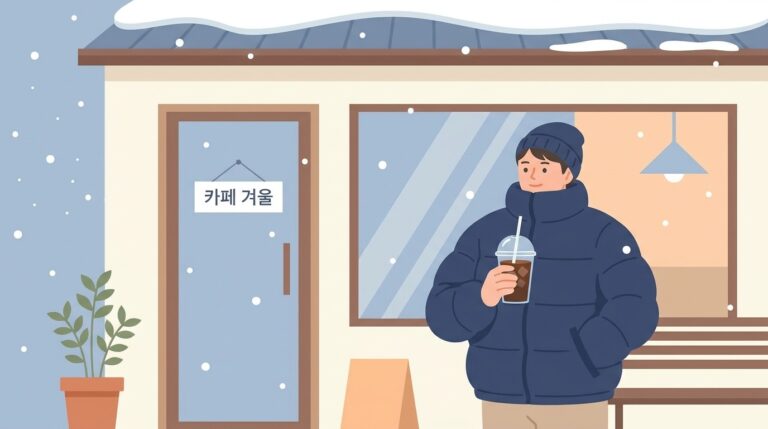
Picture this: It is the dead of January in downtown Seoul. The temperature has plunged to -10°C (14°F), freezing winds slice through the high-rise buildings of Gangnam, and everyone is bundled up in floor-length black down coats (롱패딩 – long padding). You step into a local cafe seeking warmth, but as you look around at the office workers rushing back to work, your jaw drops: almost everyone is holding a clear plastic cup filled with iced dark liquid, condensation dripping onto their gloved fingers.
You might ask yourself: Are they insane? Why is nobody ordering hot tea?
Welcome to one of Korea’s most iconic modern phenomena: 얼죽아 (Eol-juk-ah)—short for “Even if I freeze to death, Iced Americano!” Ordering coffee in Korea is not just about grabbing a beverage; it is a cultural badge, a workplace survival tool, and a dynamic language experience. Many intermediate Korean learners study standard vocabulary like “아이스 커피 주세요 (Please give me iced coffee),” only to freeze at the counter when hit with ultra-fast abbreviations, kiosk menu jargon, or subtle cafe etiquette.
This guide draws directly from real feedback gathered from our Daily Hangul community. By the end of this lesson, you won’t just order coffee smoothly; you will understand the cultural pulse of modern Korea and feel right at home at any cafe in Hongdae or Seongsu-dong.
Phase 2: Core Expressions Deep Dive
Here are the three quintessential phrases you need to master Korean cafe culture at a B1 level.
1. 얼죽아 (Eol-juk-ah)
- Pronunciation: [Eol-ju-ga] (Sounds like “All-jook-ah” with a soft ‘k’ sound transitioning into ‘ah’)
- Meaning: Literal: “Freezing to death, yet iced Americano” / Nuance: An iced coffee devotee who refuses hot coffee even in blizzard conditions.
- K-Culture Moment: You see this word constantly on K-variety shows (like Running Man) and K-pop idol livestreams. When idols walk into music shows holding an iced tumbler in mid-winter, fans comment: “완전 얼죽아네! (Total Eoljukah!)”
- Editor’s Insight: This is a portmanteau of 얼어 죽어도 아이스 아메리카노. It has evolved into an identity marker. If someone asks why you’re drinking cold coffee in winter, you can simply smile and say, “저 얼죽아예요! (I’m an Eoljukah!)”
- Situation Spectrum: Casual ✅ | Semi-formal ✅ | Formal ⚠️ (Great for office small talk, but avoid in formal business presentations)
- 🤔 Think About It: Why does Korean culture turn consumption habits into trendy identity slang so quickly compared to your native language?
2. 아아 (Ah-ah)
- Pronunciation: [Ah-ah] (Simple and sharp, like saying “Ah! Ah!”)
- Meaning: Literal: “I.A.” / Nuance: Short abbreviation for 아이스 아메리카노 (Iced Americano).
- K-Culture Moment: During busy 12:30 PM lunch rushes in office districts like Yeouido, baristas hear the rhythmic chorus of workers saying: “아아 세 잔이요! (Three Ah-ahs, please!)”
- Editor’s Insight: In Korea, speed is everything. Saying “아이스 아메리카노” takes 7 syllables, but “아아” takes only 2. The hot counterpart is 뜨아 (Tteu-ah)—short for 뜨거운 아메리카노, though “뜨아” is ordered far less often.
- Situation Spectrum: Casual ✅ | Semi-formal ✅ | Formal 🚫
- 🤔 Think About It: Notice how Korean slang favors 2-syllable abbreviations (줄임말). How does this reflect the fast-paced nature of modern urban life?
3. 샷 추가해 주세요 (Syat chugahae juseyo)
- Pronunciation: [Syat chu-ga-hae ju-se-yo] (Pronounce ‘Syat’ like the English word ‘Shot’, ‘chuga’ like ‘choo-gah’)
- Meaning: Literal: “Please add a shot” / Nuance: “Can I get an extra espresso shot in this?”
- K-Culture Moment: In K-Dramas featuring overworked lawyers or university students pulling all-nighters, characters slam down a tumbler and say: “샷 두 개 추가해 주세요 (Please add two extra shots).”
- Editor’s Insight: The noun 추가 (chuga) means ‘addition’ and the verb 추가하다 means ‘to add’. You can reuse this grammar pattern everywhere in Korea: “치즈 추가해 주세요 (Please add cheese)” or “밥 추가해 주세요 (Please add extra rice).”
- Situation Spectrum: Casual ✅ | Semi-formal ✅ | Formal ✅
- 🤔 Think About It: In English, we say “Can I get an extra shot?” using possibility modal verbs. In Korean, polite imperative requests (-해 주세요) are standard and respectful without sounding demanding.
Phase 3: Textbook Korean vs. Real Korean
Situation 1: Ordering your coffee iced during winter
- 📖 교과서 한국어 (Textbook): 차가운 아메리카노 한 잔 부탁드립니다. (Chagaun amerikano han jan butakdeurimnida. – I request one glass of cold Americano.)
- 🗣️ 진짜 한국어 (Real-Life): 따뜻한 거요, 아니면 아이스로 드릴까요? — 아이스 아아로 한 잔 주세요! (Tteutteuthan geoyo, animyeon aiseuro deurilkkayo? — Aiseu ah-ah-ro han jan juseyo!)
- 💡 왜 다를까?: Textbooks teach “차가운 (cold)”, but real Korean cafes use English loanwords “아이스 (Ice)” or slang “아아 (Ah-ah)”. Asking for “차가운 아메리카노” sounds overly poetic or robotic.
Situation 2: Asking for a takeaway cup to drink while walking
- 📖 교과서 한국어 (Textbook): 밖으로 가지고 나가겠습니다. (Bakkeuro gajigo nagagessseumnida. – I will go outside carrying this.)
- 🗣️ 진짜 한국어 (Real-Life): 테이크아웃으로 해 주세요. / 가져갈게요. (Teikeu-a-useuro hae juseyo. / Gajyeogalgeyo.)
- 💡 왜 다를까?: Korean environmental laws strictly penalize cafes if customers drink from single-use plastic cups inside the store. Baristas will always ask: “드시고 가세요, 포장이세요? (Drinking here or to-go?)” Real Koreans answer simply with “가져갈게요 (I’ll take it to go)” or “테이크아웃이요 (Takeout, please)”.
Phase 4: K-Culture Deep Dive & Non-Verbal Manners
4-1. 눈치 (Nunchi) & Cafe Body Language
- The Two-Handed Handover: When tapping your card or receiving your iced cup, gently touch your right wrist or forearm with your left hand, or hold the cup with both hands. It shows immediate respect to the staff.
- The Winter Puffer Jacket Reflex: If you’re freezing, hold your icy cup with your coat sleeve pulled over your hand (소매 덮기). Koreans love the humorous contrast of shivering while sipping cold coffee.
- The In-Store Plastic Rule: If you ordered “매장용 (for dine-in)”, you will receive a glass mug. Never walk out with this mug, and if you change your mind and want to leave, politely ask: “테이크아웃 잔으로 바꿔 주실 수 있나요? (Could you switch this to a takeout cup?)”
4-2. Cultural Code: The Fuel of “Ppal-li Ppal-li” (빨리빨리)
Why are Koreans so obsessed with iced Americano even in sub-zero winter? It boils down to two cultural pillars:
1. Instant Refreshment & Speed: Hot coffee takes time to cool down before you can drink it quickly. In Korea’s fast-paced society (빨리빨리 문화), workers need instant caffeine to wake up after lunch without burning their tongues.
2. Post-Meal Palate Cleanser: Korean meals often feature savory, spicy, or fermented flavors (garlic, kimchi, stew). A crisp, cold, bitter iced Americano acts as the ultimate refreshing palate cleanser (입가심).
Phase 5: Real-Life Roleplay Scenario
- Setting: A trendy, bustling cafe near Hongdae Station on a freezing Tuesday afternoon. Smooth indie music is playing, and steam rises from the espresso machine.
- Characters:
- 민지 (Minji): A swift, friendly barista wearing a dark brown apron.
- 알렉스 (Alex – You): An intermediate Korean learner determined to order like an authentic Seoulite.
[Scene Start]

민지 (Barista): 어서 오세요! 주문 도와드릴게요. (Eoseo oseyo! Jumun dowadeurilgeyo.)
🎭 [Smiles brightly, fingers ready over the POS touch screen]
English: Welcome! How can I help with your order?

알렉스 (Alex): 안녕하세요! 아아 한 잔이랑 따뜻한 라떼 한 잔 주세요. (Annyeonghaseyo! Ah-ah han jan-irang ttatteut-han latte han jan juseyo.)
🎭 [Speaks clearly, making brief eye contact]
English: Hello! One iced Americano and one hot latte, please.

민지 (Barista): 네, 아아 한 잔, 핫 라떼 한 잔이요. 원두는 고소한 맛이랑 산미 있는 것 중에 어떤 걸로 하시겠어요? (Ne, ah-ah han jan, hat latte han jan-iyo. Wonduneun gosohan mas-irang sanmi inneun geot junge eotteon geollo hasigesseoyo?)
🎭 [Points to the two coffee bean options on the counter display]
English: Got it, one iced Americano, one hot latte. For the beans, would you prefer nutty flavor or acidic/fruity flavor?

알렉스 (Alex): 고소한 원두로 해 주세요. 그리고 아아에 샷 하나 추가해 주세요! (Gosohan wonduro hae juseyo. Geurigo ah-ah-e syat hana chugahae juseyo!)
🎭 [Nods comfortably with confidence]
English: Nutty beans, please. And please add an extra shot to the iced Americano!

민지 (Barista): 네, 샷 추가 확인했습니다. 드시고 가시나요, 아니면 가져가시나요? (Ne, syat chuga hwaginhaessseumnida. Deusigo gasinayo, animyeon gajyeogasinayo?)
🎭 [Tilts head slightly, checking cup types]
English: Okay, extra shot noted. Are you drinking here, or taking it to go?

알렉스 (Alex): 가져갈게요! 테이크아웃이요. (Gajyeogalgeyo! Teikeu-a-ut-iyo.)
🎭 [Takes out payment card with both hands]
English: Taking it to go! Takeout, please.

민지 (Barista): 네, 총 9,500원입니다. 카드는 앞쪽 리더기에 꽂아 주세요. (Ne, chong gu-cheon-o-baek-won-imnida. Kadeuneun apjjok rideogie kkoja juseyo.)
🎭 [Gestures politely toward the IC card chip terminal]
English: Okay, that is 9,500 won in total. Please insert your card into the front reader.

알렉스 (Alex): 네, 영수증은 버려 주세요. 감사합니다! (Ne, yeongsujeungeun beoryeo juseyo. Gamsahamnida!)
🎭 [Inserts card, smiles politely]
English: Yes, please discard the receipt. Thank you!

[Scene End]
🔀 Interactive Choice Point
The barista asks: “포인트 적립하시겠어요? (Pointeu jeongniphagisseoyo? – Would you like to save membership points?)”
- Choice A: “네! 010-1234-5678로 해 주세요.” (Ne! 010-1234-5678-ro hae juseyo.)
- Result: [Best] Perfect if you live in Korea and have a local phone number. Points accumulate instantly!
- Choice B: “아니요, 괜찮아요. 없어요.” (Aniyo, gwaenchannayo. Eopseoyo.)
- Result: [Best for Travelers] Natural and polite response indicating you don’t need point accumulation.
- Choice C: “포인트가 무엇입니까? 저는 외국인입니다.” (Pointeuga mueosimnikka? Jeoneun oeguginimnida.)
- Result: [Awkward / Risk] Too formal and textbook-heavy; during a busy rush, it might confuse the staff.
Phase 6: 10-Second Emotional Shadowing Drill
Practice these natural rhythm pauses (/) while matching the intended feeling!
[🥶 Shivering but completely unapologetic]- 날씨가 아무리 추워도 / 저는 무조건 / 얼죽아예요!
- (Nalssiga amuri chuwodo / jeoneun mujogeon / eol-juk-a-yeyo!)
- “No matter how cold the weather gets / I am unconditionally / an Eoljukah!”
[⚡ Fast, decisive, and energetic - Seoul lunch rush style]- 사장님, / 아아 두 잔 테이크아웃으로 / 빨리 부탁드려요!
- (Sajangnim, / ah-ah du jan teikeu-a-ut-euro / ppalli butakdeuryeoyo!)
- “Boss, / two iced Americanos to-go / quickly please!”
[😴 Exhausted student / Worker needing survival caffeine]- 오늘 너무 피곤해서 / 샷 하나 꼭 / 추가해야겠어요.
- (Oneul neomu pigonhaeseo / syat hana kkok / chugahaeyagess-eoyo.)
- “I’m so exhausted today / I really must / add an extra shot.”
Phase 7: K-Culture Mini Dictionary
- 카공족 (Ka-gong-jok) | Cafe Study Tribe
- Portmanteau of 카페에서 공부하는 사람족. Refers to students and freelancers who study or work in cafes for hours. Many cafes now install individual desk plugs specifically for them.
- 디카페인 (Di-ka-pe-in) | Decaf Coffee
- Essential vocabulary if you love evening cafe visits without insomnia: “디카페인으로 변경 가능한가요? (Can I change this to decaf?)”
- 텀블러 할인 (Teombeulleo Harin) | Tumbler Eco-Discount
- Bringing your own personal tumbler usually gets you a 200–500 KRW discount at major franchises like Mega Coffee, Compose, or Starbucks.
- 뜨아 (Tteu-ah) | Hot Americano
- The direct counterpart to 아아. From 뜨거운 아메리카노. When the winter chill is truly unbearable, even some Eoljukahs surrender to a 뜨아!
Phase 8: Survival Kit for Travelers
Top 3 On-the-Spot Phrases
- 연하게 해 주세요. (Yeonhage hae juseyo.)
- Pro Tip: “Please make it mild/light.” Korean espresso can be quite strong and roasty. If you get heart palpitations easily, use this magic phrase.
- 얼음 적게 넣어 주세요. (Eoreum jeokge neoeo juseyo.)
- Pro Tip: “Please put less ice.” Perfect if you want more actual liquid volume or find drinks too freezing.
- 화장실 비밀번호가 뭐예요? (Hwajangsil bimilbeonhoga mwoyeyo?)
- Pro Tip: “What is the restroom passcode?” Most Korean cafe bathrooms are locked with digital door locks. Check the bottom of your paper receipt first, or ask the staff with this sentence!
🧳 Editor’s Travel Note
- Kiosk Ordering: 80% of budget Korean coffee shops (Mega Coffee, Paik’s Coffee, Compose Coffee) use automated touch kiosks. Look for the English button at the top right, or simply spot the tabs labeled 커피 (Coffee), ICED, and 포장 (Takeout).
- Navigation Essential: Avoid using Google Maps for cafe hunting in Korea; instead, refer to our Naver Map app download and navigation guide to find hidden specialty roasteries and check live customer reviews.
Phase 9: “One Step Deeper” (Societal Insight)
In many Western cultures, coffee is treated as a slow, mindful ritual—a companion to long conversations or a lazy Sunday brunch. In South Korea, however, coffee operates as modern social stamina. The fierce dedication to 얼죽아 (Eol-juk-ah) mirrors the resilience and high-octane drive of Korean society, where people push through grueling work hours, academic pressure, and icy winters with sheer willpower and an ice-cold beverage in hand. Drinking ice coffee in the freeze is almost a playful rebellion against nature itself.
💬 Your Turn: What is your go-to coffee order in your home country? Would you brave a -10°C Seoul winter with an iced Americano in hand, or are you strictly team “뜨아 (Hot Americano)”? Let us know in the comments below!
Phase 10: FAQ & Common Mistakes
Q: Can I sit inside the cafe if I chose “테이크아웃 (Takeout)” at the counter?
A: No! Under Korean environmental regulations, businesses face heavy municipal fines if customers drink from single-use takeout cups inside the store seating area. If you plan to sit down even for 10 minutes, always choose “매장 이용 (Dine-in / store cup)”.
Q: What is the difference between 아메리카노 and 더치커피 (Dutch Coffee)?
A: While an Americano is espresso diluted with water, 더치커피 (Dutch coffee / Cold Brew) is cold-water drip coffee steeped over several hours. It has a smoother, wine-like aroma and is widely popular in Korean boutique cafes.
Q: Is it rude to ask for water at a Korean cafe?
A: Not at all! Most Korean cafes have a self-service “Condiment Bar” (컨디바) with a water dispenser, paper cups, napkins, and syrup. If you don’t see one, politely ask: “물 한 잔만 주실 수 있나요? (Could I get a glass of water?)”
🚨 Common Mistakes Alert!
- Mistake: Saying “차가운 커피 주세요” at franchise kiosks.
- Correct Action: Use the universally accepted term 아이스 커피 or 아아.
- Mistake: Forgetting to specify hot vs. iced.
- Correct Action: In Korea, you should state the temperature first: “아이스 바닐라 라떼” or “따뜻한 아메리카노”.
- Mistake: Throwing cups with leftover ice directly into general trash cans.
- Correct Action: Separate disposal is strictly practiced. Pour leftover liquid/ice into the designated cafe drain sink, and discard the plastic cup and straw in the recycling bin.
Phase 11: Action Mission & Challenge
- 🥉 Bronze Mission (Solo Practice): Record a 10-second voice memo saying: “안녕하세요! 고소한 원두로 아아 한 잔 테이크아웃해 주세요!” Focus on clean pronunciation of ‘아아’.
- 🥈 Silver Mission (Social Engagement): Snap a photo of your next coffee and tag our Instagram
@DailyHangulwith the hashtag#얼죽아챌린지 (#EoljukahChallenge). - 🥇 Gold Mission (Real-Life Mastery): Visit a local Korean-run cafe or order completely in Korean at a cafe during your next trip without using a single word of English!
- 🎮 K-Culture Mission: Watch an episode of a modern office K-Drama (like Misaeng or Business Proposal) and count how many times characters walk into an office holding plastic iced Americano cups!
Phase 12: Interactive Quiz Challenge
Test your knowledge before you hit the cafes in Seoul!
- Situational Judgment: You are at a bustling cafe in Gangnam. You want one hot latte to drink inside the store. Which sentence is most natural?
- A) 차가운 라떼 포장해 주세요.
- B) 따뜻한 라떼 매장에서 마시고 갈게요.
- C) 아아 샷 추가해서 밖으로 가지고 나가겠습니다.
- Fill-in-the-Blank: Complete the quintessential Korean winter slang:
- 얼어 죽어도 ________! (Even if I freeze to death, iced Americano!)
- True or False: In Korea, it is completely legal to drink from a plastic disposable takeout cup while sitting at an indoor cafe table for hours.
- ( True / False )
🔍 Click here to view Answer Key & Explanations
- Answer: B
- Explanation: “따뜻한 라떼 매장에서 마시고 갈게요” clearly specifies temperature (따뜻한), drink type (라떼), and dine-in intention (매장).
- Answer: 아이스 아메리카노 (or 아아 / 얼죽아)
- Explanation: The full phrase is “얼어 죽어도 아이스 아메리카노!”
- Answer: False
- Explanation: Single-use plastic cups are prohibited for indoor dine-in seating across South Korea due to environmental laws.
- Explanation: Single-use plastic cups are prohibited for indoor dine-in seating across South Korea due to environmental laws.







