

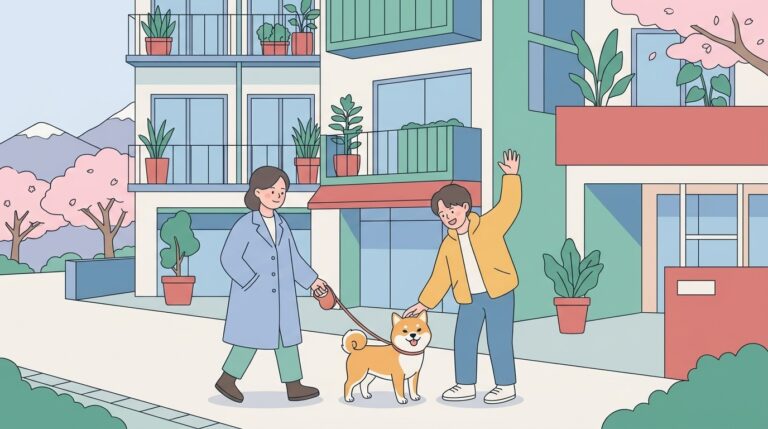
Phase 1: 공감 (Story-driven Opening)
안녕하세요! 매일한글 에디터입니다.
Imagine this: It’s a crisp autumn evening in Seoul. You’ve just stepped out of your officetel with your beloved golden retriever for an evening stroll along the Han River. The elevator dings on the 12th floor, and an elderly neighbor steps back in visible shock, pressing themselves against the hallway wall with a startled “어머, 깜짝이야!” (Oh my goodness, you scared me!). Your dog simply wags its tail, but the neighbor’s scowl deepens as they mutter about dogs taking over residential spaces. Your heart races. How do you de-escalate this without sounding overly defensive or dismissive of their fear?
Navigating pet culture in South Korea is a delicate art. With more than 15 million Koreans living with companion animals in high-density urban environments, the tension between 반려인 (pet owners) and 비반려인 (non-pet owners) is a prominent social topic. In Korea’s communal culture, personal freedom often meets the unwritten rule of 배려 (consideration for others). Master-level proficiency at the C1 level is not just about knowing words for leash and treats; it’s about wielding nuanced, de-escalating Korean that demonstrates social grace, asserts your rights responsibly, and instantly puts non-pet owners at ease.
This guide was forged directly from real-world scenarios faced by foreign pet parents in Korea and curated by Daily Hangul’s veteran linguistic navigators. Let’s elevate your Korean beyond the textbook and into culturally intelligent fluency.
Phase 2: 핵심 표현 3선 심층 분석 (Top 3 Core Expressions)
1. 혹시 강아지 무서워하세요? 제가 줄 짧게 잡을게요.
(Hoksi gang-aji museowohaseyo? Jega jul jjalge jabeulgeyo.)
* Pronunciation: Hok-shee gahng-ah-jee moo-suh-woh-hah-seh-yoh? Jeh-gah jool jjal-geh jah-beul-geh-yoh. (Think of jjal like the sharp, snappy double-z sound in a crisp Italian pizza, followed by a tight closure).
* Meaning: Literal: “By any chance, are you scared of puppies? I will hold the leash short.” | Nuance: “I acknowledge your comfort zone and am actively taking physical control so you feel 100% safe.”
* K-Culture Moment: Seen frequently in urban dramas like My Liberation Notes or variety shows like Dogs Are Incredible, where apartment dwellers proactively reassure anxious neighbors before entering cramped elevators.
* Editor’s Insight: Starting with 혹시 (by any chance) acts as a linguistic shock absorber. Saying 강아지 (puppy/doggy) instead of the technical term 개 (dog) subtly softens the emotional atmosphere.
* Situation Spectrum: Casual: ⚠️ | Semi-formal: ✅ | Formal: ✅
* 🤔 Think About It: In your home country, do you wait for someone to express fear, or do you proactively verbally signal control of your pet?2. 불편을 드려 정말 죄송합니다. 바로 조치하겠습니다.
(Bulpyeon-eul deuryeo jeongmal joesonghamnida. Baro jochihagessseumnida.)
* Pronunciation: Bool-pyeon-eul deu-ryuh jung-mahl jweh-song-hahm-nee-dah. Bah-roh joh-chee-hah-get-seum-nee-dah. (The jochi sounds like “joe-chee”, spoken with crisp, decisive urgency).
* Meaning: Literal: “I am truly sorry for causing inconvenience. I will take action immediately.” | Nuance: “I take full accountability without making excuses, and the issue is being resolved right this second.”
* K-Culture Moment: The textbook de-escalation line used whenever unexpected barking occurs in a shared hallway or if a dog accidentally spills water in a pet-friendly cafe.
* Editor’s Insight: C1 speakers know that explaining why your dog did something before saying 죄송합니다 sounds like an excuse (변명). Prioritize the emotional apology first, followed by the decisive action verb 조치하다 (to take measures).
* Situation Spectrum: Casual: 🚫 | Semi-formal: ✅ | Formal: ✅
* 🤔 Think About It: Why does immediate acknowledgment carry more social weight in Korea’s collective society than explaining your dog’s temperament?3. 목줄 착용이랑 배변 처리는 확실히 하고 있으니 안심하세요.
(Mokjul chagyong-irang baebyeon cheorineun hwaksilhi hago isseuni ansimhaseyo.)
* Pronunciation: Moke-jool chah-gyong-ee-rahng beh-byeon chuh-ree-neun hwahk-sheel-hee hah-goh ee-sseu-nee ahn-sheem-hah-seh-yoh.
* Meaning: Literal: “I am certainly wearing the leash and managing waste disposal, so please be relieved.” | Nuance: “I am an ethical, rule-abiding pet guardian who respects public hygiene and community boundaries.”
* K-Culture Moment: Common in park confrontations where a pedestrian aggressively assumes a pet owner will leave waste behind or violate the mandatory 2-meter leash rule.
* Editor’s Insight: The connective -으니 establishes clear causality (“Because I am doing X properly, you can feel safe”), offering a firm, dignified boundary without aggression.
* Situation Spectrum: Casual: ⚠️ | Semi-formal: ✅ | Formal: ✅
* 🤔 Think About It: How does distinguishing between defensive confrontation and confident compliance reassurance change the outcome of an argument?
Phase 3: 교과서 한국어 vs 진짜 한국어 (Textbook vs. Real Korean)
Situation 1: In the apartment elevator when an uneasy neighbor gets in
- 📖 교과서 한국어: 제 개는 사람을 물지 않으니까 걱정하지 마십시오. (Je gaeneun sarameul mulji aneunikka geokjeonghaji masipsio. / Do not worry because my dog does not bite people.)
- 🗣️ 진짜 한국어: 죄송해요, 얼른 안아 올릴게요! 많이 놀라셨죠? (Joesonghaeyo, eolleun ana ollilgeyo! Mani nollasyeotjyo? / Sorry about that, I’ll scoop him right up! You must have been startled, right?)
- 💡 왜 다를까? Saying “my dog doesn’t bite” invalidates the other person’s phobia and sounds dismissive. Real Koreans show physical empathy by holding the pet close and asking 많이 놀라셨죠? to disarm tension.
Situation 2: When an angry passerby scolds you unfairly in a public park
- 📖 교과서 한국어: 저는 공공 법규를 위반하지 않았습니다. 따지지 마세요. (Jeoneun gonggong beopgyureul wibanhaji anasseumnida. Ttajiji maseyo. / I have not violated public regulations. Do not argue with me.)
- 🗣️ 진짜 한국어: 언짢으셨다면 죄송합니다. 규정대로 2미터 줄 유지하고 있으니 너그럽게 봐주세요. (Eonjjaneusyeotdamyeon joesonghamnida. Gyujeongdaero imiteo jul yujihago isseuni neogeureopge bwajuseyo. / I apologize if this upset you. I’m keeping the 2-meter leash regulation, so I’d appreciate your gracious understanding.)
- 💡 왜 다를까? Hard-line legalistic responses escalate public conflict in Korea. Combining a soft conditional apology (언짢으셨다면) with concrete compliance (규정대로) and an appeal to magnanimity (너그럽게 봐주세요) immediately takes the wind out of their sails.
Phase 4: K-Culture 딥다이브 & 비언어적 매너 (Deep Dive & Non-Verbal Manners)
4-1. 눈치(Nunchi) & Body Language
- The Corner Block (구석 대기): When waiting for an elevator with your dog, stand in the furthest corner and position your body between your dog and the elevator door. This physical shield signals high Nunchi.
- The Leash Wrap (줄 감아쥐기): Even on an extendable leash, you must visibly wrap the excess cord around your palm until it is under 1 meter in hallways or crosswalks. It serves as visual proof of control.
- The Micro-Bow (목례): Combine eye contact avoidance with a 15-degree head bow when sharing cramped spaces. Do not stare at the person complaining; address the ground gently while tending to your dog.
4-2. Cultural Code: The “Pettiquette” Revolution (펫티켓)
South Korea has transformed from a society where pets were called 애완견 (toy/play animals) to 반려견 (companion family members). However, dense communal living (아파트 공화국) creates real friction. Shows like 개는 훌륭하다 hosted by renowned trainer Kang Hyung-wook have set a high social standard: non-dog owners expect pet parents to possess absolute control over their dogs. Neglecting basic etiquette can quickly lead to online neighborhood forums (당근마켓 동네생활 or apartment council boards) blowing up with complaints.
Phase 5: 실전 롤플레이 시나리오 (Interactive Roleplay)
Setting: 6:30 PM, the lobby elevator of Mapo Raemian Prugio Apartments. Mr. Park, an exhausted middle-aged executive, steps in while you are holding your 10kg French Bulldog on a short leash.
- Mr. Park: (인상을 찌푸리며 뒤로 물러선다) 쯧, 엘리베이터에 개를 그냥 태우나? 요새 개물림 사고도 많은데 말이야.
(In-sangeul jjipurimyeo dwiro mulleoseonda. Jjeut, ellibeiteoe gaereul geunyang taeuna? Yosae gaemullim sagodo maneunde mariya.)
🎭 Scowling and stepping back: “Tsk, bringing a dog into the elevator just like that? There are so many dog bite incidents these days.” -
You: 죄송합니다, 어르신. 제가 구석 쪽으로 바짝 붙어서 가겠습니다.
(Joesonghamnida, eoreusin. Jega guseok jjok-euro bajjak buteoseo gagessseumnida.)
🎭 Pulling the dog closer to your legs and bowing softly: “Apologies, sir. I will stick tightly to the corner.” -
Mr. Park: 줄이나 좀 바짝 당겨요. 털도 날리고 무섭구먼.
(Jurina jom bajjak danggyeoyo. Teoldo nalligo museopgumeon.)
🎭 Crossing his arms skeptically: “Pull that leash tight. Fur is flying everywhere and it’s scary.” -
You: 네, 줄 짧게 잡았고 사람에게 다가가지 않도록 통제하고 있습니다. 놀라게 해드려 죄송해요.
(Ne, jul jjalge jabatgo saramege dagagaji antorok tongjehago isseumnida. Nollage haedeuryeo joesonghaeyo.)
🎭 Placing your hand gently over your dog’s chest: “Yes, I have shortened the leash and am keeping him from approaching anyone. I’m sorry for startling you.” -
Mr. Park: (누그러진 표정으로 개를 쳐다보며) 순하긴 한 것 같은데… 그래도 조심해야지.
(Nugeureojin pyojeong-euro gaereul cheodabomyeo. Sunhagin han geot gateunde… Geuraedo josimhaeyaji.)
🎭 Looking down with a softened expression: “He seems gentle enough… but still, one can never be too careful.” -
You: 말씀 맞습니다. 공용 공간이니만큼 늘 주의 기울이겠습니다.
(Malsseum matseumnida. Gong-yong gong-gan-inimankeum neul juui giurigessseumnida.)
🎭 Nodding respectfully with steady composure: “You are entirely right. Since it’s a shared space, I will always remain extra attentive.” -
Mr. Park: 그래요, 수고해요. (먼저 내린다)
(Geuraeyo, sugohaeyo.)
🎭 Stepping out at the 10th floor: “Alright then, take care.” -
You: 좋은 저녁 보내세요, 어르신.
(Joeun jeonyeok bonaeseyo, eoreusin.)
🎭 Lightly bowing as the elevator doors close: “Have a pleasant evening, sir.”
🔀 인터랙티브 분기점: If Mr. Park demanded you take the stairs next time, how would you respond?
- Option A: “아파트 관리 규약상 반려동물 탑승은 합법입니다. 계단 강요하지 마세요.” (According to apartment rules, pets are legal. Don’t force me onto stairs.)
- Feedback [Bad ❌]: Factually correct, but socially disastrous. It sparks immediate confrontation and will likely lead to an official complaint to the management office (관리사무소).
- Option B: “불편하셨다면 죄송합니다. 다음번엔 주민분들이 안 계실 때 타거나 먼저 양해를 구할게요.” (I apologize for the discomfort. Next time I will ride when it’s empty or ask for understanding first.)
- Feedback [Best ⭐]: De-escalates instantly by validating his mood while making a courteous compromise that preserves community harmony.
- Option C: (아무 말 없이 째려보며 스마트폰만 응시한다) (Say nothing, glare at him, and look at your smartphone.)
- Feedback [Risk ⚠️]: Passive aggression triggers extreme indignation in older Koreans, who view silence as blatant disrespect (무시).
Phase 6: 10초 감정 섀도잉 드릴 (10-Second Emotional Shadowing)
Practice matching these rhythm breaks (/) and tonal intentions:
[😟 차분하고 정중하게 / Calm & Courteous]- 불편을 드려 / 정말 죄송합니다. / 제가 바로 안쪽으로 물러설게요.
(Bulpyeon-eul deuryeo / jeongmal joesonghamnida. / Jega baro anjjok-euro mulleoseolgeyo.)
- 불편을 드려 / 정말 죄송합니다. / 제가 바로 안쪽으로 물러설게요.
[🤝 단호하지만 부드럽게 / Firm yet Reassuring]- 목줄 규정 철저히 지키고 있으니 / 너무 염려하지 않으셔도 괜찮습니다.
(Mokjul gyujeong cheoljeohi jikigo isseuni / neomu yeomryeohaji aneusyeodo gwaenchansseumnida.)
- 목줄 규정 철저히 지키고 있으니 / 너무 염려하지 않으셔도 괜찮습니다.
[😊 공감하며 배려하듯 / Empathetic & Considerate]- 큰 개라 놀라셨을 텐데 / 배려해 주셔서 진심으로 감사드려요.
(Keun gaera nollasyeosseul tende / baeryeohae jusyeoseo jinsim-euro gamsadeuryeoyo.)
- 큰 개라 놀라셨을 텐데 / 배려해 주셔서 진심으로 감사드려요.
Phase 7: K-Culture 미니 사전 (Key Terminology)
- 펫티켓 (Pettiquette – [Pet + Etiquette])
- The gold-standard compound word in modern Korea defining the civic responsibilities of pet owners (cleaning waste, maintaining short leashes, minimizing barking).
- 맹견 (Maeng-gyeon – Dangerous / Fierce Dog Breeds)
- Legally classified 5 breeds (Tosa, American Pit Bull Terrier, American Staffordshire Terrier, Staffordshire Bull Terrier, Rottweiler) required by law to wear a muzzle (입마개) and carry liability insurance.
- 오프리시 (Off-leash – Unleashed Dog Activity)
- Strictly prohibited in almost all Korean public parks and streets. Doing so incurs fines of up to 500,000 KRW.
- 펫팸족 (Petfam-jok – Pet + Family Tribe)
- Sociological term for the modern generation of Koreans who view companion animals as equal family members and children.
Phase 8: 여행자를 위한 생존 키트 (Traveler’s Survival Kit)
Survival Expressions TOP 3
- 1. “만져봐도 괜찮을까요?” (Manjyeobwado gwaenchaneulkkayo? / May I pet your dog?)
- Pro Tip: Always ask before reaching out. Korean pet owners appreciate this boundary immensely.
- 2. “배변 봉투 버리는 곳이 어디인가요?” (Baebyeon bongtu beorineun gosi eodi-ingayo? / Where can I dispose of the dog waste bag?)
- Pro Tip: Korea has very few street trash cans. Many parks have designated 반려견 배변 수거함 near entrance paths.
- 3. “반려동물 동반 가능한가요?” (Banryeodongmul dongban ganeunghangayo? / Is pet entry allowed here?)
- Pro Tip: Essential when entering outdoor cafe terraces or boutique shops in Seongsu-dong.
Editor’s Travel Note
- Check pet-friendly routes using the Naver Map Application with Pet Filters. Remember that dogs on public buses and subways must be enclosed completely in an airline-approved carrier bag or stroller (개모차). The maximum legal leash length in all public zones is 2 meters.
Phase 9: 한 발 더 깊이 (Cultural Insight)
In Western individualist traditions, the public sidewalk is often viewed as a neutral space where personal freedoms take precedence until harm is proven. In Korea’s traditionally collective mindset (공동체 의식), shared residential environments like apartment complexes (단지) are considered shared living rooms. An unexpected encounter with an animal is not judged purely by whether the dog actually bites, but by whether the pet guardian demonstrates sufficient 배려 (consideration) to minimize emotional disruption for everyone else.
💬 Your Turn: How does the balance between pet owners’ rights and non-pet owners’ comfort work in your home country? Drop your thoughts in the comments below!
Phase 10: FAQ & Common Mistakes
Q: Are all dogs required to wear muzzles (입마개) in Korea?
A: No. Legally, only five specific designated 맹견 (fierce breeds) and their crossbreeds are required to wear muzzles in public. However, many non-pet owners mistakenly believe all medium-to-large dogs need muzzles. You can politely explain: “법적 맹견 지정 견종은 아니지만, 줄을 짧게 잡고 안전하게 통제하겠습니다.” (He isn’t a legally designated fierce breed, but I will keep the leash short and maintain safe control).
Q: Can I take my dog inside a convenience store or restaurant?
A: As a default rule under the Food Sanitation Act, pets are not allowed inside dining and grocery establishments unless the venue has acquired specific government-designated pet-friendly certification (규제 샌드박스 승인). Always look for the “Pet Friendly” sticker or ask first.
Q: What should I do if a neighbor files a noise complaint regarding dog barking?
A: Write a handwritten note with a modest gift (like a fruit basket or bakery set) stating: “불편을 드려 대단히 죄송합니다. 방음 매트 설치 및 행동 교정 훈련을 진행 중입니다.” (We sincerely apologize. We are installing soundproof mats and undergoing behavioral training). In Korea, taking visible corrective action solves 90% of neighborhood disputes.
🚨 흔한 실수 (Common Mistakes) Warning Board
- Mistake: Letting an extendable leash loosen to 3-5 meters in residential parks.
- Correct Action: Keep leashes under 2 meters at all times; hold them under 1 meter in elevators and crosswalks.
- Mistake: Arguing “My dog is safe and doesn’t bite!” (우리 개는 안 물어요!).
- Correct Action: Reassure the person’s emotions first (놀라셨죠, 죄송합니다) rather than asserting your dog’s character.
- Mistake: Discarding tied dog waste bags in residential recycling bins.
- Correct Action: Carry waste back to your accommodation or use municipal designated pet waste bins.
Phase 11: 액션 미션 & 참여 유도 (Action Missions)
- 🥉 Bronze Mission: Practice saying “혹시 강아지 무서워하세요? 줄 짧게 잡을게요.” aloud three times with a reassuring smile.
- 🥈 Silver Mission: Film a 10-second shadowing reel using our Phase 6 audio cadence and tag @DailyHangul on Instagram with
#KoreanPettiquette. - 🥇 Gold Mission: Next time you step into an elevator with a neighbor in Korea, execute the polite micro-bow (목례) and corner stance smoothly!
- 🎮 K-Culture Challenge: Search for clips of 개는 훌륭하다 (Dogs Are Incredible) on YouTube and spot how master trainer Kang Hyung-wook advises owners to address neighbors during walk training.
Phase 12: 인터랙티브 퀴즈 챌린지 (Interactive Quiz)
1. Situational Judgment: An elderly neighbor gasps as your small dog sniffs near their shoes in the lobby. What is the most culturally intelligent response?
* (A) “왜 소리를 지르세요? 작은 강아지인데.”
* (B) “죄송합니다! 얼른 안을게요. 많이 놀라셨죠?”
* (C) “우리 강아지는 사람 좋아해서 괜찮아요.”
2. Fill in the Blank: Fill in the correct particles and honorific ending:
* “공용 공간이니만큼 주민분들께 [ _____ ] 드리지 않도록 항상 [ _____ ] 하겠습니다.”
(Since it is a shared space, I will always take measures so as not to cause [inconvenience] to residents.)
3. True or False: In Korea, any dog weighing over 15kg is legally mandated to wear a muzzle in public parks. [ T / F ]
🔍 Click here to reveal Answers & Explanations!
- Answer: (B) – (B) validates the neighbor’s shock instantly (많이 놀라셨죠?) and takes immediate physical custody of the situation. (A) is confrontational, and (C) invalidates the neighbor’s boundaries.
- Answer: 불편을 (inconvenience) / 조치 (action/measures) or 주의 (caution). Full sentence: “공용 공간이니만큼 주민분들께 불편을 드리지 않도록 항상 주의하겠습니다.”
- Answer: False (F) – Only 5 legally designated 맹견 (fierce breeds) are required to wear muzzles regardless of weight. However, maintaining strict leash control under 2 meters is mandatory for all dogs.







