

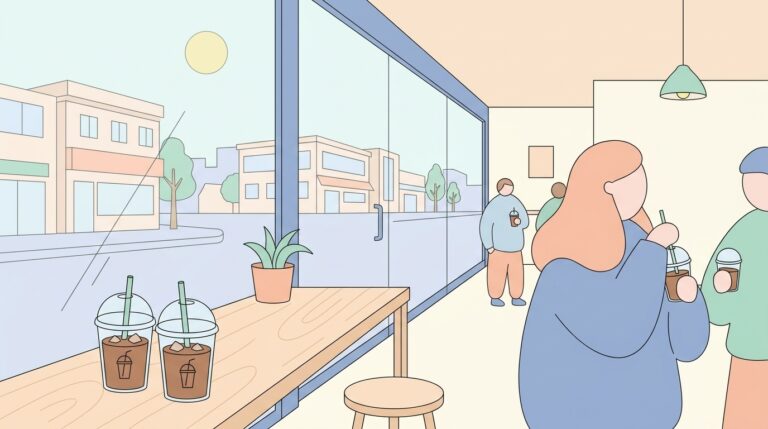
Why Koreans Drink 3 Coffees a Day: Essential Cafe Phrases & Survival Guide
Phase 1: 공감 (Empathy & Story-Driven Opening)
안녕하세요! 매일한글 에디터입니다. (Hello! I’m your Daily Hangul editor.)
Picture this: You step into a bustling Gangnam subway station at 8:30 AM. Half the commuters are holding a giant, sweating plastic cup of Iced Americano. By 12:45 PM, right after lunch, you see office workers marching in neat lines back to their towers, each carrying another cup. By 4:00 PM, your Korean colleague sighs, stretches their arms, and asks, “Shall we grab a coffee?”
If you’ve spent even 24 hours in South Korea, you quickly realize coffee isn’t just a morning beverage—it is the very oxygen of daily life. Many foreigners tell us they feel overwhelmed when trying to keep up with coworkers or navigate ordering at fast-paced local cafes. They worry about sounding robotic or missing out on the unspoken social rituals of the Korean “coffee walk.”
In this guide, based on real feedback from over 500 intermediate learners, we will break down the exact conversational tools you need to thrive in Korea’s 3-cups-a-day culture. By the end of this post, you won’t just know how to order coffee—you’ll know how to bond with native speakers over caffeine like a true local!
Phase 2: 핵심 표현 3선 심층 분석 (Core Expressions Deep Dive)
1. 카페인 충전 좀 해야겠어요. (Kapein chungjeon jom haeyagess-eoyo.)
- Pronunciation: kah-peh-een choong-jeon jom hae-yah-gess-uh-yo (Think of chungjeon like plugging in a dead smartphone to charge).
- Meaning: Literal: “I need to recharge my caffeine.” | Nuance: “I am totally running on empty and desperately need coffee to function.”
- K-Culture Moment: You see this constantly in office K-Dramas like Misaeng or Agency, where exhausted team members exchange tired smiles before heading to the pantry.
- Editor’s Insight: In Korean workplace culture, framing fatigue around “caffeine recharge” softens complaints about overwork into a relatable, shared social joke.
- Situation Spectrum: Casual ✅ | Semi-formal ✅ | Formal ⚠️
- 🤔 Think About It: In English, we often say “I need a coffee break.” Why do you think Korean uses the metaphor of charging a battery (충전)? What does this reveal about the pace of daily life?
2. 오늘 벌써 세 잔째예요. (Oneul beolsseo se janjjaeyeyo.)
- Pronunciation: oh-neul buhl-ssuh seh jahn-jjae-yeh-yo (The ss in beolsseo has a tight, crisp sound like the ‘ss’ in ‘hiss’).
- Meaning: Literal: “This is already my third cup today.” | Nuance: “I know it’s a lot, but that’s just how crazy my day has been!”
- K-Culture Moment: Heard across study cafes during university exam weeks, or when friends meet up for an evening chat at an indie cafe.
- Editor’s Insight: Adding 벌써 (beolsseo – already) emphasizes astonishment or mild self-deprecation about your heavy caffeine intake.
- Situation Spectrum: Casual ✅ | Semi-formal ✅ | Formal ⚠️
- 🤔 Think About It: Sharing how many cups of coffee you drank is often a subtle way Koreans express camaraderie through shared hardship (고생).
3. 커피 한잔 테이크아웃해서 산책할래요? (Keopi hanjan teikeu-a-ut-haeseo sanchaek-hallae-yo?)
- Pronunciation: kuh-pee hahn-jahn tay-keu-ah-oot-hae-suh sahn-chaek-hahl-lae-yo.
- Meaning: Literal: “Shall we take out a cup of coffee and take a walk?” | Nuance: “Let’s take a refreshing post-lunch stroll while sipping our coffee.”
- K-Culture Moment: In almost every romantic comedy, the transition from polite coworkers to close friends begins with a 15-minute coffee stroll around the block or near Cheonggyecheon Stream.
- Editor’s Insight: The 식후 커피 산책 (post-meal coffee walk) is an essential social bridge. It implies you want to talk about non-work topics in a relaxed setting.
- Situation Spectrum: Casual ✅ | Semi-formal ✅ | Formal 🚫
- 🤔 Think About It: Notice how the activity links eating, drinking, and walking together. Is walking with a beverage common after meals in your home country?
Phase 3: 교과서 한국어 vs 진짜 한국어 (Textbook vs. Real-World Korean)
Situation 1: Ordering an Iced Americano quickly
- 📖 교과서 한국어: 차가운 아메리카노 한 잔을 주문하고 싶습니다. (Chagaun amerkano han janeul jumunhago sipseumnida. – I would like to order one cold Americano.)
- 🗣️ 진짜 한국어: 아이스 아메리카노 한 잔 테이크아웃이요! (A-i-seu a-me-ri-ka-no han jan te-i-keu-a-ut-i-yo! – One Iced Americano to go, please!)
- 💡 왜 다를까?: Native speakers prioritize speed and clarity. In everyday cafes, people drop stiff honorifics like ~고 싶습니다 and use direct noun-ending phrases with ~요.
Situation 2: Suggesting an afternoon coffee run to coworkers
- 📖 교과서 한국어: 우리 이제 커피를 마시러 갑시다. (Uri ije keopireul masireo gapsida. – Let us go to drink coffee now.)
- 🗣️ 진짜 한국어: 우리 커피 수혈하러 가요! (Uri keopi suhyeol-hareo gayo! – Let’s go get some coffee blood transfusion!)
- 💡 왜 다를까?: At the B1 level, you should start using witty slang! 커피 수혈 (coffee blood transfusion) is universally understood as humorously treating coffee like life support.
Phase 4: K-Culture 딥다이브 & 비언어적 매너 (Deep Dive & Non-Verbal Manners)
4-1. 눈치 (Nunchi) & Cafe Etiquette
- Handing & Receiving Drinks: When a coworker or senior (선배/상사) hands you your drink, receive it with both hands (or one hand resting gently under your opposite forearm) and offer a quick nod.
- Table Manners & Seating: In busy lunch-hour cafes, never linger at a 4-person table alone if smaller seats are free. Keeping your eye on available seating shows great nunchi.
- Straw & Cup Sleeve Etiquette: Koreans grab straws and cardboard sleeves (홀더) from the pick-up counter instinctively. Offering to grab one for your companion is considered thoughtful and warm.
4-2. Cultural Code: The “Eol-Juk-Ah” Phenomenon
- Korea has a national subculture nicknamed 얼죽아 (Eol-juk-ah), short for 얼어 죽어도 아이스 아메리카노 (“Even if I freeze to death, I will drink Iced Americano”).
- Even in minus-10-degree winter weather, you will spot people holding iced drinks. Why? It’s fast to drink, delivers instant crisp caffeine, and matches the fast-paced 빨리빨리 (ppalli-ppalli) lifestyle.
Phase 5: 실전 롤플레이 시나리오 (Real-World Roleplay)
Setting: 1:15 PM at a bustling cafe in Yeouido Financial District. The line is moving fast, and your colleague Min-woo is checking his watch.
- 민우 (Min-woo):
🎭 하품을 작게 하며 목을 주무른다오늘 점심 먹고 나니까 너무 졸리네요. (Oneul jeomsim meokgo nanikka neomu jollineyo.) – I’m so sleepy after lunch today. - 학습자 (You):
🎭 고개를 끄덕이며 미소를 짓는다맞아요, 저도 카페인 충전 좀 해야겠어요. (Majayo, jeodo kapein chungjeon jom haeyagess-eoyo.) – Right, I need to recharge my caffeine too. - 민우 (Min-woo):
🎭 메뉴판을 가리키며저는 시원한 아아 마실 건데, 뭐 드실래요? (Jeoneun siwonhan a-a masil geonde, mwo deusillaeyo?) – I’m getting a refreshing Iced Americano, what will you have? - 학습자 (You):
🎭 지갑을 꺼내며저도 아아로 할게요. 오늘 벌써 세 잔째예요! (Jeodo a-a-ro halgeyo. Oneul beolsseo se janjjaeyeyo!) – I’ll have an Iced Americano too. This is already my 3rd cup today! - 민우 (Min-woo):
🎭 눈이 동그래지며 웃는다와, 세 잔이요? 오늘 진짜 열일하시네요. (Wa, se janiyo? Oneul jinjja yeoril-hasineyo.) – Wow, 3 cups? You are working really hard today. - 학습자 (You):
🎭 카운터를 향해 걸어가며네, 커피 한잔 테이크아웃해서 산책할래요? (Ne, keopi hanjan teikeu-a-ut-haeseo sanchaek-hallae-yo?) – Yeah! Shall we get takeout and go for a walk? - 민우 (Min-woo):
🎭 결제 카드를 내밀며좋아요! 5분 정도 공원 돌다 들어가요. (Joayo! Obun jeongdo gongwon dolda deureogayo.) – Sounds great! Let’s stroll in the park for 5 minutes before heading in. - 학습자 (You):
🎭 음료를 두 손으로 받아 들며완벽해요, 가요! (Wanbyeokhaeyo, gayo!) – Perfect, let’s go!
🔀 Interactive Choice Point
Min-woo insists on tapping his corporate card to pay for both of your coffees. What do you do?
- Option A: “제가 살게요!” (I will buy it!) while physically pushing his hand away.
- 👉 Feedback [Risk]: Too aggressive. In Korea, fighting too hard over small coffee bills can create unnecessary awkwardness if the other person is senior or invited you.
- Option B: “감사합니다! 다음엔 제가 맛있는 디저트 살게요.” (Thank you! Next time, I’ll buy us a nice dessert.)
- 👉 Feedback [Best]: Natural and polite! Accepting gracefully while promising reciprocity (기브 앤 테이크) is the golden standard of Korean social etiquette.
- Option C: Stand silently looking at your phone without saying thank you.
- 👉 Feedback [Bad]: Lacks nunchi and manners. Even if someone insists on treating, a warm verbal acknowledgment is essential.
Phase 6: 10초 감정 섀도잉 드릴 (10-Second Emotion Shadowing Drill)
Practice reading these out loud, pausing at the / marks, and copying the emotional tone!
[🥱 피곤하지만 간절하게 / Exhausted but desperate]- 아, / 진짜 / 카페인 충전 / 좀 해야겠어요.
(Ah, / jinjja / kapein chungjeon / jom haeyagess-eoyo.)
- 아, / 진짜 / 카페인 충전 / 좀 해야겠어요.
[😲 놀라움과 너스레 / Mild shock and self-deprecating chuckle]- 벌써 / 오늘만 / 세 잔째예요! / 저 어떡하죠?
(Beolsseo / oneulman / se janjjaeyeyo! / Jeo eotteokhajyo?)
- 벌써 / 오늘만 / 세 잔째예요! / 저 어떡하죠?
[☀️ 상쾌하고 기분 좋게 / Refreshing and breezy]- 날씨 좋은데 / 커피 테이크아웃해서 / 산책할래요?
(Nalssi joeunde / keopi teikeu-a-ut-haeseo / sanchaek-hallae-yo?)
- 날씨 좋은데 / 커피 테이크아웃해서 / 산책할래요?
Phase 7: K-Culture 미니 사전 (Mini Dictionary)
- 얼죽아 (Eol-juk-ah) [Noun]
- Meaning: Short for “Even if I freeze to death, Iced Americano.” Used playfully to describe hardcore iced coffee lovers in freezing weather.
- 커피 수혈 (Keopi Su-hyeol) [Noun/Slang]
- Meaning: “Coffee blood transfusion.” Refers to urgently drinking coffee to revive oneself from extreme lethargy or fatigue.
- 아아 (Ah-Ah) [Abbreviation]
- Meaning: Short for 아이스 아메리카노 (Iced Americano). The undisputed #1 order in Korean cafes.
- 디카페인 (Di-ka-pe-in) [Noun]
- Meaning: Decaf. If you already had 3 cups and can’t take more caffeine, ask: “디카페인으로 변경 가능해요?” (Can I change it to decaf?).
Phase 8: 여행자를 위한 생존 키트 (Traveler’s Survival Kit)
Survival Expressions TOP 3
- 연하게 해주세요. (Yeonhage hae-juseyo.)
- Meaning: Please make it weak / with less espresso shots.
- Pro Tip: Korean espresso shots are notoriously strong. Use this if you are caffeine-sensitive.
- 텀블러 할인 되나요? (Teombeulleo harin doenayo?)
- Meaning: Do you offer a tumbler discount?
- Pro Tip: Many franchises like Mega Coffee, Compose, and Starbucks give 100~400 KRW discounts for bringing your own reusable cup.
- 얼음 적게 넣어주세요. (Eoreum jeokge neoeojuseyo.)
- Meaning: Please put less ice.
- Pro Tip: Useful in winter when you want cold coffee without freezing your fingers off.
Editor’s Travel Note
- Most franchise cafes in Korea now use self-service touchscreen kiosks. You can switch the language to English, but knowing terms like 포장 (Takeout) vs 매장 (For Here) is vital.
- When looking for specialty cafes, skip generic Google searches. Instead, download the [Naver Map App for Cafe Navigation] to check real-time photo reviews, seat availability, and menus.
Phase 9: 한 발 더 깊이 (Cultural Reflection)
In many Western cultures, a cafe visit is a leisurely weekend luxury. In modern Korea, however, coffee serves as both the fuel for industrial productivity and a social lubricant in a dense urban society. Inviting someone for a coffee is rarely about the drink itself; it represents a brief, mutual ceasefire from intense daily pressures. It is an invitation to connect, breathe, and validate each other’s hard work.
💬 Your Turn: How many cups of coffee do you usually drink per day? If someone asked you for a “coffee recharge” right now, what drink would you order? Share with us in the comments below! (댓글로 여러분의 커피 습관을 알려주세요!)
Phase 10: FAQ & 흔한 실수 (FAQ & Common Mistakes)
Q: Can I sit inside the cafe with a takeout plastic cup?
A: No! Under Korean environmental regulations, single-use plastic cups are strictly prohibited for indoor seating. If you order “테이크아웃 (Takeout)”, you must consume it outside the cafe premises.
Q: How do I ask for an extra shot of espresso?
A: Simply say: “샷 추가해 주세요.” (Syat chugahae juseyo. – Please add a shot.).
Q: Is it okay to ask for decaf at any cafe in Korea?
A: Large chains (Starbucks, Twosome Place, Compose, Ediya) almost always offer decaf options. However, smaller local indie roasteries might not carry decaf beans, so it’s always polite to check first with “디카페인 있어요?” (Do you have decaf?).
🚨 흔한 실수 (Common Mistakes) 경고판
| Mistake | Why it Sounds Odd | Correct Action |
|---|---|---|
| Saying “뜨거운 아메리카노” awkwardly | Koreans rarely say “뜨거운” at counters | Say “따뜻한 아메리카노” (Tatteut-han Amerikano) or simply “뜨아” (Tteu-Ah) |
| Translating “To go” literally as “가다” | Confuses kiosk and counter staff | Use “테이크아웃” (Takeout) or “포장” (Pojang) |
| Handing cash/card with one hand to elders | Considered discourteous in business settings | Hand your payment card using both hands |
Phase 11: 액션 미션 & 참여 유도 (Action Missions)
- 🥉 Bronze Mission (Solo Practice): Look into the mirror and practice saying: “오늘 벌써 세 잔째예요!” with a dramatic tired expression 3 times.
- 🥈 Silver Mission (Social Challenge): Take a photo of your next coffee cup, post it on Instagram/Threads with the caption
#DailyHangul #카페인충전 #얼죽아, and tag us! - 🥇 Gold Mission (Real Life / Voice Note): Order your next coffee entirely in Korean—whether at a local Korean cafe or via voice messaging with a language exchange partner—using the phrase “아이스 아메리카노 한 잔 포장이요!”.
🎮 K-Culture Mission: Watch any modern workplace K-Drama (e.g., King the Land or Business Proposal) and count how many times characters walk into an office holding plastic takeout coffee trays!
Phase 12: 인터랙티브 퀴즈 챌린지 (Interactive Quiz)
1. Situation Judgment: It’s 2:00 PM and your coworker looks exhausted at their desk. What is the most natural, friendly B1 phrase to suggest grabbing a coffee?
* A) “커피를 빨리 사러 갑시다.”
* B) “우리 카페인 충전하러 갈래요?”
* C) “커피 마실 수 있습니까?”
👉 Click to view Answer & Explanation
- Correct Answer: B
- Explanation: Suggesting “우리 카페인 충전하러 갈래요?” (Shall we go recharge some caffeine?) is natural, polite, and uses modern social phrasing. Option A is too commanding, while Option C sounds overly stiff and unnatural.
2. Fill-in-the-Blank: Fill in the missing word.
“날씨가 너무 춥지만 저는 _______ 라서 아이스 커피를 마셔요!”
(Even though the weather is freezing, I’m an [ice-coffee-lover] so I drink iced coffee!)
👉 Click to view Answer & Explanation
- Correct Answer: 얼죽아 (Eol-juk-ah)
- Explanation: 얼죽아 describes someone who insists on drinking iced drinks regardless of freezing weather.
3. True or False: In South Korea, it is legal and normal to sit inside a cafe table for 2 hours while drinking from a single-use plastic takeout cup.
👉 Click to view Answer & Explanation
- Correct Answer: False
- Explanation: By law, disposable plastic cups cannot be used inside cafe dining areas. If you sit down, you must be served in a reusable mug/glass (매장용 컵).







