

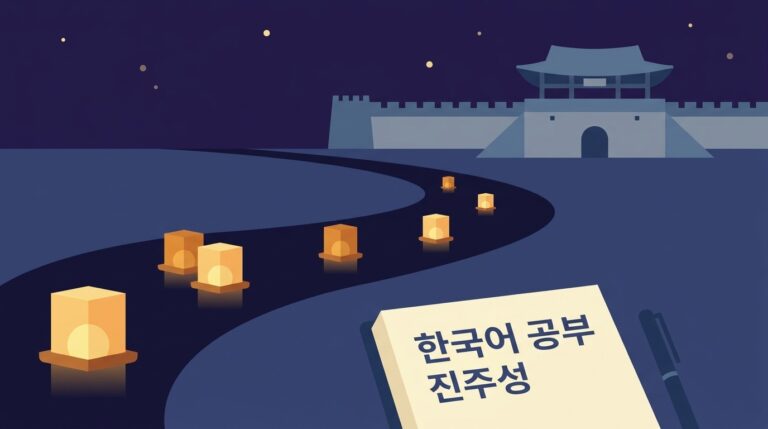
Master the Night Vibes: Jinju Namgang Yudeung Festival Korean Guide
Phase 1: Empathy (Story-Immersive Opening)
안녕하세요! 매일한글 에디터입니다.
Picture this: It is a crisp October evening in Jinju, Gyeongsangnam-do. The sun has dipped behind the historic ramparts of Jinjuseong Fortress, and suddenly, the dark waters of the Namgang River erupt into a kaleidoscope of glowing silk lanterns. Thousands of miniature wish lanterns bob on the gentle ripples while massive dragons and mythical heroes illuminate the night sky.
You are standing on the riverbank, mesmerized. You want to buy a lantern slip, step onto the floating bridge, and strike up a conversation with local festival-goers to share the pure magic of this scenery. But wait—do you just blurt out “Yeppeoyo” (It is pretty) like a beginner textbook student?
Expressing true awe and navigating a vibrant regional festival at an intermediate (B2) level requires nuanced, evocative Korean. You want to say that the panoramic night view takes your breath away, understand the etiquette of launching a wish lantern, and naturally join in the festive excitement. This masterclass is crafted from real traveler pain points and curated feedback from over 500 intermediate learners who wanted to move past robotic textbook lines into natural, expressive festival Korean.
Phase 2: Top 3 Core Expressions for Jinju Night Views
1. 야경이 한눈에 들어오네요 (Yagyeongi hannune deureooneyo)
- Pronunciation: [Ya-gyeong-i han-nu-ne deu-reo-o-ne-yo] (Think: “Ya-gyung-ee hahn-noo-neh dew-row-oh-neh-yo”)
- Meaning: Literal: “The night view enters in one eye” ➔ Actual Nuance: “You can take in the entire panoramic night view in a single glance!”
- K-Culture Moment: Heard frequently in romantic K-Drama scenes when the lead characters reach an observatory or riverside hill overlooking a dazzling cityscape.
- Editor’s Insight: The phrase
한눈에 들어오다is vastly superior to simple verbs like보이다(to be seen). It captures the majestic, wide-angle sweep of seeing Jinjuseong Fortress and the river lanterns all at once.- Situation Spectrum: Casual: ✅ (야경이 한눈에 들어와) | Semi-formal: ✅ (야경이 한눈에 들어오네요) | Formal: ✅ (야경이 한눈에 들어옵니다)
- 🤔 Think About It: In English, we “take in” a view; in Korean, the view “enters” into your eye. How does this passive visual absorption reflect Korean perceptual framing?
2. 강물에 소원을 띄우다 (Gangmure sowoneul ttiuda)
- Pronunciation: [Gang-mu-re so-wo-neul tti-u-da] (Think: “Gahng-moo-reh soh-wuh-neul ddee-oo-dah”)
- Meaning: Literal: “To float a wish on the river water” ➔ Actual Nuance: “To release a wish lantern onto the river.”
- K-Culture Moment: Seen in historical sageuk dramas where characters write secret hopes on paper boats or lanterns before gently sending them down river rapids.
- Editor’s Insight: In Jinju, lanterns are not merely decorative lights; they carry personal hopes (
소원). Using the verb띄우다(to float/send off) demonstrates an authentic grasp of festive cultural customs.- Situation Spectrum: Casual: ✅ (소원 띄우자) | Semi-formal: ✅ (소원 띄워 봐요) | Formal: ✅ (소원을 띄우겠습니다)
- 🤔 Think About It: Why does Korean link abstract feelings (like wishes) with concrete physical actions on water and wind?
3. 축제 분위기에 흠뻑 젖다 (Chukje bunwigie heumppeok jeotda)
- Pronunciation: [Chuk-je bun-wi-gi-e heum-ppeok jeot-da] (Think: “Chook-jeh boon-wee-gee-eh hoom-puk jut-dah”)
- Meaning: Literal: “To be drenched completely in festival atmosphere” ➔ Actual Nuance: “To be totally soaked in / fully immersed in the festival spirit.”
- K-Culture Moment: Korean travel variety shows (like 2 Days & 1 Night) often use this phrase when cast members lose themselves in night markets and street parades.
- Editor’s Insight:
흠뻑is an evocative onomatopoeic adverb meaning “drenched/soaked through.” Pairing it with분위기elevates your Korean from basic conversationalist to expressive storyteller.- Situation Spectrum: Casual: ✅ (분위기에 흠뻑 젖었어) | Semi-formal: ✅ (분위기에 흠뻑 젖게 되네요) | Formal: ✅ (분위기에 흠뻑 젖어 듭니다)
- 🤔 Think About It: Contrast “immersed in vibes” with “drenched in vibes.” What sensory imagery does wetness convey in Korean emotional expression?
Phase 3: Textbook Korean vs. Real Korean
Situation 1: Expressing awe at the panoramic river lanterns
- 📖 교과서 한국어 (Textbook):
- 경치가 아주 아름답습니다. (Gyeongchiga aju areumdapsumnida. / The scenery is very beautiful.)
- 🗣️ 진짜 한국어 (Real Korean B2):
- 강 위에 뜬 유등 보니까 진짜 가슴이 웅장해지네요! (Gang wie tteun yudeung bonikka jinjja gaseumi ungjanghaejineyo! / Seeing these lanterns floating on the river truly feels magnificent!)
- 💡 왜 다를까? (Why the difference?):
- While 아름답습니다 is grammatically sound, native speakers at grand nighttime festivals prefer sensory, emotive expressions like
가슴이 웅장해지다(one’s heart feels grandeur/stirred) to match the visual scale.
- While 아름답습니다 is grammatically sound, native speakers at grand nighttime festivals prefer sensory, emotive expressions like
Situation 2: Asking someone to snap a memorable night photo
- 📖 교과서 한국어 (Textbook):
- 저의 사진을 찍어 주실 수 있습니까? (Jeoui sajineul jjigeo jusil su isseumnikka? / Can you take my picture?)
- 🗣️ 진짜 한국어 (Real Korean B2):
- 실례지만, 유등 배경으로 인생샷 한 장만 남겨주실 수 있을까요? (Sillyejiman, yudeung baegyeongeuro insaengsyat han jangman namgyeojusil su isseulkkayo? / Excuse me, could you take a memorable life shot of me with the lanterns in the background?)
- 💡 왜 다를까? (Why the difference?):
- Intermediate Korean embraces modern colloquial collocations such as
인생샷(photo of a lifetime) and남기다(to leave/capture a memory), transforming a mechanical request into a warm, relatable interaction.
- Intermediate Korean embraces modern colloquial collocations such as
Phase 4: K-Culture Deep Dive & Non-verbal Manners
4-1. Nunchi & Gestures: Crossing the Floating Bridges (부교)
- Floating Bridge Etiquette: During the festival, temporary pontoon bridges (부교, Bugyo) connect Jinjuseong Fortress with the opposite riverbank. They sway gently with the river current.
- Crowd Flow Nunchi: Avoid stopping abruptly right in the middle of narrow pontoon gangways to take selfies. Instead, step to the designated photo alcoves, give a slight bow of acknowledgment (
목례) to the marshals holding glowing safety batons, and offer to take photos for groups waiting near the railing.
4-2. Cultural Code: From Defense Beacon to Lanterns of Peace
- Historical Heritage: The Jinju Namgang Yudeung Festival traces its roots back to the 1592 Jinju Fortress Battle during the Imjin War. Military Commander Kim Si-min floated lanterns down the river to illuminate enemy night troop movements and send personal survival messages to soldiers’ families outside the besieged castle.
- Modern Transformation: What began as a wartime defense strategy and poignant familial beacon has transformed over 400 years into Korea’s premier festival of peace, hope, and artistic community bonding.
Phase 5: Real-world Roleplay Scenario
- Setting: Riverside Wish Lantern Pavilion on the Namgang bank beneath Chokseongnu Pavilion.
- Characters: You (Intermediate Traveler) & Min-jun (진주 청년 자원봉사자 / Jinju Local Youth Volunteer).
-
Turn 1 (Min-jun):
- 🎭 [따뜻한 미소로 소원지 종이를 건네며]
- 어서 오세요! 유등 띄우기 체험하러 오셨나요?
- (Eoseo oseyo! Yudeung ttiugi cheheomhareo osyeonnayo?)
- Welcome! Are you here to try floating a wish lantern?
- Turn 2 (You):
- 🎭 [호기심 가득한 눈으로 소원지를 바라보며]
- 네! 야경이 너무 근사해서 꼭 참여해보고 싶었어요. 소원지는 어떻게 쓰면 돼요?
- (Ne! Yagyeongi neomu geunsahaeseo kkok chamyeohaebogo sipeosseoyo. Sowonjineun eotteoke sseumyeon dwaeyo?)
- Yes! The night view is so magnificent that I really wanted to participate. How should I write the wish slip?
- Turn 3 (Min-jun):
- 🎭 [붓펜을 쥐여주며 친절하게 가리킨다]
- 건강이나 학업처럼 바라시는 걸 정성껏 적으신 뒤에, 저기 유등 안쪽에 붙이시면 됩니다.
- (Geongang-ina hageopcheoreom barasineun geol jeongseongkkeot jeogeusin dwie, jeogi yudeung anjjoge buchisimyeon doemnida.)
- You can write your hopes—like health or studies—with care, and attach it inside the lantern over there.
- Turn 4 (You):
- 🎭 [소원지에 또박또박 한글로 적은 후]
- 다 썼어요! ‘한국어 마스터하기’라고 적었는데, 강물에 띄우면 정말 소원이 이뤄질까요?
- (Da sseosseoyo! ‘Hangugeo maseuteohagi’rago jeogeonneunde, gangmure ttiumyeon jeongmal sowoni irwojilkkayo?)
- All done! I wrote ‘Mastering Korean’—if I float this on the river, will my wish really come true?
- Turn 5 (Min-jun):
- 🎭 [엄지를 치켜세우며 유쾌하게]
- 남강 유등의 기운이 워낙 좋아서 무조건 이뤄질 겁니다! 자, 이쪽 부교로 이동해서 띄워볼까요?
- (Namgang yudeungui giuni wonak joaseo mujogeon irwojil geomnida! Ja, ijjok bugyoro idonghaeseo ttiwobolkkayo?)
- The energy of the Namgang lanterns is so powerful that it will definitely come true! Now, shall we head to the floating bridge to release it?
- Turn 6 (You):
- 🎭 [조심스럽게 강물에 등불을 내려놓으며]
- 멀리 떠내려가는 불빛을 보니까 마음이 몽글몽글해지네요.
- (Meolli tteonaeryeoganeun bulbicheul bonikka maeumi monggeulmonggeulhaejineyo.)
- Watching the glowing light drift away makes my heart feel all warm and fuzzy.
- Turn 7 (Min-jun):
- 🎭 [강 건너 촉석루 조명을 가리키며]
- 맞아요. 저기 촉석루 조명 켜진 곳 보이시죠? 저기가 인생샷 명당이니 꼭 들러보세요!
- (Majayo. Jeogi Chokseongnu jomyeong kyeonjin got boisijyo? Jeogiga insaengsyat myeongdang-ini kkok deulleoboseyo!)
- Indeed. See where the lights are on at Chokseongnu Pavilion over there? That is the prime photo spot, so be sure to check it out!
- Turn 8 (You):
- 🎭 [가볍게 고개 숙여 인사하며]
- 친절하게 안내해주셔서 감사해요. 축제 분위기에 흠뻑 취해볼게요!
- (Chinjeolhage annaehaejusyeoseo gamsahaeyo. Chukje bunwigie heumppeok chwihaebolgeyo!)
- Thank you for guiding me so kindly. I will soak up the festive atmosphere to the fullest!
🔀 Interactive Scenario Branches
- Choice A (Best): “야경 명당까지 추천해주셔서 감사해요. 부교 건너면서 천천히 감상할게요!” (Polite, acknowledges the local tip, flows seamlessly into the night walk.)
- Choice B (Risk): “저기 다리는 공짜인가요, 아니면 표 검사 따로 하나요?” (A bit blunt; while practical, asking transactional questions right after a sentimental wish-floating moment breaks conversational rapport.)
- Choice C (Bad): “사람이 너무 많아서 어지럽네요. 빨리 나가는 길 어디예요?” (Complaining about crowds at a celebratory festival kills the shared excitement.)
Phase 6: 10-Second Emotion Shadowing Drill
- [✨ 감탄하며 벅찬 목소리로 – Awe & Wonder]
- 진주 남강에 / 수천 개의 유등이 뜨니까 / 밤하늘이 낮처럼 / 환해지네요!
- (Jinju Namgange / sucheon gaeui yudeungi tteunikka / bamhaneuri natcheoreom / hwanhaejineyo!)
- As thousands of lanterns float on Jinju’s Namgang River, the night sky turns as bright as day!
- [🙏 진심을 담아 간절하게 – Earnest Wishful Tone]
- 정성껏 띄운 소원등이 / 꺼지지 않고 / 저 멀리까지 / 닿았으면 좋겠어요.
- (Jeongseongkkeot ttiun sowondeungi / kkeojiji anko / jeo meollikkaji / daasseumyeon jokesseoyo.)
- I hope the wish lantern I sent with all my heart floats far away without going out.
- [🥳 텐션을 올려 신나게 – Vibrant Festive Energy]
- 야시장 먹거리 냄새에 / 화려한 불빛까지 더해지니까 / 축제 기분 제대로 나네요!
- (Yasijang meokgeori naemsaee / hwaryeohan bulbitkkaji deohaejinikka / chukje gibun jedaero naneyo!)
- With the aroma of night market food combined with the dazzling lights, I truly feel the festival spirit!
Phase 7: K-Culture Mini Dictionary
- 유등 (Yudeung / 油燈)
- Translation: Floating Oil/Paper Lantern.
- Usage: Specific cultural term referring to historical and ornamental lanterns floated on water bodies during traditional memorial and seasonal festivals.
- 부교 (Bugyo / 浮橋)
- Translation: Pontoon / Floating Bridge.
- Usage: Temporary walking bridges anchored across the river during Korean river festivals, allowing visitors to cross on the water surface.
- 소원지 (Sowonji / 所願紙)
- Translation: Wish Paper Slip.
- Usage: Long strips of paper upon which visitors write aspirations for family health, success, and prosperity before attaching them to lanterns or temple walls.
- 물멍 (Mulmeong / Slang-Compound)
- Translation: Staring blankly at water to zone out and relax.
- Usage: Modern Korean lifestyle trend of therapeutic relaxation by silently watching ripples, bonfires (불멍), or lantern reflections on the water.
Phase 8: Traveler’s Survival Kit
Top 3 Survival Phrases
- 부교 건너는 매표소가 어디예요?
- (Bugyo geonneoneun maepyosoga eodiyeyo? / Where is the ticket booth to cross the floating bridge?)
- Pro Tip: During the festival peak, floating bridges often require a nominal wristband pass or crossing ticket.
- 소원등 띄우기 체험은 몇 시까지 하나요?
- (Sowondeung ttiugi cheheomeun myeot sikkaji hanayo? / Until what time is the wish lantern floating experience open?)
- Pro Tip: The lantern pavilion typically wraps up ticket sales 30 to 60 minutes before the river access closes at night.
- 진주성 쪽 야경 잘 나오는 뷰포인트가 어디예요?
- (Jinjuseong jjok yagyeong jal naoneun byupointeuga eodiyeyo? / Where is the best viewpoint to capture Jinjuseong Fortress at night?)
- Pro Tip: Ask staff near Chokseongnu for directions to the riverbank overlook rocks.
Editor’s Travel Note
- Transportation: Jinju is easily accessible via KTX from Seoul Station (approx. 2 hrs 15 mins to Jinju Station), followed by dedicated city festival shuttle buses running directly to the river.
- Essential Navigation App: Download and check the 네이버 지도 앱 다운로드 (Naver Map App Download) to track real-time festival shuttle stops and avoid traffic detours.
- Payment Tip: Night market food stalls (포장마차/푸드트럭) universally support Korean debit/credit cards, KakaoPay, and cash, but keeping small cash bills ensures zero wait time when buying handmade wish lanterns.
Phase 9: 한 발 더 깊이 (One Step Deeper)
In Western festival traditions, lanterns are often released upward into the boundless sky—an expansive, individualistic reach toward the stars. In Korea’s Namgang tradition, lanterns are gently laid onto the flowing river. Water in Korean philosophical thought represents collective time, continuity, and cleansing. By placing personal hopes alongside thousands of others on a shared current, the community symbolically reconciles historical trauma from ancient sieges and transforms it into shared solidarity. When you release a lantern in Jinju, you are not merely making a wish; you are weaving your personal hope into a centuries-old stream of collective healing.
💬 Your Turn: If you were standing at the banks of the Namgang River tonight, what wish would you write on your 소원지? Share your wish in Korean in the comments below!
Phase 10: FAQ & Common Mistakes
Q: What is the difference between 등 (Deung) and 유등 (Yudeung)?
A: 등 (Deung) is an umbrella term for any lantern or light fixture (e.g., 가등, 연등). 유등 (Yudeung) specifically designates lanterns that float on water or use floating oil wicks, intrinsically tied to the historic Namgang festival.
Q: Can I float lanterns anywhere along the riverbank?
A: No. Due to river safety and environmental recovery systems, lantern floating is only permitted at designated experiential piers (체험장) with safety guides.
Q: How do I express that the festival is bustling without sounding negative?
A: Instead of saying 사람이 너무 많아서 싫어요 (Too many people, I hate it), use 북적북적해서 축제 분위기 제대로 나네요! (It is delightfully lively and feels like a true festival!).
🚨 Common Mistakes Warning Board
- Mistake: Confusing
띄우다(to float something) with뜨다(to float by itself).- Incorrect: 내가 소원을 떴어요 (Naega sowoneul tteosseoyo).
- Correct Action: 내가 소원을 띄웠어요 (Naega sowoneul ttiwosseoyo).
- Mistake: Saying 빛이 밝아요 (The light is bright) when admiring the full scenery.
- Correct Action: Say 야경이 장관이네요! (The night view is a grand spectacle!).
- Mistake: Using flat textbook honorifics (사진 찍어라) with friendly strangers.
- Correct Action: Always use soft honorific suggestions: 사진 한 장 찍어드릴까요? (Shall I take a photo for you?).
Phase 11: Action Missions & Engagement
- 🥉 Bronze Mission (Solo Practice): Read the Phase 6 Shadowing Drill aloud three times, emphasizing the natural breath pause at each
/mark. - 🥈 Silver Mission (Social Media): Post a nighttime scenery photo on your Instagram Story and caption it in Korean: “야경이 한눈에 들어오는 밤 ✨ #진주남강유등축제”.
- 🥇 Gold Mission (Real-World Execution): Next time you visit a night festival or riverside market, strike up a conversation with a vendor using: “축제 분위기에 흠뻑 젖어서 시간 가는 줄 모르겠어요!”
- 🎮 K-Culture Mission: Watch an episode of a historical travel K-Drama (such as Mr. Sunshine or The King’s Affection) and spot the exact moment lanterns are floated down water.
Phase 12: Interactive Quiz Challenge
1. Situational Judgment:
You want to describe the panoramic night view of Jinjuseong Fortress and the river illuminated with thousands of lanterns in a natural, intermediate way. Which expression is most fitting?
* A) 등이 조금 켜져 있습니다.
* B) 야경이 한눈에 들어와서 가슴이 웅장해져요.
* C) 밤이라서 아무것도 안 보여요.
2. Fill in the Blank:
한국어 실력이 늘기를 바라는 마음을 담아 남강에 소원을 [ ].
* A) 덮었다
* B) 띄웠다
* C) 깎았다
3. True / False Cultural Check:
The Jinju Namgang Yudeung Festival originated purely as a modern commercial light festival created in the year 2000.
* (True / False)
🔍 Click here for Answer & Explanation
- Correct Answer: B (야경이 한눈에 들어와서 가슴이 웅장해져요)
- Explanation: Option B beautifully uses B2-level collocations describing both visual panorama and emotional resonance.
- Correct Answer: B (띄웠다)
- Explanation: The verb
띄우다(past tense:띄웠다) is the standard collocation for floating lanterns or wishes onto water.
- Explanation: The verb
- Correct Answer: False
- Explanation: The festival dates back to military communication and family signal lanterns during the 1592 Jinju Fortress Battle in the Imjin War.
- Explanation: The festival dates back to military communication and family signal lanterns during the 1592 Jinju Fortress Battle in the Imjin War.







