

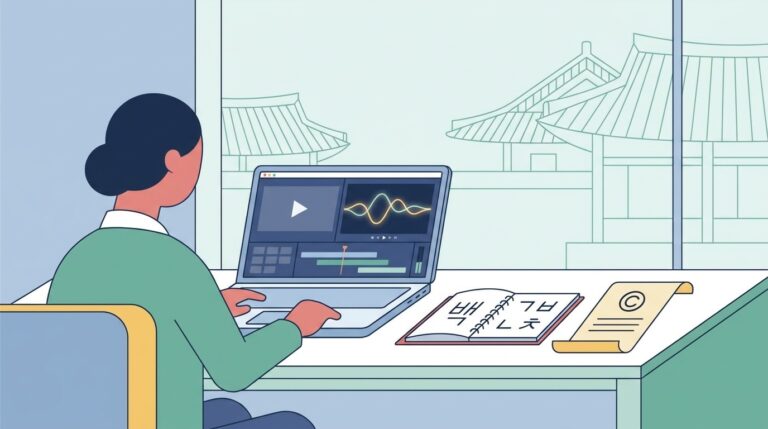
Phase 1: Empathy (Story-Driven Opening)
안녕하세요! 매일한글 에디터입니다. (Annyeonghaseyo! It’s your Daily Hangul editor.)
Picture this: You’ve spent forty-eight hours roaming the neon-lit alleyways of Euljiro and capturing pristine 4K footage of Seoul’s bustling night markets. You spent another three days color-grading and slicing your vlog to the buttery beats of a rising Korean indie bedroom-pop artist you discovered on SoundCloud. You hit “Publish” on YouTube, expecting waves of comments—only to wake up the next morning to a dreaded red banner: 저작권 침해 신고 (Copyright Claim). Your video is demonetized, or worse, blocked in South Korea.
Navigating YouTube background music (BGM) copyright in South Korea can feel like untangling headphone cords in the dark. Korean copyright law (저작권법, jeojakkwonbeop) and collective management systems like KOMCA (한국음악저작권협회, Hanguk Eum-ak Jeojakkwon Hyeophoe) possess unique legal frameworks and social etiquette. At a C1 advanced level, learning these concepts isn’t just about avoiding a strike; it is about knowing how to professionally contact Korean producers, negotiate sync terms, and understand the cultural ethics of creative attribution.
Based on real feedback from international content creators and digital nomads living in Seoul, this guide equips you with nuanced, professional, and socially savvy Korean expressions to navigate creative ownership with confidence.
Phase 2: Top 3 Core Expressions Breakdown
1. 출처를 명시하다 (Chulcheoreul myeongsihada)
- Pronunciation: [Chool-cheo-reul myeong-si-ha-da] (Sounds like “chul-chuh” with a sharp, clear “myeong-shee”)
- Meaning: Literally “to clearly specify the origin/source” | Nuance: To properly credit and attribute the original creator according to licensing guidelines.
- K-Culture Moment: Seen in the description box (더보기란, deobogiran) of popular Korean vloggers: “영상 내 음원 출처는 더보기란에 명시되어 있습니다.” (The BGM sources used in this video are specified in the description box.)
- Editor’s Insight: In Korean creator culture, failing to credit isn’t merely a legal oversight—it’s viewed as a breach of creative etiquette (예의, ye-ui). Using 명시하다 shows high linguistic sophistication compared to the basic 적다 (to write) or 쓰다 (to use).
- Situation Spectrum: Casual ⚠️ | Semi-formal ✅ | Formal ✅
- 🤔 Think About It: How does giving credit in your native language balance legal requirements versus community respect compared to Korea’s strict attribution culture?
2. 상업적 이용이 가능한가요? (Sang-eopjeok iyong-i ganeunghangayo?)
- Pronunciation: [Sang-eop-jjeok ee-yong-ee gah-neung-hang-gah-yo?]
- Meaning: Literally “Is commercial utilization possible?” | Nuance: Can I monetize my content (via YouTube AdSense, sponsored segments, or commercial distribution) using this music?
- K-Culture Moment: Frequently used when direct messaging (DMing) independent beatmakers on Instagram or audio platforms before dropping a track into an edit.
- Editor’s Insight: In Korean copyright terminology, distinguishing between 비영리적 사용 (non-profit use) and 상업적 이용 (commercial use/monetization) is crucial. Asking this exact phrasing prevents costly copyright disputes.
- Situation Spectrum: Casual ⚠️ | Semi-formal ✅ | Formal ✅
- 🤔 Think About It: In English, we often say “Can I use this for monetized videos?”. Notice how Korean packages “commercial use” into a single Sino-Korean compound (상업적 이용).
3. 저작권 침해 우려가 있다 (Jeojakkwon chimhae uryeoga itda)
- Pronunciation: [Jeo-jak-kwon cheem-hae oo-ryeo-gah eet-da]
- Meaning: Literally “There is concern/worry of copyright infringement.” | Nuance: A sophisticated, diplomatic way of stating “This might violate copyright policies, so let’s tread carefully.”
- K-Culture Moment: Heard in production meetings at Korean broadcasting networks (Mnet, tvN) and MCN (Multi-Channel Network) agencies when reviewing video drafts.
- Editor’s Insight: Koreans rarely say flatly, “This is illegal” (이거 불법이에요) in professional settings. Instead, using 우려가 있다 softens the claim while maintaining a firm, professional stance.
- Situation Spectrum: Casual 🚫 | Semi-formal ✅ | Formal ✅
- 🤔 Think About It: Why does professional Korean rely heavily on nominalized expressions of caution (like “concern exists”) rather than direct confrontational statements?
Phase 3: Textbook Korean vs. Real Native Korean
Situation 1: Asking an indie producer for permission to use their track in your video
- 📖 교과서 한국어 (Textbook Korean): 저작권 허가를 받고 싶습니다. (Jeojakkwon heogareul batgo sipseumnida.) — I want to receive copyright permission.
- 🗣️ 진짜 한국어 (Real Native Korean): 혹시 유튜브 BGM으로 음원 사용 허락을 구할 수 있을까요? (Hoksi yutyubeu BGM-euro eum-won sayong heorakeul guhal su isseulkkayo?) — Could I possibly seek your permission to use your audio track as background music for YouTube?
- 💡 왜 다를까? (Why the difference?): Saying 허가를 받다 sounds bureaucratic, like applying for a government construction permit. Native speakers use the humble phrase 허락을 구하다 (to seek gracious permission) with 혹시 to sound polite and respectful.
Situation 2: Inquiring whether a “royalty-free” beat allows channel monetization
- 📖 교과서 한국어 (Textbook Korean): 이것은 무료 음악입니까? (Igeoseun muryo eum-agimnikka?) — Is this free music?
- 🗣️ 진짜 한국어 (Real Native Korean): 이 음원 영상에 삽입해서 수익 창출해도 문제없을까요? (I eum-won yeongsang-e sabiphaeseo su-ik changchulhaedo munjeeopseulkkayo?) — If I insert this track into my video and monetize it, will there be no issues?
- 💡 왜 다를까? (Why the difference?): “Free” (무료) in Korea often covers only personal listening. Content creators care specifically about 수익 창출 (monetization/revenue generation) and 영상 삽입 (insertion into video/sync).
Phase 4: K-Culture Deep Dive & Non-Verbal Manners
4-1. 눈치 (Nunchi) & Creator Etiquette when DMing Korean Artists
When reaching out to Korean indie musicians, beatmakers, or illustrators:
* Start with specific appreciation: Do not paste a generic template. Mention the exact track title and what you liked about their chord progression or mood.
* State usage parameters upfront: State your channel genre, whether the video is sponsored (유료 광고 포함), where the credit link will sit, and whether monetization is enabled.
* Closing with respectful humility: Always end business communications with phrases like “답변 기다리겠습니다. 편하실 때 회신 부탁드립니다.” (I look forward to your reply. Please respond at your convenience.)
4-2. The Culture of ‘Playlist (플리) Channels’ and KOMCA in Korea
South Korea has an immense subculture of YouTube “Playlist” (플리) channels featuring aesthetic loops and curated K-Indie or R&B tracks. Many international creators mistakenly assume these playlist tracks are free to sample.
In reality, South Korea’s KOMCA (한국음악저작권협회) operates an automated Content ID sync system with YouTube. Even if an artist says “Sure, use it!” in an Instagram DM, if the song is registered with KOMCA, KOMCA’s automated system will flag your video and route the advertising revenue directly to the songwriter. Understanding the distinction between 저작재산권 (economic rights managed by KOMCA) and the artist’s personal permission is essential for serious creators.
Phase 5: Real-World Roleplay Scenario
Setting: Alex (an international travel vlogger living in Mapo-gu) is meeting Min-ho (an indie lofi producer) at a shared creator studio in Hongdae to discuss licensing a track for a commercial travel series.
- 알렉스: 민호 님, 지난번에 들려주신 신곡 비트가 이번 서울 브이로그 영상 분위기와 정말 잘 맞아서요. (Min-ho nim, jinanbeon-e deullyeojusin sin-gok biteuga ibeon seoul beuilrogeu yeongsang bun-wigiga jeongmal jal maj-aseoyo.)
🎭 Leaning forward slightly with genuine enthusiasm, showing a preview clip on a tablet.
(Min-ho, the beat from the new track you shared last time matches the vibe of my Seoul vlog series perfectly.) - 민호: 아, 진짜요? 마음에 드셨다니 다행이네요! (A, jinjjayo? Ma-eum-e deusyeotdani dahaeng-ineyo!)
🎭 Smiling warmly while checking the video edit.
(Oh, really? I’m so glad you like it!) - 알렉스: 혹시 이번 프로젝트 영상 BGM으로 음원을 활용해도 괜찮을까요? (Hoksi ibeon peurojekteu yeongsang BGM-euro eum-woneul hwal-yonghaedo gwaenchaneulkkayo?)
🎭 Maintaining polite eye contact with both hands resting gently on the table.
(Could I possibly use the audio as background music for this project video?) - 민호: 유튜브 업로드용이면 언제든 환영이죠. 출처 표기만 깔끔하게 해주시면 돼요. (Yutyubeu eobeurodeuyong-imyeon eonjedeun hwanyeong-ijyo. Chulcheo pyogiman kkalkkeumhage haejusimyeon dwaeyo.)
🎭 Nodding casually.
(If it’s for YouTube uploads, you’re always welcome! Just make sure to credit the source cleanly.) - 알렉스: 감사합니다! 다만 이번 영상에 지자체 협찬이 포함되어 있어서, 상업적 이용 및 2차 가공 범위에 대해 미리 조율하고 싶습니다. (Gamsahamnida! Daman ibeon yeongsang-e jijache hyeopchan-i pohamdoeeo isseoseo, sang-eopjeok iyong mit icha gagong beom-wie daehae miri joyulhago sipseumnida.)
🎭 Handing over a neatly organized one-page sync agreement summary.
(Thank you! However, since this video includes local government sponsorship, I’d like to coordinate the scope of commercial use and derivative adaptation in advance.) - 민호: 아, 스폰서십이 들어간 영상이군요. 꼼꼼하게 짚어주셔서 감사합니다. (A, seuponseosibi deureogan yeongsang-igunyo. Kkomkkomhage jipeojusyeoseo gamsahamnida.)
🎭 Reading through the summary with an approving nod.
(Ah, it’s a sponsored video! Thank you for being so thorough about this.) - 알렉스: 음원 수정이나 템포 조절 없이 원곡 그대로 삽입하고, 더보기란 상단에 음원 링크와 크레딧을 명시하겠습니다. (Eum-won sujeong-ina tempo jojeol eopsi won-gok geudaero sabiphago, deobogiran sangdan-e eum-won ringkeuwa keurediseul myeongsihagessseumnida.)
🎭 Explaining the exact technical implementation clearly.
(I will insert the original track as-is without alterations or tempo changes, and place the track link and credit at the very top of the description box.) - 민호: 좋습니다. 정식 라이선스 계약서 초안 보내주시면 바로 서명해서 전달드릴게요! (Joeusseumnida. Jeongsing raiseonseu gyeyakseo cho-an bonaejusimyeon baro seomyeonghaeseo jeondaldeurilgeyo!)
🎭 Offering a firm, friendly handshake.
(Sounds great. Send me the formal licensing contract draft, and I’ll sign and return it right away!)
🔀 Interactive Choice Point
During the negotiation, Min-ho asks: “Is this song going to be used in paid social media ads as well?”
How should Alex respond if he plans to run short Instagram Ad promos?
- Option A: “아니요, 그냥 유튜브에만 올릴 건데 쇼츠랑 인스타 광고에도 조금 쓸게요.” (No, I’ll just put it on YouTube, but I’ll use it a little bit on Shorts and Instagram Ads too.)
- Option B: “추후 2차 마케팅 광고 집행 가능성이 있어서, 광고 활용 범위를 포함한 라이선스 비용을 별도로 협의하고 싶습니다.” (There is a possibility of executing secondary marketing ads later, so I’d like to separately discuss licensing fees that cover advertising use.)
- Option C: “저작권 침해 우려 없게 제가 알아서 5초 이하로 짧게 자를게요.” (I’ll cut it under 5 seconds on my own so there’s no copyright concern.)
Feedback:
* Option A (Bad): Contradictory and unprofessional. Using a track in paid promotional ads requires distinct licensing beyond organic YouTube uploads.
* Option B (Best ✅): Flawless C1-level business Korean. Differentiating standard usage from secondary ad execution (2차 마케팅 광고 집행) builds tremendous professional trust.
* Option C (Risk ⚠️): Dangerous myth. The “5-second/3-second copyright rule” is legally false in both Korean and international copyright law.
Phase 6: 10-Second Emotional Shadowing Drill
Practice these lines with native rhythm markers (/ indicates a natural breath/intonation pause):
[🤝 정중하고 신뢰감 넘치게 / Courteous and confident]- 혹시 이번 프로젝트 영상에 / 음원을 활용해도 / 괜찮을까요?
- (Hoksi ibeon peurojekteu yeongsang-e / eum-woneul hwal-yonghaedo / gwaenchaneulkkayo?)
[🧐 명확하고 프로페셔널하게 / Clear and analytical]- 상업적 이용 및 / 2차 가공 허용 범위에 대해 / 사전에 협의하고 싶습니다.
- (Sang-eopjeok iyong mit / icha gagong heoyong beom-wie daehae / sajeon-e hyeobyihago sipseumnida.)
[🙏 감사와 존중을 담아 / Gracious and appreciative]- 영상 더보기란 상단에 / 공식 음원 출처와 크레딧을 / 반드시 명시하겠습니다.
- (Yeongsang deobogiran sangdan-e / gongsik eum-won chulcheowa keurediseul / bandeusi myeongsihagessseumnida.)
Phase 7: K-Culture Mini Dictionary
- 음원 라이선스 (Eum-won Raiseonseu) | Music Synchronization License
- Legal authorization granted by the copyright owner allowing an audio track to be synced with moving visual images (videos, vlogs, documentaries).
- 저작인격권 (Jeojakingyeokgwon) | Moral Rights of the Author
- Non-transferable personal rights of the creator under Korean law, which include the right to claim authorship (성명표시권) and protect the integrity of the work (동일성유지권).
- 무료 BGM / 노카피라이트 (Muryo BGM / Nokapiraito) | Royalty-Free / No-Copyright Audio
- Freely accessible background tracks intended for content creation. In Korea, always double-check if CC BY (attribution required) or non-commercial constraints apply.
- 한국음악저작권협회 (KOMCA / Eumjeohyeop) | Korea Music Copyright Association
- The major collective rights management organization in South Korea representing composers, lyricists, and music publishers.
Phase 8: Creator Survival Kit
Top 3 Creator Survival Expressions in Korea
- 상업적 무료 음원인가요? (Sang-eopjeok muryo eum-won-in-gayo? / Is this audio free for commercial use?)
- Pro Tip: Use this when browsing Korean royalty-free audio libraries or indie sample platforms.
- 크레딧 표기 가이드라인이 어떻게 되나요? (Keuredit pyogi gaideurain-i eotteoke doenayo? / What are the guidelines for crediting?)
- Pro Tip: Ask this directly to Korean artists to receive their preferred text string for your description box.
- 저작권 침해 경고를 받았습니다. (Jeojakkwon chimhae gyeong-goreul badasseumnida. / I received a copyright infringement strike/warning.)
- Pro Tip: Essential when communicating with your Multi-Channel Network (MCN) or legal counsel in Korea.
Editor’s Resource & Workflow Note
When hunting for 100% legal, royalty-free traditional and contemporary Korean music provided by the Korean government for global creators, visit the official 한국저작권위원회 공유마당 공공누리 포털. Look for assets labeled KOGL Type 1 (제1유형), which permits commercial use and modification as long as source attribution is provided.
Phase 9: “One Step Deeper” (Cultural Reflection)
In South Korea’s digital ecosystem, the concept of 창작자에 대한 리스펙트 (Respect for Creators) runs parallel to strict legal codification. Korean society places immense value on social trust (신뢰) and procedural fairness (절차적 정당성). Taking someone’s creative asset without prior communication—even if you intend to give credit later—is often perceived as interpersonal disrespect rather than a simple technical oversight. Conversely, reaching out proactively with impeccable honorifics and clear commercial terms will frequently open doors to genuine creative friendships and unique collaborations with South Korea’s vibrant indie arts scene.
💬 Your Turn: Have you ever experienced a copyright strike on YouTube, or navigated music licensing in another language? How do you usually credit indie artists in your video descriptions? Share your stories below in Korean or English!
Phase 10: FAQ & Common Mistakes
Q: If a Korean indie artist gives me written permission over Instagram DM, will my YouTube video avoid Content ID claims?
A: Not necessarily. If the artist has their track registered with KOMCA or an automated digital distributor, KOMCA’s automated Content ID system will still flag the video. You will need to ask the artist to whitelist (화이트리스트 등록) your channel or provide a signed sync license to dispute the claim on YouTube.
Q: What is the difference between 저작재산권 and 저작인격권 under Korean law?
A: 저작재산권 (Economic Rights) covers reproduction, distribution, and broadcasting rights, which can be sold, transferred, or managed by agencies like KOMCA. 저작인격권 (Moral Rights) belongs exclusively to the original creator forever and protects their right to be named as the author and to prevent destructive modifications of their work.
Q: Can I use 10 seconds of a famous K-Pop song in my vlog intro under Fair Use in Korea?
A: South Korea’s fair use provisions (공정이용, Article 35-5 of the Korean Copyright Act) are applied very strictly by courts. There is no statutory “10-second rule.” Using recognizable K-Pop hooks without licensing will almost certainly result in monetization redirection or audio muting.
🚨 Common Mistakes Warning Board
| Foreign Creator Mistake | Real Consequence in Korea | Correct Professional Action (C1 Level) |
|---|---|---|
| 1. Assuming “Free Download” means “Commercial Use Allowed” | Receiving a copyright strike and demonetization on YouTube. | Always ask: “수익 창출 영상에 활용 가능한 비표준 라이선스인가요?” (Does this permit monetized video usage?) |
| 2. Crediting only the artist name without song links | Violating the specific CC BY terms or Korean moral rights attribution. | Confirm: “더보기란 기재용 표준 크레딧 양식이 있으신가요?” (Do you have a standard credit template for the description box?) |
| 3. Altering the pitch/speed to evade Content ID filters | Intentionally infringing 동일성유지권 (Right of Integrity) under Korean moral rights. | Obtain formal sync licensing or replace with registered 공공누리 제1유형 assets. |
Phase 11: Action Mission & Community Challenge
- 🥉 Bronze Mission (Solo Mastery): Read Phase 6’s Shadowing Drill aloud 3 times. Focus on keeping a professional, rhythmic cadence during the phrase “사전에 협의하고 싶습니다“.
- 🥈 Silver Mission (Social Application): Find an independent Korean musician on YouTube or SoundCloud whose music you love. Leave a polite, professional Korean comment praising their work and asking about licensing.
- 🥇 Gold Mission (Real-World Execution): Draft a mock one-page sync license request letter in formal Korean for your upcoming YouTube vlog project.
- 🎮 K-Culture Discovery Mission: Look at the description box of three major Korean vloggers (e.g., travel or cooking channels). Identify how they phrase their music credits (음원 출처) and note the vocabulary used.
Phase 12: Interactive Quiz Challenge
Test your mastery of Korean copyright nuances with these three C1-level challenges!
Question 1: Situational Judgment
Which of the following email subject lines is the most professional and native way to request BGM usage from a Korean music composer?
* A) 음악 저작권 좀 쓰겠습니다. (Eum-ak jeojakkwon jom sseugesseumnida.)
* B) [음원 사용 문의] 유튜브 영상 BGM 활용 및 라이선스 협의 건 (Eum-won sayong mun-ui: Yutyubeu yeongsang BGM hwal-yong mit raiseonseu hyeob-ui geon)
* C) 무료 음악 맞나요? 제 채널에 쓸게요. (Muryo eum-ak mannayo? Je chaeneor-e sseulgeyo.)
🔍 Click to reveal the Answer & Explanation
Correct Answer: B
- Why it’s right: B uses standard Korean business email formatting with bracket tags
[문의], concise noun endings (건), and professional terminology (활용 및 라이선스 협의). - Why A & C are wrong: Option A sounds blunt and commanding, while Option C is overly casual and makes unwarranted assumptions about commercial rights.
Question 2: Fill-in-the-Blank
Complete the sentence using the appropriate C1-level professional phrase:
“상업적 광고 영상에 음원을 삽입할 경우, 원작자의 사전 동의 및 (________) 침해 여부를 면밀히 검토해야 합니다.”
- A) 출처
- B) 저작재산권
- C) 구독자
🔍 Click to reveal the Answer & Explanation
Correct Answer: B (저작재산권 – Economic Copyright)
- Sentence Translation: “When inserting audio tracks into commercial promotional videos, one must carefully review prior consent from the original author and potential infringement of economic copyright.”
- Explanation: In commercial contexts where monetization and advertising are involved, 저작재산권 is the exact legal domain being impacted.
Question 3: True / False Cultural Copyright Check
Statement: In South Korea, if you purchase a song on Melon or Genie Music, you legally own the sync rights to use that song as background music in your monetized YouTube videos.
- True (참)
- False (거짓)
🔍 Click to reveal the Answer & Explanation
Correct Answer: False (거짓)
- Explanation: Purchasing a track on streaming services grants only a personal listening license (개인적 청취 권한). It does not grant synchronization rights (동기화 권리), reproduction rights, or commercial distribution rights for video platforms like YouTube.







