

Phase 1: Empathy (Real-Life K-Story Opening)
안녕하세요! This is your Daily Hangul editor and your personal Korean cultural navigator!
Picture this: You are exploring the buzzing alleys of the Hongdae Free Market on a crisp Saturday afternoon. You spot a one-of-a-kind handmade K-pop photocard holder or vintage jacket. Your eyes light up! You reach into your pocket, but oh no—your cash is gone, and the independent booth owner smiles apologetically: “Sorry, no credit card!”
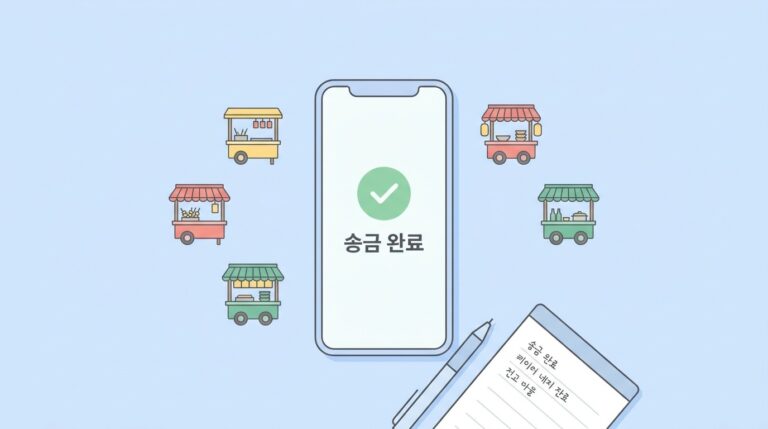
Then, you notice a small handwritten paper sign taped to the table with numbers on it. Other local Korean shoppers simply pull out their smartphones, tap three times, show their screen, and walk away happily with their goodies. They just did a 계좌 이체 (bank transfer)!
In South Korea, instant account transfers are an everyday superpower. From splitting the bill for crispy Korean fried chicken with friends to buying cute street souvenirs, transferring money directly via phone is second nature. If you’ve ever felt nervous wondering, “How do I tell them I just sent the money?” or “How do I ask for their account number?”, don’t worry. This beginner-friendly A1 guide is built directly from real expat hurdles to help you send money smoothly and confidently like a true local!
Phase 2: Core 3 Expressions In-Depth Analysis
Here are the top 3 magic expressions you need for bank transfers in Korea.
1. 계좌 이체할게요 (Gyejwa iche-halgeyo)
- Pronunciation: [Gye-jwa I-che-hal-ge-yo] (Sounds like: ‘Gyeh-jwah’ as in ‘get’ + ‘jwah’ with soft lips, followed by ‘ee-cheh hal-geh-yo’)
- Meaning:
- Literal: Account transfer I will do.
- Real Nuance: “I’ll pay via bank transfer!” / “I will transfer the money to your account.”
- K-Culture Moment: You hear this in every K-drama when characters split a late-night meal or when visiting trendy pop-up stores in Seongsu-dong.
- Editor’s Insight: The word 계좌 (gyejwa) means “bank account” and 이체 (iche) means “transfer”. When you add ~할게요 (~halgeyo), it signals a polite, friendly intention to take action.
- Situation Spectrum:
- Casual (Friends): ⚠️ (Use ‘돈 보낼게 – Don bonaelge’)
- Semi-formal (Cafes, Market stalls): ✅ (Perfect!)
- Formal (Banks, Business meetings): ✅
- 🤔 Think About It: In many Western countries, people ask for Venmo or PayPal handles. Why do you think Korea relies so seamlessly on direct bank-to-bank account numbers?
2. 계좌 번호 알려주세요 (Gyejwa beonho allyeojuseyo)
- Pronunciation: [Gye-jwa beon-ho al-lyeo-ju-se-yo] (Phonetic tip: ‘Beon-ho’ rhymes with ‘fun-ho’)
- Meaning:
- Literal: Account number please let me know.
- Real Nuance: “Could you please give me your account number?”
- K-Culture Moment: In variety shows like Running Man, when members lose a bet and have to send penalty money, they immediately shout this phrase.
- Editor’s Insight: 번호 (beonho) means “number”. Combining it with 알려주세요 (allyeojuseyo – please tell/inform me) creates a very polite, natural request that never sounds demanding.
- Situation Spectrum:
- Casual (Friends): ⚠️ (Use ‘계좌 번호 줘 – Gyejwa beonho jwo’)
- Semi-formal (Vendors, Acquaintances): ✅ (Ideal choice)
- Formal (Official transactions): ✅
- 🤔 Think About It: Notice how Korean uses “알려주세요” (let me know) instead of “주세요” (give me) for numbers and information. How does this soften the request?
3. 돈 보냈어요 (Don bonaesseoyo)
- Pronunciation: [Don bo-naet-sseo-yo] (Sounds like: ‘Don’ as in ‘dawn’ + ‘bo-net-suh-yo’)
- Meaning:
- Literal: Money (I) sent.
- Real Nuance: “I’ve sent the money!” / “The transfer is done!”
- K-Culture Moment: Used right after tapping ‘Confirm’ on your banking app while holding up your phone screen to show the vendor.
- Editor’s Insight: 돈 (don) is “money”, and 보냈어요 (bonaesseoyo) is the past tense of 보내다 (to send). It is short, punchy, and instantly understood anywhere.
- Situation Spectrum:
- Casual (Friends): ⚠️ (Use ‘돈 보냈어 – Don bonaesseo’)
- Semi-formal (Everyday shops & markets): ✅
- Formal (Professional invoices): ⚠️ (Use ‘입금 완료했습니다 – Ipgeum wanryo-haetseumnida’)
- 🤔 Think About It: In Korean, the subject “I” (저는) is dropped because the context is already obvious. Isn’t Korean pleasantly efficient?
Phase 3: Textbook Korean vs Real Korean
Situation 1: Telling a seller you will send the money
- 📖 Textbook Korean: 계좌로 송금하도록 하겠습니다. (Gyejwaro songgeum-hadorok hagetseumnida.) — “I shall proceed to remit the funds to your account.”
- 🗣️ Real Korean: 계좌 이체할게요! (Gyejwa iche-halgeyo!) — “I’ll do a bank transfer!”
- 💡 Why is it different? The textbook phrase sounds like a formal corporate contract! In daily life, Koreans prefer the simple verb 이체하다 (to transfer) with the friendly ending ~할게요.
Situation 2: Asking if the payment went through
- 📖 Textbook Korean: 송금이 정상적으로 완료되었습니까? (Songgeumi jeongsang-jeogeuro wanryo-doe-eotseumnikka?) — “Has the remittance completed properly?”
- 🗣️ Real Korean: 들어갔어요? (Deureo-gasseoyo?) or 입금됐어요? (Ipgeum-dwaesseoyo?) — “Did it go through?”
- 💡 Why is it different? Koreans use 들어가다 (to enter/go in) to describe money arriving into someone’s bank balance safely. It feels warm, visual, and fast.
Phase 4: K-Culture Deep Dive & Non-Verbal Manners
4-1. Nunchi (눈치) & The Two-Handed Phone Flash
When transferring money in person at a market or pop-up stall, visual confirmation is key.
* The Gesture: Once you finish the transfer on your banking app, hold your phone with both hands (or support your right forearm with your left hand) and gently tilt the screen toward the seller so they can see the green checkmark and amount.
* The Eye Contact & Bow: Give a light 15-degree head nod while saying, “보냈어요, 확인해 보세요!” (Bonaesseoyo, hwaginhae boseyo! – I sent it, please check!). This shows ultimate respect and transparency.
4-2. The “N-bbang (N빵)” and 1-Second Transfer Culture
In Korea, splitting the bill evenly is colloquially called N빵 (N-ppang)—where “N” stands for the mathematical variable and “ppang” refers to dividing up! Koreans rarely split credit cards one by one at the register during busy lunch hours because it slows down the line. Instead, one person pays the whole bill, snaps a photo of the receipt, sends it to the group chat, and everyone transfers their exact share within minutes using instant apps like KakaoPay or Toss.
Phase 5: Real-Life Roleplay Scenario
- Location: A bustling vintage craft shop in Dongdaemun Design Plaza (DDP).
- Characters:
- You (Alex): A foreign traveler buying a handmade souvenir.
- Vendor (Sujin): A friendly young craft designer.
Turn 1 [Sujin]: 어서 오세요! 마음에 드는 거 있으세요?
(Eoseo oseyo! Maeume deuneun geo isseuseyo?)
[Welcome! Is there anything you like?]
🎭 Smiling brightly while arranging earrings.

Turn 2 [You]: 네! 이거 얼마예요?
(Ne! Igeo eolmayeyo?)
[Yes! How much is this?]
🎭 Pointing at a handmade brooch.

Turn 3 [Sujin]: 만 오천 원이에요.
(Man ocheon-won-ieyo.)
[It is 15,000 won.]

Turn 4 [You]: 카드 돼요?
(Kadeu dwaeyo?)
[Do you take credit cards?]
🎭 Reaching into your wallet.

Turn 5 [Sujin]: 죄송해요, 오늘은 현금이나 계좌 이체만 돼요.
(Joesonghaeyo, oneureun hyeongeumina gyejwa icheman dwaeyo.)
[Sorry, today only cash or bank transfer is accepted.]

Turn 6 [You]: 괜찮아요! 계좌 번호 알려주세요.
(Gwaenchanhayo! Gyejwa beonho allyeojuseyo.)
[No problem! Please let me know your account number.]
🎭 Pulling up your mobile banking app.

Turn 7 [Sujin]: 여기 앞에 적혀 있어요. 국민은행이에요!
(Yeogi ape jeokhyeo isseoyo. Gungmin-eunhaeng-ieyo!)
[It is written right here in front. It's KB Kookmin Bank!]
🎭 Pointing to a cute acrylic stand with bank details.

Turn 8 [You]: 네, 만 오천 원 보냈어요! 확인해 주세요.
(Ne, man ocheon-won bonaesseoyo! Hwaginhae juseyo.)
[Yes, I sent 15,000 won! Please check.]
🎭 Showing the screen politely with both hands.
🔀 Interactive Choice: What will you say next?
After showing the confirmation screen to Sujin, how do you wrap up the conversation?
- Option A: “돈 받았어? 나 갈게!” (Don badasseo? Na galge!)
- Option B: “감사합니다! 많이 파세요!” (Gamsahamnida! Mani paseyo!)
- Option C: “영수증 당장 내놓으세요.” (Yeongsujeung dangjang naenoh-useyo!)
🔍 Check Choice Feedback
- Option A (Bad / Disrespectful): Using 반말 (informal speech) with a shop owner is considered rude to strangers in Korea!
- Option B (Best Choice ✨): “Thank you! Wishing you big sales!” This is the warmest, most natural Korean blessing to give small business owners. Sujin will love your Korean!
- Option C (Risk / Aggressive): This translates to “Hand over a receipt right now!” which sounds like an angry movie villain!
Phase 6: 10-Second Emotion Shadowing Drill
Read these aloud while mimicking the rhythm slashes (/) and feeling the emotion!
- [😊 Friendly & Confident]
계좌 이체 / 할게요!
(Gyejwa iche / halgeyo!) -
[🙋 Politeness & Curiosity]
계좌 번호 / 알려주세요!
(Gyejwa beonho / allyeojuseyo!) -
[✨ Proud & Clear]
방금 / 만 원 / 보냈어요!
(Banggeum / man won / bonaesseoyo! — I just sent 10,000 won!) -
[🤝 Respectful Reassurance]
화면 / 확인해 / 보세요!
(Hwamyeon / hwaginhae / boseyo! — Please check the screen!)
Phase 7: K-Culture Mini Dictionary
| Word (Hangul + Romanization) | English Meaning | Daily Life & Business Usage |
|---|---|---|
| 1. 계좌 (Gyejwa) | Bank Account | The foundation of all financial transactions in Korea. Often combined as 계좌 번호 (account number). |
| 2. 송금 (Songgeum) / 이체 (Iche) | Wire Transfer / Transfer | 송금 refers to sending money outward; 이체 refers to transferring between accounts. In conversation, 이체 is much more common. |
| 3. 입금 (Ipgeum) | Deposit / Money Received | Used when checking if funds arrived: “입금 확인했어요” (I confirmed the deposit). |
| 4. N빵 (N-ppang) | Splitting the bill evenly | Essential slang when hanging out with Korean friends after eating K-BBQ or drinking somaek! |
Phase 8: Traveler’s Survival Kit
🚨 Survival TOP 3 Phrases
- 계좌 이체 돼요? (Gyejwa iche dwaeyo?)
- Pro Tip: Ask this before ordering street food if you run out of cash.
- 은행 이름이 뭐예요? (Eunhaeng ireumi mwoyeyo?)
- Pro Tip: In Korea, you always need both the Bank Name (e.g., Kakao Bank, Shinhan, Kookmin) and the Account Number to transfer.
- 보냈어요! (Bonaesseoyo!)
- Pro Tip: Pair this with showing your digital transfer receipt.
🧭 Editor’s Travel Note
- Apps you must know: Foreign travelers with Korean bank accounts or prepaid tourist cards (like WOWPASS or NAMANE) can download the WOWPASS App to easily manage card balances and local transfers.
- Name Check Magic: When typing the account number into an ATM or banking app, the recipient’s Korean legal name will appear on the confirmation screen (often with one letter masked, e.g., 김*수). Always double-check this name with the vendor before tapping “Send”!
Phase 9: “One Step Deeper” (Cultural Reflection)
Have you noticed how quickly and casually Koreans share their bank account numbers on personal business cards, wedding invitations, and market stalls? In many cultures, giving out a bank account number feels like a severe privacy risk. However, in Korea’s highly digitized and secure banking ecosystem, an account number is solely used to deposit money, making it a symbol of communal trust and hyper-speed convenience.
💬 Your Turn: In your home country, how do friends usually split dinner bills or pay independent street artists? Do you use an app, cash, or credit cards? Share your experience in the comments below!
Phase 10: FAQ & Avoiding Misunderstandings
Q: Can I transfer money to a Korean account using an overseas bank app?
A: Standard foreign banking apps cannot do real-time domestic Korean transfers instantly. If you are a traveler without a Korean bank account, use services like Wise or dedicated Korean travel cards (WOWPASS/NAMANE), or ask if they accept cash/PayPal.
Q: What is the difference between ‘보내다 (Bonaeda)’ and ‘부치다 (Buchida)’?
A: Both mean “to send” money in conversational Korean! You can say “돈 보냈어요” (Don bonaesseoyo) or “돈 부쳤어요” (Don buchyeosseoyo) interchangeably. Beginners can stick to 보냈어요 because it is easier to pronounce.
Q: What does ‘예금주 (Ye-geum-ju)’ mean on the payment sign?
A: 예금주 (Yegeumju) translates to “Account Holder Name.” When looking at a handwritten payment sign at a flea market, you will see the Bank Name, Account Number, and the Account Holder’s name next to 예금주.
🚨 Common Mistakes Alert
- Forgetting to check the Bank Name: Trying to send money using only the numbers. Correction: Always ask **”어느 은행이에요?” (Eoneu eunhaeng-ieyo? – Which bank is it?)*.
- Saying ‘페이 돼요?’ (Pay dwaeyo?) to mean bank transfer: “Pay” usually refers to mobile barcode systems like Apple Pay, Samsung Pay, or KakaoPay QR. Correction: Say “계좌 이체 돼요?” (Gyejwa iche dwaeyo?).
- Leaving out honorifics with shop owners: Saying just “돈 보냈다” (I sent money). Correction: Always keep the polite ending “보냈어요!” (Bonaesseoyo!).
Phase 11: Action Mission & Engagement
- 🥉 Bronze Mission (Solo Shadowing): Stand in front of your mirror and practice showing your phone with both hands while smiling and saying: “계좌 이체할게요!” 5 times.
- 🥈 Silver Mission (Comment Challenge): Write a comment below answering: “계좌 번호 알려주세요!” using your favorite K-pop idol or drama character’s name as the account holder!
- 🥇 Gold Mission (Real-Life Application): The next time you order from a Korean online seller or visit a Korean market, try requesting an account transfer using today’s expressions.
- 🎮 K-Culture Mission: Watch an episode of a modern slice-of-life K-drama (like Hospital Playlist or Business Proposal) and spot the moment characters transfer lunch money to each other!
Phase 12: Interactive Quiz Challenge
Test your knowledge before you head out to the Korean night markets!
Q1. [Situational Judgment] You are buying a cute postcard at a market stall. You want to ask the seller for their bank account number. What should you say?
* (A) 전화번호 주세요. (Jeonhwabeonho juseyo.)
* (B) 계좌 번호 알려주세요. (Gyejwa beonho allyeojuseyo.)
* (C) 카드 번호 뭐예요? (Kadeu beonho mwoyeyo?)
Q2. [Fill in the Blank] Fill in the missing word for “I transferred/sent the money!”:
* “돈 ________!” (Don ________!)
Q3. [True / False Cultural Quiz] In Korea, splitting the bill evenly among friends is informally known as “N-ppang (N빵)”.
* (True / False)
👉 Click here to reveal the answers and explanations!
- Q1 Answer: (B) 계좌 번호 알려주세요.
(A means “Please give me your phone number”, and C means “What is your credit card number?”) - Q2 Answer: 보냈어요 (bonaesseoyo) or 이체했어요 (ichehaesseoyo).
- Q3 Answer: True! “N빵” is the standard slang for dividing the cost equally among group members.







