

Phase 1: Empathy & Storytelling Opening
안녕하세요! 매일한글 에디터입니다. (Hello! I’m your Daily Hangul editor.)
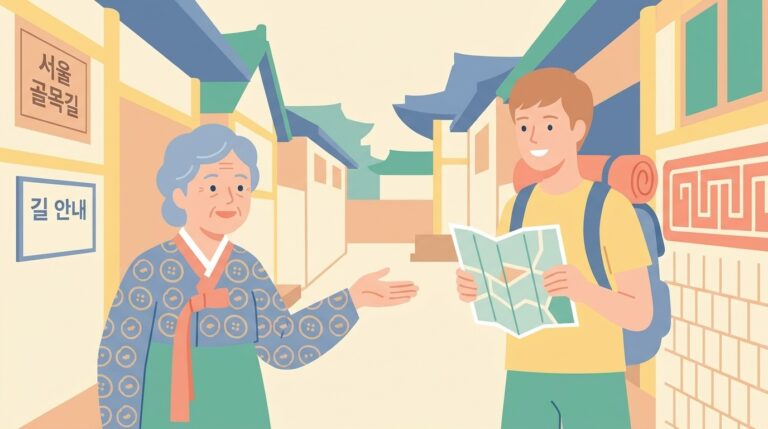
Picture this: You are wandering through the picturesque, labyrinth-like alleys of Ikseon-dong in Seoul. The sun is setting, your phone battery flashes a terrifying 2%, and your map app is spinning in circles. You are completely lost. Hesitantly, you muster up your courage and approach a local elder tending to small flowerpots outside a traditional hanok. You point to your screen and ask how to reach the nearest subway station.
In many parts of the world, someone might simply point over their shoulder, utter a brief direction, and walk away. But here in Korea, something magical happens. The elderly person puts down their watering can, looks into your eyes with genuine warmth, smiles, and says: “I’ll take you there!” They literally walk three blocks alongside you to ensure you don’t take a wrong turn, even offering you a warm piece of rice cake from their pocket along the way.
This heartwarming experience is the essence of 정 (Jeong)—Korea’s unique cultural DNA of unconditional warmth, empathy, and deep interpersonal connection. Asking for and giving directions in Korea is never just a cold exchange of navigational data; it is an invitation to connect with real Korean humanity. Based on real-world feedback from hundreds of beginner students at Daily Hangul, this guide will give you the practical Korean phrases and cultural confidence to navigate Korean streets like a beloved local friend.
Phase 2: Core Expressions In-Depth
Here are the top 3 essential direction expressions infused with warmth and politeness for A2 learners.
1. 실례지만, 길 좀 물어봐도 될까요? (Sil-lye-ji-man, gil jom mu-reo-bwa-do doel-kka-yo?)
- Pronunciation: [Sheel-lyeh-jee-mahn, geel johm moo-ruh-bwah-doh dwel-kkah-yoh?] (Sounds like ‘Sheel-yeh’ + ‘jom’ as in ‘chum’ + ‘doel-kkayo’ with an upbeat rising intonation at the end).
- Meaning: Literal: “It’s a rudeness, but may I ask a bit of road?” | Actual Nuance: “Excuse me, but would it be okay if I asked you for directions?”
- K-Culture Moment: In K-Dramas like Hometown Cha-Cha-Cha, when an outsider enters a seaside village and politely approaches a local elder, this phrase instantly softens anyone’s heart.
- Editor’s Insight: The tiny word 좀 (jom) literally means “a little”, but pragmatically it acts as a magical politeness cushion in Korean. It softens your request, showing that you respect the other person’s time.
- Situation Spectrum: Casual: 🚫 | Semi-formal: ✅ | Formal: ✅
- 🤔 Think About It: In your native language, do you apologize before asking a question, or do you dive straight into asking? Why do you think Korean uses “rudeness” (실례) to show instant respect?
2. 이쪽으로 쭉 가시면 돼요. (I-jjok-eu-ro jjuk ga-si-myeon dwae-yo.)
- Pronunciation: [Ee-jjohk-eu-roh jjook gah-shee-myeon dweh-yoh.] (The ‘jjuk’ sounds like drawing a long straight line with your voice: jjooook!).
- Meaning: Literal: “If you go straight toward this side, it becomes fine.” | Actual Nuance: “You can just go straight in this direction.”
- K-Culture Moment: You hear this constantly at subway information desks or from friendly convenience store staff pointing toward the street exit.
- Editor’s Insight: 쭉 (jjuk) is an expressive Korean onomatopoeic/mimetic word that conveys a continuous, uninterrupted line. Adding -시면 돼요 (-si-myeon dwae-yo) frames the instruction as an easy, stress-free recommendation rather than a command.
- Situation Spectrum: Casual: ⚠️ (change to 쭉 가면 돼) | Semi-formal: ✅ | Formal: ✅
- 🤔 Think About It: How does saying “you can just go straight” feel more welcoming than saying “go straight”?
3. 제가 데려다 드릴게요. (Je-ga de-ryeo-da deu-ril-ge-yo.)
- Pronunciation: [Jeh-gah deh-ryuh-dah deu-reel-geh-yoh.] (‘Deu-ril-ge-yo’ rolls softly with a gentle, reassuring tone).
- Meaning: Literal: “I will escort and give to you.” | Actual Nuance: “I will walk you there / I’ll show you the way myself.”
- K-Culture Moment: The ultimate manifestation of 정 (Jeong) in variety shows like Korean Hostel in Spain or You Quiz on the Block, where everyday citizens drop what they’re doing to guide a traveler.
- Editor’s Insight: The honorific verb 드리다 (deu-ri-da) turns the act of walking someone to their destination into a humble gift. If a Korean says this to you, don’t panic! It is pure hospitality and neighborly care.
- Situation Spectrum: Casual: ⚠️ | Semi-formal: ✅ | Formal: ✅
- 🤔 Think About It: Would a stranger in your hometown walk 5 minutes with you to show you the way? What cultural values make this natural in Korea?
Phase 3: Textbook Korean vs. Real Native Korean
Let’s upgrade your Korean from stiff robot mode to warm native speaker level!
Situation 1: Asking where the subway station is
- 📖 교과서 한국어 (Textbook):
- 지하철역이 어디에 있습니까? (Ji-ha-cheol-yeog-i eo-di-e it-seum-ni-kka?)
- “Where is the subway station located?”
- 🗣️ 진짜 한국어 (Real Native):
- 저기요, 혹시 지하철역 어디로 가야 돼요? (Jeo-gi-yo, hok-si ji-ha-cheol-yeok eo-di-ro ga-ya dwae-yo?)
- “Excuse me, by any chance, which way should I go for the subway station?”
- 💡 왜 다를까? (Why is it different?): Textbook Korean overuses the hyper-formal
-습니까?. Real locals use 저기요 (Excuse me) combined with 혹시 (by any chance), which makes your approach gentle, natural, and polite without sounding like an army officer.
Situation 2: Asking if a destination is far
- 📖 교과서 한국어 (Textbook):
- 여기서 그곳까지 거리가 멉니까? (Yeo-gi-seo geu-got-kka-ji geo-ri-ga meom-ni-kka?)
- “Is the distance from here to that place far?”
- 🗣️ 진짜 한국어 (Real Native):
- 여기서 많이 멀어요? 걸어갈 수 있어요? (Yeo-gi-seo man-i meol-eo-yo? Geor-eo-gal su iss-eo-yo?)
- “Is it far from here? Can I walk there?”
- 💡 왜 다를까? (Why is it different?): Native Koreans prefer practical, action-oriented questions like “Can I walk?” (걸어갈 수 있어요?) rather than measuring abstract distances in kilometers.
Phase 4: K-Culture Deep Dive & Non-Verbal Manners
4-1. 눈치 (Nunchi) & Body Gestures When Asking for Directions
- The Open Palm Rule: Never point at a direction or person using a single index finger! In Korean culture, pointing with a single index finger can feel sharp or accusatory. Instead, extend all four fingers joined together with your palm slightly tilted upward when indicating a street or building.
- The Two-Handed Gratitude: When someone gives you directions or shows you their phone map, hold your hands lightly in front of your chest and nod slightly. When saying thank you, a 15-degree bow along with “감사합니다!” (Gam-sa-ham-ni-da!) shows genuine appreciation.
- The Hesitation Signal: Approaching someone too aggressively might startle them. Tap your own chest lightly, say a soft “저기요…” (Excuse me…), and take one step back to respect personal space.
4-2. Cultural Code: The Warmth of ‘Jeong’ (정)
In western urban cities, individual privacy is often paramount. However, Korean society is rooted in a collective village mindset (Pumasi and Dure community spirit). Even in modern Seoul, older adults still view young travelers or foreigners as “guests in our neighborhood” (동네 손님). When you ask for directions, you aren’t interrupting their day—you are triggering their innate instinct of 정 (Jeong) to care for someone in need.
Phase 5: Real-Life Roleplay Scenario
Setting: Mangwon Traditional Market (망원시장) alleyway on a crisp autumn afternoon. You are trying to find the famous handmade noodle shop (Kalguksu).
Characters: You (Lost traveler) & Friendly Fruit Shop Owner (과일가게 아주머니, Ahjumma).
- Turn 1 (You): 🎭 Approaching with a polite slight bow and smiling warmly.
- 저기요, 실례지만 길 좀 물어봐도 될까요? (Jeo-gi-yo, sil-lye-ji-man gil jom mu-reo-bwa-do doel-kka-yo?)
- Excuse me, would it be okay if I asked for directions?
- Turn 2 (Owner): 🎭 Wiping her hands on her apron and stepping out of the stall with a big smile.
- 네, 학생! 어디 찾아요? 편하게 물어봐요! (Ne, hak-saeng! Eo-di chaj-a-yo? Pyeon-ha-ge mu-reo-bwa-yo!)
- Yes, student! Where are you looking for? Ask away comfortably!
- Turn 3 (You): 🎭 Showing the restaurant photo on your smartphone screen.
- 혹시 망원 칼국수 집이 어디에 있어요? (Hok-si Mang-won kal-guk-su jib-i eo-di-e iss-eo-yo?)
- By any chance, where is the Mangwon Kalguksu restaurant?
- Turn 4 (Owner): 🎭 Looking closely at the phone screen and nodding excitedly.
- 아, 여기 맛집이지! 여기서 이쪽 골목으로 쭉 가요. (A, yeo-gi mat-jib-i-ji! Yeo-gi-seo i-jjok gol-mok-eu-ro jjuk ga-yo.)
- Ah, this place is delicious! From here, go straight down this alley.
- Turn 5 (You): 🎭 Looking down the alley, trying to gauge the distance.
- 여기서 걸어서 많이 멀어요? (Yeo-gi-seo geor-eo-seo man-i meol-eo-yo?)
- Is it far to walk from here?
- Turn 6 (Owner): 🎭 Waving her hand playfully, then pointing with an open palm.
- 아니야, 3분이면 가! 사거리에서 오른쪽으로 돌면 바로 보여요. (A-ni-ya, sam-bun-i-myeon ga! Sa-geo-ri-e-seo o-reun-jjok-eu-ro dol-myeon ba-ro bo-yeo-yo.)
- No, it takes just 3 minutes! Turn right at the four-way intersection and you’ll see it immediately.
- Turn 7 (You): 🎭 Bowing politely with both hands placed neatly in front.
- 아, 감사합니다! 좋은 하루 보내세요! (A, gam-sa-ham-ni-da! Jo-eun ha-ru bo-nae-se-yo!)
- Ah, thank you so much! Have a wonderful day!
- Turn 8 (Owner): 🎭 Handing you a small, fresh tangerine with a warm laugh.
- 맛있게 먹고 가요! 귤 하나 먹어요! (Mat-it-ge meok-go ga-yo! Gyul ha-na meok-eo-yo!)
- Enjoy the meal! Eat a tangerine on your way!
🔀 Interactive Branching Moment
Suppose the owner says: **”골목이 복잡한데, 제가 데려다 드릴까요?” (The alleys are complicated, shall I walk you there?)* How do you respond?
- Option A: “아니요, 됐어요.” (No, forget it.)
- 🚫 Feedback (Bad): Too cold and blunt! It rejects their warm gesture harshly.
- Option B: “바쁘실 텐데 괜찮아요! 길 알려주셔서 감사합니다.” (You must be busy, so it’s okay! Thank you for the directions.)
- 🏆 Feedback (Best): Pure Korean etiquette masterclass! You acknowledge their busy schedule while warmly declining with gratitude.
- Option C: “네! 빨리 가요!” (Yes! Let’s go quickly!)
- ⚠️ Feedback (Risk): While enthusiastic, it treats the kind local like an unpaid tour guide. Remember to stay humble and say “정말 감사해요!” (Thank you so much!).
Phase 6: 10-Second Emotional Shadowing Drill
Practice these three lines out loud! Follow the rhythm breaks (/) and tap into the specified emotion.
[😊 공손하고 조심스럽게 / Polite & Gentle]- 저기요, / 실례지만 / 길 좀 물어봐도 될까요? /
- (Jeo-gi-yo, / sil-lye-ji-man / gil jom mu-reo-bwa-do doel-kka-yo?)
[🧭 확신을 담아 명확하게 / Confident & Clear]- 이쪽으로 / 쭉 가시다가 / 오른쪽으로 도세요! /
- (I-jjok-eu-ro / jjuk ga-si-da-ga / o-reun-jjok-eu-ro do-se-yo!)
[❤️ 감동받은 마음으로 / Touched & Deeply Grateful]- 친절하게 알려주셔서 / 정말 감사합니다! /
- (Chin-jeol-ha-ge al-lyeo-ju-syeo-seo / jeong-mal gam-sa-ham-ni-da!)
Phase 7: K-Culture Mini Dictionary
- 1. 정 (Jeong) | Warm emotional bond / Heartfelt affection
- The invisible social glue of Korea. It represents deep empathy, neighborly kindness, and doing favors for strangers without expecting anything in return.
- 2. 길치 (Gilchi) | Directionally challenged / Person with no sense of direction
- A humorous self-deprecating term used in daily conversation. (e.g., “제가 완전 길치라서요!” = “I have zero sense of direction!”).
- 3. 골목길 (Golmok-gil) | Charming traditional alleyway
- The vibrant, narrow alleys connecting Korean neighborhoods where hidden cafés, eateries, and authentic local life thrive.
- 4. 직진 (Jikjin) | Going straight ahead
- Often used informally in navigation and pop culture memes meaning “going forward without hesitation!”
Phase 8: Traveler’s Survival Kit
Survival Expressions TOP 3
- 이 주소로 가주세요. (I ju-so-ro ga-ju-se-yo.) — “Please take me to this address.”
- Pro Tip: Show this to taxi drivers or locals on your phone when Korean street addresses get complicated.
- 여기서 가까워요? (Yeo-gi-seo ga-kka-wo-yo?) — “Is it close from here?”
- Pro Tip: Perfect when deciding whether to hop on a bus or take a brisk walk.
- 지하철역 몇 번 출구예요? (Ji-ha-cheol-yeok myeot beon chul-gu-ye-yo?) — “Which subway exit is it?”
- Pro Tip: Korean subway stations can have over 14 exits! Knowing the exit number saves you 20 minutes of wandering.
Editor’s Travel Note
- Navigation App Insight: Google Maps has limited walking navigation in South Korea due to national security map data laws. Before boarding your flight, make sure to check out the Naver Map App Download Guide or KakaoMap for pinpoint walking routes and live bus arrivals.
- Transit Tip: Keep a rechargeable T-Money card or Climate Card handy for seamless transfers between subways and buses.
Phase 9: One Step Deeper
In many modern mega-cities, streets are treated merely as functional transit corridors designed to move bodies from point A to point B as fast as possible. But in Korean culture, streets and golmok-gil (alleys) are vibrant shared living rooms. When a Korean elder stops their day to walk you to your destination, they are extending the boundaries of their home to include you. By learning these direction phrases, you are opening the door to experiencing genuine Korean humanity.
💬 Your Turn: Have you ever experienced unexpected kindness from a stranger while traveling? Share your story in the comments below!
Phase 10: FAQ & Common Mistakes
Q: What should I call an older person when asking for directions on the street?
A: For older women, calling them 어머님 (Eomeonim) or 이모님 (Imonim) feels very warm and respectful. For middle-aged men, 선생님 (Seonsaengnim) or 아저씨 (Ajeossi) is appropriate. If in doubt, a polite 저기요 (Jeo-gi-yo, Excuse me) is universally safe!
Q: What if the local speaks very fast and I cannot understand their directions?
A: Don’t panic! Simply smile and say: “죄송하지만 조금만 천천히 말씀해 주시겠어요?” (Joe-song-ha-ji-man jo-geum-man cheon-cheon-hi mal-sseum-hae ju-si-gess-eo-yo? – Sorry, but could you speak a little more slowly, please?).
Q: Is it rude to show my phone screen directly to someone on the street?
A: Not at all! In fact, locals appreciate it because reading the Korean name of the shop or building on your screen makes it much faster and easier for them to guide you accurately.
🚨 Common Mistakes Alert
- Calling strangers “당신 (Dangsin)”: While textbooks translate dangsin as “you”, in real life it can sound confrontational or overly intimate. Use 저기요 instead!
- Pointing with a single finger: Always use an open palm facing upward to indicate direction.
- Forgetting to say goodbye: Always finish the interaction with “감사합니다, 좋은 하루 되세요!” (Thank you, have a nice day!).
Phase 11: Action Mission & Engagement
- 🥉 Bronze Mission (Solo Practice): Stand in front of your mirror and practice saying “실례지만, 길 좀 물어봐도 될까요?” 5 times with a gentle smile and open-palm gesture.
- 🥈 Silver Mission (Social Media): Post a photo of your favorite Korean drama neighborhood on Instagram or TikTok and caption it using our keyword #골목길 (Golmok-gil) and tag @DailyHangul!
- 🥇 Gold Mission (Real Life / K-Buddy): Next time you meet a Korean speaker or visit Korea, ask for directions in full Korean without switching to English first!
- 🎮 K-Culture Mission: Watch an episode of a slice-of-life K-Drama (like Reply 1988 or My Mister) and count how many times neighbors say “어디 가요?” (Where are you heading?) as a warm greeting!
Phase 12: Interactive Quiz Challenge
1. Situational Judgment: You want to ask a friendly passerby where the bus stop is. What is the most polite and natural way to start?
* A) 야! 버스 어디 있어? (Ya! Beo-seu eo-di iss-eo?)
* B) 저기요, 실례지만 버스 정류장이 어디에 있어요? (Jeo-gi-yo, sil-lye-ji-man beo-seu jeong-ryu-jang-i eo-di-e iss-eo-yo?)
* C) 버스를 내놓아라. (Beo-seu-reul nae-noh-a-ra.)
🔍 Click to Reveal Answer & Explanation
Correct Answer: B
* Explanation: B is polite, natural, and respectful. Option A uses rude banmal (informal speech), and Option C sounds like an ancient historical villain demanding a bus!
2. Fill in the Blank: Complete the phrase meaning “Go straight in this direction.”
* 이쪽으로 ______ 가시면 돼요.
🔍 Click to Reveal Answer & Explanation
Correct Answer: 쭉 (jjuk)
* Explanation: 쭉 (jjuk) signifies continuing in a straight, unbroken path.
3. True or False: In Korea, if a local offers to walk you to your destination (“제가 데려다 드릴게요”), it usually means they want to charge you a guide fee.
🔍 Click to Reveal Answer & Explanation
Correct Answer: False
* Explanation: This is a pure expression of 정 (Jeong)—warm hospitality and caring for a traveler. They do it out of genuine kindness!







