

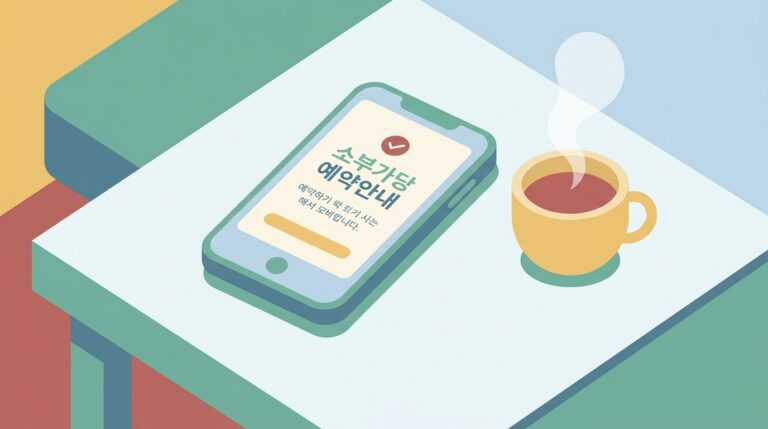
Never Ghost in Korea: How to Politely Cancel or Change Reservations Like a Local
Phase 1: Empathy (Real-Life Story Opening)
안녕하세요! Daily Hangul Editor here! Have you ever found yourself in this situation? You spent weeks researching the hottest K-BBQ spot in Seongsu-dong or booked an appointment at an aesthetic hair salon in Hongdae. But on the day of the appointment, your subway train gets delayed, or sudden travel fatigue hits you like a truck.
Panic sets in. You think, “Should I just not show up? They probably have plenty of customers anyway.”
Wait! In Korea, doing a 노쇼 (No-Show) is considered a major breach of social etiquette. With the explosion of reservation apps like CatchTable and Naver Booking, Korean businesses take table bookings and salon slots very seriously—often charging non-refundable reservation deposits (예약금).
Ghosting might feel easier in the moment, but sending a short, polite Korean message takes less than 30 seconds and protects your reputation (and wallet!). Based on feedback from hundreds of our intermediate learners, mastering polite cancellation and delay phrases is the ultimate test of conversational confidence. Let’s make sure you never feel awkward managing appointments in Korea again!
Phase 2: 3 Key Expressions Deep-Dive
Here are the top 3 essential phrases you need when plans change.
1. 정말 죄송하지만 예약을 취소할 수 있을까요? (Jeongmal joesonghajiman yeyageul chwisohal su isseulkkayo?)
- Pronunciation: JOHNG-mahl jweh-song-hah-jee-mahn yeh-yah-geul chwee-so-hahl soo ees-seul-kkah-yo? (Think of chwee like whistling wind and kkah with a sharp crisp ‘k’).
- Meaning:
- Literal: Really I am sorry but can I cancel the reservation?
- Actual Nuance: “I am truly sorry, but would it be possible for me to cancel my booking?”
- K-Culture Moment: You will hear this frequently in office K-Dramas when a junior employee has to cancel a dinner reservation with a client at the last minute.
- Editor’s Insight: Using 정말 죄송하지만 (~hajiman = “but”) before your request softens the blow dramatically. It conveys sincere regret before asking for a favor.
- Situation Spectrum:
- Casual (Friends): 🚫 (Too formal)
- Semi-formal (Cafes/Restaurants): ✅
- Formal (High-end Dining/Clinics): ✅
- 🤔 Think About It: In English, we often say “I need to cancel my reservation.” In Korean, framing it as a question (~수 있을까요? – Can I…?) shows deference to the host’s schedule. How does asking permission change the feeling of a cancellation in your culture?
2. 차가 막혀서 15분 정도 늦을 것 같아요. (Chaga makhyeoseo sibobun jeongdo neujeul geot gat-ayo.)
- Pronunciation: Cha-gah mahk-hyeo-seo shee-bo-boon jung-doh neu-jeul geot gah-tah-yo. (Pronounce makhyeoseo naturally as mak-kyeo-seo due to aspiration).
- Meaning:
- Literal: Because traffic is blocked, I think I will be about 15 minutes late.
- Actual Nuance: “Traffic is heavy, so I expect I will be roughly 15 minutes late.”
- K-Culture Moment: Seen in romantic comedies when a protagonist is rushing in a Kakao Taxi to meet their blind date at a trendy bistro.
- Editor’s Insight: In Korean communication, stating the reason first using ~아/어서 (because) followed by a softened prediction ~것 같아요 (“I think / It seems”) sounds far more considerate than bluntly stating “I will be late.”
- Situation Spectrum:
- Casual: ✅ (Change to 늦을 것 같아)
- Semi-formal: ✅
- Formal: ⚠️ (Use 늦을 것 같습니다 for strict business settings)
- 🤔 Think About It: Why do Koreans prefer using “it seems like” (~것 같아요) even when they know 100% that they are running late? It’s all about softening certainty to reduce friction.
3. 혹시 다른 시간으로 변경 가능할까요? (Hoksi dareun sigan-euro byeongyeong ganeunghalkkayo?)
- Pronunciation: Hohk-shee dah-reun shee-gahn-eu-ro byun-gyung gah-neung-hahl-kkah-yo? (Rhyme hoksi with “oak-she”).
- Meaning:
- Literal: By any chance, to another time, is change possible?
- Actual Nuance: “By any chance, would it be possible to reschedule for a different time?”
- K-Culture Moment: Used constantly when booking nail art appointments or personal color consultations in Seoul via KakaoTalk or Instagram DM.
- Editor’s Insight: Starting a sensitive request with 혹시 (Hoksi – By any chance) is a magical politeness buffer in Korean. It immediately signals that you respect the other party’s constraints.
- Situation Spectrum:
- Casual: ⚠️ (Use 시간 바꿀 수 있어?)
- Semi-formal: ✅
- Formal: ✅
- 🤔 Think About It: How does introducing uncertainty with “by any chance” help maintain harmony between customers and small business owners?
Phase 3: Textbook Korean vs Real Korean
| Situation | 📖 Textbook Korean | 🗣️ Real Korean | 💡 Why It Matters |
|---|---|---|---|
| Canceling Same-Day | 오늘 예약을 취소합니다. (Oneul yeyageul chwisohamnida.) | 죄송한데 오늘 급한 일이 생겨서 취소해야 할 것 같아요. (Joesonghande oneul geupan iri saenggyeoseo chwisohaeya hal geot gat-ayo.) | The textbook version sounds like an administrative command. Real Koreans give a polite cushion (급한 일이 생겨서 – sudden matter came up) and soften the verb ending. |
| Running 10 Mins Late | 저는 지각하겠습니다. (Jeoneun jigakhagessseumnida.) | 차가 좀 밀려서 10분만 늦어도 될까요? (Chaga jom millyeoseo sipbunman neujeodo doelkkayo?) | Saying 지각하겠습니다 sounds like a school student declaring a violation. Asking 10분만 늦어도 될까요? (“May I be 10 minutes late?”) asks for understanding gently. |
Phase 4: K-Culture Deep Dive & Non-Verbal Manners
4-1. 눈치 (Nunchi) & Non-Verbal Gestures
When calling or speaking in person to adjust a booking:
* The Head Tilt & Slight Bow: Even over the phone, Korean native speakers subconsciously nod or bow slightly when apologizing (정말 죄송합니다). This physical gesture actually softens your vocal tone!
* Two-Handed Phone Grip: When showing your reservation screen to staff at a venue to explain a mistake, always hold your phone with both hands or support your right wrist with your left hand.
* Speed is Courtesy: In Korea’s Palli-Palli (fast-paced) society, notifying a venue at least 1 to 2 hours before your time slot is considered basic manners (매너).
4-2. Cultural Code: The Rise of “CatchTable” & No-Show Penalties
In the past, booking via phone often led to frequent no-shows, causing heavy losses for small restaurant owners who prepared fresh daily ingredients. Today, Korea has shifted almost completely to digital reservation platforms like CatchTable (캐치테이블) and Naver Place (네이버 예약).
Most popular spots require a deposit of 10,000 KRW to 50,000 KRW per person. If you cancel at least 1 day in advance, you get a 100% refund. If you no-show, the entire deposit is forfeited. Knowing how to communicate early saves your hard-earned won!
Phase 5: Real-Life Roleplay Scenario
Setting: You booked a table for 2 at a trendy Hanok restaurant in Ikseon-dong under the name “Alex”. Due to subway line transfer confusion, you are 20 minutes behind schedule. You call the restaurant.
Character: Manager Min-ji (Staff)
- Staff (Min-ji): 여보세요, 익선 다이닝입니다. (Yeoboseyo, Ikseon Dain-ing-imnida.)
(English: Hello, this is Ikseon Dining.)🎭 [Polite, energetic greeting] - Alex: 여보세요! 저 7시에 예약한 알렉스인데요. (Yeoboseyo! Jeo ilgopsie yeyak-han Alleukseu-inde-yo.)
(English: Hello! I’m Alex who made a reservation for 7 PM.)🎭 [Slightly breathless, checking reservation] - Staff (Min-ji): 네, 알렉스 고객님! 오고 계신가요? (Ne, Alleukseu gogaengnim! Ogo gyesingayo?)
(English: Yes, Customer Alex! Are you on your way?)🎭 [Checking the reservation tablet] - Alex: 죄송하지만 지하철을 잘못 타서 20분 정도 늦을 것 같아요. (Joesonghajiman jihacheoreul jalmot taseo isipbun jeongdo neujeul geot gat-ayo.)
(English: I am sorry, but I took the wrong subway, so I think I will be about 20 minutes late.)🎭 [Apologetic and humble tone] - Staff (Min-ji): 아, 그러시군요. 다음 예약 손님이 있어서요… (A, geureosigunyo. Daeum yeyak sonnimi isseoseoyo…)
(English: Ah, I see. We have another reservation after you, so…)🎭 [Hesitant, looking at the table schedule] - Alex: 혹시 7시 30분으로 시간을 미룰 수 있을까요? 아니면 대기를 해야 할까요? (Hoksi ilgopsi samsipbuneuro siganeul mirul su isseulkkayo? Animyeon daegireul haeya halkkayo?)
(English: By any chance, could we push the time to 7:30? Or should we wait in line?)🎭 [Providing flexible solutions] - Staff (Min-ji): 7시 30분에는 바(Bar) 자리가 비는데, 괜찮으실까요? (Ilgopsi samsipbune-neun ba jariga bineunde, gwaenchaneusilkkayo?)
(English: At 7:30, seats at the bar will open up. Would that be okay with you?)🎭 [Offering an alternative option] - Alex: 네! 바 자리도 정말 괜찮습니다. 배려해 주셔서 감사합니다! (Ne! Ba jarido jeongmal gwaenchansseumnida. Baeryeohae jusyeoseo gamsahamnida!)
(English: Yes! The bar seats are totally fine. Thank you so much for your consideration!)🎭 [Relieved, expressing warm gratitude]
🔀 Interactive Choice Point
What if Min-ji said the restaurant is completely booked and cannot hold your table?
- Choice A: “그냥 갈게요. 알아서 취소하세요.” (Geunyang galgeyo. Araseo chwisohaseyo. – I’ll just go. Cancel it yourself.)
- 👉 Feedback [BAD]: Extremely rude! This will leave a terrible impression and definitely forfeit your deposit.
- Choice B: “알겠습니다. 오늘 못 가서 죄송합니다. 다음에는 꼭 미리 갈게요!” (Algetseumnida. Oneul mot gaseo joesonghamnida. Daeumeneun kkok miri galgeyo! – Understood. I’m sorry I couldn’t make it today. I will definitely come early next time!)
- 👉 Feedback [BEST]: Perfect polite closure. It respects their business policy while keeping doors open for a future visit.
- Choice C: Hang up the phone immediately without saying anything.
- 👉 Feedback [RISK]: Classic No-Show behavior. You will be flagged in system records as an unresponsive guest.
Phase 6: 10-Second Emotional Shadowing Drill
Practice these lines out loud with the marked pauses (/) and emotional tone!
[🥺 죄송하고 조심스럽게 / Apologetic & Cautious]
정말 죄송하지만 / 오늘 급한 일이 생겨서 / 예약을 취소할 수 있을까요?
(Jeongmal joesonghajiman / oneul geupan iri saenggyeoseo / yeyageul chwisohal su isseulkkayo?)-
[🙏 다급하지만 예의 바르게 / Urgent yet Polite]
차가 너무 막혀서요, / 15분만 늦게 도착해도 / 괜찮을까요?
(Chaga neomu makhyeoseoyo, / sibobunman neutge dochakhaedo / gwaenchaneulkkayo?) -
[😊 고맙고 안도하며 / Relieved & Grateful]
시간 바꿔 주셔서 감사합니다! / 조심히 빨리 갈게요!
(Sigan bakkwo jusyeoseo gamsahamnida! / Josimhi ppalli galgeyo!)
Phase 7: K-Culture Mini Dictionary
- 노쇼 (Nosyo): Noun. No-show. Failing to appear for a reservation without prior notice. Highly discouraged in modern Korean service culture.
- 예약금 (Yeyakgeum): Noun. Reservation deposit. A partial advance payment required by dining spots and salons to secure your spot.
- 당일 취소 (Dang-il chwiso): Noun. Same-day cancellation. Canceling on the day of the event, which often incurs a 50% to 100% penalty fee.
- 대기 번호 (Daegi beonho): Noun. Waiting queue number. Received when registering on a tablet (like Tableing) outside fully-booked restaurants.
Phase 8: Traveler’s Survival Kit
Top 3 Survival Phrases
- 예약자 알렉스입니다. (Yeyakja Alleukseu-imnida.)
“I am the person who booked, Alex.”- Pro Tip: Say this immediately upon walking into any restaurant or salon.
- 조금 늦을 것 같아요. (Jogeum neujeul geot gat-ayo.)
“I think I will be a little late.”- Pro Tip: Send this via CatchTable messaging or KakaoTalk chat as soon as you anticipate a delay.
- 예약 변경 가능한가요? (Yeyak byeongyeong ganeunghangayo?)
“Is a reservation modification possible?”- Pro Tip: Short, punchy, and direct for rapid text communication.
Editor’s Travel Note
- Essential Navigation Tools: Google Maps often lags with walking directions in Korea. Install the Naver Map App or KakaoMap for real-time subway and bus transfer routes to avoid being late.
- CatchTable Global: If you don’t have a Korean phone number, use the English version of CatchTable to book and manage cancellations without foreign card issues.
Phase 9: “One Step Deeper” (Cultural Reflection)
In Korean society, punctuality and honoring appointments are tied to the core value of 배려 (Baeryeo – Consideration for others). When you book a table, that small business turns down other paying customers to prepare fresh food exclusively for you. Canceling courteously isn’t just about avoiding financial loss; it reflects mutual respect and trust between human beings in a tight-knit society.
💬 Your Turn: Have you ever experienced a sudden cancellation while traveling abroad? What is the standard etiquette for no-shows in your hometown? Share your story in the comments below!
Phase 10: FAQ & Common Mistakes
Q: Can I just send a direct message on Instagram to cancel a booking?
A: If you made the booking via Instagram DM, yes. However, if you booked through Naver Booking or CatchTable, always cancel directly within the app first so the system can automatically release your slot to waiting guests.
Q: How much advance notice should I give if I’m running late?
A: Ideally 15 to 30 minutes before your scheduled arrival time. If you notify them after your booking time has already started, your table may already have been given to a walk-in guest.
Q: What should I do if I can’t speak Korean well over the phone?
A: You can use short text messages on KakaoTalk or CatchTable chat! Texting: “안녕하세요, [Name]입니다. 오늘 15분 정도 늦을 것 같습니다. 죄송합니다!” works wonders.
🚨 Common Mistakes Warning Board
- Mistake 1: Saying nothing because you feel too shy.
❌ Bad: Disappearing because Korean phone calls feel scary.
✅ Correct Action: Send a short pre-written text message or cancel in the app. - Mistake 2: Using overly stiff textbook words like ‘지각’.
❌ Bad: “저는 오늘 지각합니다.”
✅ Correct Action: “조금 늦을 것 같아요. 죄송합니다.” - Mistake 3: Asking for a full deposit refund on late cancellations.
❌ Bad: “예약금 다 돌려주세요.”
✅ Correct Action: Understand Korean booking policy (취소 규정) and thank them for accommodating changes.
Phase 11: Action Mission & Engagement
- 🥉 Bronze Mission (Solo Practice): Read Key Expression #1 and #2 out loud 3 times in front of the mirror, matching the polite facial expression and head nod.
- 🥈 Silver Mission (Social Sharing): Leave a comment below using the pattern:
[Reason] + ~아/어서 [Number]분 정도 늦을 것 같아요.(e.g., 길이 막혀서 10분 정도 늦을 것 같아요.) - 🥇 Gold Mission (Real-Life Application): Next time you use CatchTable or book an appointment at a Korean cafe or salon, manage your schedule politely in Korean without defaulting to English!
🎮 K-Culture Mission: In your favorite K-Drama, look out for how characters answer phone calls when they are stuck in traffic. Note down the exact phrase they use to apologize!
Phase 12: Interactive Quiz Challenge
Test your B1 knowledge with these 3 quick challenges!
1. Situational Judgment
You are on the subway and realize you will arrive 10 minutes late for your 6:00 PM dinner reservation. What is the most natural message to send?
* A) 오늘 안 갑니다. (Oneul an gamnida.)
* B) 차가 막혀서 10분 정도 늦을 것 같아요. 죄송합니다! (Chaga makhyeoseo sipbun jeongdo neujeul geot gat-ayo. Joesonghamnida!)
* C) 빨리 갈 테니 기다리십시오. (Ppalli gal teni gidarisipsio.)
2. Fill-in-the-Blank
Complete the polite cancellation phrase:
“정말 죄송하지만 예약을 취소할 수 ________?” (Could I cancel… ?)
3. True / False Cultural Check
True or False: In Korea, popular restaurants will hold your reserved table indefinitely even if you do not contact them.
👉 Click here to check the Quiz Answers & Explanations!
-
Answer: B
Explanation: Option B gives a polite reason and softens the statement with ~것 같아요 and an apology. Option A is cold and rude; Option C sounds like an aggressive command. -
Answer: 있을까요 (isseulkkayo)
Explanation: Combined with ~수 있다, ~수 있을까요? creates the polite question: “Would it be possible to…?” -
Answer: False
Explanation: Most restaurants hold reservations for only 10 to 15 minutes before releasing the table to waiting walk-in customers and classifying the reservation as a No-Show (노쇼).







