

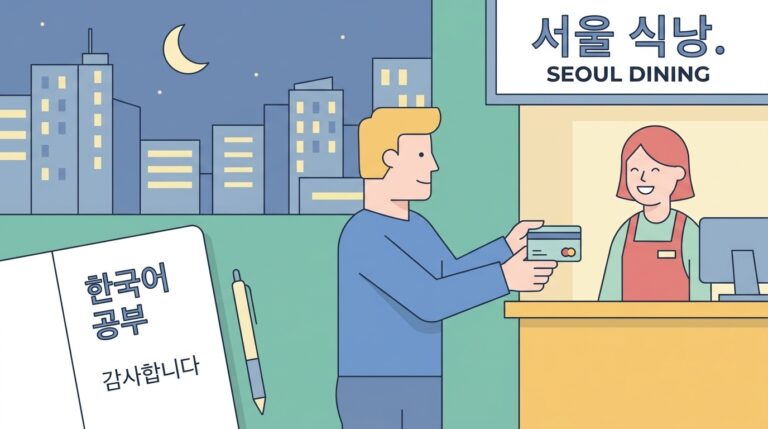
Mastering the Korean Business Bill: How to Pay and Settle Receipts Like a Pro
Phase 1: Empathy (Story-Immersive Opening)
안녕하세요! 매일한글 에디터입니다. (Hello! This is your Daily Hangul editor.)
Picture this: You are sitting in a private dining room (hanjeongsik, 한정식) in Yeouido, surrounded by exquisite side dishes, empty glasses of premium soju, and your company’s most important prospective client. The conversation has flowed effortlessly, thanks to your sharp industry insights and polished manners. But suddenly, dinner is winding down. Your Korean team leader shoots you a subtle, razor-sharp glance and gives a tiny nod toward the sliding door.
You know what that look means: It’s time to settle the bill before the client even touches their jacket.
You quietly slip out to the counter with the black company card (beopka, 법인카드) in your pocket. But as you reach the cashier, your mind goes blank. How do you pay discreetly without drawing the client’s attention? How do you ask for an itemized business receipt (jichul jeungbing, 지출증빙) so your finance department doesn’t reject your expense report next Monday?
Navigating Korean business hospitality (jeopdae, 접대) can feel like walking a tightrope between traditional social hierarchy and modern corporate compliance. Based on real feedback from international managers working in Seoul, mastering payment etiquette and corporate receipt processing is the exact moment an expat transforms from an “honored guest” into a trusted, reliable business insider. Let’s make sure you handle your next business dinner with absolute poise!
Phase 2: Top 3 Core Expressions
1. 제가 계산하겠습니다.
- Pronunciation: [Je-ga gye-san-ha-ge-sseum-ni-da] (Think: Je-gah gyeh-sahn-hah-get-soom-nee-dah)
- Meaning: Literal: “I will calculate.” / Nuance: “I will take care of the bill / Dinner is on us tonight.”
- K-Culture Moment: In K-dramas like Business Proposal or Misaeng, whenever senior managers host external partners, they smoothly intercept the bill at the counter and deliver this exact sentence with a calm, reassuring smile.
- Editor’s Insight: While
제가 낼게요(Je-ga nael-ge-yo) works when buying coffee for your close peers,제가 계산하겠습니다is the standard formal declaration in commercial settings. The suffix-겠습니다expresses firm intention and respectful service.- Situation Spectrum: Casual ⚠️ | Semi-formal ✅ | Formal ✅
- 🤔 Think About It: In many Western business contexts, splitting the bill or waiting for an invoice by email is standard. Why does Korean business culture place such an emotional emphasis on declaring upfront that you are treating the entire table?
2. 법인카드로 결제해 주시고, 영수증 챙겨주세요.
- Pronunciation: [Beop-in-ka-deu-ro gyeol-je-hae ju-si-go, yeong-su-jeung chaeng-gyeo-ju-se-yo] (Think: Bup-een-kah-doo-roh gyul-jeh-heh joo-she-goh, young-soo-joong cheng-gyuh-joo-seh-yoh)
- Meaning: Literal: “Please pay with the corporate card, and pack the receipt for me.” / Nuance: “Please charge this to the corporate card and make sure to include the itemized receipt.”
- K-Culture Moment: Seen in corporate office dramas whenever junior associates rush to the restaurant counter while holding the precious black corporate card with both hands.
- Editor’s Insight: The verb
챙기다(chaeng-gi-da) literally means to pack, look after, or take care of something. Using챙겨주세요instead of simply주세요(give me) politely implies, “Please don’t forget to include the receipt, as it is critical for my paperwork.”- Situation Spectrum: Casual 🚫 | Semi-formal ✅ | Formal ✅
- 🤔 Think About It: How does the linguistic use of
챙겨주다(taking care of an item) reflect the Korean cultural emphasis on mutual attentiveness and thoroughness in daily business interactions?3. 세금계산서 발행 가능한가요?
- Pronunciation: [Se-geum-gye-san-seo bal-haeng ga-neung-han-ga-yo?] (Think: Seh-goom-gyeh-sahn-suh bahl-heng gah-noong-hahn-gah-yoh?)
- Meaning: Literal: “Is issuing a tax invoice possible?” / Nuance: “Can you issue a formal VAT tax invoice for this transaction?”
- K-Culture Moment: Essential during high-budget corporate catering, private banquet bookings, or when the payment exceeds standard corporate card limits and requires direct bank transfer (tongjang ipgeum).
- Editor’s Insight: In Korea, a standard credit card slip is often sufficient, but for large banquets or direct bank transfers, companies require an electronic tax invoice (jeonja segeumgyesanseo) registered with the National Tax Service (Hometax).
- Situation Spectrum: Casual 🚫 | Semi-formal ✅ | Formal ✅
- 🤔 Think About It: Why is tax compliance paperwork so strictly intertwined with dining culture in Korea compared to countries where receipts are purely transactional?
Phase 3: Textbook Korean vs. Real Korean
Situation 1: Stepping up to pay at the counter
- 📖 교과서 한국어 (Textbook Korean): 저기요, 얼마예요? 제가 돈을 내겠습니다. (Jeogiyo, eolmayeyo? Jega doneul naegesseumnida. / “Excuse me, how much is it? I will pay money.”)
- 🗣️ 진짜 한국어 (Real Korean): 사장님, 오늘 저희 테이블 결제 먼저 도와주시겠어요? (Sajangnim, oneul jeohui teibeul gyeolje meonje dowajusigesseoyo? / “Boss, could you please help me settle our table’s bill first?”)
- 💡 왜 다를까? (Why is it different?): Direct mentions of “money” (don) sound blunt and transactional during hospitality. Using
결제 도와주시겠어요?(“Could you assist with the payment?”) treats the cashier with utmost hospitality honorifics while keeping the interaction elegant.
Situation 2: Requesting expense proof for corporate filing
- 📖 교과서 한국어 (Textbook Korean): 영수증을 주십시오. (Yeongsujeungeul jusipsio. / “Please give me the receipt.”)
- 🗣️ 진짜 한국어 (Real Korean): 법카 결제라서 그런데, 지출증빙용 상세 영수증으로 끊어주실 수 있나요? (Beopka gyeoljeraseo geureonde, jichuljeungbingyong sangse yeongsujeungeuro kkeuneojusil su 있nayo? / “It’s on the corporate card, so could you issue a detailed receipt for expense proof?”)
- 💡 왜 다를까? (Why is it different?): Finance departments in Korea require specific business registration slips or itemized receipts rather than simple credit card summaries.
끊어주다(literally: to tear/issue a paper slip) is the natural native verb for issuing receipts and tickets.
Phase 4: K-Culture Deep Dive & Non-Verbal Manners
4-1. 눈치 (Nunchi) & The “Stealth Payment” Dance
In Korean business hospitality, settling the bill in front of the client is considered clumsy. The gold standard of nunchi (quick situational awareness) is the Stealth Exit:
1. The Timing: When the main dishes are cleared and tea or dessert is served, excuse yourself under the pretense of going to the restroom: 잠시 화장실 다녀오겠습니다 (Jamsi hwajangsil danyeo-ogesseumnida).
2. The Two-Handed Handover: Hand the corporate card to the cashier using both hands (or supporting your right forearm with your left hand). Receive the card and receipt back using both hands with a slight head bow.
3. The Discretion: Never check the amount out loud at the register while guests are nearby. Put the receipt in your inside jacket pocket immediately.
[Client & Boss Chatting in Room]
       │ (Excuses self: "화장실 다녀오겠습니다")
       ▼
[Stealth Walk to Cashier Counter]
       │ (Two-handed card pass: "법카 결제 부탁드립니다")
       ▼
[Pocket Receipt & Return Silently]
       │ (Client prepares to leave, finds bill already settled)
       ▼
[Flawless Business Hospitality Impression Achieved!]
4-2. Cultural Code Analysis: The Legend of “법카” (Beopka) & The Anti-Graft Act
In Korean office culture, the corporate card (beopka, short for beopin kadeu) is treated with almost mythical reverence. However, business dining is strictly regulated under the Kim Young-ran Act (Improper Solicitation and Graft Act). When entertaining public officials, educators, or state partners, business meals must remain under statutory limits (typically 30,000 to 50,000 KRW per person). Keeping itemized receipts (sangse yeongsujeung) is not just an administrative hassle—it protects both your company and your guests from legal liabilities!
Phase 5: Real Role-Play Scenario
Setting: A serene private room at a traditional upscale Korean restaurant in Gwanghwamun. Dinner with Director Kim (a VIP client) and your supervisor, Team Leader Park, is concluding.
Characters:
* You (Alex / 알렉스): Global Operations Manager.
* Team Leader Park (박 팀장): Your sharp-eyed manager.
* Manager Lee (이 지배인): The restaurant floor manager at the counter.
박 팀장: (Looking over at the empty dessert bowls, giving Alex a subtle wink) 알렉스 씨, 슬슬 마무리할까요? (Alex-ssi, seul-seul ma-mu-ri-hal-kka-yo? / “Alex, shall we start wrapping things up?”)
You: (Nodding knowingly, standing up gracefully) 🎭 일어나며 살짝 목례한다 네, 팀장님. 제가 잠시 화장실 다녀오면서 정리하고 오겠습니다. (Ne, tim-jang-nim. Je-ga jam-si hwa-jang-sil da-nyeo-o-myeon-seo jeong-ri-ha-go o-ge-sseum-ni-da. / “Yes, Team Leader. I will use the restroom and take care of arrangements on my way.”)
이 지배인: (Smiling warmly behind the register counter) 어서 오세요, 손님. 3번 룸이시죠? (Eo-seo o-se-yo, son-nim. Sam-beon rum-i-si-jyo? / “Welcome, sir. Room number 3, right?”)
You: (Handing over the corporate card with both hands) 🎭 두 손으로 법인카드를 건네며 네, 3번 방 결제 부탁드립니다. 법인카드인데 지출증빙용 영수증도 같이 출력해 주시겠어요? (Ne, sam-beon bang gyeol-je bu-tak-deu-rim-ni-da. Beop-in-ka-deu-in-de ji-chul-jeung-bing-yong yeong-su-jeung-do ga-chi chul-ryeok-hae ju-si-ge-sseo-yo? / “Yes, please settle Room 3. It’s a corporate card—could you also print out an expense proof receipt for me?”)
이 지배인: (Typing on the POS terminal) 네, 총 38만 원 결제 완료되었습니다. 여기 카드와 상세 내역 영수증입니다. (Ne, chong sam-sip-pal-man-won gyeol-je wan-ryo-doe-eot-seum-ni-da. Yeo-gi ka-deu-wa sang-se nae-yeok yeong-su-jeung-im-ni-da. / “Yes, a total of 380,000 KRW has been processed. Here is your card and the itemized breakdown receipt.”)
You: (Receiving both with a slight bow) 🎭 두 손으로 받으며 고개 숙여 인사 감사합니다. 주차 등록도 2대 부탁드릴게요. (Gam-sa-ham-ni-da. Ju-cha deung-rok-do i-dae bu-tak-deu-ril-ge-yo. / “Thank you. Could you also please register parking for two cars?”)
이 지배인: (Nodding promptly) 네, 차량 번호 등록해 드렸습니다. 편안한 밤 되세요. (Ne, cha-ryang beon-ho deung-rok-hae deu-ryeo-sseum-ni-da. Pyeon-an-han bam doe-se-yo. / “Yes, the license plates are registered. Have a pleasant evening.”)
You: (Returning calmly to the dining room to guide the guests) 김 이사님, 팀장님, 밖으로 모시겠습니다. (Kim I-sa-nim, tim-jang-nim, bakk-eu-ro mo-si-ge-sseum-ni-da. / “Director Kim, Team Leader, allow me to guide you outside.”)
🔀 Interactive Decision Point
When the client insists on paying at the front door: “아이고, 알렉스 매니저! 오늘은 저희가 사야죠!” (Aigo, Alex manager! We should treat you today!), what should you do?
- Choice A: “이미 제가 법카로 결제 끝냈습니다! 걱정 마시고 나가시죠.” (I already finished paying with the corporate card! Don’t worry and let’s go.)
- ⚠️ Risk Feedback: A bit too blunt. Mentioning beopka loudly in front of the client strips away the hospitality grace.
- Choice B: “저희 대표님께서 오늘 귀한 분 모신다고 꼭 대접하라고 신신당부하셨습니다. 맛있게 드셔주셔서 저희가 더 영광입니다.” (Our CEO specifically insisted on hosting such an esteemed guest today. It is our absolute honor that you enjoyed the meal.)
- 🏆 Best Feedback: Masterclass in Korean business etiquette! It honors the client, credits your company leadership, and makes them feel respected without awkwardness.
- Choice C: “그럼 다음에는 꼭 이사님이 사주세요!” (Well, then you must definitely buy next time!)
- 🚫 Bad Feedback: Too casual for a formal B2B hospitality setting. It breaks the professional boundary.
Phase 6: 10-Second Emotional Shadowing Drill
Practice these lines with precise rhythm, pausing at / and channeling the designated emotion:
[🤫 은밀하고 신속하게 - Discreetly & Efficiently]- 사장님, / 3번 룸 결제 / 먼저 도와주시겠어요? / 영수증도 꼭 챙겨주세요.
- (Sajangnim, / sam-beon rum gyeolje / meonje dowajusigesseoyo? / yeongsujeungdo kkok chaenggyeojuseyo.)
[💼 정중하고 당당하게 - Polite & Confident]- 오늘 자리는 / 저희 회사에서 / 정성껏 준비했습니다. / 편안히 모시겠습니다.
- (Oneul jarineun / jeohui hoesa-eseo / jeongseongkkeot junbihaesseumnida. / Pyeon-an-hi mosigesseumnida.)
[📑 꼼꼼하고 프로페셔널하게 - Thorough & Professional]- 법인카드 결제라서 / 사업자 번호가 들어간 / 상세 내역 영수증이 필요합니다.
- (Beop-in-ka-deu gyeoljeraseo / sa-eop-ja beon-ho-ga deureogan / sangse naeyeok yeongsujeung-i piryoham-ni-da.)
Phase 7: K-Culture Mini Dictionary
- 법카 (Beop-ka)
[Noun]- Meaning: Abbreviation of 법인카드 (Corporate Credit Card).
- Usage: Widely used in office banter (“오늘 점심 법카 찬스?” = “Are we using the company card for lunch today?”). In business hospitality, handling the beopka demonstrates trust from your department head.
- 지출증빙 (Ji-chul-jeung-bing)
[Noun]- Meaning: Expense proof / Corporate tax deduction verification.
- Usage: Used when requesting a receipt that includes the company’s business registration number (saeopja beonho) for auditing and corporate tax write-offs.
- 2차 (I-cha)
[Noun]- Meaning: “Round 2” (The second venue of an evening out, often a pub, lounge, or karaoke room).
- Usage: After settling the first dinner bill, the host traditionally invites the party to a secondary venue:
2차로 가벼운 맥주 한잔 모시겠습니다(I would like to host you for a light beer for Round 2).
- 김영란법 (Gim-yeong-ran-beop)
[Proper Noun]- Meaning: The Improper Solicitation and Graft Act.
- Usage: Common cultural shorthand for anti-corruption price caps during business hospitality. Essential vocabulary for any corporate executive operating in South Korea.
Phase 8: Traveler’s & Expat Survival Kit
Top 3 Survival Expressions
- 1. 영수증 버려주세요. (Yeongsujeung beoryeojuseyo. / “Please discard the receipt.”)
- Pro Tip: Use this only for minor personal expenses (like buying chewing gum at a convenience store). Never say this during a business dinner!
- 2. 카카오T 대리 불러주실 수 있나요? (Kakao-T daeri bulleojusil su 있nayo? / “Could you call a designated driver via Kakao T for us?”)
- Pro Tip: In Korea, after hosting clients with alcohol, booking a designated driver (daeri unjeon) for their vehicle is the pinnacle of hospitality.
- 3. 부가세 포함 금액인가요? (Bugase poham geumaek-in-ga-yo? / “Is this price inclusive of VAT?”)
- Pro Tip: Almost all restaurant prices in Korea include 10% VAT (bugase), but hotel banquets may list service charges separately.
Editor’s Travel & Business Note
- Essential Expense Apps: Install the 국세청 홈택스 전자세금계산서 확인 앱 다운로드 to verify corporate tax status on the fly. For transportation arrangements, make sure you have the 카카오 T 대리운전 및 택시 호출 서비스 linked to your company payment profile.
- Card Compatibility: Foreign corporate cards (Amex/Visa) occasionally fail on older POS terminals in smaller traditional restaurants. Always carry a secondary domestic payment option or verify card compatibility when booking the private room.
Phase 9: “A Step Deeper” (Reflective Mini-Essay)
In Korean corporate dynamics, the act of paying the bill is rarely about the exchange of currency; it is an orchestrated ritual of saving face (chaemyeon, 체면) and cultivating relational debt (jeong, 정). When you smoothly pay for a meal without creating commotion, you alleviate any emotional burden from your guest, establishing your company as a capable and respectful partner. Sponsoring a dinner signifies that your relationship goes beyond contractual stipulations—it is an investment in human connection. In Korean business, the contract is signed on paper, but the partnership is cemented over the dinner table.
💬 Your Turn: Have you ever experienced a “payment dance” in your home country or while traveling in Korea? How does your culture handle splitting vs. treating during business dinners? Share your story in the comments below!
Phase 10: FAQ & Common Mistakes
Q: Can I ask the restaurant to split the bill among individual corporate cards during a Korean business dinner?
A: While technically possible, splitting the bill (Dutch pay, 더치페이) during business hospitality (jeopdae) is considered bad etiquette. The hosting party is expected to cover the entire cost on a single card. If multiple departments must share costs, settle the entire bill first and reallocate internally through your corporate finance accounting system.
Q: What should I do if the client tries to grab the bill at the counter before I reach it?
A: Intercept gracefully with your body language, gently place your hand over the card machine, and say: 이사님, 오늘은 저희가 모시는 자리입니다. 다음번에 맛있는 커피 사주십시오! (“Director, today is our turn to host you. Please buy us a great coffee next time!”). Never get into an aggressive physical tug-of-war.
Q: Is a basic printed paper card slip enough for company tax reimbursement in Korea?
A: For small amounts, yes. However, for amounts over 30,000 KRW, many Korean companies require the receipt to display the restaurant’s Business Registration Number (saeopja deungrok beonho), the itemized order breakdown, and date/time stamps.
🚨 Common Mistakes Alert
- Mistake: Handing the company card over with one hand while looking at your smartphone.
- Correct Action: Hand the card with both hands, make brief polite eye contact, and give a slight nod to the cashier.
- Mistake: Announcing the total bill amount loudly in the room: “와, 오늘 50만 원 나왔네요!” (“Wow, 500,000 KRW today!”).
- Correct Action: Keep financial figures confidential. Slip the receipt directly into your wallet or jacket pocket without public remarks.
- Mistake: Throwing away the detailed paper receipt assuming the SMS alert is sufficient.
- Correct Action: Always keep the paper yeongsujeung. Many accounting teams reject digital SMS notifications without itemized slips.
Phase 11: Action Missions
- 🥉 Bronze Mission (Solo Practice): Stand in front of your mirror and practice passing your card with both hands while smoothly reciting:
"법인카드로 결제해 주시고, 영수증 챙겨주세요."in under 5 seconds. - 🥈 Silver Mission (Social / Community): Watch an episode of an office K-Drama (like Misaeng or Agency) and identify the moment a corporate card (법카) is used. Post the episode timestamp and the phrase you heard in our community forum!
- 🥇 Gold Mission (Real-world Challenge): Next time you visit a Korean restaurant or cafe, request an itemized receipt using:
"상세 영수증으로 끊어주실 수 있나요?"(Sangse yeongsujeungeuro kkeuneojusil su innayo?).
🎮 K-Culture Mission: Search the hashtag #법카 or #회식스타그램 on Korean social media. Observe the types of restaurants and dishes commonly associated with corporate dinner celebrations in Seoul!
Phase 12: Interactive Quiz Challenge
1. Situational Judgment
During a business dinner with a major client, when is the best time to settle the bill?
* A) When everyone is standing by the restaurant exit putting on their shoes.
* B) Right after ordering appetizers at the very beginning.
* C) Discreetly during dessert or right before the table finishes, by excusing yourself.
* D) Asking the cashier to bring the card machine to the dining table in front of the client.
🔍 Click here to view Answer & Feedback
Correct Answer: C
* Feedback: Discreetly excusing yourself before the meal fully wraps up allows you to complete payment without creating an awkward pause or allowing the client to compete for the bill.
2. Fill in the Blank
Complete the natural Korean phrase for requesting an itemized expense receipt:
“법카 결제라서 그런데, 지출증빙용 ( _________ ) 영수증으로 끊어주세요.”
* A) 할인 (Hal-in – Discount)
* B) 상세 (Sang-se – Detailed / Itemized)
* C) 취소 (Chwi-so – Cancellation)
* D) 간이 (Gan-i – Simplified / Hand-written)
🔍 Click here to view Answer & Feedback
Correct Answer: B (상세)
* Feedback: 상세 영수증 means an itemized, detailed receipt, which is required for accounting verification.
3. True or False Cultural Quiz
- Statement: Under modern Korean business etiquette, splitting the bill 50/50 (Dutch pay) during an official B2B hospitality dinner is considered standard and polite.
- [ True / False ]
🔍 Click here to view Answer & Feedback
Correct Answer: False
* Feedback: In business hospitality (jeopdae), the inviting host covers the full expense. Splitting the bill damages the impression of hospitality and leadership.







