

Phase 1: Empathy (Welcome to the Warmth of Jeong!)
안녕하세요! (Annyeonghaseyo!) I’m your Daily Hangul editor and your 10-year local culture navigator.
Picture this classic K-Drama scene: You’ve just spent the most heartwarming evening at a Korean friend’s apartment. You cooked bubbling Kimchi Jjigae together, exchanged funny stories, and laughed until your stomach hurt. Now, you’re sitting in the entryway (hyeon-gwan), lacing up your sneakers. As you stand up, your friend smiles brightly, hands you a small bag of fresh mandarins, and says with sparkling eyes: “또 놀러 와요!”
You freeze for a second. You know Annyeonghi gaseyo (Goodbye), but your heart wants to say something warmer—something like “I had the best time, invite me again anytime!”
In Korean culture, goodbyes are rarely abrupt endings. They are warm bridges to the next get-together. This deep, unspoken bond of affection and hospitality is what Koreans call 정 (Jeong). Master this single concept and the phrase “또 놀러 오세요” (Come visit again!), and you will instantly transform from a polite foreigner into a cherished lifelong friend. Let’s unlock how native speakers really use this phrase!
Phase 2: Core 3 Expressions Deep-Dive
1. 또 놀러 와요! (Tto nolleo wayo!)
- Pronunciation: [Tto nol-leo wa-yo] (Say it like: “Ttoh” with a punchy ‘T’ + “noll-uh” + “wah-yo”)
- Meaning: Literal: “Come play again!” | Real Nuance: “Come over and hang out again soon!”
- K-Culture Moment: You’ll hear this constantly on variety shows like Home Alone (나 혼자 산다) or Three Meals a Day (삼시세끼) when celebrity guests finish a cozy weekend visit and walk out the front door.
- Editor’s Insight: In Korean, the verb 놀다 (nolda) literally means ‘to play’, but for adults, it simply means to relax, hang out, or chill. Don’t worry, saying 놀러 와요 doesn’t mean you’re inviting them to play with toys!
- Situation Spectrum:
- Casual (Close friends): ✅ 또 놀러 와! (Tto nolleo wa!)
- Semi-formal (Polite/Acquaintances): ✅ 또 놀러 와요! (Tto nolleo wayo!)
- Formal (Official business): 🚫 (Use 다음에 다시 방문해 주십시오 / Daeume dasi bangmunhae jusipsio)
- 🤔 Think About It: In English, we often say “Let’s hang out again.” How does using the word “play” (놀다) soften the social atmosphere and bring people closer together?
2. 언제든지 또 오세요! (Eonjedeunji tto oseyo!)
- Pronunciation: [Eon-je-deun-ji tto o-se-yo] (Say it like: “Un-jay-doon-jee ttoh oh-say-yo!”)
- Meaning: Literal: “Come again anytime!” | Real Nuance: “Our door is always open for you!”
- K-Culture Moment: A sweet Halmoni (grandmother) running a traditional guesthouse (Hanok stay) waving both hands with a wide grin as you check out.
- Editor’s Insight: The magic word here is 언제든지 (eonjedeunji – anytime). Adding this shows genuine generosity. It removes the pressure of setting a fixed date while emphasizing unconditional warmth.
- Situation Spectrum:
- Casual: ⚠️ 언제든지 또 와! (Eonjedeunji tto wa! – friendly)
- Semi-formal: ✅ 언제든지 또 오세요! (Eonjedeunji tto oseyo! – standard & polite)
- Formal: ✅ 언제든지 다시 찾아주십시오. (Eonjedeunji dasi chajajusipsio. – business/hospitality)
- 🤔 Think About It: Is “come anytime” in your home country considered a literal open invitation, or just a polite formality?
3. 조심히 들어가고, 또 보자! (Josimhi deureogago, tto boja!)
- Pronunciation: [Jo-sim-hi deu-reo-ga-go, tto bo-ja] (Say it like: “Joh-sheem-hee doo-ruh-gah-goh, ttoh boh-jah!”)
- Meaning: Literal: “Enter (home) safely, and let’s see each other again!” | Real Nuance: “Get home safe, and let’s meet up again real soon!”
- K-Culture Moment: Parting ways at the subway stairs under bright neon city lights after late-night Korean fried chicken and sparkling soda.
- Editor’s Insight: Notice that Koreans say 들어가다 (deureogada – to enter) rather than just “go home”. It expresses care that you make it all the way inside your safe home.
- Situation Spectrum:
- Casual: ✅ 조심히 들어가, 또 보자! (Josimhi deureoga, tto boja!)
- Semi-formal: ✅ 조심히 들어가세요, 또 봬요! (Josimhi deureogaseyo, tto bwaeyo!)
- Formal: 🚫 (Too personal for formal corporate settings)
- 🤔 Think About It: Why does Korean care so deeply about the journey home after a gathering?
Phase 3: Textbook Korean vs. Real Korean
Situation 1: Inviting a friend back to your apartment
- 📖 Textbook Korean: 다음에 저희 집을 다시 방문하세요. (Daeume jeohui jibeul dasi bangmunhaseyo. – “Please visit our residence again next time.”)
- 🗣️ Real Korean: 우리 집에 또 놀러 와! (Uri jibe tto nolleo wa! – “Come hang out at our place again!”)
- 💡 Why is it different? The word 방문하다 (bangmunhada – to visit) sounds like an official inspection or a diplomatic mission! Real friends always say 우리 집 (our house) and 놀러 오다 (come hang out).
Situation 2: A warm cafe or cozy shop owner bidding farewell
- 📖 Textbook Korean: 안녕히 가십시오. (Annyeonghi gasipsio. – “Goodbye, go in peace.”)
- 🗣️ Real Korean: 또 놀러 오세요~ 자주 봬요! (Tto nolleo oseyo~ Jaju bwaeyo! – “Come visit again~ Hope to see you often!”)
- 💡 Why is it different? Local neighborhood shops in Korea thrive on building Dan-gol (regular customer) affection. Treating customers like friendly guests makes the interaction warmer.
Phase 4: K-Culture Deep Dive & Non-Verbal Manners
4-1. 눈치 (Nunchi) & Essential Body Language
- The Doorstep Walk (배웅 – Baeung): Never say goodbye while sitting on the sofa! Always walk your guest all the way to the front entryway (hyeon-gwan), or even downstairs to the building entrance or bus stop.
- The Double-Hand Wave & Mini Bow: When saying “또 놀러 오세요!”, raise both hands at chest height for a gentle wave, accompanied by a soft 15-degree bow.
- The KakaoTalk Safety Check: About 30–45 minutes after your guest leaves, text them: “잘 들어갔어요?” (Jal deureogasseoyo? – Did you get home safe?). This seals the golden standard of Korean politeness.
4-2. Culture Code: The Magic of 바리바리 싸주기 (Sending Off with Goodies)
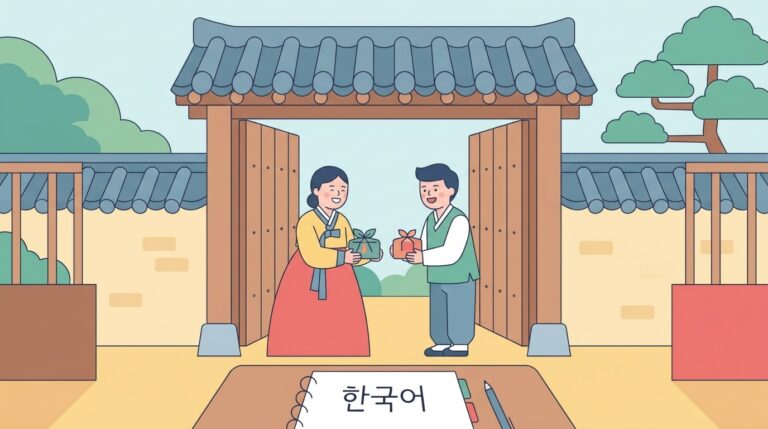
In Korea, Jeong is tangible. If someone visits your home, you never let them leave empty-handed. Hosts will pack side dishes (banchan), seasonal fruits, or snacks into airtight containers (Tupperware) and put them in your hands. When receiving this, accept with two hands, smile, and say: “감사해요, 또 놀러 올게요!” (Gamsahaeyo, tto nolleo olgeyo! – Thank you, I’ll definitely come hang out again!).
Phase 5: Real-Life Roleplay Scenario
Setting: Front door of your studio apartment in Hongdae. You just finished sharing homemade Tteokbokki with your Korean classmate, Minji (민지).
- Turn 1 (Minji): 벌써 10시네! 오늘 떡볶이 진짜 맛있었어. 이제 가볼게!
(Beolsseo yeolsine! Oneul tteokbokki jinjja masisseosseo. Ije gabolge!)
🎭 [Checks her watch and slips on her coat with a happy smile]
“It’s already 10 PM! The Tteokbokki was delicious today. I should get going!” -
Turn 2 (You):벌써 가? 시간 진짜 빠르다.
(Beolsseo ga? Sigan jinjja ppareuda.)
🎭 [Walks Minji to the front door entryway]
“Leaving already? Time flew by so fast.” -
Turn 3 (Minji): 그러니까! 오늘 초대해 줘서 고마워.
(Geureonikka! Oneul chodaehae jwoseo gomawo.)
🎭 [Puts on her sneakers at the hyeon-gwan]
“I know, right! Thanks so much for inviting me today.” -
Turn 4 (You): 별말씀을! 오늘 너무 재미있었어.
(Byeolmalsseumeul! Oneul neomu jaemiisseosseo.)
🎭 [Hands her a small box of bakery cookies]
“Don’t mention it! I had so much fun today.” -
Turn 5 (Minji): 헐, 과자까지? 감동이야… 잘 먹을게!
(Heol, gwajakkaji? Gamdong-iya… Jal meogeulge!)
🎭 [Holds the cookie box with both hands, touched by your gesture]
“Omg, even snacks? I’m so touched… I’ll enjoy them!” -
Turn 6 (You): 응! 조심히 들어가고, 우리 집에 또 놀러 와!
(Eung! Josimhi deureogago, uri jibe tto nolleo wa!)
🎭 [Waves warmly with a bright smile]
“Yeah! Get home safe, and come hang out at my place again!” -
Turn 7 (Minji): 좋아! 다음엔 내가 맛있는 거 사 올게.
(Joha! Daeumen naega masinneun geo sa olge.)
🎭 [Gives a cheerful thumbs-up]
“Awesome! Next time I’ll buy and bring something yummy.” -
Turn 8 (You): 기대할게! 도착하면 카톡해~
(Gidaehalge! Dochakhamyeon katokhae~)
🎭 [Waves as the elevator door opens]
“I’ll look forward to it! KakaoTalk me when you arrive home~”
🔀 Interactive Decision Branch
What would you say if Minji was your senior colleague (seonbae) or teacher whom you invited for tea?
- Option A: “야! 다음에 우리 집에 또 놀러 와!” (Ya! Daeume uri jibe tto nolleo wa!)
- Option B: “오늘 와주셔서 감사해요. 조심히 들어가시고 또 놀러 오세요!” (Oneul wajusyeoseo gamsahaeyo. Josimhi deureogasigo tto nolleo oseyo!)
- Option C: “안녕히 가십시오. 저희 사적인 공간 방문을 종료합니다.” (Annyeonghi gasipsio. Jeohui sajeogin gonggan bangmuneul jongnyohamnida.)
Feedback:
* Option A (Risk 🚨): Too casual! “Ya!” is only for very close same-age friends.
* Option B (Best Choice ⭐): Perfect balance of polite honorifics (-seyo) and warm personal Jeong!
* Option C (Bad ❌): Sounds like a robotic automated announcement ending a spaceship tour!
Phase 6: 10-Second Emotion Shadowing Drill
Read out loud, pausing at each slash (/) and matching the emotional tone!
- [😊 Warm & Welcoming]
오늘 너무 즐거웠어요! / 조심히 들어가시고 / 또 놀러 오세요!
(Oneul neomu jeulgeowosseoyo! / Josimhi deureogasigo / tto nolleo oseyo!)
“I had such a wonderful time today! / Get home safe / and please come visit again!” -
[🥺 Playful & Caring]
벌써 가? 아쉽다! / 다음에 또 놀러 와야 해! / 카톡 보내!
(Beolsseo ga? Aswipda! / Daeume tto nolleo waya hae! / Katok bonae!)
“Leaving already? What a pity! / You must come hang out again next time! / Text me!” -
[☕ Cozy Host Nuance]
언제든지 편하게 / 놀러 와요~ / 문 언제나 열려 있어요!
(Eonjedeunji pyeonhage / nolleo wayo~ / Mun eonjena yeollyeo isseoyo!)
“Whenever you want, comfortably / come visit~ / My door is always open!”
Phase 7: K-Culture Mini Dictionary
- 정 (Jeong): The unique Korean concept of unconditional interpersonal warmth, empathy, and emotional bonding built over time through shared experiences.
- 집들이 (Jipdeuri): A traditional housewarming gathering where friends bring practical gifts (like toilet paper for rolling prosperity or laundry detergent for bubbling success) and the host prepares a feast.
- 단골 (Dangol): A loyal, regular customer. Becoming a dangol at a Korean eatery often unlocks free side dishes (Service / 서비스) and warm greetings like “또 오셨네요!” (You came again!).
- 배웅 (Baeung): The act of walking an honored guest out to the doorway, elevator, or street to ensure they depart comfortably.
Phase 8: Survival Kit for Travelers
🧳 Top 3 Survival Expressions
- 다음에 또 올게요! (Daeume tto olgeyo!)
Meaning: “I will definitely come visit again!”
Pro Tip: Use this when leaving a delightful local boutique, cafe, or Airbnb host! - 초대해 주셔서 감사합니다. (Chodaehae jusyeoseo gamsahamnida.)
Meaning: “Thank you for inviting me.”
Pro Tip: The golden phrase to say the moment you step into a Korean host’s living room. - 잘 놀다 갑니다! (Jal nolda gamnida!)
Meaning: “I had such a great time hanging out!”
Pro Tip: Say this to close friends or homestay families as you put on your shoes.
🗺️ Editor’s Travel Note
When hosting or seeing off Korean friends in Seoul, public transit navigation is key. Make sure to download the Naver Map App Download to check the real-time last subway and bus departures (mak-cha / 막차). If your guest leaves late, offering to call a safe ride via Kakao T (Kakao Taxi) is a top-tier gesture of Jeong!
Phase 9: “One Step Deeper” (Reflective Essay)
In many fast-paced urban societies, individuality and personal boundaries reign supreme. Yet in Korea, the linguistic boundary between “you” and “me” dissolves into 우리 (Uri – We/Us).
When a Korean host tells you “우리 집에 또 놀러 와요”, they are not simply offering polite small talk; they are sharing a piece of their personal sanctuary with you. In a world full of digital disconnects, inviting someone into your physical home to share a warm meal is one of the purest expressions of human connection. The beauty of the Korean language is that a single word like 놀러 오다 holds the power to turn a stranger into family.
💬 Your Turn: Have you ever experienced a moment of unexpected hospitality or Jeong while traveling in Korea or meeting Korean friends? Share your story in the comments below!
Phase 10: FAQ & Common Mistakes
Q: Does “또 놀러 오세요” mean I can show up unannounced at their house?
A: No! While it is a genuine expression of warmth, Korean culture values preparation. Always send a text message or KakaoTalk a few days in advance (e.g., “이번 주 토요일에 시간 돼요?” / Are you free this Saturday?) before dropping by.
Q: What is the difference between “놀러 오세요” and “놀러 가세요”?
A: Direction matters! 놀러 오세요 (Nolleo oseyo) means “Come hang out at MY place/here”, while 놀러 가세요 (Nolleo gaseyo) means “Go hang out (at someone else’s place or vacation spot)”.
Q: Can I say “또 놀러 와” to my boss or professor?
A: Definitely not! 또 놀러 와 is casual language (banmal). For professors or bosses visiting an event or office, say: “다음에 또 찾아와 주십시오” (Daeume tto chajawa jusipsio) or “와주셔서 진심으로 감사드립니다” (Wajusyeoseo jinsimeuro gamsadeurimnida).
🚨 Common Mistakes Alert
- Mistake: Saying “안녕히 계세요” when you are the host.
Correct Action: If you are staying home and your guest leaves, say “안녕히 가세요” (Go well) or “조심히 들어가세요, 또 놀러 오세요!”. - Mistake: Using “플레이 하러 와” (Direct literal translation of “come play”).
Correct Action: Never translate “play” literally as English loanword 플레이. Always use 놀러 오다. - Mistake: Forgetting the “Safe Journey” phrase.
Correct Action: Always pair 놀러 와 with 조심히 가요 (Go safely) for maximum warmth.
Phase 11: Action Missions & K-Culture Challenge
- 🥉 Bronze Mission (Self-Practice): Look into the mirror and practice the 3-step farewell: Smile ➔ Double-hand wave ➔ Say “조심히 들어가고, 또 놀러 와!” smoothly in under 5 seconds.
- 🥈 Silver Mission (Social Media): Post a photo of your favorite Korean food on Instagram or Threads and caption it: “우리 집에 떡볶이 먹으러 또 놀러 와요!” (Come over to my place to eat Tteokbokki again!).
- 🥇 Gold Mission (Real Life): Next time you hang out with a Korean speaker or practice partner, use “다음에 또 놀러 오세요!” as your closing line.
- 🎮 K-Culture Hunt: Watch one episode of a cozy K-Variety show (like Youth MT or Jinny’s Kitchen) and see if you can spot the cast saying 놀러 오세요 to guests!
Phase 12: Interactive Quiz Challenge
Test your knowledge below! Click each toggle to reveal the correct answer.
Quiz 1. Situation Judgment
You just had tea with an older neighbor who brought you homemade Kimchi. What is the most natural and polite way to bid them farewell at your door?
1. 야, 또 놀러 와!
2. 조심히 들어가시고, 언제든지 또 놀러 오세요!
3. 바이바이, 내일 봐.
👉 Click to view Answer & Explanation
Correct Answer: 2번
Explanation: Option 2 uses polite honorifics (-세요, 조심히 들어가시고) while warmly inviting them to visit again anytime, showing deep respect and Jeong.
Quiz 2. Fill in the Blank
Complete the natural Korean phrase:
“오늘 너무 재미있었어! 집들이에 _________ 놀러 와!” (Come hang out again!)
* Hint: Starts with “ㄸ”
👉 Click to view Answer & Explanation
Correct Answer: 또 (Tto)
Explanation: 또 (Tto) means “again”. 또 놀러 와 is the gold-standard phrase for inviting friends over once more.
Quiz 3. True or False
“In Korean culture, walking a departing guest all the way to the front door or elevator (배웅) is considered an essential part of hospitality.”
👉 Click to view Answer & Explanation
Correct Answer: TRUE (O)
Explanation: Seeing someone off (Baeung) is a heartfelt Korean custom that shows respect and affection from the start to the very last moment of their visit.







