

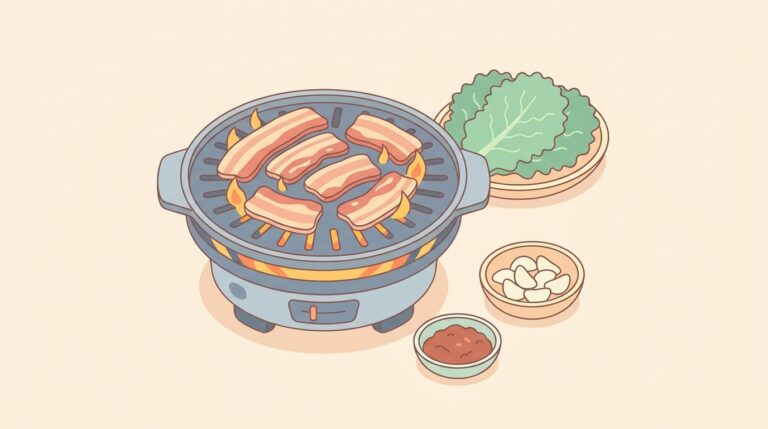
Master Korean BBQ: How to Order and Enjoy Samgyeopsal Like a Local
Phase 1: Empathy & K-Culture Opening
안녕하세요! Welcome back to Daily Hangul! I’m your Korean cultural navigator, and today we’re tackling the ultimate rite of passage in Korean food culture: Samgyeopsal (삼겹살 – Grilled Pork Belly).
Imagine this: You step off the bustling streets of Hongdae into a sizzling, smoke-filled Korean BBQ joint. Upbeat K-Pop plays in the background, friends are clinking green soju glasses, and thick strips of juicy pork belly sizzle loudly on tabletop grills. The server approaches swiftly with a notepad: “Eotteon geo deuliseyo?” (What can I get for you?). Suddenly, freeze! You panic. How many portions should you order? Do you grill it yourself? And how do you ask for that delicious leafy lettuce wrap refill?
Don’t worry—almost every beginner gets intimidated by the fast-paced K-BBQ rhythm. Today, we’re unlocking simple, beginner-friendly (A1) phrases and etiquette tips based on real feedback from over 500 foreign learners. By the end of this guide, you will order, wrap, and feast like a true Seoulite!
Phase 2: Top 3 Core Expressions
1. 삼겹살 2인분 주세요 (Samgyeopsal i-inbun juseyo)
- Pronunciation: [Sam-gyup-sal ee-in-boon joo-seh-yo] (Think: Sam-gyup-sal + number ‘2’ sounding like the English letter ‘E’ + inbun like in-boon)
- Meaning: Literal: “Pork belly 2 servings please” | Real Nuance: “We’d like two orders of pork belly, please.”
- K-Culture Moment: Seen in classic K-Dramas like Weightlifting Fairy Kim Bok-joo, where a table always starts with the golden rule: ordering meat portions equal to or greater than the number of people sitting.
- Editor’s Insight: In Korea, BBQ meats are almost always ordered in servings called 인분 (inbun). Even if you come alone, most BBQ spots require a minimum 2-person order!
- Situation Spectrum: Casual: ✅ | Semi-formal: ✅ | Formal: ⚠️
- 🤔 Think About It: In many Western steakhouses, you order by meat cuts or grams. Why do Koreans count portions per ‘person-count’ (인분)?
2. 상추 더 주세요 (Sangchu deo juseyo)
- Pronunciation: [Sang-choo duh joo-seh-yo] (Sangchu sounds like ‘Song-chew’, deo sounds like the start of ‘dirt’ without the t)
- Meaning: Literal: “Lettuce more please” | Real Nuance: “Could we get more lettuce wraps, please?”
- K-Culture Moment: When characters in dramas make a gigantic Ssam (leaf wrap) bursting with meat, garlic, and ssamjang paste to feed a co-worker or crush.
- Editor’s Insight: Side dishes (banchan) and leafy wrap greens (ssam) are 100% free and refillable in Korea! Never hesitate to ask for deo (more).
- Situation Spectrum: Casual: ✅ | Semi-formal: ✅ | Formal: ✅
- 🤔 Think About It: The custom of endless free side-dish refills reflects Korea’s communal Jeong (warm sharing culture).
3. 불판 갈아 주세요 (Bulpan gara juseyo)
- Pronunciation: [Bool-pan gah-rah joo-seh-yo] (Bul = fire, pan = plate/grill)
- Meaning: Literal: “Grill plate change please” | Real Nuance: “Could you change our grill grate, please?”
- K-Culture Moment: In varieties like Sixth Sense or mukbang channels, when the charred grill gets swapped swiftly with fresh tongs to prevent burning the meat.
- Editor’s Insight: If your grill starts smoking with black char, simply say this sentence. Staff will replace the metal plate in five seconds flat!
- Situation Spectrum: Casual: ✅ | Semi-formal: ✅ | Formal: ✅
- 🤔 Think About It: How does attentive tabletop service reflect Korean dining speed (Ppalli-ppalli)?
Phase 3: Textbook Korean vs. Real Korean
Situation 1: Calling the Server
- 📖 Textbook Korean: 저기요, 웨이터님! (Jeogiyo, weiteonim! – “Excuse me, waiter!”)
- 🗣️ Real Korean: 사장님! (Sajangnim! – “Boss / Owner!”) or 저기요~ (Jeogiyo~)
- 💡 Why is it different? Koreans rarely use ‘waiter’. Calling restaurant staff 사장님 (Sajangnim – store boss) or friendly terms like 이모 (Imo – auntie) shows friendly warmth and gets immediate smiling service.
Situation 2: Asking for the Bill
- 📖 Textbook Korean: 계산서를 가져다주시겠습니까? (Gyesanseoreul gajyeodajusigessseumnikka?)
- 🗣️ Real Korean: 계산해 주세요! (Gyesanhae juseyo! – “Check please!”)
- 💡 Why is it different? You pay at the front register counter upon leaving in 99% of Korean restaurants, not at the table. Just walk up to the counter and say Gyesanhae juseyo!
Phase 4: K-Culture Deep Dive & Non-Verbal Manners
4-1. Nunchi (눈치) & Table Manners
- The Golden Tongs Rule: If dining with Korean elders or bosses, the youngest or junior person usually manages the grill and cuts meat. If a friend takes the tongs, show appreciation by distributing side dishes or pouring water!
- Two Hands for Drinks: When receiving or pouring water, soda, or soju, hold the bottle or cup with both hands as a sign of respect.
- The Ssam Bite: A wrap (Ssam) must go into your mouth in one single bite! Biting it in half spills juices and drops ingredients onto the table.
4-2. Food Culture: The Ssam Formula
- Lay a fresh lettuce or sesame leaf on your palm.
- Place one slice of sizzling pork belly dipped in Ssamjang (savory red soybean paste).
- Add grilled garlic, roasted kimchi, and scallion salad (Pajeori).
- Fold into a pocket, pop it whole into your mouth, and experience pure bliss!
Phase 5: Live Roleplay Scenario
Setting: A vibrant, retro-styled Samgyeopsal eatery in Mapo-gu. Thick pork belly sizzles on cast iron grills.
Characters: You (Hungry Traveler) & Minho (Friendly BBQ Server / NPC).
- Turn 1 (Server Minho): 어서 오세요! 몇 분이세요? (Eoseo oseyo! Myeot bun-iseyo?) 🎭 [Smiles holding two menus] – “Welcome! How many people?”
- Turn 2 (You): 두 명이에요! (Du myeong-ieyo!) 🎭 [Holds up two fingers] – “Two people!”
- Turn 3 (Server Minho): 편한 데 앉으세요. 뭐 드릴까요? (Pyeonhan de anjeuseyo. Mwo deurilkkayo?) 🎭 [Points to a table next to the window] – “Please sit anywhere comfortable. What can I get you?”
- Turn 4 (You): 삼겹살 2인분 주세요! (Samgyeopsal i-inbun juseyo!) 🎭 [Points politely to the menu item] – “Two portions of pork belly, please!”
- Turn 5 (Server Minho): 네! 된장찌개도 하나 드릴까요? (Ne! Doenjang-jjigaedo hana deurilkkayo?) 🎭 [Jots down order] – “Sure! Would you also like one soybean paste stew?”
- Turn 6 (You): 네, 찌개 하나 주세요. (Ne, jjigae hana juseyo.) 🎭 [Nods happily] – “Yes, please give us one stew.”
- Turn 7 (Server Minho): 상추랑 김치는 셀프바에 더 있어요! (Sangchurang gimchineun selpeuba-e deo isseoyo!) 🎭 [Sets down raw meat on the grill] – “More lettuce and kimchi are at the self-service bar!”
- Turn 8 (You): 네, 감사합니다! (Ne, gamsahamnida!) 🎭 [Bows slightly] – “Yes, thank you!”
🔀 Interactive Choice Point
The pork belly is cooked, but you ran out of Ssamjang (dipping sauce). How do you ask for more?
- Choice A: 저기요, 쌈장 더 주세요! (Jeogiyo, ssamjang deo juseyo!)
- Choice B: 쌈장 원해요. (Ssamjang wonhaeyo.)
- Choice C: 이모! 고기 더 공짜로 줘! (Imo! Gogi deo gongjjaro jwo!)
Feedback:
* Choice A [BEST]: Natural, polite, and instantly understood by every restaurant staff!
* Choice B [RISK]: Grammatically strange. Wonhaeyo (I want) sounds like robotic book Korean.
* Choice C [BAD]: Rude informal speech (panmal) asking for free meat! Avoid this completely.
Phase 6: 10-Second Emotion Shadowing Drill
Practice matching natural rhythm slashes / and real emotions!
[😊 Excitement & Confidence]삼겹살 / 2인분 / 주세요! (Samgyeopsal / i-inbun / juseyo!)[🙏 Polite & Friendly Request]사장님, / 물 좀 / 더 주세요~ (Sajangnim, / mul jom / deo juseyo~)[😋 Delighted & Hungry]볶음밥 / 하나 / 볶아 주세요! (Bokkeumbap / hana / bokka juseyo! – Please fry one serving of fried rice!)
Phase 7: K-Culture Mini Dictionary
- 삼겹살 (Samgyeopsal): Three-layered pork belly; Korea’s undisputed favorite BBQ cut.
- 쌈장 (Ssamjang): A savory, slightly sweet condiment paste made from soybean paste (doenjang), chili paste (gochujang), and sesame oil.
- 셀프바 (Sel-peu-ba / Self Bar): The buffet station in modern Korean restaurants where you freely refill garlic, kimchi, and lettuce.
- 볶음밥 (Bokkeumbap): Fried rice cooked directly on the oily meat grill at the end of the meal—the ultimate Korean dessert!
Phase 8: Traveler’s Survival Kit
TOP 3 Survival Expressions:
- 공깃밥 하나 주세요 (Gonggitbap hana juseyo): “One bowl of steamed white rice, please.”
- Pro Tip: Rice isn’t always included with meat; order a bowl to pair with your stew!
- 앞치마 있어요? (Apchima isseoyo?): “Do you have an apron?”
- Pro Tip: Pork oil splatters everywhere! Grab a red or black apron usually hanging on wall hooks.
- 물은 셀프예요? (Mureun selpeuyeyo?): “Is water self-service?”
- Pro Tip: If no water bottle arrives with your cups, look for the metal water purifier.
🧳 Editor’s Travel Note
- Install the Naver Map navigation app to search for top-rated Samgyeopsal spots around your neighborhood instead of relying on outdated travel books.
- Tipping is never accepted in Korea. The price on the menu is the exact final price including tax.
Phase 9: A Step Deeper (Reflection)
In Korean dining culture, Samgyeopsal is rarely eaten alone. Grilling food on a single shared fire symbolizes intimacy, breaking down social walls after hard working days. When someone cooks meat for you, it is an unspoken gesture of affection and care (Jeong).
💬 Your Turn: Have you ever experienced sharing a meal cooked right on your table? How does this communal BBQ style compare to eating in your home country? Drop your thoughts below!
Phase 10: FAQ & Common Mistakes
Q: Can I go to a Korean BBQ restaurant alone (Honbap)?
A: Yes, but keep in mind that most traditional Samgyeopsal restaurants have a minimum order requirement of 2 portions (2-inbun). You can simply order 2 portions for yourself!
Q: How do I know when the pork belly is ready to eat?
A: Wait until both sides turn golden-brown and slightly crispy. Avoid flipping the meat too frequently—flip it 2 to 3 times for optimal juiciness!
Q: Is Kimchi supposed to be grilled together with the meat?
A: Absolutely! Place kimchi at the bottom edge of the tilted grill so it absorbs the savory pork oil while caramelizing.
🚨 Common Mistakes Alert Board
- ❌ Mistake 1: Cutting the meat the second it hits the cold grill. -> Correct Action: Wait until the pork strip is half-cooked before using the kitchen shears to cut bite-sized pieces!
- ❌ Mistake 2: Biting a Ssam wrap in half. -> Correct Action: Make the wrap slightly smaller and pop it whole into your mouth.
- ❌ Mistake 3: Waiting for the waiter to bring the bill to your table. -> Correct Action: Take your table number tag or clipboard to the front exit counter to pay.
Phase 11: Action Missions
- 🥉 Bronze Mission (Solo): Stand in front of your mirror and say “Samgyeopsal 2-inbun juseyo!” three times with a confident smile.
- 🥈 Silver Mission (Social): Share your favorite Korean BBQ photo or drama scene on Instagram and tag
#DailyHangulSamgyeopsal. - 🥇 Gold Mission (Real Life): Visit a local Korean supermarket or BBQ restaurant and order lettuce (Sangchu) in Korean!
- 🎮 K-Culture Bonus Mission: Watch one episode of a K-Drama and spot whether the characters drink Soju or cider with their pork belly!
Phase 12: Interactive Quiz Challenge
Q1. How do you say “2 servings of pork belly, please” in Korean?
a) 삼겹살 둘 개 주세요 (Samgyeopsal dul gae juseyo)
b) 삼겹살 2인분 주세요 (Samgyeopsal i-inbun juseyo)
c) 삼겹살 2마리 주세요 (Samgyeopsal i-mari juseyo)
👉 Click to see the answer & explanation!
Correct Answer: b) 삼겹살 2인분 주세요
Explanation: Food portions in restaurants use the counter word 인분 (inbun) with Sino-Korean numbers (일, 이, 삼…). ‘개’ is for general objects, and ‘마리’ is for whole animals!
Q2. [True / False] Side-dish refills like lettuce and kimchi require extra payment in standard Korean restaurants.
👉 Click to see the answer & explanation!
Correct Answer: False!
Explanation: Banchan and wrap vegetables are complimentary in standard Korean restaurants. Simply ask with “Sangchu deo juseyo!” or visit the Self-bar.






