

Phase 1: Empathy & Immersion Opening
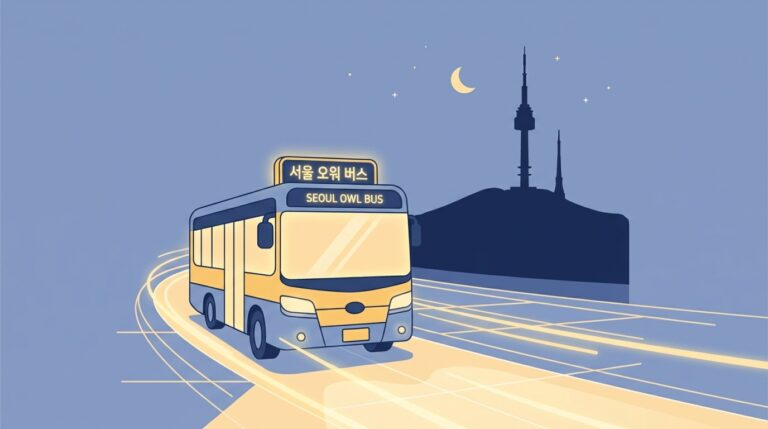
안녕하세요! 매일한글 에디터입니다. (Hello! I’m your Daily Hangul editor.) Picture this: It is 1:30 AM in the neon-drenched alleys of Gangnam or Euljiro. You just finished an unforgettable dinner and noraebang session with Korean colleagues, feeling on top of the world. Then reality hits. The subway line 2 shuttered half an hour ago, taxi drivers have their “Reserved” (예약) lamps blazing while zooming past, and the rideshare surge pricing looks like a small mortgage payment. You look up the legendary Seoul Owl Bus (올빼미 버스), only to realize the nearest stop is a 40-minute walk away or completely bypasses your residential district.
At a C2 proficiency level, you are no longer satisfied with merely asking for directions; you possess the linguistic tools and civic awareness to articulate complex public infrastructure needs. Expressing policy grievances, petitioning local district offices (구청), and advocating for route expansions require high-register lexicon and sophisticated pragmatic tact. This guide synthesizes field-tested communicative strategies and institutional vocabulary so you can discuss late-night transit accessibility with native-level diplomacy and rhetorical precision.
Phase 2: In-Depth Breakdown of 3 Core C2 Expressions
1. 심야 대중교통 사각지대를 해소해야 합니다
- Pronunciation: [Sim-ya dae-jung-gyo-tong sa-gak-ji-dae-reul hae-so-hae-ya ham-ni-da] (Think: “Seem-yah dae-joong-gyo-tong sah-gahk-jee-dae-reul hae-so-hae-yah hahm-nee-dah”)
- Meaning: Literal: “We must resolve the late-night public transport blind spots.” / Real Nuance: “Policy interventions are urgently needed to connect transit-isolated neighborhoods during overnight hours.”
- K-Culture Moment: Heard on current affairs podcasts or investigative journalism shows like PD Notebook when civic activists debate suburban transit welfare for late-night shift workers.
- Editor’s Insight: 사각지대 (blind spot) is a favorite C2 rhetorical noun used in policy discussions (복지 사각지대, 교통 사각지대) to elevate conversational discourse to macro-societal relevance.
- Situation Spectrum: Casual 🚫 | Semi-formal ⚠️ | Formal/Civic Proposal ✅
- 🤔 Think About It: How does phrasing infrastructure gaps as “rights/welfare blind spots” (사각지대) influence civic accountability compared to simply calling it “inconvenient”?
2. 올빼미 버스 노선 증설 및 배차 간격 단축을 촉구합니다
- Pronunciation: [Ol-ppae-mi beo-seu no-seon jeung-seol mit bae-cha gan-gyeok dan-chug-eul chok-gu-ham-ni-da] (Think: “Ohl-ppae-mee buh-seu noh-seon jeung-seol meet bae-chah gahn-gyeok dahn-choo-geul chohk-goo-hahm-nee-dah”)
- Meaning: Literal: “I urge the expansion of Owl Bus routes and the shortening of dispatch intervals.” / Real Nuance: “We formally demand more midnight lines and increased bus frequency.”
- K-Culture Moment: Displayed on official banners (현수막) hoisted by neighborhood resident committees or posted on the Seoul City Civic Petition portal (민주주의 서울).
- Editor’s Insight: The term 촉구하다 (to urge/press for) carries significant weight. It demonstrates firm civic agency without sliding into emotional petulance.
- Situation Spectrum: Casual 🚫 | Semi-formal ⚠️ | Formal/Town Hall/Petition ✅
- 🤔 Think About It: Notice the paired Sino-Korean verbs 증설 (expansion of facilities/routes) and 단축 (shortening). How does Sino-Korean compounding give authority to civic requests?
3. 귀가권 보장 차원에서 노선 다변화가 시급합니다
- Pronunciation: [Gwi-ga-gwon bo-jang cha-won-e-seo no-seon da-byeon-hwa-ga si-geup-ham-ni-da] (Think: “Gwee-gah-gwon boh-jahng chah-won-eh-suh noh-seon dah-byun-hwah-gah shee-geup-hahm-nee-dah”)
- Meaning: Literal: “In terms of guaranteeing the right to return home safely, route diversification is urgent.” / Real Nuance: “Ensuring safe and affordable late-night transit for all citizens demands immediate route restructuring.”
- K-Culture Moment: Cited by city council members during municipal assembly hearings addressing transit-desert complaints from nighttime workers.
- Editor’s Insight: Coining rights with -권 (귀가권, the right to return home safely) establishes your point on moral and legal grounds rather than mere personal comfort.
- Situation Spectrum: Casual ⚠️ | Semi-formal ✅ | Formal/Debate ✅
- 🤔 Think About It: How does framing the late-night journey home as a structural right (귀가권) change public spending discussions?
Phase 3: Textbook Korean vs. Real Native C2 Korean
Situation 1: Expressing that the midnight bus route is too limited
- 📖 Textbook Korean: 밤에 버스가 없어서 너무 불편하니까 버스를 더 많이 만들어 주세요. (Bam-e beo-seu-ga eop-seo-seo neo-mu bul-pyeon-ha-ni-kka beo-seu-reul deo manh-i man-deul-eo ju-se-yo.)
- 🗣️ Real Native C2 Korean: 외곽 지역 거주민들의 심야 이동권 보장을 위해 올빼미 버스 노선 확충이 불가피해 보입니다. (Oe-gwak ji-yeok geo-ju-min-deul-ui sim-ya i-dong-gwon bo-jang-eul wi-hae ol-ppae-mi beo-seu no-seon hwak-chung-i bul-ga-pi-hae bo-im-ni-da.)
- 💡 Why it differs: Advanced native speakers avoid elementary emotive words like 불편하다 (inconvenient) when debating public systems, substituting institutional concepts like 이동권 (mobility rights) and 노선 확충 (route expansion).
Situation 2: Highlighting dangerous overcrowding on midnight routes
- 📖 Textbook Korean: 버스에 사람이 너무 꽉 차서 위험해요. (Beo-seu-e sa-ram-i neo-mu kkwak cha-seo wi-heom-hae-yo.)
- 🗣️ Real Native C2 Korean: 막차 시간대 특정 노선의 과밀 현상이 심각하여 안전사고 예방을 위한 탄력 배차가 절실합니다. (Mak-cha si-gan-dae teuk-jeong no-seon-ui gwa-mil hyeon-sang-i sim-gak-ha-yeo an-jeon-sa-go ye-bang-eul wi-han tal-ryeok bae-cha-ga jeol-sil-ham-ni-da.)
- 💡 Why it differs: Using technical terminology like 과밀 현상 (overcrowding phenomenon) and 탄력 배차 (flexible/dynamic scheduling) transforms an observational complaint into a policy-ready solution.
Phase 4: K-Culture Deep Dive & Non-Verbal Nuance
4-1. Nunchi & Public Advocacy Demeanor
When addressing public transit issues in Korea—whether signing community initiatives, speaking at ward forums (구민 공청회), or writing to transit authorities—balance assertive logic with deferential courtesy. Maintain open posture, avoid pointing fingers, and frame demands around communal welfare (공공의 이익) rather than isolated personal grievance. Expressing civic dissatisfaction through well-researched policy phrasing commands immediate institutional respect.
4-2. The Cultural Mechanics of the “Owl Bus” (N-Bus)
Launched by the Seoul Metropolitan Government using big data analysis of late-night telecommunication patterns and taxi calls, the Owl Bus (올빼미 버스, designated with an ‘N’ prefix like N13 or N61) represents a vital bridge between Korea’s 24-hour Yashik (야식) culture, late-shift essential workers, and university students. Understanding the Owl Bus ecosystem unlocks a deeper sociopolitical view of Korean urban governance.
Phase 5: Realistic Roleplay Scenario
Setting: A neighborhood civic participatory budgeting meeting (주민참여예산 총회) at a District Office in northern Seoul.
Characters:
* You (민우 / Min-woo): A long-term foreign resident advocating for nocturnal transit equity.
* Director Park (박 과장): Senior Official from the District Transit Administration Division.
Dialogue:
1. Min-woo: 🎭 Respectfully adjusting microphone, presenting transit data sheets
과장님, 최근 심야 시간대 당 권역의 대중교통 이용 실태를 면밀히 검토해 보셨는지요?
(Gwa-jang-nim, choe-geun sim-ya si-gan-dae dang gwon-yeok-ui dae-jung-gyo-tong i-yong sil-tae-reul myeon-mil-hi geom-to-hae bo-syeot-neun-ji-yo?)
“Director Park, have you closely examined the actual conditions of public transit usage in our district during late-night hours?”
2. Director Park: 🎭 Nodding thoughtfully while taking notes
예, 모니터링은 지속하고 있습니다만 예산과 기사 인력 수급 문제로 단기간 내 증차는 조심스러운 입장입니다.
(Ye, mo-ni-teo-ring-eun ji-sok-ha-go it-seum-ni-da-man ye-san-gwa gi-sa in-ryeok su-geup mun-je-ro dan-gi-gan nae jeung-cha-neun jo-sim-seu-reon ip-jang-im-ni-da.)
“Yes, we continuously monitor it, but due to budget and driver supply issues, expanding runs in the short term remains sensitive.”
3. Min-woo: 🎭 Pointing to an infographic chart on the screen
그 고충은 이해합니다만, 번화가와 주거 밀집 지역을 잇는 N-버스 지선의 부재로 주민들의 심야 이동권 침해가 가중되고 있습니다.
(Geu go-chung-eun i-hae-ham-ni-da-man, beon-hwa-ga-wa ju-geo mil-jip ji-yeok-eul it-neun en-beo-seu ji-seon-ui bu-jae-ro ju-min-deul-ui sim-ya i-dong-gwon chim-hae-ga ga-jung-doe-go it-seum-ni-da.)
“I understand those constraints; however, the absence of feeder Owl Bus lines linking commercial hubs to dense residential clusters is compounding infringements on residents’ mobility rights.”
4. Director Park: 🎭 Leaning forward with genuine curiosity
구체적으로 어떤 구간의 노선 신설이 가장 시급하다고 보십니까?
(Gu-che-jeok-eu-ro eo-tteon gu-gan-ui no-seon sin-seol-i ga-jang si-geup-ha-da-go bo-sim-ni-kka?)
“Specifically, which section do you view as requiring the most urgent new route establishment?”
5. Min-woo: 🎭 Maintaining firm eye contact, speaking in measured cadence
지하철 종착역에서 주택 단지로 연계되는 굴곡 노선을 직선화하고 심야 순환 셔틀을 시범 운영하는 방안을 제안합니다.
(Ji-ha-cheol jong-chak-yeok-e-seo ju-taek dan-ji-ro yeon-gye-doe-neun gul-gok no-seon-eul jik-seon-hwa-ha-go sim-ya sun-hwan syeo-teul-eul si-beom un-yeong-ha-neun bang-an-eul je-an-ham-ni-da.)
“I propose straightening curvy detour routes connecting terminal subway stations to housing complexes and piloting a late-night circular shuttle.”
6. Director Park: 🎭 Impressed by the methodical alternative
민우 님의 제안은 비용 대비 사회적 편익이 꽤 높아 보이는 합리적 대안이군요.
(Min-u nim-ui je-an-eun bi-yong dae-bi sa-hoe-jeok pyeon-ik-i kkwae nop-a bo-i-neun hap-ri-jeok dae-an-i-gun-yo.)
“Min-woo’s proposal presents a highly rational alternative with seemingly high social benefits relative to costs.”
7. Min-woo: 🎭 Concluding with collaborative deference
주민 설문조사 데이터와 비용 추계안을 취합하여 정식 청원서로 제출하도록 하겠습니다.
(Ju-min seol-mun-jo-sa de-i-teo-wa bi-yong chu-gye-an-eul chwi-hap-ha-yeo jeong-sik cheong-won-seo-ro je-chul-ha-do-rok ha-get-seum-ni-da.)
“I will aggregate our neighborhood survey data alongside fiscal estimates and submit a formal petition.”
8. Director Park: 🎭 Standing to exchange business cards
적극적으로 검토하여 서울시 도시교통실과의 협의 안건에 상정해 보겠습니다.
(Jeok-geuk-jeok-eu-ro geom-to-ha-yeo seoul-si do-si-gyo-tong-sil-gwa-ui hyeop-ui an-geon-e sang-jeong-hae bo-get-seum-ni-da.)
“We will review it proactively and table it as an agenda item for consultation with Seoul’s City Transportation Bureau.”
🔀 Interactive Decision Point
How should Min-woo respond if Director Park initially claims “There is not enough late-night passenger demand”?
* Option A: “그건 현장을 전혀 모르는 탁상공론입니다! 당장 밤에 나와서 버스정류장 줄을 보십시오!” (That is armchair administration! Come out at night and see the queues yourself!)
* Option B: “교통 카드 태그 빅데이터와 심야 택시 승차 거부 신고 통계를 교차 검증하면 실질 잠재 수요가 충분히 입증됩니다.” (Cross-referencing transit card tap data with late-night taxi refusal reports clearly substantiates significant latent demand.)
* Option C: “택시비가 너무 비싸서 파산할 지경이니 버스 좀 더 늘려 주세요.” (Taxi fares are bankrupting us, so please just add more buses.)
Decision Feedback:
* Option A (Risk): Too confrontational. Accusing officials of 탁상공론 (armchair bureaucracy) breaks diplomatic harmony.
* Option B (Best): Flawless C2 administrative strategy. Presenting empirical data (빅데이터, 잠재 수요) builds undeniable credibility.
* Option C (Bad): Low register and emotionally self-centered, inappropriate for formal civic meetings.
Phase 6: 10-Second Emotion Shadowing Drill
- [🏛️ Confident, Authoritative Civic Rhetoric]
“심야 노동자와 취약계층의 이동권을 보장하는 것은 / 선택이 아닌 / 지자체의 기본 책무입니다.”
(Sim-ya no-dong-ja-wa chwi-yak-gye-cheung-ui i-dong-gwon-eul bo-jang-ha-neun geos-eun / seon-taek-i a-nin / ji-ja-che-ui gi-bon chaek-mu-im-ni-da.)
“Guaranteeing mobility rights for night workers and vulnerable groups / is not an option / but a fundamental duty of local government.” -
[📊 Logical, Analytical Policy Pitch]
“정체 구간의 노선을 개편하고 / 배차 간격을 15분대로 압축한다면 / 공공 교통 분담률이 비약적으로 상승할 것입니다.”
(Jeong-che gu-gan-ui no-seon-eul gae-pyeon-ha-go / bae-cha gan-gyeok-eul sip-o-bun-dae-ro ap-chuk-han-da-myeon / gong-gong gyo-tong bun-dam-ryul-i bi-yak-jeok-eu-ro sang-seung-hal geos-im-ni-da.)
“If we reorganize bottleneck routes / and compress dispatch intervals to 15 minutes / public transit modal share will surge dramatically.”
Phase 7: K-Culture Mini Dictionary (C2 Key Terms)
- 이동권 (I-dong-gwon | Right to Mobility): The fundamental socio-legal right of all citizens to access transportation without physical, economic, or temporal discrimination.
- 배차 간격 (Bae-cha Gan-gyeok | Dispatch Interval / Headway): The scheduled time between successive transit vehicles along a given route.
- 탁상공론 (Tak-sang-gong-ron | Desk/Armchair Deliberation): Unrealistic, theoretical discussions conducted detached from on-the-ground reality.
- 교통 복지 (Gyo-tong Bok-ji | Transit Welfare): State-subsidized infrastructure policies ensuring equitable transit accessibility regardless of income or regional location.
Phase 8: Traveler’s & Expat’s Survival Kit
Top 3 Late-Night Transit Survival Phrases
- 심야 할증 요금이 언제부터 적용되나요? (Sim-ya hal-jeung yo-geum-i eon-je-bu-teo jeok-yong-doe-na-yo?) — “From what time does the late-night surcharge apply?” [Pro Tip: Night taxi surcharge in Seoul begins at 10 PM with tiered peak rates between 11 PM and 2 AM.]
- 이 버스가 막차인가요, 아니면 뒤에 올빼미 버스가 더 있나요? (I beo-seu-ga mak-cha-in-ga-yo, a-ni-myeon dwi-e ol-ppae-mi beo-seu-ga deo it-na-yo?) — “Is this the regular last bus, or is there an Owl Bus following it?”
- N버스 실시간 도착 정보가 앱에 연동되어 있습니까? (En-beo-seu sil-si-gan do-chak jeong-bo-ga aep-e yeon-dong-doe-eo it-seum-ni-kka?) — “Is real-time arrival info for the N-Bus synced to the navigation app?”
Editor’s Civic Travel Note
For real-time late-night bus tracking and comprehensive schedule maps, bookmark the 카카오맵 실시간 버스 도착 정보 안내 and check the 서울시 심야 대중교통 올빼미버스 공식 포털 before late outings. Remember that Korean transit cards (T-Money/EZL) still offer free transfer discounts on Owl buses if tapped within 30 minutes (or 60 minutes during late-night hours between 9 PM and 7 AM).
Phase 9: “Thinking Deeper” Essay (한 발 더 깊이)
In many Western metropolitan centers, transit services dwindle past midnight, shifting the responsibility of night travel strictly onto private rideshares or personal vehicles. In Korea, however, public transportation is perceived as an organic extension of collective welfare and public safety. The inception of the Owl Bus illustrates how communal civic expectations hold the municipal state accountable for citizens’ 24-hour safety and economic vitality. When you petition for route expansions in Korean, you are participating in a rich tradition of civic engagement that views urban mobility not as a luxury commodity, but as a shared communal entitlement.
💬 Your Turn: Have you ever experienced a late-night transit desert in your home country or in Korea? How would you articulate the need for improved public infrastructure using today’s C2 vocabulary? Share your perspective in the comments below!
Phase 10: FAQ & Common Pitfalls
Q: Can foreign residents formally submit transit expansion proposals to Korean municipal offices?
A: Yes! Foreign nationals registered with an Alien Registration Card can submit public proposals and policy petitions via local Ward websites (구청 참여마당) or the Seoul Oasis/Democracy Seoul portal (민주주의 서울).
Q: What is the difference between 증차 (Jeung-cha) and 증설 (Jeung-seol)?
A: 증차 refers to increasing the number of active vehicles running on an existing route, whereas 증설 refers to establishing entirely new routes, lines, or facility infrastructure.
Q: Why do Owl Buses carry higher base fares than standard green/blue city buses?
A: Owl Buses (N-buses) operate with specialized night-shift driver wages and safety protocols. Their base fare is set at 2,500 KRW (card), representing a policy balance between transit affordability and operational sustainability.
🚨 Common Mistakes Warning Board
| Mistake | Why It Fails | Correct Action |
|---|---|---|
| “밤에 버스 많이 오게 해줘” | Grammatically sound among close friends, but completely dismissive and rude when speaking to drivers, officials, or in public settings. | Use high honorific civic registers: “심야 버스 배차 확충을 요청드립니다.” |
| Confusing 막차 (last regular bus) with 심야버스 (Owl bus) | Assuming the 막차 is an all-night bus leads to being stranded after 12:45 AM. | Distinguish 일반 버스 막차 (regular last run) from N-버스(올빼미 버스). |
| Using 택시 승차거부 (taxi refusal) emotionally without legal context | Stating “택시기사가 나빠요” carries no weight. | Use formal regulatory terms: “심야 승차거부 단속 강화 및 대체 공공노선 신설이 필요합니다.” |
Phase 11: Action Mission & Engagement
- 🥉 Bronze Mission (Self Practice): Read the Phase 6 Shadowing sentences aloud three times with a confident administrative intonation.
- 🥈 Silver Mission (Social/Writing): Write a 3-sentence formal petition on your social media or study journal asking for an N-bus route in your favorite Seoul district.
- 🥇 Gold Mission (Real Life Application): Check the TOPIS map tonight around 1:00 AM, locate your nearest Owl Bus route, and plan an end-to-end trip without using private taxis.
- 🎮 K-Culture Mission: Watch a clip of Korean city council debates or urban planning news segments, noting down every instance of words ending in -권 (권리) or -화 (변화).
Phase 12: Interactive Quiz Challenge
1. Situation Judgment Quiz
Which phrasing is most persuasive and politically sophisticated during a municipal town hall meeting advocating for night transit?
* (A) “우리 동네에 버스 안 오면 다음 선거 때 표 안 줍니다!”
* (B) “심야 교통 사각지대 해소를 위해 기존 간선 노선의 연장 및 심야 탄력 배차 도입을 건의합니다.”
* (C) “새벽에 택시 잡기가 너무 힘드니까 구청에서 택시비 지원해 주세요.”
🔍 Click to reveal the Answer & Explanation
Correct Answer: (B)
Explanation: Option (B) demonstrates exemplary C2 civic rhetoric, utilizing terms like 사각지대 해소 (resolving blind spots), 간선 노선 연장 (trunk line extension), and 탄력 배차 (dynamic scheduling). Option (A) is an overt political threat, while Option (C) lacks macroeconomic realism.
2. Fill-in-the-Blank Cloze Challenge
Fill in the appropriate institutional Sino-Korean word:
“외곽 지역 주민들의 심야 (____)권 보장을 위해 올빼미 버스의 노선 확충이 시급합니다.”
(To guarantee suburban residents’ right to late-night _____, the expansion of Owl Bus routes is urgent.)
🔍 Click to reveal the Answer & Explanation
Correct Answer: 이동 (I-dong) or 귀가 (Gwi-ga)
Explanation: Both 이동권 (right to mobility) and 귀가권 (right to return home safely) fit seamlessly into this formal policy sentence.
3. True or False Culture Check
Statement: Seoul’s Owl Bus routes (N-Buses) were designed arbitrarily based on driver convenience.
🔍 Click to reveal the Answer & Explanation
Correct Answer: False
Explanation: Owl Bus routes were strategically mapped utilizing multi-billion data points, including late-night telecommunication movement patterns and nighttime taxi hailing cluster data compiled by the Seoul Metropolitan Government and telecom carriers.







