

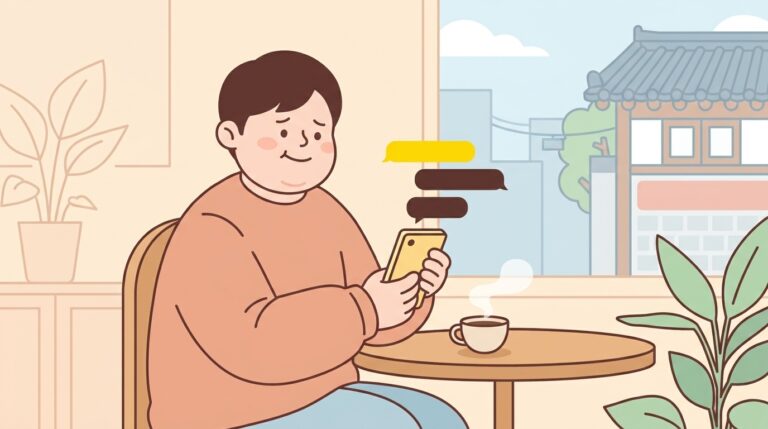
How to Say “I Can’t Make It” in Korean Without Sounding Rude
Phase 1: 공감 (Story Empathy Opening)
안녕하세요! 매일한글 에디터입니다. (Hello! I’m your Daily Hangul editor.)
Imagine this classic K-Drama scene: You’re studying at a cozy cafe in Hongdae or working at an office in Gangnam. Your lovely Korean friend or colleague texts you on KakaoTalk: “오늘 퇴근하고 치맥 콜? (Oneul toegeunhago chimaek col? – Fried chicken and beer after work today?)”
Your stomach screams yes, but your calendar says you have a huge exam tomorrow morning, or you are drowning in overtime. You stare at your screen in panic. If you reply “아니요, 안 돼요 (Aniyo, an dwaeyo – No, I can’t)”, you sound like a robot rejecting a mission! In Korean culture, flat rejections can feel surprisingly cold and hurt personal connections (Jeong).
Don’t worry! Based on hundreds of real coaching sessions with learners just like you, I have put together the ultimate playbook for declining plans gracefully at the A2 level. By the end of this guide, you will master smooth, polite ways to explain why you can’t meet while keeping your friendship warmer than a fresh bowl of Tteokbokki!
Phase 2: 핵심 표현 3선 심층 분석 (Top 3 Core Expressions)
1. 오늘은 좀 힘들 것 같아요 (Oneureun jom himdeul geot gat-ayo)
- Pronunciation: [Oh-neu-reun jom him-deul geot gah-tah-yo] (Think: “Oh-ner-run” + “chom” + “him-deul”)
- Meaning: Literal: “Today seems a bit difficult” | Real Nuance: “I’d love to, but I realistically can’t make it today.”
- K-Culture Moment: Used by university students when their sunbae (senior) asks them out for an impromptu dinner during midterms.
- Editor’s Insight: The magic word here is 좀 (jom – a little bit). Koreans use jom as a social cushion to soften bad news!
- Situation Spectrum: Casual ✅ | Semi-formal ✅ | Formal ⚠️
- 🤔 Think About It: Why does Korean culture prefer softening negatives with words like “it seems difficult” instead of a direct “I cannot”?
2. 제가 선약이 있어서요 (Jega seonyagi isseoseoyo)
- Pronunciation: [Jeh-gah sun-yahg-ee ee-ssuh-suh-yo] (Sounds like “Sun-yag-ee”)
- Meaning: Literal: “Because I have a previous appointment” | Real Nuance: “I already have plans scheduled beforehand.”
- K-Culture Moment: Essential in professional settings or blind dates (Sogeting) when declining a sudden schedule change politely.
- Editor’s Insight: The ending -아서/어서요 (-aseo/eoseoyo) naturally implies a gentle explanation/excuse without making you sound defensive.
- Situation Spectrum: Casual ⚠️ (use 반말) | Semi-formal ✅ | Formal ✅
- 🤔 Think About It: How does giving a formal reason like “prior appointment” protect both your dignity and the other person’s feelings?
3. 다음에 꼭 봐요! (Daeume kkok bwayo!)
- Pronunciation: [Dah-eum-eh kkohk bwah-yo!] (Crisp double ‘k’ sound in kkok)
- Meaning: Literal: “Let’s definitely see each other next time!” | Real Nuance: “I really value our friendship, so let’s raincheck for sure!”
- K-Culture Moment: The heartwarming final line sent on KakaoTalk with an apologetic bowing bear sticker.
- Editor’s Insight: Always end your refusal with this phrase! It shifts the focus from “rejection” to “future excitement.”
- Situation Spectrum: Casual ✅ | Semi-formal ✅ | Formal ⚠️
- 🤔 Think About It: Is “next time” a real promise or a polite conversational wrapper in your own language?
Phase 3: 교과서 한국어 vs 진짜 한국어 (Textbook vs. Real-Life Korean)
Situation 1: Explaining that you have too much work/study
- 📖 교과서 한국어 (Textbook): 저는 시간이 없습니다. (Jeoneun sigani eopseumnida. – I have no time.)
- 🗣️ 진짜 한국어 (Real Native): 오늘 할 일이 많아서 안 될 것 같아요. (Oneul hal iri manhaseo an doel geot gat-ayo. – I have a lot to do today, so I don’t think it’ll work out.)
- 💡 왜 다를까? (Why is it different?): Saying “I have no time” sounds dismissive. Stating what is keeping you busy (hal iri manhaseo) sounds warm and authentic.
Situation 2: Skipping a casual group hangout
- 📖 교과서 한국어 (Textbook): 저는 모임에 갈 수 없습니다. (Jeoneun moime gal su eopseumnida. – I am unable to attend the gathering.)
- 🗣️ 진짜 한국어 (Real Native): 아쉽지만 이번엔 패스할게요ㅠㅠ (Aswipjiman ibonen paeseu-halgeyoㅠㅠ – It’s a bummer, but I’ll pass this time!)
- 💡 왜 다를까? (Why is it different?): Young Koreans love borrowing the English word “Pass (패스)” combined with “아쉽지만 (it’s a pity)” to keep group chat vibes lighthearted.
Phase 4: K-Culture 딥다이브 & 비언어적 매너 (Deep Dive & Body Language)
4-1. 눈치(Nunchi) & Polite Non-Verbal Cues
When declining in person:
* The Head Tilt & Inhale: Tilt your head slightly to a 45-degree angle, gently sucking in air through your teeth (“씁… 어떡하지…”). This shows you are genuinely conflicted.
* Two-Handed Apology: Clasp both hands together near your chest or give a gentle 15-degree head bow while saying sorry. Never shrug nonchalantly!
4-2. Cultural Code: The Art of “밥 한번 먹자 (Let’s grab a meal sometime)”
In Korea, food equals affection. When you turn down a dinner plan, you aren’t just declining calories; you are turning down bonding time! This is why Koreans always follow a refusal with a promise for future food. Acknowledging your shared craving for K-Food (like 삼겹살 or 떡볶이) eases any social tension immediately.
Phase 5: 실전 롤플레이 시나리오 (Roleplay Scenario)
Setting: Friday 5:30 PM. Your colleague/friend Minji (민지) walks up to your desk in an office in Mapo-gu.
- 민지 (Minji): 민우 씨! 오늘 불금인데 퇴근하고 곱창 먹으러 갈래요?
(Min-u ssi! Oneul bulgeuminde toegeunhago gopchang meogeureo gallaeyo?)
🎭 [Smiling brightly, leaning over your desk]
“Minwoo! It’s Friday night! Wanna grab grilled Gopchang after work?” -
나 (You): 아, 곱창 진짜 좋아하는데… 오늘은 좀 힘들 것 같아요.
(A, gopchang jinjja joahaneunde… Oneureun jom himdeul geot gat-ayo.)
🎭 [Eyes wide with genuine regret, slight head tilt]
“Ah, I really love Gopchang, but… I think today might be tough.” -
민지 (Minji): 헐, 왜요? 오늘 무슨 일 있어요?
(Heol, waeyo? Oneul museun il isseoyo?)
🎭 [Pouting playfully]
“Oh no, why? Is something going on today?” -
나 (You): 내일 아침 일찍 한국어 시험이 있어서 공부해야 해요.
(Naeil achim iljjik hangugeo siheomi isseoseo gongbuhaeya haeyo.)
🎭 [Hands clasped apologetically]
“I have a Korean test early tomorrow morning, so I have to study.” -
민지 (Minji): 아 맞다! 시험 기간이었죠! 아쉽네요ㅠㅠ
(A matda! Siheom gigani-eotjyo! Aswimneyoㅠㅠ)
🎭 [Nodding in understanding]
“Ah, that’s right! It’s test season! What a pity!” -
나 (You): 시험 끝나고 다음 주에 제가 맛있는 거 살게요!
(Siheom kkeutnago daeum jue jega masinneun geo salgeyo!)
🎭 [Smiling warmly with a firm reassuring nod]
“After my test, I’ll buy you something delicious next week!” -
민지 (Minji): 진짜죠? 약속 도장 쾅! 시험 잘 봐요!
(Jinjyajyo? Yaksok dojang kwang! Siheom jal bwayo!)
🎭 [Making a pinky promise gesture]
“For real, right? Stamped promise! Good luck on the test!” -
나 (You): 네! 다음에 꼭 봐요, 민지 씨!
(Ne! Daeume kkok bwayo, Minji ssi!)
🎭 [Waving with two hands]
“Yes! Let’s definitely catch up next time, Minji!”
🔀 인터랙티브 분기점 (Your Choice!)
If Minji asks you again next week, what is your best response if you are busy again?
* Choice A: “안 돼요. 바빠요.” (An dwaeyo. Bappayo.)
👉 Bad: Too curt and blunt. Might make Minji think you dislike her!
* Choice B: “앗, 그날은 선약이 있어서 어려울 것 같아요. 금요일은 어떠세요?”
👉 Best: Perfect! Politeness + reason + proactive alternative date.
* Choice C: (Read message and reply 24 hours later) “깜빡했네요.”
👉 Risk: Ghosting (Ipsip) damages trust quickly in fast-paced Korean chats.
Phase 6: 10초 감정 섀도잉 드릴 (10-Second Shadowing Drill)
Practice reading these out loud with rhythm and emotion:
[🥺 아쉽고 미안하게 - Apologetic & Regretful]
아, / 가고 싶은데 / 오늘은 좀 힘들 것 같아요.
(A, / gago sipeunde / oneureun jom himdeul geot gat-ayo.)-
[💼 정중하고 깔끔하게 - Polite & Professional]
죄송하지만 / 미리 잡힌 선약이 있어서요.
(Joesonghajiman / miri japhin seonyagi isseoseoyo.) -
[😊 밝고 다정하게 - Bright & Reassuring]
이번엔 못 가지만, / 다음에 꼭 불러주세요!
(Ibeonen mot gajiman, / daeume kkok bulleojuseyo!)
Phase 7: K-Culture 미니 사전 (Mini Dictionary)
- 선약 (Seonyak) | Prior engagement / Previous appointment
Usage: The gold standard polite excuse in both business and personal scheduling. - 야근 (Yageun) | Overtime work
Usage: A universally understood reason in Korea (“오늘 야근각이에요 – Looks like overtime tonight!”). - 불금 (Bulgeum) | “Fire Friday” (TGIF)
Usage: The most popular day for social hangouts and appointments. - 다음에 (Daeume) | Next time
Usage: The social buffer word used to keep promises warm and relations positive.
Phase 8: 여행자를 위한 생존 키트 (Traveler’s Survival Kit)
TOP 3 Survival Phrases
- 저 오늘 일정이 있어서 안 될 것 같아요. (Jeo oneul iljeongi isseoseo an doel geot gat-ayo.) – “I have travel plans scheduled today, so I can’t make it.”
- 다음에 꼭 다시 올게요! (Daeume kkok dasi olgeyo!) – “I will definitely visit your shop/restaurant again next time!”
- 죄송해요, 지금 가봐야 해요. (Joesonghaeyo, jigeum gabwaya haeyo.) – “I’m sorry, I must get going now.”
Editor’s Travel Note
When traveling in South Korea, keeping in touch in real time is essential. Make sure you complete your KakaoTalk messenger app installation and account setup guide before landing so you can share cute apology emojis when your schedule changes!
Phase 9: “한 발 더 깊이” (Cultural Reflection)
In Korean society, relationships are built on mutual consideration and maintaining face (Chemyon). Directly saying “No” can make the inviter feel rejected in front of peers. By using cushions like “힘들 것 같아요 (it seems difficult)” and proposing a future meal, you protect the bond while setting your boundaries.
💬 Your Turn: In your home country, how do you usually decline an invitation without hurting someone’s feelings? Let me know in the comments below!
Phase 10: FAQ & 오해 방지 (FAQ Schema)
Q: Is saying “안 돼요 (An dwaeyo)” rude when declining an invitation?
A: In social contexts, yes. “안 돼요” sounds like a rule prohibition (like “You are not allowed to”). Use “어려울 것 같아요 (It might be difficult)” instead.
Q: What if I don’t have a specific reason to decline?
A: You don’t need to over-explain! Simply saying “개인적인 일정이 있어서요 (I have a personal schedule)” is completely polite and respected.
Q: Does “다음에 밥 먹자” mean an exact promise?
A: Often it is a warm social greeting (Insa-mal). However, if someone suggests a specific day or asks for your schedule, it’s a real plan!
🚨 흔한 실수 (Common Mistakes TOP 3)
- ❌ Mistake 1: Saying “싫어요 (Sireoyo – I hate it/I don’t want to)”.
👉 Action: Replace with “가고 싶지만 오늘은 어려워요 (I want to go, but today is difficult).” - ❌ Mistake 2: Ignoring the message for days.
👉 Action: Reply within a few hours using “답장이 늦어 미안해요 (Sorry for the late reply)”. - ❌ Mistake 3: Not adding “다음에 꼭 봐요”.
👉 Action: Always attach a future greeting to wrap up nicely.
Phase 11: 액션 미션 & 참여 유도 (Action Missions)
- 🥉 Bronze Mission: Say “오늘은 좀 힘들 것 같아요” 5 times aloud in front of a mirror with the head-tilt gesture.
- 🥈 Silver Mission: Write a sample KakaoTalk refusal text in our comment section below.
- 🥇 Gold Mission: Use “다음에 꼭 봐요!” with a Korean friend or language partner this week.
- 🎮 K-Culture Mission: Spot this phrase in a K-Drama when two characters fail to meet on a date!
Phase 12: 인터랙티브 퀴즈 챌린지 (Interactive Quiz)
1. [Situation] Your Korean buddy asks: “오늘 삼겹살 먹으러 갈래?” How should you politely decline?
* A) 싫어요. (Sireoyo.)
* B) 안 돼요. (An dwaeyo.)
* C) 오늘은 선약이 있어서 힘들 것 같아요ㅠㅠ 다음에 꼭 가요!
2. [Fill-in-the-blank] Fill in the magic word that softens refusals:
“오늘은 ( ) 어려울 것 같아요.”
3. [True / False] In Korean culture, directly telling someone “I have no time” is considered the warmest response. (T / F)
👉 Click here for Answers & Explanations!
- Answer: C (Option C softens the blow, gives a reason, and suggests a future meetup!)
- Answer: 좀 (jom) (Meaning ‘a little bit’, used to make statements gentler.)
- Answer: False (Saying ‘시간이 없어요’ directly can sound cold; natives prefer explaining why or using ‘힘들 것 같아요’.)







