

Phase 1: Welcome to Your First Korean Wedding!
안녕하세요! 매일한글 에디터입니다. (Hello! I’m your Daily Hangul Editor!)
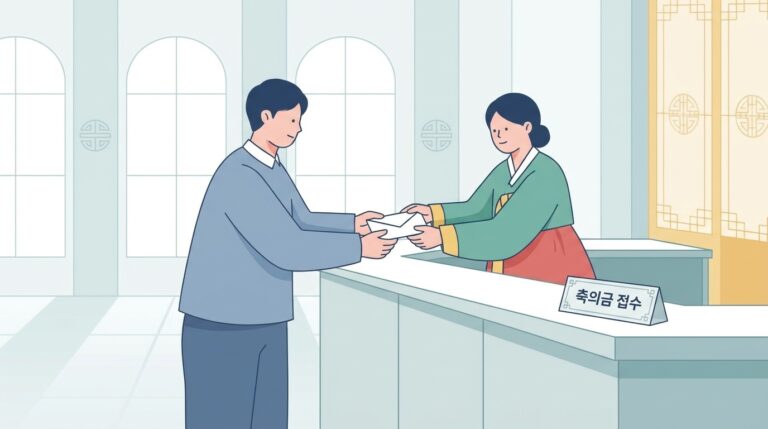
Imagine this: You receive a gorgeous, pastel-colored wedding invitation from your Korean coworker. You dress in your neatest semi-formal outfit and step into a sparkling Seoul wedding hall filled with flowers, lively music, and hundreds of chatting guests. But as you step into the lobby, you suddenly freeze. Right in front of you is a long wooden counter with two large boxes and receptionists holding stacks of paper tickets.
Everyone in front of you is handing over a crisp white envelope, writing something in a giant guestbook, and receiving a small voucher in return. You clutch your bag and wonder: How much cash was I supposed to put in? Do I hand it with both hands? What do I even say to the person at the desk?
Don’t panic! Giving congratulatory gift money, known as 축의금 (Chuk-ui-geum), is a warm and essential tradition in Korea. In this guide, tailored specifically for beginners (A1), you will learn the exact 3 magic phrases, key etiquette gestures, and cultural insider tips so you can hand over your envelope like a confident Seoul local.
Phase 2: Top 3 Essential Expressions for 축의금 (Gift Money)
1. 축하드려요! (Chuk-ha-deu-ryeo-yo!)
- Pronunciation: [Chook-ha-deu-ryuh-yo] (Think of ‘Chook’ like ‘chook-chook train’, ‘ha’, and ‘deu-ryuh-yo’)
- Meaning: Literal: “I give congratulations!” | Nuance: “Warmest congratulations on your special day!”
- K-Culture Moment: The signature line every K-drama protagonist whispers warmly with a smile when greeting the bride or groom in the waiting room.
- Editor’s Insight: This is the polite, honorific form of ‘축하해요’. Using ‘드려요’ shows deep respect to the bride, groom, and their family members at the reception table.
- Situation Spectrum: Casual 🚫 | Semi-formal ✅ | Formal ✅
- 🤔 Think About It: In English, we simply say “Congratulations!”. In Korean, the ending changes depending on whether you are talking to a peer or an elder. Why do you think wedding greetings emphasize honorific endings?
2. 여기 축의금이에요. (Yeogi chuk-ui-geum-i-e-yo.)
- Pronunciation: [Yeo-gi chook-eui-geum-ee-eyo] (Rhymes with: ‘Yuh-gi’ + ‘Chook-ee-geum’ + ‘ee-eyo’)
- Meaning: Literal: “Here is wedding gift money.” | Nuance: “Here is my celebratory gift envelope.”
- K-Culture Moment: Handing your envelope over the registration desk while bowing slightly at 15 degrees.
- Editor’s Insight: You do not need long, complex sentences. A friendly smile paired with this simple sentence clearly signals your intention to the desk staff.
- Situation Spectrum: Casual ⚠️ | Semi-formal ✅ | Formal ✅
- 🤔 Think About It: In many Western cultures, physical registries (toaster, blender) are popular. Why do you think cash is preferred and celebrated as the primary gift in modern Korean weddings?
3. 식권 주세요. (Sik-gwon ju-se-yo.)
- Pronunciation: [Sheek-gwon joo-seh-yo] (Sounds like: ‘Sheek’ + ‘Gwon’ + ‘Joo-say-yo’)
- Meaning: Literal: “Please give me a meal ticket.” | Nuance: “May I have a banquet meal ticket, please?”
- K-Culture Moment: The golden ticket to the legendary Korean wedding buffet featuring unlimited 갈비탕 (short rib soup), sushi, and tteok!
- Editor’s Insight: Reception desks exchange your gift envelope for meal vouchers (식권). If you are attending with a partner, you can say: “식권 두 장 주세요” (Sik-gwon du jang ju-se-yo – Two meal tickets, please).
- Situation Spectrum: Casual 🚫 | Semi-formal ✅ | Formal ✅
- 🤔 Think About It: Why are meal tickets handed out individually at the desk rather than just letting everyone walk straight into the dining hall?
Phase 3: Textbook Korean vs. Real-Life Korean
Situation 1: Handing over the envelope
- 📖 Textbook Korean: “제가 축의금을 전달해 드리겠습니다.” (Je-ga chuk-ui-geum-eul jeon-dal-hae deu-ri-get-seum-ni-da. – I will convey the congratulatory money to you.)
- 🗣️ Real-Life Korean: “축하드려요! 여기요.” (Chuk-ha-deu-ryeo-yo! Yeo-gi-yo. – Congratulations! Here you go.)
- 💡 Why the Difference? Wedding reception desks are bustling with crowds. Short, warm, and natural phrasing is much more common and polite than stiff, robotic textbook declarations.
Situation 2: Asking for meal tickets for two people
- 📖 Textbook Korean: “저에게 식권을 두 개 제공해 주실 수 있습니까?” (Jeo-e-ge sik-gwon-eul du gae je-gong-hae ju-sil su it-seum-ni-kka?)
- 🗣️ Real-Life Korean: “식권 두 장 부탁드려요!” (Sik-gwon du jang bu-tak-deu-ryeo-yo! – Two meal tickets, please!)
- 💡 Why the Difference? Native speakers use ‘장’ (jang – paper counter) instead of ‘개’ (gae – general item counter) and wrap requests with the polite phrase ‘부탁드려요’ (please / I kindly ask).
Phase 4: K-Culture Deep Dive & Non-Verbal Manners
4-1. 눈치 (Nunchi) & Body Gestures at the Desk
- Two-Hand Rule (두 손): Always hand your envelope using both hands (or support your right wrist/forearm lightly with your left hand). This shows heartfelt sincerity.
- Eye Contact & Slight Bow: Make warm eye contact, bow your head slightly (15 to 30 degrees), and hand the envelope with the front facing the receiver.
- Writing the Envelope: Write your name vertically on the back-left side of the envelope. If you represent a company or school, write the organization name next to your name.
4-2. The Golden Rules of Korean 축의금 Amounts
- Odd Numbers Rule: In Korean tradition, odd numbers (3, 5, 7) represent positive energy (Yang, 陽).
- Acquaintance / Casual coworker: ₩50,000 (5만 원)
- Close friend / Direct team member: ₩100,000 (10만 원 – 10 is considered a complete lucky number)
- Best friend / Special relationship: ₩150,000 ~ ₩200,000+
- Clean Bills Only: Korean guests withdraw fresh, crisp banknotes from the ATM before attending.
Phase 5: Real-Life Roleplay Scenario
Setting: The Grand Ballroom lobby at 1:40 PM. You approach the groom’s side reception desk (신랑 측 접수대). Groom’s cousin Min-jun is managing the guestbook.
- Turn 1 (Min-jun): 안녕하세요! 신랑 측 손님이신가요?
(An-nyeong-ha-se-yo! Sil-lang cheuk son-nim-i-sin-ga-yo?)
🎭 Smiles warmly and gestures toward the guestbook.
“Hello! Are you a guest of the groom?” -
Turn 2 (You): 네, 맞아요. 신랑 회사 동료예요.
(Ne, ma-ja-yo. Sil-lang hoe-sa dong-ryo-ye-yo.)
🎭 Nod gently with a polite smile.
“Yes, that’s right. I’m the groom’s coworker.” -
Turn 3 (Min-jun): 아, 와주셔서 감사합니다! 방명록 먼저 작성해 주세요.
(Ah, wa-ju-syeo-seo gam-sa-ham-ni-da! Bang-myeong-rok meon-jeo jak-seong-hae ju-se-yo.)
🎭 Hands you a traditional calligraphy pen.
“Ah, thank you for coming! Please sign the guestbook first.” -
Turn 4 (You): 네, 알겠습니다.
(Ne, al-get-seum-ni-da.)
🎭 Signs name neatly in the guestbook.
“Yes, understood.” -
Turn 5 (You): 축하드려요. 여기 축의금이에요.
(Chuk-ha-deu-ryeo-yo. Yeo-gi chuk-ui-geum-i-e-yo.)
🎭 Hands white envelope using both hands.
“Congratulations. Here is the gift money.” -
Turn 6 (Min-jun): 정말 감사합니다! 식사하고 가시나요?
(Jeong-mal gam-sa-ham-ni-da! Sik-sa-ha-go ga-si-na-yo?)
🎭 Receives envelope respectfully with two hands.
“Thank you so much! Will you be having a meal with us today?” -
Turn 7 (You): 네! 식권 한 장 주세요.
(Ne! Sik-gwon han jang ju-se-yo.)
🎭 Holds up one finger lightly.
“Yes! Please give me one meal ticket.” -
Turn 8 (Min-jun): 네, 여기 식권 있습니다. 맛있게 드시고 좋은 시간 보내세요!
(Ne, yeo-gi sik-gwon it-seum-ni-da. Ma-sit-ge deu-si-go jo-eun si-gan bo-nae-se-yo!)
🎭 Hands over the buffet voucher.
“Yes, here is your meal ticket. Enjoy the meal and have a wonderful time!”
🔀 Interactive Choice: What will you do next?
- Choice A: Bow, say “감사합니다!”, and head to the bride/groom photo room.
- Choice B: Open your envelope on the desk to double-check if you put enough money.
- Choice C: Ask for 5 extra meal tickets for friends who didn’t show up.
Feedback:
* Choice A (Best): Perfect etiquette! Graceful, polite, and respectful.
* Choice B (Bad): Never open or count cash in front of the reception desk; it is considered very awkward.
* Choice C (Risk): Meal tickets are directly accounted for per envelope given. Asking for extras without envelopes creates a high risk of embarrassing the hosts!
Phase 6: 10-Second Emotion Shadowing Drill
Practice reading these out loud with rhythm and natural feelings!
[😊 Warm & Joyful]
결혼 / 진심으로 / 축하드려요!
(Gyeol-hon / jin-sim-eu-ro / chuk-ha-deu-ryeo-yo!)
“Congratulations on your wedding from the bottom of my heart!”-
[🤝 Polite & Respectful]
여기 / 축의금 / 봉투예요.
(Yeo-gi / chuk-ui-geum / bong-tu-ye-yo.)
“Here is the celebratory money envelope.” -
[😋 Excited for the Buffet]
식권 / 한 장 / 부탁드립니다!
(Sik-gwon / han jang / bu-tak-deu-rim-ni-da!)
“One meal ticket, please!”
Phase 7: K-Culture Mini Dictionary
- 축의금 (Chuk-ui-geum) | Congratulatory cash gift given at weddings.
- Usage: Standard etiquette in Korea to support the newlyweds starting their new home.
- 봉투 (Bong-tu) | Envelope.
- Usage: Wedding halls always provide free blank white envelopes at side desks with pens.
- 방명록 (Bang-myeong-rok) | Guestbook / Attendance registry.
- Usage: The book where you write your name and quick warm wishes before entering the hall.
- 식권 (Sik-gwon) | Meal ticket / Banquet coupon.
- Usage: The paper slip required at the entrance of the wedding buffet dining area.
Phase 8: Survival Kit for Guests
Top 3 Emergency Phrases
- 봉투 어디에 있어요? (Bong-tu eo-di-e it-seo-yo?) – “Where are the envelopes?”
- Pro Tip: Look for the small side table near the ATM in the lobby.
- ATM 어디예요? (ATM eo-di-ye-yo?) – “Where is the ATM?”
- Pro Tip: Almost all Korean wedding venues have cash dispensers on the B1 or 1st floor.
- 식당이 몇 층이에요? (Sik-dang-i myeot cheung-i-e-yo?) – “Which floor is the buffet restaurant on?”
- Pro Tip: Wedding ceremonies and banquet halls are often on separate floors.
Editor’s Travel Note
Always prepare cash beforehand! While ATMs exist inside venues, lines right before the ceremony can be 20 people deep. Use the Naver Map App Download to find a convenient bank or convenience store near the subway station before walking into the venue.
Phase 9: One Step Deeper (한 발 더 깊이)
Korean wedding gift money originates from 품앗이 (Pumasi)—an ancient traditional system of mutual communal aid. When a family had a major life milestone (such as a wedding, 60th birthday, or funeral), the entire village pooled resources together to share the financial load. When you give 축의금 today, you are participating in a beautiful, centuries-old social contract of mutual love and support. The couple keeps a detailed ledger and will return the exact gift when you celebrate your own milestone!
💬 Your Turn: Does your home country gift cash or physical registry items at weddings? Tell us in the comments below!
Phase 10: FAQ & Common Mistakes
Q: Can I put ₩40,000 or ₩90,000 in the envelope?
A: No. In Korean superstition, the number 4 (사) is associated with death (사, 死), and 9 is an incomplete number. Always stick to 50,000, 100,000, or 150,000 KRW.
Q: What if I don’t eat at the buffet? Do I still get a gift?
A: Yes! If you cannot stay for the meal, inform the desk (“식사 안 해요” – I won’t be eating). They will often hand you a 답례품 (Dap-rye-pum), which is a small return gift such as Korean red ginseng, premium cookies, or wine.
Q: Can I wear a white dress or white suit to the wedding?
A: Absolutely not! In Korean wedding etiquette, only the bride wears white. Wearing white is considered impolite (민폐). Choose navy, beige, pastel, or dark tones.
🚨 Common Mistakes Board
| Mistake | Why It’s Risky | Correct Action |
|---|---|---|
| Handing cash without an envelope | Considered rude and overly transactional | Use the free white envelopes provided in the lobby |
| Writing your name in red ink | Red ink historically symbolizes bad luck/danger | Always use black or dark blue pen |
| Giving the envelope with one hand | Appears dismissive or arrogant | Hold with both hands and bow slightly |
Phase 11: Action Missions
- 🥉 Bronze Mission: Stand in front of a mirror and practice saying “축하드려요, 식권 한 장 주세요!” with a bright smile 3 times.
- 🥈 Silver Mission: Share this post on Instagram Stories or with a friend who loves K-Dramas and tag your favorite wedding scene.
- 🥇 Gold Mission: Next time you attend a Korean celebration, write your name vertically in Hangul on the back of the envelope and hand it over using both hands!
🎮 K-Culture Mission: Watch an episode of a drama like Queen of Tears or Crash Landing on You—spot the scene where guests hand envelopes at an event desk!
Phase 12: Interactive Quiz Challenge
Q1. How much is the ideal 축의금 (gift money) for a standard acquaintance or coworker?
A) ₩40,000
B) ₩50,000
C) ₩90,000
👉 Click to reveal Answer & Explanation
Correct Answer: B) ₩50,000
Explanation: Korean gift amounts prefer odd numbers (3, 5, 7) or 10. 40,000 and 90,000 are traditionally avoided.
Q2. Fill in the blank:
“Congratulations! Here is my gift money.” = “축하드려요! 여기 (________)이에요.”
👉 Click to reveal Answer & Explanation
Correct Answer: 축의금 (Chuk-ui-geum)
Explanation: 축의금 refers specifically to wedding celebratory gift money.
Q3. True or False: It is completely fine to wear a bright white dress as a wedding guest in Korea.
👉 Click to reveal Answer & Explanation
Correct Answer: False
Explanation: Only the bride wears white to stand out. Guests wear muted tones, navy, beige, or neat semi-formal suits.






