

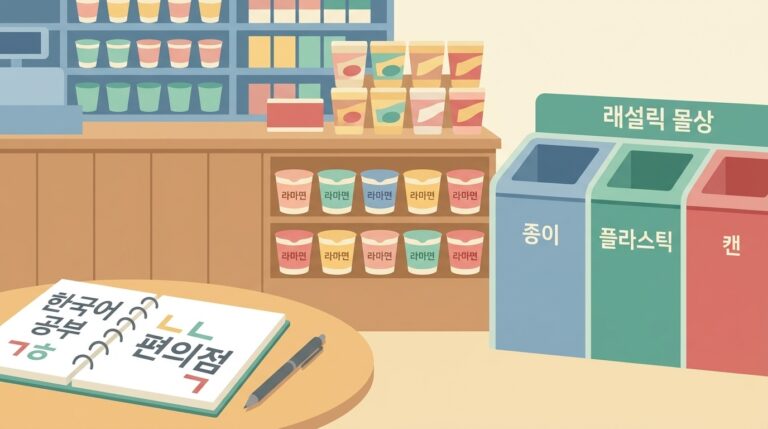
Phase 1: Empathy (Story Immersion Opening)
안녕하세요! 매일한글 에디터입니다. (Hello! This is your Daily Hangul editor.)
Picture this: You have just finished a delicious bowl of steaming Shin Ramyun and a tuna-mayo triangle gimbap (samgak gimbap) at a bright, bustling GS25 or CU convenience store in Hongdae. Your belly is happily full, your mouth is tingling with spicy bliss, but now you face a classic K-travel dilemma: you are holding an empty plastic bowl, chopsticks, and a greasy wrapper, looking around in utter confusion. Where on earth is the trash can? In Korea, public street bins are notoriously rare, and inside convenience stores, waste disposal is a high-tech art form called bunrisugeo (recycling sorting). Walking up to the busy store clerk (alba-saeng) holding trash can feel intimidating if you do not know the right words. Today’s guide is crafted directly from real feedback from intermediate learners who wanted to handle store interactions like natural locals. Master these key phrases, and you will never awkwardly wander around holding an empty cup noodle container again!
Phase 2: Top 3 Essential Expressions Deep Dive
1. 쓰레기통 어디에 있어요? (Sseuregitong eodie isseoyo?)
- Pronunciation: Sseu-reh-gi-tong eo-di-eh ee-sseo-yo? (Think of sseu like the hissing ‘s’ in ‘suit’, and tong like ‘tone’ with a crisp ‘g’ sound).
- Meaning: Literal: “Trash bin where is it?” | Nuance: “Excuse me, where can I find the trash can?”
- K-Culture Moment: In K-dramas like Hospital Playlist or Our Blues, whenever characters grab a midnight snack outside a convenience store table, you’ll hear them casually asking the clerk where the bin is before heading home.
- Editor’s Insight: Sseuregi means trash, and tong means bucket/container. Adding eodie isseoyo? makes it polite, natural, and immediately understood anywhere in South Korea.
- Situation Spectrum:
- Casual (with close friends): 쓰레기통 어디 있어? (Sseuregitong eodi isseo?) ✅
- Semi-formal (to clerks/strangers): 쓰레기통 어디에 있어요? (Sseuregitong eodie isseoyo?) ✅
- Formal (official broadcast/military): 쓰레기통은 어디에 위치해 있습니까? ⚠️
- 🤔 Think About It: Why does Korean emphasize location particles (-e) and politeness endings (-yo) even for simple utility questions compared to English’s quick “Where’s the bin?”
2. 이거 버려도 돼요? (Igeo beoryeodo dwaeyo?)
- Pronunciation: Ee-geo beo-ryeo-do dwae-yo? (Rhymes with ‘eagle’ + ‘bury-uh-dough’ + ‘dway-yo’).
- Meaning: Literal: “Is it okay even if I throw this away?” | Nuance: “May I throw this out here? / Can you dispose of this for me?”
- K-Culture Moment: When you buy a coffee or drink from an outside cafe and want to discard the empty cup at a convenience store counter while buying something new, polite Koreans show the item and ask this exact sentence.
- Editor’s Insight: Koreans are very sensitive about store etiquette. Asking permission before tossing outside trash shows immense respect and instantly earns you warm smiles from clerks.
- Situation Spectrum:
- Casual: 이거 버려도 돼? (Igeo beoryeodo dwae?) ✅
- Semi-formal: 이거 버려도 돼요? (Igeo beoryeodo dwaeyo?) ✅
- Formal: 이것을 폐기해도 되겠습니까? 🚫 (Too bureaucratic for a store!)
- 🤔 Think About It: In your home country, is it normal to ask permission before tossing trash in a retail store?
3. 분리수거는 어디서 해요? (Bunrisugeoneun eodiseo haeyo?)
- Pronunciation: Boon-ri-soo-geo-neun eo-di-seo hae-yo? (Flows like Boon-nee-soo-guh-neun due to Korean nasal assimilation sound rules).
- Meaning: Literal: “As for separate collection, where do I do it?” | Nuance: “Where do I sort the recyclables?”
- K-Culture Moment: You see this constantly on variety shows like Jinny’s Kitchen or Three Meals a Day, where cast members meticulously separate plastic, food waste, and paper.
- Editor’s Insight: Korea has one of the world’s most sophisticated recycling systems (bunrisugeo). Convenience stores usually have distinct slots for liquids (ramyun broth), food remnants, plastic cups, and wooden chopsticks.
- Situation Spectrum:
- Casual: 분리수거 어디서 해? (Bunrisugeo eodiseo hae?) ✅
- Semi-formal: 분리수거는 어디서 해요? (Bunrisugeoneun eodiseo haeyo?) ✅
- Formal: 분리수거 구역이 어디입니까? ⚠️
- 🤔 Think About It: How does structured waste separation reflect the communal responsibility mindset in Korean culture?
Phase 3: Textbook Korean vs Real-life Korean
Situation 1: Asking where the trash can is located
* 📖 교과서 한국어 (Textbook): 실례지만 쓰레기를 버리는 장소가 어디에 존재합니까? (Excuse me, where does the location for discarding garbage exist?)
* 🗣️ 진짜 한국어 (Real-Life): 저기요, 쓰레기통 어디 있어요? (Jeogiyo, sseuregitong eodi isseoyo?)
* 💡 왜 다를까?: Real Koreans use the soft attention-grabber 저기요 (jeogiyo) and drop unnecessary literary vocabulary like 존재하다 (to exist) for snappy everyday clarity.
Situation 2: Asking if you can throw away an empty ramyun cup
* 📖 교과서 한국어 (Textbook): 이 라면 용기를 여기에 투기해도 무방합니까? (Is it permissible to discard this ramyun container here?)
* 🗣️ 진짜 한국어 (Real-Life): 국물은 싱크대에 버리면 되나요? (Gungmureun singkeudae-e beorimyeon doenayo? – Should I pour the soup into the sink?)
* 💡 왜 다를까?: Convenience store cup noodles contain liquid soup. Rather than asking a broad question, locals ask specifically about the broth and bin setup.
Phase 4: K-Culture Deep Dive & Non-verbal Manners
4-1. 눈치 (Nunchi) & Body Language
When asking for the trash can in a Korean convenience store, the clerk is often restocking triangular gimbap or scanning items rapidly.
* The Glance & Angle: Make gentle eye contact and give a slight 15-degree head nod.
* Two-Handed Gesture: If holding an empty cup or wrapper that you want the clerk to take over the counter, hold it or point towards it with both hands or with your right hand supported under your wrist by your left hand.
* Nunchi Tip: Glance around the corner near the hot water dispenser first. 90% of the time, the bunrisugeo station (equipped with a cylindrical soup disposal sink and labelled slots) is right under or beside the microwave station!
4-2. The Convenience Store (Pyeon-ui-jeom) Culture Code
In Korean society, the 24-hour convenience store (pyeon-ui-jeom) is an urban community hub. It is not merely a retail outlet; it is where students study, office workers unwind with a 4-can beer special, and friends gather for late-night cup ramen. Because it operates with minimal staff, there is an unwritten civic rule: clean up your own table spotless (dwitsujeong) so the next person can sit immediately.
Phase 5: Real-Life Roleplay Scenario
Setting: Midnight at a CU convenience store near the Han River. Rain is tapping on the glass. Minho (the friendly store clerk with a blue apron) is organizing shelves while Alex (B1 learner) finishes a spicy bowl of Buldak ramyun.
- Alex: 저기요, 사장님! 다 먹었는데 쓰레기통 어디에 있어요?
(Jeogiyo, sajangnim! Da meogeonneunde sseuregitong eodie isseoyo?)
🎭 (Holds empty noodle cup with both hands, smiling politely)
“Excuse me, boss! I’m all done, where is the trash bin?” -
Minho (Clerk): 아, 드신 거요? 전자레인지 바로 아래쪽에 있어요.
(A, deusin geoyo? Jeonjareinji baro araejjoge isseoyo.)
🎭 (Points toward the microwave station with an open palm)
“Ah, the finished food? It’s right underneath the microwave.” -
Alex: 아, 찾았어요! 그런데 남은 라면 국물은 어디에 버려요?
(A, chajasseoyo! Geureonde nameun ramyeon gungmureun eodie beoryeoyo?)
🎭 (Tilts the cup slightly to show leftover broth)
“Ah, found it! But where do I pour the leftover ramyun soup?” -
Minho (Clerk): 국물통 뚜껑 여시고 거기에 부으시면 돼요. 나무젓가락은 따로 일반 쓰레기에 넣어주시고요!
(Gungmultong ttukkeong yeosigo geogie bueusimyeon dwaeyo. Namujeotgareageun ttaro ilban sseuregie neoeojusigoyo!)
🎭 (Nods encouragingly)
“Open the lid of the liquid bucket and pour it in. Please put the wooden chopsticks separately into general waste!” -
Alex: 네, 알겠습니다. 플라스틱 뚜껑은 분리수거 맞죠?
(Ne, algesseumnida. Peullaseutik ttukkkeongeun bunrisugeo matjyo?)
🎭 (Separates the lid carefully)
“Got it. The plastic lid goes to recycling, right?” -
Minho (Clerk): 네, 맞아요! 손님 진짜 깔끔하게 잘 치워주시네요.
(Ne, majayo! Sonnim jinjja kkalkkeumhage jal chiwojusineyo.)
🎭 (Beams with a warm smile)
“Yes, that’s right! You clean up so neatly, customer.” -
Alex: 한국 편의점 에티켓을 열심히 배웠거든요! 정리 다 했습니다.
(Hanguk pyeon-ui-jeom etiketeul yeolsimhi baewotgeodeunyo! Jeongni da haesseumnida.)
🎭 (Puts everything in place and wipes the table with a napkin)
“I studied Korean convenience store etiquette hard! All cleaned up.” -
Minho (Clerk): 감사합니다! 좋은 밤 보내세요!
(Gamsahamnida! Joeun bam bonaeseyo!)
🎭 (Bows slightly as Alex prepares to exit)
“Thank you! Have a great night!”
🔀 Interactive Branching Point
You finish a canned coffee and want to throw it out before leaving. What do you say?
* Choice A: “야! 이거 받아!” (Hey! Take this!)
* Choice B: “사장님, 이거 캔 분리수거 여기에 넣으면 돼요?” (Boss, can I put this recyclable can in here?)
* Choice C: “이거 그냥 바닥에 둘게요.” (I’ll just leave this on the floor.)
Feedback:
* Choice A (Bad/Risk): Extremely rude informal command (banmal). You will startle the clerk!
* Choice B (Best): Perfect! Polite title (사장님), clear intent (캔 분리수거), and respectful question format (-면 돼요?).
* Choice C (Terrible): Major cultural faux pas. Incurring negative vibes in a shared space.
Phase 6: 10-Second Emotion Shadowing Drill
Read these aloud, hitting the emotion marks and pausing at /:
[😊 Polite & Inquiring]저기요, / 쓰레기통 / 어디에 있어요?
(Jeogiyo, / sseuregitong / eodie isseoyo?)[🤔 Curious & Careful]남은 국물은 / 여기에 / 부으면 되나요?
(Nameun gungmureun / yeogie / bueumyeon doenayo?)[😄 Cheerful & Responsible]분리수거 / 다 했어요! / 안녕히 계세요!
(Bunrisugeo / da haesseoyo! / Annyeonghi gyeseyo!)
Phase 7: K-Culture Mini Dictionary
- 분리수거 (Bun-ri-su-geo) | Recycling / Waste Sorting
- Essential everyday practice in Korea where paper, plastics, glass, cans, and food waste are strictly categorized.
- 일반 쓰레기 (Il-ban Sseu-re-gi) | General Non-Recyclable Waste
- Dirty tissues, soiled wrappers, wooden chopsticks, and items that cannot be turned into new materials.
- 음식물 쓰레기 (Eum-sik-mul Sseu-re-gi) | Food Waste
- Organic scraps processed into fertilizer/animal feed. At convenience stores, soup bins count under this category.
- 뒷정리 (Dwit-jeong-ni) | Cleaning up after oneself
- The cultural virtue of leaving your eating station or seat spotless before you depart.
Phase 8: Traveler’s Survival Kit
TOP 3 Emergency Phrases
- 비닐봉투 필요하세요? (Binilbongtu piryohaseyo?)
- Pro Tip: Clerks will ask this at checkout (“Do you need a plastic bag?”). Answer with “네, 주세요 (Yes, please)” or “아니요, 괜찮아요 (No, I’m good)”.
- 영수증 버려주세요. (Yeongsujeung beoryeojuseyo.)
- Pro Tip: “Please throw away the receipt for me.” Use this when paying and you don’t need paper.
- 휴지 어디 있어요? (Hyuji eodi isseoyo?)
- Pro Tip: “Where are the napkins/tissues?” Handy when wiping sauce off the counter.
Editor’s Travel Note
- Install the KakaoMap App for Navigation or Naver Map App Download before exploring. Both allow you to search for 24-hour convenience stores (편의점) with microwave and seating facilities in your neighborhood.
Phase 9: One Step Deeper (Reflection)
In South Korea, waste management is not viewed as a private individual chore, but as a collective civic harmony. When you meticulously sort your triangle gimbap plastic wrap and pour noodle soup into the dedicated container, you are participating in a quiet nationwide social contract. It shows consideration for the store clerk who works the graveyard shift and respects the next neighbor sharing your table.
💬 Your Turn: What is the most surprising waste sorting rule you have encountered while traveling in Korea or abroad? Share your story in the comments below!
Phase 10: Structured FAQ & Common Mistakes
Q: Can I throw away trash from another cafe inside a convenience store bin?
A: While small items like an empty water bottle are usually tolerated if you purchase something, throwing away bulky outside takeout trash without permission is frowned upon. Always ask first: “이거 버려도 돼요? (Igeo beoryeodo dwaeyo?)”.
Q: What should I do with unfinished ramyun soup if there is no bucket?
A: Look for a small drainage sink next to the hot water dispenser. Never pour spicy soup directly into a plastic or paper trash bin bag, as it will tear and spill everywhere.
Q: Where do wooden chopsticks (namujeotgarak) go?
A: Wooden chopsticks always go into 일반 쓰레기 (General Waste), never into paper or plastic recycling.
🚨 Common Mistakes Warning Board
- Mistake: Tossing plastic cup with iced coffee liquid into the plastic bin.
- Correct Action: Empty the liquid/ice into the sink first, then place the plastic cup in the plastic recycling bin.
- Mistake: Using 반말 (banmal / informal speech) like “쓰레기통 어디야?” to convenience store staff.
- Correct Action: Always add -yo -> “쓰레기통 어디에 있어요?”
- Mistake: Leaving leftover food on the outdoor plastic table.
- Correct Action: Gather all waste and dispose of it inside the designated store sorting station before leaving.
Phase 11: Action Mission & Engagement
- 🥉 Bronze Mission: Say “쓰레기통 어디에 있어요?” out loud 5 times in front of your mirror with a friendly smile.
- 🥈 Silver Mission: Next time you study or post a K-drama clip on Instagram/TikTok, tag your study buddy with the word #분리수거.
- 🥇 Gold Mission: Visit a Korean grocery mart or convenience store in Korea, finish a drink, and successfully ask the clerk where to discard the bottle in Korean!
- 🎮 K-Culture Mission: Watch one episode of a slice-of-life K-drama (like My Liberation Notes) and spot the blue CU/GS25 convenience store waste sorting bins in the background.
Phase 12: Interactive Quiz Challenge
Q1. (Situation Judgment) You finished a cup ramyun. What is the correct sequence of disposal?
1. Throw the entire cup with soup into the general trash.
2. Pour soup into the liquid bin, put chopsticks in general trash, and recycle the plastic lid/cup.
3. Leave it on top of the microwave for the clerk to clean.
👉 Click to reveal Answer & Explanation
Answer: 2
Explanation: In Korea, liquid soup, wooden chopsticks (general waste), and recyclable plastic/paper materials must be separated!
Q2. (Fill in the Blank) Fill in the missing word for “Can I throw this away?”:
“이거 ________ 돼요?”
👉 Click to reveal Answer & Explanation
Answer: 버려도 (beoryeodo)
Explanation: 버리다 (to throw away) + -어도 돼요 (is it okay to…?) = 버려도 돼요.
Q3. (True / False Culture Quiz)
In Korea, wooden chopsticks are categorized as recyclable paper.
👉 Click to reveal Answer & Explanation
Answer: False (X)
Explanation: Used wooden chopsticks cannot be recycled as paper; they must always go into 일반 쓰레기 (General Waste).







