

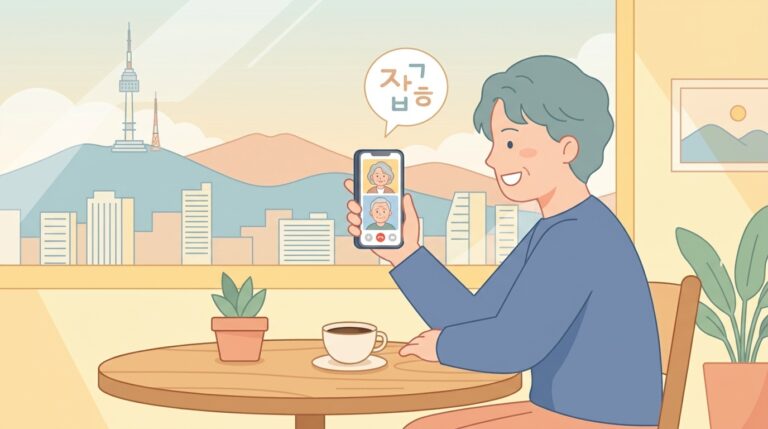
Phase 1: Empathy & Story Opening
안녕하세요! 매일한글 에디터입니다. (Hello! I’m your Daily Hangul editor.)
Picture this: You are sitting around a sizzling samgyeopsal grill with your new Korean friends or coworkers on a breezy Friday evening. Everyone is sharing childhood memories, laughing about school days, and naturally, someone turns to you with a warm smile and asks, “가족들은 어디에 계세요? (Where does your family live?)” Your heart skips a beat. You want to warmly share that your mom and dad are doing well back in your home country, that you miss them, and that you video call them every Sunday morning. But suddenly, your mind freezes. Do you say ‘부모님이 있어요’ or ‘부모님이 계세요’? Is ‘우리 부모님’ right, or should you say ‘제 부모님’?
Many of our global learners tell us that talking about family across borders feels emotionally rich yet linguistically intimidating. You want to express deep respect and affection without sounding like a robotic grammar textbook. Today, we have built this ultimate A2 beginner guide based on hundreds of real learner stories. By the end of this lesson, you will confidently share heartfelt stories about your parents back home with natural honorifics, perfect tone, and true K-drama warmth!
Phase 2: 3 Key Expressions Deep Dive
1. 부모님은 고향에 계세요 (Bumonimeun gohyange gyeseyo)
- Pronunciation: [Boo-moh-neem-eun go-hyang-eh gyeh-seh-yo] (Think of ‘gyeseyo’ like ‘geh-say-yo’ with a soft gliding ‘y’)
- Meaning: Literal: “Parents are in hometown.” / Real Nuance: “My parents are currently living back in my home country / hometown.”
- K-Culture Moment: Seen in heartfelt K-Dramas like Reply 1988 or Our Blues when a character moves to Seoul for work and fondly mentions their folks back in the province.
- Editor’s Insight: In Korean, when talking about elders or parents, never use 있어요 (isseoyo) for existence. Always upgrade to the honorific verb 계세요 (gyeseyo)! It instantly demonstrates your good manners.
- Situation Spectrum:
- Casual with close friends: ⚠️ (Better: 부모님은 고향에 계셔)
- Semi-formal (Polite everyday): ✅ (부모님은 고향에 계세요)
- Formal / Business: ✅ (부모님께서는 고향에 계십니다)
- 🤔 Think About It: In English, we simply say “My parents live in…”. Why do you think Korean society developed entirely different honorific verbs dedicated to showing respect to elders?
2. 부모님이 너무 보고 싶어요 (Bumonimi neomu bogo sipeoyo)
- Pronunciation: [Boo-moh-neem-ee nuh-moo boh-goh sheep-uh-yo] (Sound metaphor: ‘neomu’ sounds like ‘gnome’ + ‘moo’)
- Meaning: Literal: “I want to see parents very much.” / Real Nuance: “I miss my parents so much.”
- K-Culture Moment: The iconic line sung in K-Pop ballads or spoken by idols during world tours when thanking their family overseas.
- Editor’s Insight: Korean does not have a direct single verb like the English “to miss”. Instead, Koreans express longing visually: 보고 싶다 (bogo sipda – to want to see). It captures a warm, tangible craving for presence.
- Situation Spectrum:
- Casual: ✅ (부모님 너무 보고 싶어)
- Semi-formal: ✅ (부모님이 너무 보고 싶어요)
- Formal: ⚠️ (부모님이 뵙고 싶습니다)
- 🤔 Think About It: How does expressing “missing someone” as “wanting to see them” change the emotional temperature of your connection?
3. 주말마다 부모님께 영상 통화해요 (Jumal-mada bumonimkke yeongsang tonghwahaeyo)
- Pronunciation: [Joo-mahl-mah-dah boo-moh-neem-kkay young-sahng tong-hwah-hae-yo] (Sound metaphor: ‘tonghwa’ sounds like ‘tongue-hwa’)
- Meaning: Literal: “Every weekend, to parents, video call do.” / Real Nuance: “I do a video call with my parents every weekend.”
- K-Culture Moment: College students or expats in Korea setting up their smartphones on a desk while eating mom’s side dishes (banchan) on a weekend evening.
- Editor’s Insight: Notice the particle 께 (kke)! While you use 에게 (ege) or 한테 (hante) for friends, always use 께 (kke) when directing an action towards parents or grandparents.
- Situation Spectrum:
- Casual: ⚠️ (친구한테 영상 통화해)
- Semi-formal: ✅ (부모님께 영상 통화해요)
- Formal: ✅ (부모님께 영상 통화를 드립니다)
- 🤔 Think About It: Why does Korean switch particles based on who is receiving the phone call or gift?
Phase 3: Textbook Korean vs Real Korean
Situation 1: Introducing where your parents live
- 📖 Textbook Korean: 저의 부모님은 미국의 고향 집에 살고 있습니다. (Jeoui bumonimeun miguk-ui gohyang jibe salgo itsseumnida. – “My parents are living in the hometown house in the US.”)
- 🗣️ Real Korean: 저희 부모님은 미국 고향에 계세요! (Jeohui bumonimeun miguk gohyange gyeseyo! – “Our parents are back home in the States!”)
- 💡 Why it’s different: Koreans rarely use “저의 (my)” because family is seen as a collective unit (“저희 / 우리 – our”). Also, in natural speech, 계세요 (gyeseyo) is much more common than the stiff grammatical construct 살고 있습니다.
Situation 2: Saying your parents sent you something
- 📖 Textbook Korean: 부모님이 저에게 소포를 주었습니다. (Bumonimi jeo-ege soporeul jueotsseumnida. – “Parents gave a parcel to me.”)
- 🗣️ Real Korean: 부모님이 택배 보내주셨어요. (Bumonimi taekbae bonaejusyeosseoyo. – “My parents sent over a care package for me.”)
- 💡 Why it’s different: Korean speakers use 택배 (parcel/delivery) instead of the formal 소포, and add the honorific helper -주셨어요 (-jusyeosseoyo) to honor parents giving something lovingly.
Phase 4: K-Culture Deep Dive & Non-verbal Manners
4-1. Nunchi & Gestures: Talking About Family With Respect
When talking about your parents in Korea, your physical demeanor speaks just as loudly as your vocabulary:
* Slight Head Tilt & Soft Eyes: When mentioning you miss your parents (보고 싶어요), maintaining a warm, thoughtful expression creates instant bonding.
* Two-Hand Gesture: If you show a picture of your parents on your phone, hold your phone with both hands rather than flicking it with one thumb. This subtle body language shows that you treasure your elders.
4-2. Cultural Code: The Power of “우리” (We / Our)
In Western languages, ownership is individual (“My mother”, “My father”). However, in Korea, community harmony rules. Calling your parents 우리 부모님 (uri bumonim) or the humble 저희 부모님 (jeohui bumonim) reflects the cultural idea that family is a shared harbor. Don’t worry—people know you aren’t literally sharing the same parents with the listener! It is simply an expression of affection and belonging.
Phase 5: Real-world Roleplay Scenario
Setting: A cozy cafe in Hongdae on a Sunday afternoon. You are catching up with your Korean language exchange buddy, Minho (민호), over an Iced Americano.
- Turn 1 (Minho): 이번 주말에 뭐 했어요? 잘 쉬었어요?
(Ibeon jumare mwo haesseoyo? Jal swieosseoyo?)
🎭 Leaning forward, swirling his coffee straw.
“What did you do this weekend? Did you rest well?” -
Turn 2 (You): 네! 고향에 계신 부모님께 영상 통화했어요.
(Ne! Gohyange gyesin bumonimkke yeongsang tonghwahaesseoyo.)
🎭 Smiling warmly while touching your phone.
“Yes! I had a video call with my parents back home.” -
Turn 3 (Minho): 와, 다정하네요! 부모님은 고향에서 잘 지내세요?
(Wa, dajeonghaneyo! Bumonimeun gohyang-eseo jal jinaeseyo?)
🎭 Nodding with an impressed smile.
“Wow, that’s so sweet! Are your parents doing well back home?” -
Turn 4 (You): 네, 두 분 다 건강하게 잘 지내고 계세요.
(Ne, du bun da geongang-hage jal jinaego gyeseyo.)
🎭 Giving a slight nod of reassurance.
“Yes, both of them are healthy and doing great.” -
Turn 5 (Minho): 한국에 혼자 와 있어서 가끔 부모님 보고 싶지 않아요?
(Hanguge honja wa isseoseo gakkeum bumonim bogo sipji anayo?)
🎭 Asking with genuine empathy.
“Since you’re in Korea alone, don’t you miss your parents sometimes?” -
Turn 6 (You): 맞아요, 가끔 엄마 요리도 생각나고 너무 보고 싶어요.
(Majayo, gakkeum eomma yorido saenggangnago neomu bogo sipeoyo.)
🎭 Chuckling nostalgically.
“That’s true. Sometimes I think of mom’s cooking and miss them a lot.” -
Turn 7 (Minho): 부모님 사진 있어요? 한번 보여주세요!
(Bumonim sajin isseoyo? Hanbeon boyeojuseyo!)
🎭 Curious and eager to see.
“Do you have a picture of your parents? Show me!” -
Turn 8 (You): 네, 여기 있어요! 저희 부모님이세요.
(Ne, yeogi isseoyo! Jeohui bumonimiseyo.)
🎭 Holding your phone with both hands to display a photo.
“Yes, here it is! These are my parents.”
🔀 Interactive Branching Moment
Minho looks at the photo and asks: “부모님이 인상이 정말 좋으시네요! 다음 휴가 때 고향 가요? (Your parents look so kind! Are you going home next holiday?)” How do you respond?
- Option A: 네! 이번 겨울 방학 때 부모님 뵈러 고향에 갈 거예요. (Ne! Ibeon gyeoul banghak ttae bumonim boereo gohyange gal geoyeyo.)
👉 Feedback [BEST]: Perfect! Using 뵈러 (boereo – to go visit an elder) sounds polished, natural, and respectful. - Option B: 아니요, 내 부모님은 바빠서 나 안 만나요. (Aniyo, nae bumonimeun bappaseo na an mannayo.)
👉 Feedback [BAD]: Inappropriate for A2. Using informal 내 (my) and 나 (me) while speaking casually about parents sounds rude to Korean ears. - Option C: 네, 부모님이 한국에 놀러 올 거예요. (Ne, bumonimi hanguge nolleo ol geoyeyo.)
👉 Feedback [RISK]: Grammatically understood, but it misses honorifics. A more natural Korean phrasing would be: 부모님이 한국에 놀러 오실 거예요 (osild geoyeyo).
Phase 6: 10-Second Emotion Shadowing Drill
Practice saying these lines with pitch peaks and natural rhythm. Pause at each / mark!
[🥺 그리움을 담아서 - With sweet longing]
저희 부모님이 / 너무 / 보고 싶어요!
(Jeohui bumonim-i / neomu / bogo sipeoyo!)-
[😊 자랑스럽고 따뜻하게 - Warmly and proudly]
부모님은 / 고향에서 / 잘 지내고 계세요.
(Bumonim-eun / gohyang-eseo / jal jinaego gyeseyo.) -
[🥰 정답고 활기차게 - Lively and affectionate]
주말마다 / 부모님께 / 영상 통화해요!
(Jumal-mada / bumonim-kke / yeongsang tonghwa-haeyo!)
Phase 7: K-Culture Mini Dictionary
- 부모님 (Bumonim) | Parents (Honorific)
Usage: The respectful way to refer to parents. While 부모 (bumo) exists, Koreans almost always add the honorific suffix -님 (-nim). - 고향 (Gohyang) | Hometown / Home country
Usage: Means where you grew up. When international residents in Korea say ‘고향’, Koreans understand it as your home country. - 영상 통화 (Yeongsang Tonghwa) | Video Call (FaceTime/KakaoTalk Video)
Usage: Often shortened as 영통 (Yeongtong) among younger friends and K-pop fandoms! - 안부 전하다 (Anbu Jeonhada) | To send regards / Say hello for someone
Usage: Essential phrase when saying goodbye: “부모님께 안부 전해 드려요! (Send my warm regards to your parents!)”
Phase 8: Traveler’s Survival Kit
Top 3 Survival Phrases
- “부모님 선물로 뭐가 좋아요?” (Bumonim seonmullo mwoga joayo?)
Meaning: “What is good as a gift for parents?”
Pro Tip: Use this at Incheon Airport Duty Free or Insadong souvenir shops. Staff will instantly recommend red ginseng (홍삼) or traditional teas. - “부모님께 드릴 거예요.” (Bumonimkke deuril geoyeyo.)
Meaning: “This is a gift for my parents.”
Pro Tip: Say this when buying cosmetics or snacks, and the shop clerk will wrap it in a pretty gift bag for free! - “부모님과 같이 사진 찍어 주시겠어요?” (Bumonimgwa gachi sajin jjigeo jusigesseoyo?)
Meaning: “Could you take a photo of me with my parents?”
Pro Tip: Handy when your parents visit you in Korea at places like Gyeongbokgung Palace.
Editor’s Travel Note
When your parents visit Korea or when staying in touch abroad, download the KakaoTalk official app guide for international HD video calls (FaceTalk). When buying transport or gift items for parents, check out the Naver Map navigation app guide to find tax-free gift shops easily.
Phase 9: “한 발 더 깊이” (Cultural Reflection)
In Korean culture, the concept of 효도 (Hyodo – Filial Piety) is deeply woven into the language. Honoring parents is not just an ancient Confucian rule; it is an active daily habit. By choosing respectful verbs like 계세요 (gyeseyo) instead of 있어요 (isseoyo), you communicate love, gratitude, and maturity. It proves that despite physical distance across oceans, emotional bonds remain close.
💬 Your Turn: Where are your parents living right now, and how often do you reach out to them? Leave a comment in Korean below using today’s sentence structure: “저희 부모님은 [Country]에 계세요!”
Phase 10: FAQ & Common Mistakes
Q: Can I use “우리 엄마” (Uri eomma) instead of “저희 어머니” (Jeohui eomeoni)?
A: Yes! While “저희 어머니” is polite and formal, “우리 엄마/아빠” is universally accepted in friendly casual conversations, even with acquaintances. It sounds warm and endearing.
Q: What is the difference between “있으세요” and “계세요”?
A: Use 계세요 (gyeseyo) when talking about the person’s physical presence/location (e.g., 부모님이 집에 계세요). Use 있으세요 (isseuseyo) when talking about something the elder possesses (e.g., 부모님이 시간이 있으세요 – My parents have time).
Q: How do I say “My parents miss me too”?
A: You can say: “부모님도 저를 많이 보고 싶어 하세요! (Bumonimdo jeoreul mani bogo sipeo haseyo!)” Notice that for 3rd person desires, we use -고 싶어 하다 (-go sipeo hada).
🚨 Common Mistakes Alert
| ❌ Wrong Expression | ⭕ Correct Action | Why it matters |
|---|---|---|
| 부모님이 고향에 있어요 | 부모님이 고향에 계세요 | ‘있어요’ fails to apply subject honorifics to parents. |
| 내 부모님 (Nae bumonim) | 우리 / 저희 부모님 | Koreans value collective identity; ‘내’ sounds detached. |
| 부모님한테 전화해요 | 부모님께 전화해요 | Use the honorific particle ‘께’ instead of ‘한테’. |
Phase 11: Action Missions
- 🥉 Bronze Mission (Solo Shadowing): Look in the mirror and say: “저희 부모님은 고향에 계세요. 너무 보고 싶어요!” with clear pronunciation 3 times.
- 🥈 Silver Mission (Social Sharing): Post a nostalgic photo with your family on Instagram story with the Korean caption: “우리 부모님 보고 싶다 ❤️”.
- 🥇 Gold Mission (Real Life Action): Today, initiate a call or text message to your parents in real life and tell your Korean study buddy: “오늘 부모님께 연락드렸어요! (I contacted my parents today!)”.
- 🎮 K-Culture Mission: Watch any episode of a family K-Drama (like Crash Landing on You or Hospital Playlist) and catch whenever someone says 부모님께 or 어머니/아버지!
Phase 12: Interactive Quiz Challenge
Q1. Fill in the blank with the most polite and natural honorific verb:
“저희 부모님은 지금 캐나다에 ________.”
(A) 있어요 (B) 계세요 (C) 살아요 (D) 가세요
🔍 Click to Reveal Answer & Explanation
Correct Answer: (B) 계세요 (gyeseyo)
Explanation: When stating where parents or respected elders exist or live, always use the honorific existence verb 계시다 (계세요) instead of 있다 (있어요).
Q2. True or False:
In natural Korean conversation, it is more natural to say “우리 부모님” than “내 부모님”.
🔍 Click to Reveal Answer & Explanation
Correct Answer: TRUE!
Explanation: Korean culture emphasizes communal connection. Using ‘우리’ (our) sounds warm and culturally authentic.
Q3. Which sentence correctly uses the honorific particle for ‘to parents’?
(A) 부모님한테 용돈을 드렸어요.
(B) 부모님에게 용돈을 드렸어요.
(C) 부모님께 용돈을 드렸어요.
🔍 Click to Reveal Answer & Explanation
Correct Answer: (C) 부모님께 용돈을 드렸어요.
Explanation: The particle 께 (kke) is the honorific counterpart of ‘에게/한테’ and must be used when presenting something to elders or parents.







