

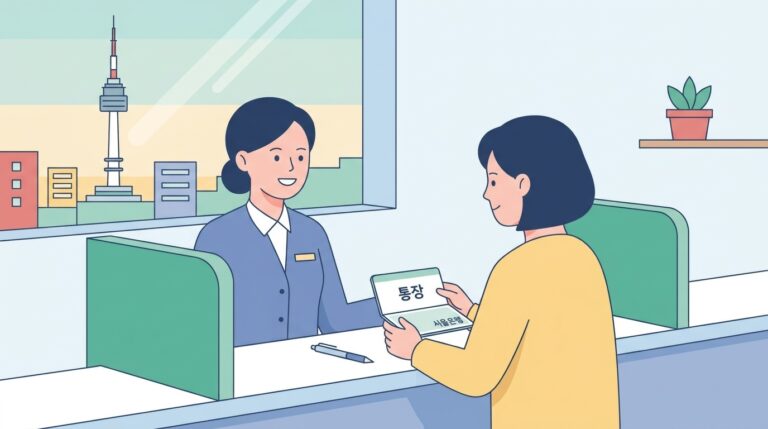
How to Open a Korean Bank Account Without Sweating
Phase 1: Empathy & Story Opening
안녕하세요! 매일한글 에디터입니다. (Hello! This is your Daily Hangul editor.)
Imagine walking into a sleek bank branch in Gangnam or Hongdae. The air conditioning hums, the digital ticket dispenser beeps rhythmically, and behind the crystal-clear glass partition sits a polite teller wearing a tailored blazer. You pull ticket #142 from the machine. As your number flashes on the LED display with a cheerful chime, your heart rate suddenly doubles. You have your passport and Alien Registration Card (ARC) in hand, but your mind goes blank. How do you explain that you want to open a basic checking account and get a debit card, without sounding like a robotic translation app or getting tangled in confusing financial jargon?
If you’ve watched K-dramas like Misaeng or Start-Up, you know how fast-paced and formal Korean office interactions appear. Many of our intermediate learners share that banking in Korea feels like their first true “final boss” test of practical independence. Today’s guide is crafted directly from field experiences and real student breakthroughs. Master these expressions, and you will stride up to the teller counter with calm confidence.
Phase 2: Core Expressions Deep Dive
1. 통장 하나 새로 만들고 싶어서 왔어요.
- Pronunciation: [Tong-jang ha-na sae-ro man-deul-go sip-eo-seo wass-eo-yo] (Sounds like: “Tong-jahng ha-nah seh-roh mahn-deul-goh sheep-aw-saw wah-saw-yoh”)
- Meaning: Literal: “I came because I want to make a new bankbook.” / Nuance: “Hi, I’d like to open a new bank account today.”
- K-Culture Moment: In slice-of-life dramas, a university student starts their first part-time job at a convenience store and visits the neighborhood bank branch with excitement to set up their payroll account.
- Editor’s Insight: Koreans traditionally use the physical paper booklet called tongjang (통장) as a synonym for an account. Even in our digital age, asking to “make a bankbook” is the most natural, standard way to say “open an account.”
- Situation Spectrum: Casual 🚫 | Semi-formal ✅ | Formal ✅
- 🤔 Think About It: Why do you think Korean retains physical imagery like tongjang (booklet) and dorjang (stamp) even when banking is almost 100% digital via smartphone apps?
2. 체크카드도 같이 신청할 수 있을까요?
- Pronunciation: [Che-keu-ka-deu-do gat-i sin-cheong-hal su iss-eul-kka-yo?]
- Meaning: Literal: “Can I apply for a check card together as well?” / Nuance: “Could I also get a debit card issued with this account?”
- K-Culture Moment: When character leaves home for their first solo apartment, they ask the bank clerk for a cute character-embossed debit card to tap on the subway turnstiles.
- Editor’s Insight: In Korea, a debit card connected directly to your checking account is universally called a check card (체크카드). Saying debit card (데빗카드) will cause confusion.
- Situation Spectrum: Casual 🚫 | Semi-formal ✅ | Formal ✅
- 🤔 Think About It: What daily payment tools in your home country have English-borrowed names that differ completely from standard American/British English terms?
3. 어떤 서류가 필요한가요?
- Pronunciation: [Eo-tteon seo-ryu-ga pil-yo-han-ga-yo?]
- Meaning: Literal: “Which documents are needed?” / Nuance: “What paperwork or identification do I need to provide?”
- K-Culture Moment: An expat character in a webtoon stands before an office desk with a folder of documents, double-checking compliance before signing forms.
- Editor’s Insight: The soft ending -n-ga-yo? (-ㄴ/인가요?) sounds polite and considerate without feeling overly stiff or robotic.
- Situation Spectrum: Casual ⚠️ | Semi-formal ✅ | Formal ✅
- 🤔 Think About It: Notice how polite inquiries in Korean often soften question endings to avoid sounding demanding or abrupt.
Phase 3: Textbook Korean vs. Real Korean
Situation 1: Explaining your visit to the teller
- 📖 교과서 한국어: 저는 새로운 은행 계좌를 개설하기를 원합니다. (Jeoneun saeroun eunhaeng gyejwateul gaeseolhagireul wonhamnida.)
- 🗣️ 진짜 한국어: 통장 개설하려고 하는데요, 체크카드도 같이 만들고 싶어요. (Tongjang gaeseolharyeogo haneundeyo, chekeukadeudo gachi mandeulgo sipeoyo.)
- 💡 왜 다를까? Phrases like wonhamnida (원합니다) sound overly theatrical or translated from English. Real Koreans use -ryeogo haneundeyo (I’m planning to…) to gently state their purpose.
Situation 2: Inquiring about mobile banking setup
- 📖 교과서 한국어: 모바일 뱅킹 시스템을 작동시켜 주십시오. (Mobail baengking siseutemeul jakdongsikyeo jusipsio.)
- 🗣️ 진짜 한국어: 핸드폰 뱅킹도 여기서 바로 등록할 수 있나요? (Haendeupon baengkingdo yeogiseo baro deungnokal su 있nayo?)
- 💡 왜 다를까? Native speakers say haendeupon baengking (핸드폰 뱅킹) or eop deungnok (앱 등록) rather than formal textbook jargon.
Phase 4: K-Culture Deep Dive & Non-verbal Manners
4-1. 눈치 (Nunchi) & Gestures at the Counter
- Two-Handed Delivery: When handing over your Alien Registration Card (ARC), passport, or signing a digital pad, always hold the item or pen with both hands, or support your right forearm lightly with your left hand.
- Digital Touchpad Etiquette: Korean bank counters feature interactive touchscreen tablets facing the customer. When inputting your 4-digit PIN (비밀번호), politely focus your eyes on the keypad screen. The teller will deliberately look away to respect your privacy.
4-2. Culture Code: The Legend of Korean Fast Banking
Korea’s banking system is renowned for rapid processing. Unlike many Western countries where a physical debit card arrives by mail two weeks later, Korean bank branches print your name onto a shiny new check card and hand it to you across the desk within ten minutes. To experience this seamless speed, being prepared with the right vocabulary and required paperwork is key.
Phase 5: Real Role-Play Scenario
Setting: A bustling branch of Hana Bank near Sinchon Station. Teller Min-ji is seated behind the counter, organizing documents.
- Customer (You): 안녕하세요! 통장 하나 새로 만들고 싶어서 왔어요. (Annyeonghaseyo! Tongjang hana saero mandeulgo sipeoseo wasseoyo.)
🎭 [Hands over the waiting ticket with a slight 15-degree bow](Hello! I came because I’d like to open a new bank account.) - Teller Min-ji: 네, 고객님! 신분증이나 외국인등록증 가지고 오셨나요? (Ne, gogaengnim! Sinbunjeung-ina oeguk-in-deungnok-jeung gajigo osyeonnayo?)
🎭 [Smiles warmly and adjusts the customer monitor](Yes, customer! Did you bring your ID card or Alien Registration Card?) - Customer (You): 네, 여기 외국인등록증이랑 여권 있어요. (Ne, yeogi oeguk-in-deungnok-jeung-irang yeogwon isseoyo.)
🎭 [Hands over the cards using both hands](Yes, here are my Alien Registration Card and passport.) - Teller Min-ji: 확인 감사합니다. 통장 개설 목적이 어떻게 되실까요? 급여 수령용이신가요, 아니면 생활비용이신가요? (Hwagin gamsahamnida. Tongjang gaeseol mokjeogi eotteoke doesilkkayo? Geub-yeo suryeong-yong-isin-gayo, animyeon saenghwal-bi-yong-isin-gayo?)
🎭 [Types quickly on the computer keyboard](Thank you. What is the purpose of opening this account? Is it for salary deposit or daily living expenses?) - Customer (You): 생활비 통장으로 쓸 거예요. 그리고 체크카드도 같이 신청할 수 있을까요? (Saenghwal-bi tongjang-euro sseul geoyeyo. Geurigo che-keu-ka-deu-do gat-i sin-cheong-hal su iss-eul-kka-yo?)
🎭 [Points politely toward the card catalog](I will use it for daily living expenses. And could I apply for a debit card together?) - Teller Min-ji: 네, 바로 발급 가능합니다. 교통카드 기능도 넣어 드릴까요? (Ne, baro balgeup ganeunghamnida. Gyo-tong-ka-deu gi-neung-do neo-eo deu-ril-kka-yo?)
🎭 [Pulls out a blank IC chip card](Yes, it can be issued immediately. Shall I add public transportation card functionality as well?) - Customer (You): 네! 후불 교통카드 기능 꼭 넣어 주세요. (Ne! Hubul gyo-tong-ka-deu gi-neung kkok neo-eo ju-se-yo.)
🎭 [Nods affirmatively with a smile](Yes! Please definitely include the postpaid transportation function.) - Teller Min-ji: 알겠습니다. 모니터 서명란에 전자 서명 부탁드립니다. (Algetseumnida. Moniteo seomyeong-nane jeonja seomyeong bu-tak-deu-rim-nida.)
🎭 [Hands the electronic stylus pen to customer](Understood. Please provide your digital signature on the screen.)
🔀 Interactive Decision Point
The teller asks: “모바일 뱅킹도 지금 같이 신청해 드릴까요?” (Shall I set up mobile banking for you right now as well?)
- Choice A: “아니요, 나중에 혼자 할게요.” (No, I will do it alone later.)
- Feedback [Risk]: Setting up Korean banking certificates and identity verification on your phone alone without teller assistance can be extremely tricky for non-native speakers.
- Choice B: “네, 앱 설치랑 인증서 발급도 도와주실 수 있나요?” (Yes, could you also help me with app installation and certificate issuance?)
- Feedback [Best!]: Excellent choice! Tellers are happy to guide you through setting up your security authentication right at the window.
- Choice C: “그냥 카드만 주세요!” (Just give me the card!)
- Feedback [Bad]: A bit too blunt in tone, and you miss out on mobile transfers for food delivery apps and online shopping.
Phase 6: 10-Second Emotion Shadowing Drill
Practice matching these rhythm breaks (/) and emotional cues:
[😊 Friendly & Confident]
통장 새로 만들고 / 체크카드도 / 같이 신청할게요.
(Tongjang saero mandeulgo / chekeukadeudo / gachi sincheonghalgeyo.)-
[🤔 Polite & Inquiring]
교통카드 기능도 / 같이 들어가는 카드인가요?
(Gyotongkadeu gineungdo / gachi deureoganeun kadeu-ingayo?) -
[🙏 Grateful & Bright]
네, / 여기 서명 다 했습니다! / 감사합니다!
(Ne, / yeogi seomyeong da haesseumnida! / Gamsahamnida!)
Phase 7: K-Culture Mini Dictionary
- 체크카드 (Che-keu-ka-deu) | Debit card directly connected to your bank account with instant deductions.
- 후불 교통카드 (Hu-bul gyo-tong-ka-deu) | Postpaid transit card built into your debit card; transit fares accumulate and deduct once per month.
- 공인인증서 / 금융인증서 (Geum-yung-in-jeung-seo) | Digital financial certificate required for secure mobile banking, online payments, and identity verification.
- 비밀번호 (Bi-mil-beon-ho) | 4-digit PIN set up at the counter for your card and account transactions.
Phase 8: Survival Kit for Travelers & Expats
Top 3 Survival Expressions
- “외국인등록증 아직 없는데 여권으로 가능한가요?” (Oegukindeungnokjeung ajik eomneunde yeogwoneuro ganeunghangayo?)
→ Pro Tip: Some banks allow passport-only limited accounts, though restrictions apply until your ARC arrives. - “이체 한도 얼마예요?” (Iche hando eolmayeyo?)
→ Pro Tip: Initial foreigner accounts often have a daily transfer limit (한도제한) of 300,000 KRW until employment or student verification is provided. - “해외 송금도 가능한가요?” (Hae-oe song-geum-do ga-neung-han-ga-yo?)
→ Pro Tip: Ask this to register your designated foreign exchange transaction bank (주거래 외국환은행).
Editor’s Travel Note
Before heading to a branch, check real-time queue lengths using the Kakao Map Official App Download Guide or Naver Maps. Major hub branches in Myeongdong, Gangnam, and Sinchon often feature specialized foreign customer service desks with English-fluent staff.
Phase 9: A Step Deeper (한 발 더 깊이)
In Korean society, your bank account and phone number form the dual pillars of your digital identity (본인인증). Because voice phishing prevention laws have strengthened significantly over recent years, banks require clear proof of purpose before lifting transfer limits. Viewing this not as bureaucratic friction, but as a cultural commitment to communal financial security, transforms a routine bank visit into an empowering cultural milestone.
💬 Your Turn: Have you ever experienced opening an account in another country? What was the most surprising difference compared to your hometown? Share your story in the comments below!
Phase 10: FAQ & Common Mistakes
Q: Can I open a bank account on a 90-day tourist visa?
A: Generally, major Korean commercial banks require a valid Alien Registration Card (ARC) or long-term visa for full-featured accounts. Some branches permit limited tourist accounts with passport and proof of departure, but features are restricted.
Q: What is a “Limit-Restricted Account” (한도제한계좌)?
A: To combat financial fraud, Korean banks initially cap new ATM/online transfers at 300,000 to 1,000,000 KRW per day. You can lift this limit later by bringing proof of employment or utility bills.
Q: Do I need a physical seal (도장) to open an account?
A: No! While traditional personal name stamps (도장, dojang) were mandatory decades ago, digital signature pads are now standard across all modern branches.
🚨 Common Mistakes Warning Board
- ❌ Mistake 1: Saying “debit card” instead of 체크카드 (check card).
→ Correct Action: Confidently ask for a 체크카드 with 후불교통 (postpaid transit). - ❌ Mistake 2: Leaving without registering for mobile banking (모바일 뱅킹).
→ Correct Action: Ask the teller to help set up mobile banking before standing up. - ❌ Mistake 3: Forgetting your 4-digit card PIN.
→ Correct Action: Choose a memorable 4-digit PIN; Korean ATMs will lock your card after 3 incorrect attempts.
Phase 11: Action Missions
- 🥉 Bronze Mission (Solo Practice): Read the Phase 5 dialogue out loud 3 times using the Emotion Shadowing rhythm cues.
- 🥈 Silver Mission (Social Connection): Record yourself saying “통장 하나 새로 만들고 싶어요” on Instagram Stories or TikTok and tag @DailyHangul.
- 🥇 Gold Mission (Real World Challenge): Visit a local bank branch or try using a Korean banking app menu in Korean interface mode!
- 🎮 K-Culture Mission: Spot a scene in a K-drama where a character pays with a check card or uses an ATM, and listen for the audio chime prompt!
Phase 12: Interactive Quiz Challenge
Question 1 (Situation Assessment): You want to add subway/bus card functionality to your new debit card. What phrase should you say to the teller?
* A) 비행기표 예약해 주세요. (Bihaenggipyo yeyakae juseyo.)
* B) 후불 교통카드 기능 넣어 주세요. (Hubul gyotongkadeu gineung neoeo juseyo.)
* C) 현금 영수증 해주세요. (Hyeongeum yeongsujeung haejuseyo.)
👉 Click to reveal Answer & Explanation
Correct Answer: B
Explanation: 후불 교통카드 기능 넣어 주세요 means “Please include the postpaid transit card feature.” Choice A is booking a flight, and Choice C is asking for a cash receipt.
Question 2 (Fill-in-the-Blank): Complete the sentence: “통장 하나 새로 _________ 왔어요.” (I came because I want to make a new bankbook.)
👉 Click to reveal Answer & Explanation
Correct Answer: 만들고 싶어서 (mandeulgo sipeoseo)
Explanation: The connective ending -고 싶어서 왔어요 conveys “I came because I wish to do [verb].”
Question 3 (True or False): You must bring a traditional wooden seal stamp (도장) to open any Korean bank account today.
👉 Click to reveal Answer & Explanation
Correct Answer: False (X)
Explanation: Modern Korean banks allow you to sign electronically on digital touchpads (전자 서명).







